Tag: staking

  • BTC staking platform Babylon teams up with Aave for Bitcoin-backed DeFi insurance

    BTC staking platform Babylon teams up with Aave for Bitcoin-backed DeFi insurance

    Babylon teams up with Aave for Bitcoin-backed DeFi insurance

    • Babylon and Aave partner to enable native BTC as collateral for DeFi lending.
    • BTC can now back decentralised insurance pools, earning yield if unused.
    • Users retain full control of their Bitcoin while accessing DeFi liquidity.

    In a groundbreaking move for the decentralised finance (DeFi) ecosystem, Bitcoin staking platform Babylon has announced a partnership with Aave, one of the largest decentralised lending protocols.

    The collaboration aims to allow Bitcoin (BTC) holders to use their native, unwrapped BTC as collateral for lending and to participate in a pioneering DeFi insurance model.

    This will reshape how Bitcoin interacts with DeFi, unlocking liquidity while maintaining the security that Bitcoin users expect.

    Native Bitcoin collateral comes to DeFi

    Traditionally, using Bitcoin in DeFi required wrapping it into a tokenised version such as WBTC, which introduced custodial risk and extra steps. Babylon’s partnership with Aave eliminates this barrier by enabling users to deposit their native BTC directly as collateral.

    Through Babylon’s trustless Bitcoin Vaults, BTC can be locked in a time-locked contract on its own blockchain and recognised by Aave’s hub-and-spoke lending architecture.

    This allows users to borrow stablecoins or other crypto assets while keeping full control of their Bitcoin keys.

    The move is expected to significantly expand BTC liquidity in DeFi. Currently, even the largest wrapped Bitcoin initiatives account for less than 1% of Bitcoin’s total market cap.

    Babylon’s own staking product secures over 56,000 BTC, demonstrating strong demand for productive uses of Bitcoin.

    By unlocking native BTC for lending, the partnership could bring a substantial portion of the dormant Bitcoin supply into productive DeFi applications, potentially transforming lending markets.

    DeFi insurance backed by Bitcoin

    Beyond lending, Babylon is preparing to extend its vaults into the insurance sector, a development that could redefine how DeFi protocols manage risk.

    The proposed model allows BTC holders to deposit their Bitcoin into decentralised insurance pools.

    These pools would serve as coverage against protocol hacks and other failures. Depositors earn yield if no claims occur, while the pool provides liquidity for payouts in the event of a validated exploit.

    This approach turns Bitcoin into a foundational asset for DeFi risk management, offering a new avenue for yield generation while safeguarding the ecosystem.

    Babylon co-founder David Tse told CoinDesk that the insurance initiative is still in development, with an official announcement expected in January 2026.

    Testing for the integrated BTC lending and insurance products is scheduled to begin in early 2026, with a broader rollout planned around April of the same year.

    The combination of Babylon’s secure vault design and Aave’s extensive liquidity network creates a framework that prioritises both safety and usability, a balance often missing in cross-chain and custodial solutions.

    Transforming Bitcoin’s role in DeFi

    This partnership addresses longstanding challenges in Bitcoin DeFi adoption.

    By removing the need for wrapped assets and custodial intermediaries, it reduces systemic risk while enabling Bitcoin holders to put their capital to work more efficiently.

    Users can participate in lending and insurance activities without relinquishing control of their Bitcoin, aligning with the core principles of security and decentralisation that have long defined the Bitcoin network.

    Experts in the space view this collaboration as a potential catalyst for broader adoption of BTC in decentralised applications.

    Unlocking even a small fraction of Bitcoin’s supply for lending and insurance could significantly deepen liquidity and reshape market dynamics.

    For the average user, it translates into safer, more streamlined, and more productive ways to generate yield from their holdings.

    Source link

  • Jito’s JTO token rises on a16z’s $50 million investment in Solana staking protocol

    Jito’s JTO token rises on a16z’s $50 million investment in Solana staking protocol

    a16z Invest In Jito

    • Jito’s native token, JTO, jumped 3% intraday on October 16, 2025, following a16z’s $50 million investment.
    • The $50 million investment by Andreessen Horowitz’s crypto arm, acquiring locked JTO tokens, signals strong institutional confidence in Jito’s liquid staking and MEV solutions.
    • The funding will fuel Jito’s Block Assembly Marketplace and node expansion.

    Andreessen Horowitz’s crypto arm has  announced a $50 million investment in Jito, acquiring a substantial allotment of the protocol’s native JTO tokens.

    Jito, an important infrastructure layer on the Solana blockchain, offers liquid staking and maximum extractable value (MEV) extraction.

    a16z investment of $50m in staking protocol

    Andreessen Horowitz’s (a16z) $50 million infusion into Jito marks the venture firm’s largest single commitment to a Solana staking protocol.

    It eventually emphasizes strategic token purchases over traditional equity. In exchange for the investment, a16z received non-circulating JTO tokens, locking them for an extended period.

    Brian Smith, executive director of the Jito Foundation. highlighted the deal’s novelty:

    If you’re accepting long-term alignment where you can’t sell for a while, then there’s traditionally some modest discount associated with that.

    This structure, particularly 16z’s prior $55 million LayerZero and $70 million EigenLayer investments, prioritizes ecosystem growth over quick flips.

    The capital to accelerate Jito’s roadmap, including BAM node expansion.

    Strategically, it aligns a16z with Solana’s high-throughput ethos, where Jito’s MEV tools mitigate front-running risks plaguing other chains.

    This infusion arrives amid a16z’s aggressive crypto pivot, following $4.5 billion in new funds raised earlier in 2025.

    As institutional inflows swell, the deal could herald a staking renaissance, democratizing yields while fortifying blockchain security.

    Jito price outlook

    Jito is currently trading at $1.16, up nearly 3% and has touched highs of $1.19 across major exchanges.

    The gains came amid news of a16z’s investment and reflected trader optimism around the token as institutional validation takes root. Solana’s price rising in the past few weeks also buoyed traders.

    Analysts are linking this rebound to the investment’s timing, coinciding with positive Solana network metrics. This includes a 15% uptick in daily active users and rising decentralized finance volume.

    In terms of the technical outlook for JTO, the daily chart price is near the oversold territory with the Relative Strength Index (RSI) at 35.

    The indecisive market nonetheless has Jito poised above $1 after bulls recovered from lows of $0.33 seen on October 10, 2025.

    Jito price chart by TradingVew

    Other than the technical perspective, regulatory shifts that could impact liquid staking tokens remain a risk.

    However, recent SEC exemptions and broader market downturns indicate a long-term bullish outlook.

    The surge to near $1.20 suggests bulls could eye the $1.50-$1.70 range, above which lie the key targets of $1.85 and $2.56.

    If market conditions align, buyers will target the all-time peak above $5.61 reached in December 2023.


    Source link

  • STRK price soars 7% as Starknet officially starts Bitcoin staking integration

    STRK price soars 7% as Starknet officially starts Bitcoin staking integration

    STRK price soars 7% as Starknet officially starts Bitcoin staking integration

    • The upgrade allows Bitcoiners to participate in Starknet’s consensus.
    • The L2 has reduced the unstaking period to 7 days to enhance flexibility for stakers.
    • STRK has gained more than 2% following the announcement.

    Cryptocurrencies traded cautiously on Monday while bracing for this week’s interest rates decision, poised to shape the markets’ trajectory in the upcoming sessions.

    Bitcoin hovers near $116,000 as Ethereum’s stability above $4,600 fuels altcoin season debates.

    Meanwhile, L2 platform Starknet has finally launched Bitcoin staking.

    The team has briefly paused the staking platform to finalise implementation before its official release in the coming hours.

    The announcement read:

    The BTC staking integration has started! The staking protocol is now paused for a few hours while we implement this massive update.

    With this move, the Ethereum-based Layer2 enables Bitcoin holders to participate in Starknet’s consensus for the first time.

    The L2 focuses on ZK rollups and scalability, and integrating BTC staking reflects its dedication to decentralisation and chain-to-chain partnerships.

    Native STRK turned bullish after the announcement.

    The digital token rallied from $0.1299 low to $0.139 intraday peak.

    That translated to an over 7% increase, demonstrating renewed interest in Starket’s ecosystem.

    Starknet integrates BTC staking

    The announcement highlighted that BTC will account for 25% of Starkent’s consensus power, whereas STRK dominated at 75%.

    That guarantees balances while attracting more stakers.

    Meanwhile, the staking protocol will support several BTC wrappers, including WBTC, tBTC, SolvBTC, and LBTC.

    The community would vote for more options in the future through governance proposals.

    That means the staking model can transform as Starknet’s BTC staking network grows.

    The team has temporarily halted its staking protocol to onboard the upgrade.

    Unstaking period reduced to 7 days

    The upgrade comes with multiple good news.

    One of the most striking adjustments is the substantial reduction of unstaking from 21 days to seven days for STRK and BTC stakers.

    The improved exit time remains paramount for participants who value responsiveness in a fast-paced crypto market.

    Users can react to price fluctuations quickly with a reduced lock period.

    That will likely lead to new money-making opportunities, consequently boosting Starknet’s liquidity.

    Flexible unstaking solves one of the main challenges for stakers.

    Thus, Starkent can expect enriched TVL in the coming times.

    What it means for Starknet and DeFi

    The BTC staking launch could make Starkent a more attractive platform for cross-chain decentralised finance (DeFi) undertakings.

    Notably, the L2 moves to tap into Bitcoin’s staggering liquidity base with plans to channel it into dApps built within the STRK ecosystem.

    DeFi developers can leverage the BTC liquidity to build innovative lending platforms, yield strategies, and derivatives markets.

    While most comments were positive, one X user criticised Starknet’s upgrade.

    He believes that the BTC staking launch renders STRK worthless for holders.

    “So STRK ends up as inflation fuel; printed to pay devs and now to reward wrapped BTC stakers? Where’s the actual value left for STRK holders?

    Nevertheless, Starknet promises to democratise the DeFi landscape by tapping Bitcoin’s robust liquidity.


    Source link

  • BTC trades at $109.7K after weekend surge; Ethereum’s Pectra upgrade boosts institutional staking

    BTC trades at $109.7K after weekend surge; Ethereum’s Pectra upgrade boosts institutional staking

    BTC trades at $109.7K after weekend surge; Ethereum's Pectra upgrade boosts institutional staking

    • Bitcoin (BTC) trades near $110K (at $109.7K), challenging recent “summer stagnation” predictions after a 3.26% weekend surge.
    • QCP Capital noted BTC was “stuck in a tight range,” with signs of fatigue like softening open interest and tapering ETF inflows.
    • Bitcoin’s breakout coincides with US-China trade talks and a $22B US Treasury bond auction, injecting market uncertainty.

    Bitcoin (BTC) is currently trading just shy of the $110,000 mark, changing hands at around $109,700 as the Asian trading week continues.

    This upward momentum challenges a prevailing market narrative that had anticipated a period of summer stagnation, and it comes even as analysts point to underlying signs of market fatigue.

    Meanwhile, developments in the Ethereum ecosystem suggest a significant shift towards institutional adoption, particularly in staking.

    Bitcoin’s surprise move: breaking out of the “tight range”

    The recent price action for Bitcoin has caught some market watchers by surprise. Over the weekend, the leading cryptocurrency surged 3.26%, climbing from $105,393 to $108,801.

    This move was accompanied by a significant spike in hourly volume, reaching 2.5 times the 24-hour average, according to CoinDesk Research’s technical analysis model.

    Bitcoin decisively broke above the $106,500 level, establishing new support at $107,600, and continued its ascent into Monday’s session, briefly touching $110,169.

    This rally comes on the heels of a recent note from QCP Capital which had emphasized suppressed volatility and a lack of immediate catalysts for a major price move.

    QCP’s Telegram note had pointed to one-year lows in implied volatility and a pattern of subdued price action, stating that BTC had been “stuck in a tight range” as summer approached.

    They suggested that a clean break below $100,000 or above $110,000 would be necessary to “reawaken broader market interest.”

    Even with this breakout, QCP had warned that recent macroeconomic developments had failed to spark strong directional conviction.

    “Even as US equities rallied and gold sold off in the wake of Friday’s stronger-than-expected jobs report, BTC remained conspicuously unmoved, caught in the cross-currents without a clear macro anchor,” the note stated.

    “Without a compelling narrative to spark the next leg higher, signs of fatigue are emerging. Perpetual open interest is softening, and spot BTC ETF inflows have started to taper.”

    This context makes Bitcoin’s current push towards $110,000 all the more noteworthy.

    The breakout also coincides with a tense macroeconomic backdrop, including ongoing US-China trade talks in London and a significant $22 billion US Treasury bond auction later this week, both of which have injected uncertainty into global markets.

    While these events could drive fresh volatility, QCP cautioned that recent headlines have mostly led to “knee-jerk reactions” that quickly fade.

    The pressing question now is whether Bitcoin’s move above $110,000 has genuine staying power or if the rally is running ahead of its underlying fundamentals.

    Ethereum’s institutional awakening: staking takes center stage

    While Bitcoin navigates its price dynamics, Ethereum (ETH) is experiencing a potentially transformative shift, with signs pointing towards accelerating institutional adoption, particularly in the realm of staking.

    Critics of Ethereum have often highlighted centralization risks within its ecosystem, but this narrative is reportedly fading as institutional infrastructure matures and recent protocol upgrades directly address past limitations.

    “Market participants will pay for decentralization because it’s in their economic interest from a security and principal protection standpoint,” Mara Schmiedt, CEO of institutional Ethereum staking platform Alluvial, told CoinDesk.

    “If you look at [decentralization metrics] all of these things have massively improved over the last couple of years.”

    Alluvial co-founded Liquid Collective, a protocol designed to facilitate institutional staking, which currently has $492 million worth of ETH staked.

    While this figure may seem modest compared to Ethereum’s total staked volume of around $93 billion, its significance lies in the fact that it originates predominantly from institutional investors.

    “We’re really on the cusp of a truly massive shift for Ethereum, driven by regulatory momentum and the ability to unlock the advantages of secure staking,” Schmiedt noted, highlighting a pivotal moment for the second-largest cryptocurrency.

    Central to Ethereum’s increasing institutional readiness is the recent Pectra upgrade, a development Schmiedt described as both “massive” and “underappreciated.”

    “I think Pectra has been a massive upgrade. I actually think it’s been underappreciated, just in terms of the tremendous amount of change it introduces into the staking mechanics,” Schmiedt said.

    A key component of Pectra, Execution Layer (EL) triggerable withdrawals, provides a crucial compatibility upgrade for institutional participants, including Exchange Traded Fund (ETF) issuers.

    This feature enables partial validator exits directly from Ethereum’s execution layer, aligning with institutional operational requirements such as T+1 redemption timelines.

    “EL triggerable withdrawals create a much more effective path to exit for large-scale market participants,” Schmiedt added.

    Ultimately, she expressed strong confidence in Ethereum’s institutional appeal, stating, “I think we’ll see that a lot more [ETH] in institutional portfolios going forward.”

    Source link

  • Bitcoin staking platform Solv Protocol partners with Ethereum L2 Soneium

    Bitcoin staking platform Solv Protocol partners with Ethereum L2 Soneium

    Bitcoin staking platform Solv Protocol partners with Ethereum L2 Soneium

    • Solv Protocol has partnered with Soneium for BTC staking on Ethereum L2.
    • Following the partnership, SolvBTC holders can stake, earn rewards, and use advanced yield strategies.
    • Soneium’s $45M TVL and 47M transactions boost DeFi growth with Solv.

    The world of decentralized finance continues to evolve, and a new partnership between Solv Protocol and Soneium is pushing the boundaries of what Bitcoin can achieve. Announced on March 6, 2025, this collaboration brings Bitcoin staking to Soneium, an Ethereum layer 2 blockchain supported by Japan’s Sony Group.

    By integrating these two platforms, users can now explore fresh opportunities to earn rewards and tap into cross-chain liquidity, blending Bitcoin’s stability with Ethereum’s expansive DeFi ecosystem.

    Solv Protocol, a platform dedicated to Bitcoin staking, is at the heart of this development. It allows users to deposit Bitcoin and receive SolvBTC, a token pegged 1:1 to Bitcoin’s value.

    Through this partnership, SolvBTC holders can stake their assets on Soneium, opening the door to passive income while maintaining Bitcoin’s core value proposition. This move reflects a growing trend among investors seeking ways to make their Bitcoin work harder beyond simply holding or trading it.

    Enhancing Bitcoin’s DeFi potential

    A standout feature of this collaboration is the introduction of SolvBTC Liquid Staking Tokens, or SolvBTC.LSTs. These tokens enable advanced yield strategies, giving Bitcoin users greater flexibility and scalability in their investments.

    With this setup, staking becomes more than just a way to earn rewards—it transforms into a tool for unlocking sophisticated financial opportunities across multiple blockchains. The partnership leverages Solv’s innovative Staking Abstraction Layer, a system designed to simplify the staking process across various networks.

    This abstraction layer is a game-changer for Bitcoin holders. It lowers the technical barriers that often keep users from participating in DeFi, making it easier to engage with decentralized applications.

    By bridging Bitcoin (BTC) to Soneium, Solv Protocol is effectively extending the cryptocurrency’s utility, allowing it to play a more active role in the fast-growing world of decentralized finance.

    Notably, the timing of this partnership couldn’t be better. As Bitcoin staking gains popularity, more investors are looking for ways to generate passive income from their holdings. Solv Protocol and Soneium are meeting this demand head-on, offering a solution that’s both accessible and forward-thinking.

    While specifics about future plans remain under wraps, both teams have hinted at additional innovations to come, signaling that this is just the beginning of Bitcoin’s deeper integration into DeFi.

    Soneium’s rising star in DeFi

    Soneium, launched in August 2024 by Sony Block Solutions Labs and web3 firm Startale, has quickly made a name for itself. Built as a high-performance Ethereum layer 2 solution, it’s designed to power creative and efficient decentralized applications.

    As of March 6, 2025, the network boasts a total value locked of $63.16 million across 19 dApps, according to DefiLlama data. Its rapid growth is evident in the 47 million transactions processed and the 4 million active addresses it has attracted in just a few months.

    The platform hosts some of the most dynamic DeFi projects in the space, including decentralized exchanges like Kyo Finance, Velodrome, and Sonex.

    Soneium’s infrastructure is tailored to handle the demands of modern DeFi, offering speed and scalability that complement Solv Protocol’s ambitions. Together, they’re creating an environment where Bitcoin users can seamlessly integrate with cutting-edge financial tools.

    Source link

  • Binance-backed Solv Protocol introduces Bitcoin staking on Base with cbBTC token

    Binance-backed Solv Protocol introduces Bitcoin staking on Base with cbBTC token

    Solv Protocol introduces Bitcoin staking on Base with cbBTC token
    • Solv Protocol has launched Bitcoin staking for cbBTC holders on the Base network.
    • cbBTC holders on the Solv protocol can mint SolvBTC and convert it to SolvBTC.BBN for Bitcoin staking yield.
    • cbBTC, backed 1:1 by Coinbase’s BTC holdings, is live on Ethereum and Base for DeFi integration.

    Solv Protocol, supported by Binance Labs, has unveiled its latest innovation in the cryptocurrency space: Bitcoin staking for holders of the newly launched wrapped Bitcoin token, cbBTC, on the Base network.

    Coinbase’s cbBTC token allows Bitcoin holders to convert their assets into this new wrapped token, similar to previous efforts with Wrapped Bitcoin (WBTC).

    The conversion process involves transferring Bitcoin from user accounts to either Base or Ethereum addresses, where it is transformed into cbBTC. This token can then be utilized across various DeFi protocols, including MakerDAO, Aave, and Compound as we had detailed in our earlier news coverage.

    Earning Bitcoin staking yields on Solv Protocol with cbBTC

    Solv Protocol is capitalizing on the newly launched Coinbase cbBTC token, which is backed 1:1 by BTC holdings on Coinbase and is now available on both Ethereum and the Base layer 2 chain to offer Bitcoin staking through the cbBTC token on the Base network.

    Solv Protocol enables cbBTC holders to mint SolvBTC, a token designed to enhance participation in decentralized finance opportunities. The users can then convert SolvBTC into SolvBTC.BBN, a liquid staking token that provides additional Bitcoin staking yields.

    Solv Protocol’s latest offering adds to the growing array of platforms providing liquid staking or restaking opportunities for Bitcoin, alongside other services like Lombard Finance, Swell, and AcreBTC.


    Source link

  • Babylon Bitcoin staking drives BTC fees higher as mainnet launches

    Babylon Bitcoin staking drives BTC fees higher as mainnet launches

    Babylon Bitcoin staking drives BTC fees higher as mainnet launches
    • Babylon’s Bitcoin staking launch on August 22 drove transaction fees to $132-$137.
    • Over 12,700 stakers quickly filled the “locking-only phase” of Babylon’s program.
    • Babylon raised $70M in May 2024, following an $18M Series A in December 2023.

    On August 22, Babylon, a pioneering Bitcoin staking system, marked a significant milestone with the launch of the first phase of its self-custodial mainnet.

    The self-custodial mainnet allows Bitcoin (BTC) to be staked via smart contracts, extending its utility beyond its traditional roles as a medium of trade and a store of wealth.

    Bitcoin transaction fees rise from under $1 to $137

    The debut of Babylon’s staking program led to a notable surge in Bitcoin transaction fees. Early on August 22, the average fee was under $1, but it skyrocketed to between $132 and $137 as the staking system went live.

    This dramatic increase was driven by a rush of users eager to participate, resulting in a fee bidding war and pushing transaction costs close to $140, according to CryptoQuant analyst J.A. Maartun.

    Babylon introducing Bitcoin into a PoS ecosystem

    Babylon’s initiative aims to introduce Bitcoin into a proof-of-stake (PoS) ecosystem, offering users the opportunity to earn yield by depositing their crypto directly onto PoS networks.

    The initial “locking-only phase” of Babylon’s staking system was quickly filled to capacity, with over 12,700 stakers and 20,610 solo delegates already participating. This rapid uptake highlights growing interest and confidence in the platform’s potential.

    The successful launch of Babylon’s staking program underscores its ambition to redefine Bitcoin’s role in the broader crypto landscape, particularly within decentralized finance (DeFi). The move aligns with increasing institutional interest in cryptocurrencies, as evidenced by recent approvals of Bitcoin spot ETFs and significant institutional investment.

    Babylon’s funding journey has been equally impressive. Following a $18 million Series A round in December 2023, the platform secured an additional $70 million in funding in late May 2024, led by Paradigm and supported by other prominent investors. This financial backing reinforces the project’s potential and solidifies its place in the evolving Bitcoin ecosystem.


    Source link

  • Self-custodial Bitcoin staking protocol Babylon announces mainnet

    Self-custodial Bitcoin staking protocol Babylon announces mainnet

    • Babylon, the self-custodial Bitcoin staking protocol, will launch its mainnet on August 22, 2024.
    • The launch brings a “third native use-case of Bitcoin” to users, adding staking to its store of value and payment, Fisher Yu, co-founder of Babylon, said.

    Babylon, a self-custodial Bitcoin staking protocol, has announced the launch of its phase-1 mainnet as it eyes the growing decentralised finance market on the leading blockchain network.

    Babylon announces Bitcoin staking mainnet

    In an announcement on Monday, the protocol revealed its mainnet launch will go live on August 22, 2024. The first phase of the mainnet will allow BTC holders to stake their coins with the self-custodial protocol.

    Meanwhile, upcoming phases will see the Bitcoin protocol allow proof-of-stake networks to tap into the $1 trillion bitcoin network security. Projects that can gain access to and utilise this ecosystem include layer-2 chains, data availability layers and oracles.

    “This launch leads to the third native use-case of Bitcoin, the asset beside value storage and simple payment: stake to secure networks and earn,” Fisher Yu, co-founder of the Babylon project, said. “We expect this to enhance the crypto-economic security of PoS chains and other decentralised applications, offering them a more secure and reliable infrastructure, while at the same time unlocking the value from the idle, unencumbered $1 trillion Bitcoin ecosystem.”

    Babylon’s announcement comes after the platform raised $70 million in a funding round led by crypto venture capital firm Paradigm. Mainnet is supported by more than 200 finality providers, including Allnodes, Galaxy Digital, P2P, Figment, Luganodes, and Stakefish.

    The project has also received support from top wallets such as Binance Web3 Wallet, OKX Web3 Wallet, Bitget Wallet, Keystone and TomoWallet.


    Source link

  • ApeCoin (APE/USD) staking launches with a thud! Will bulls overcome relentless bears?

    ApeCoin (APE/USD) staking launches with a thud! Will bulls overcome relentless bears?

    • ApeCoin gained 3% on Friday and remains green over the week

    • ApeCoin will start to issue staking rewards on December 12

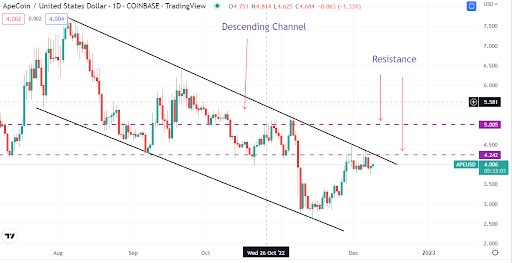
    • The cryptocurrency faces resistance approaching the upper limit of descending channel

    ApeCoin (APE/USD) staking functionality is no longer a dream – it’s a reality. Staking rewards are set to begin on December 12. Apes are making merry as the staking service launches with a thud, just like the APE airdrop.

    ApeCoin staking launched on December 5, much to the excitement of its communities. In just one day after the launch of the staking feature, $32 million worth of APE was deposited in the staking contract. Stakers are now expecting the rewards in a few days, with 175 million APEs expected to be distributed in three years. The number represents around 17.5% of the total ApeCoin tokens in circulation. Will the staking feature launch boost the price of APE?

    As CoinJournal previously reported, APE was gaining ahead of the staking service. The gains have cooled, in a typical buy the rumours, sell the news scenario. However, it is not that exactly, as APE had gained by an intraday of 3% as of press time. The cryptocurrency has remained at more than 2% in the past week. Will APE continue with the gains as the staking rewards trickle in? That will depend on the technical changes in APE price.

    ApeCoin trapped in a descending channel amid a bullish push

    APE/USD Chart by TradingView

    On the daily chart, APE trades on the upper limit of the descending channel. The cryptocurrency has been trading at this level for weeks, with bulls getting rejected. The price action is, however, looking increasingly bullish, as shown by a continued push to break higher.

    What to watch next for APE?

    A breakout at the upper limit of the descending channel is the key event for ApeCoin next. The breakout will see APE price also overcome a crucial resistance at $4.2.

    A breakout at the descending channel and $4.2 resistance will place APE for recovery to the next resistance at $5.0.

    Where to buy APE

    eToro

    eToro offers a wide range of cryptos, such as Bitcoin, XRP and others, alongside crypto/fiat and crypto/crypto pairs. eToro users can connect with, learn from, and copy or get copied by other users.


    Buy APE with eToro today

    Nexo

    Since 2018 Nexo has strived to bring professional financial services to the world of digital assets. Leveraging the best of the team’s years of experience in FinTech along with the power of blockchain technology, Nexo empowers millions of people to harness the value behind their crypto assets, shaping a new, better financial system.


    Buy APE with Nexo today

    Source link