Tag: stocks

  • Bitcoin hits record high of $112,055; crypto stocks rally in response

    Bitcoin hits record high of $112,055; crypto stocks rally in response

    Bitcoin hits record high of $112,055; crypto stocks rally in response

    Bitcoin has once again smashed through its previous records, surging past the $112,000 mark for the first time in its history to set a new all-time high on July 9.

    The milestone represents a significant achievement for the leading cryptocurrency as it continues to recover from the market aftershocks of US President Donald Trump’s tariff policies and solidifies its position in an evolving financial landscape.

    As the broader crypto market continues its recovery, Bitcoin (BTC) hit a new record high of $112,055 on Tuesday. This fresh peak surpasses the previous all-time high of $111,970.17, which was set on May 22.

    The digital asset has been trading in a volatile range since then, with the area around the $110,000 level proving to be a significant psychological and technical barrier.

    Over the past several weeks, each time Bitcoin’s price neared this level, it was met with a combination of profit-taking from existing holders and increased pressure from short-sellers.

    This latest decisive break suggests a new wave of bullish momentum has taken hold.

    The journey of Bitcoin, first introduced in a 2008 white paper by its pseudonymous creator, Satoshi Nakamoto, has been remarkable.

    Launched in 2009 as the world’s first decentralized cryptocurrency, it has grown to become the largest digital asset, with a current market capitalization of $2.18 trillion.

    At the time of this report, Bitcoin accounted for nearly 65% of the total crypto market capitalization of $3.4 trillion.

    From crossing the $100 mark in April 2013 to the $1,000 mark in November of that same year, its path has been marked by staggering growth.

    It first hit the $10,000 level in November 2017 and reached a memorable peak of $69,000 in November 2021.

    Following President Trump’s victory in his second presidential election, it set a new all-time high of $76,999 in early November 2024, before crossing the landmark $100,000 target in early December 2024.

    The institutional bedrock: a maturing market

    A key factor underpinning Bitcoin’s current strength is its growing acceptance within the traditional financial system.

    With the Trump administration signaling its validation of Bitcoin through its plan to create a strategic US Bitcoin reserve, and with the continued institutional adoption led by Wall Street giants such as BlackRock (NYSE: BLK), the “king coin” appears to have found a more secure home, at least for now, within the US financial ecosystem.

    BlackRock’s iShares Bitcoin Trust, a prime example of this institutional integration, now currently owns 3.5% of the total supply of Bitcoin.

    The success of this and other spot Bitcoin ETFs has had a profound effect on institutional investment and has likely influenced the broader market optimism.

    A quiet build-up, a bullish setup?

    While the new all-time high is a headline-grabbing event, some market watchers have noted that the build-up to this moment has been relatively slow and quiet, which they interpret as a potentially bullish setup for what’s to come.

    “Crypto feels so quiet, [while] bitcoin is ready to move,” wrote Charlie Morris, chief investment officer at ByteTree, in a recent report.

    Morris pointed out that Bitcoin’s volatility has been steadily declining, a pattern that has historically preceded large upward price movements.

    This sentiment was reflected in the performance of crypto-related stocks. Shares of Strategy (MSTR) were higher by 4.4%, trading at $414, just a few dollars shy of its highest level in 2025 (though still well below its record high of $543 set late last year).

    Crypto exchange Coinbase (COIN) was ahead by 5%, and Bitcoin miners MARA Holdings (MARA) and Riot Platforms (RIOT) were both up by roughly 6%, all riding the wave of Bitcoin’s record-breaking achievement.

    Source link

  • Bitcoin falls to $62k as crypto mirrors stocks crash

    Bitcoin falls to $62k as crypto mirrors stocks crash

    • Bitcoin price dropped to its lowest level since mid-July with a dip to near $62k on August 1.
    • Stocks also plummeted as investors reacted to latest economic data and geopolitical tensions in the Middle East.

    Bitcoin price crashed 10% to trade to near $62k on Thursday as August began on a painful footing for cryptocurrencies and stocks.

    On August 1, the global cryptocurrency market cap fell to $2.3 trillion amid an overall 5.7% dump. BTC fell to lows of $62,300 across major crypto exchanges. The declines also hit Ethereum, which traded to lows of $3k and Solana that retreated sharply to touch $160.

    XRP, Dogecoin and Pepe also experienced sharp declines.

    Why did Bitcoin, crypto prices fall today?

    Losses across the crypto market came as the stock market nosedived, with the Dow Jones Industrial Average shedding more than 600 points and the S&P 500 falling 1.5%. According to CNBC, the bloodbath across stocks follows fresh investor jitters around possible economic contraction on weak data released on Thursday.

    Markets’ reaction also follows Wednesday’s Federal Reserve FOMC meeting, although analysts say the market has fully priced in a September cut. Geopolitical tensions in the Middle East was also on investors’ minds.

    What next for BTC, crypto?

    Commenting on the overall outlook ahead of the sharp sell-off, analysts at Singapore-based firm QCP Capital noted:

    “Crypto experienced a broad sell-off overnight and into this morning. The market remains on edge as traders pay close attention to daily ETH ETF outflows and further supply pressures from Mt Gox and US government.”

    According to QCP, the long term picture remains bullish for Bitcoin. Key catalysts could be the upcoming US election and direction of the quest for a sovereign Bitcoin reserve for the US.

    “The establishment of a U.S. or sovereign “put” on BTC prices may have significant implications, potentially making accumulation on dips a strategic investment approach,” QCP Capital added in the note posted on Telegram.

    BTC traded around $63,007 at 2:40 pm ET on Thursday, up from intraday lows.


    Source link

  • Billionaire Paul Tudor Jones picks Bitcoin over stocks

    Billionaire Paul Tudor Jones picks Bitcoin over stocks

    paul tudor jones picks bitcoin over stocks
    • Paul Tudor Jones expects a recession in the first quarter of 2024.
    • He also expects the Israel-Palestine war to make stocks less attractive.
    • Bitcoin has a history of doing well in the midst of political uncertainty.

    Bitcoin is still down 13% versus its year-to-date high but Paul Tudor Jones remains bullish as ever on the world’s largest cryptocurrency.

    Paul Tudor Jones expects BTC to do well in a recession

    The billionaire hedge fund manager is constructive on Bitcoin primarily because he sees a recession ahead. The Founder of Tudor Investment also expects the Israel-Palestine war to make stocks less attractive.

    Ongoing conflict in the Middle East has already claimed close to 2,000 lives. According to Paul Tudor Jones:

    I think Bitcoin and Gold take on a larger percentage of your portfolio than historically they would because of a challenging political time in the U.S. and geopolitical situation.

    Bitcoin has a history of performing well in the midst of political uncertainty – be it related to the Ukraine war or the recent elections in Turkey.

    Why else is the billionaire constructive on Bitcoin?

    On CNBC’s “Squawk Box”, Paul Tudor Jones said the inverted yield curve was a signal of a recession ahead that he believes will materialise in the first quarter of 2024.

    The billionaire hedge fund manager first invested in Bitcoin at the start of the pandemic and holds some of it to date.

    He’s bullish on the cryptocurrency also because of a decline in the U.S. fiscal position. At 122%, the debt-to-GDP in the United States is currently at its worse since the World War II.

    Last month, U.S. lawmakers urged the Securities & Exchange Commission to “immediately” approve applications for a Spot Bitcoin ETF. Plus, total supply of the cryptocurrency is scheduled to halve in April of 2024. Both these events could translate to a rally in BTC as well.

    Source link

  • Bitcoin holds steady as DXY advance hurts stocks

    Bitcoin holds steady as DXY advance hurts stocks

    • Bitcoin rose to $26,820 on Wednesday, trading in the opposite direction to stocks as the Dollar Index hit a 10-month high.
    • An easing for the DXY could see Bitcoin price strengthen above the $26k base.

    Bitcoin (BTC) defied a surge for the Dollar Index (DXY) on Wednesday, spiking to above $26,820 in early US trading hours. The gains for the benchmark cryptocurrency buoyed the altcoin market, with several tokens seeing decent moves to push the total market cap up by about 1.5%.

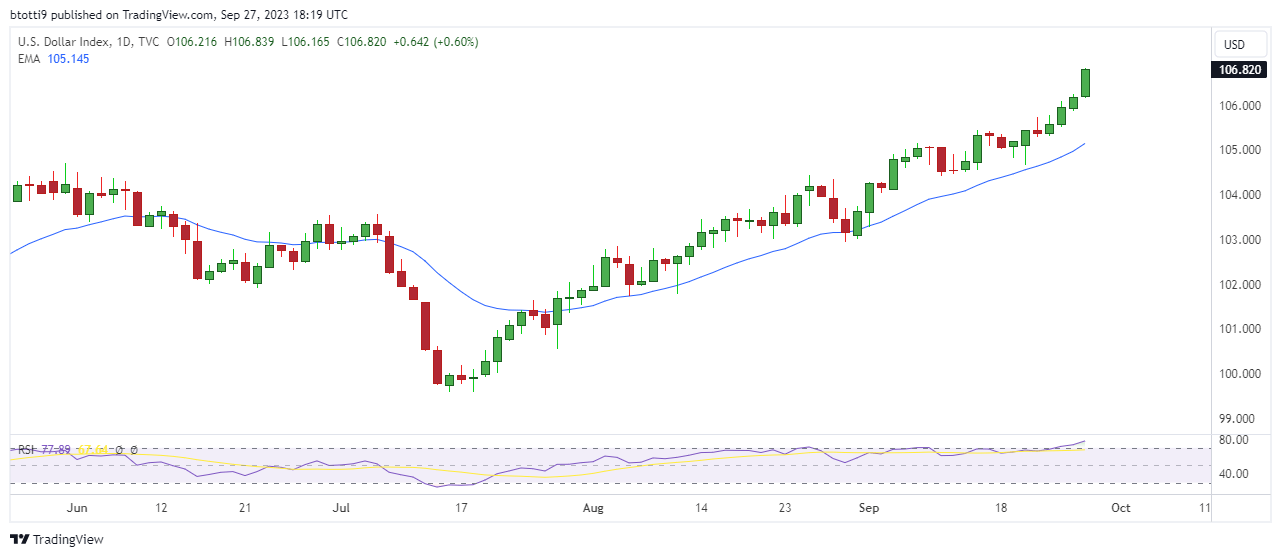
    But as the DXY, which measures the greenback’s strength against a basket of other major currencies, hit highs of 106.83 for its highest level since November 2022, stocks moved lower. Alongside the dollar’s strength has been rising yields, with the benchmark 10-year US Treasury yield soaring to a 16-year high of 4.64%. The two-year US yield rose to 5.15%

    It’s a scenario that sees the stock market compound weakness seen over the past week, including Tuesday’s Dow slump that was the biggest in a single day since March.

    US dollar index (DXY) chart from TradingView

    BTC price outlook

    The US dollar index’s upside has historically signaled a bearish outlook for stocks and other risk assets, including crypto. Market intelligence platform says the negative correlation between the dollar index and Bitcoin and S&P 500 has particularly been evident since 2021.

    That should be the perspective, though Bitcoin is showing a resilience above $26k. According to crypto investor Scott Melker, Bitcoin’s performance shows it “has its own life.”

    Meanwhile, Santiment analysts say BTC could see a breakout if the DXY begins to cool off.


    Source link

  • Bitcoin mining stocks are far riskier than Bitcoin itself

    Bitcoin mining stocks are far riskier than Bitcoin itself

    Key Takeaways

    • Bitcoin mining stocks have underperformed Bitcoin heavily over the last year

    • Greater competition among miners and higher amounts of energy required means margins are thinner

    • Rising electricity costs and lower value of Bitcoin have also hurt miners immensely 

    • Greater number of variables beyond merely the price of Bitcoin means mining stocks have been trading with greater volatility

    It’s a tough time to be a Bitcoin miner. This piece will succinctly break down how and why, as well as delving into why I believe mining stocks are far riskier than just investing in Bitcoin itself. Let’s get to it. 

    Mining competition is higher than ever

    Firstly, the competition within mining is higher than ever before. The beauty of the blockchain is that we can see all sorts of statistics regarding the Bitcoin network in real-time. One of these is the difficulty adjustment. For the uninitiated, the difficulty adjustment is a mechanism by which the difficulty of mining changes to ensure the new supply of Bitcoin released via mining remains consistent (at approximately ten-minute intervals).

    In other words, as more miners join the network, the difficulty increases so that Bitcoin is released at the same pace as prior. The same holds true the other way around – difficulty falls if miners stop operating. 

    As the below chart shows, Bitcoin mining difficulty recently smashed through the 50 trillion hash mark for the first time ever. Only three years ago, that number sat at 14 trillion.  

    This is great for the Bitcoin network: the more miners, the more secure the network. For the miners themselves, however, that means greater energy amounts are needed to complete this now-more-difficult assignment of validating transactions on the network. 

    Oh, and there is a double whammy. As you may realise if you have turned on a light, charged your phone or boiled a kettle in the last year, the price of electricity has skyrocketed around the world. The next chart shows the rise in electricity costs in the US, which according to the Cambridge Electricity Consumption Index, has the highest amount of miners (the nation is responsible for 38% of the network’s hash rate). 

    This means that higher amounts of energy are needed to mine, and the cost of that energy has also increased drastically. 

    People are using Bitcoin less 

    So, we know costs have risen. But the bad news isn’t over yet. 

    Bitcoin’s volumes have collapsed throughout the bear market. Perhaps the best barometer of this is to look at the trading volume on centralised exchanges, which fell 46% in 2022 compared to 2021. 

    Looking at Bitcoin fees shows a similar pattern, with fees far down on the heyday of the pandemic bull market. This was briefly interrupted in May when the Bitcoin Ordinals protocol sparked a revival in network activity. However, the below chart shows that fees have been falling for five consecutive weeks since (although they are still up significantly on the start of the year), giving up most of those gains. 

    Much like the cost side, which saw an increase in inputs required (greater demands via the difficulty adjustment) as well as an increase in the per-unit costs of those inputs (rising electricity costs), the revenue side for miners is also suffering from a brutal double whammy. 

    Not only is volume way down from the bull market and hence less fees (revenue) are recouped, but miners’ revenue (fees and the block subsidy award) is received in Bitcoin, which has also fallen in value. This means that, after earning Bitcoin by battling with the greater competition and toiling over increased costs, the value of that Bitcoin (revenue) on the market is substantially less – still 60% off its peak from November 2021. 

    Mining stocks are more volatile than Bitcoin

    So let’s think about these four variables:

    1. The amount of energy needed
    2. The cost of that energy (electricity)
    3. The fees and block rewards received (i.e. revenue)
    4. The value of those fees and block rewards (the Bitcoin price)

    Therefore, not only are mining companies dependent on the price of Bitcoin (variable number four), but it also depends on several other factors (admittedly variables 1 and 3 are heavily dependent on the price of Bitcoin too. In truth, economic incentives will drive mining to a certain price point, but I will discuss in another article). 

    Therefore, for the time being at least, the risk is greater with mining stocks than a direct investment in Bitcoin. As with all things, greater risk can mean greater reward, and there have been periods of mining stocks outperforming Bitcoin as a result. 

    However, over the last year or so, mining investors are in an even worse state than Bitcoin investors (who themselves are licking their wounds). I’ll let the below mining ETF, launched in February 2022, illustrate this:

    All this goes to show how tough mining has been. And that is without even mentioning the big bad wolf that is regulation. The regulatory crackdown in the US has been ferocious, and while Bitcoin has thus far been relatively unaffected, miners are more vulnerable (especially those that are publicly listed in North America) than Bitcoin itself, which is a decentralised asset theoretically immune to regulation (directly, at least). 

    This is not meant to be a pro-Bitcoin or anti-mining piece. It is just comparing the two as investments and showing why mining stocks tend to be more volatile. And when you’re more volatile than Bitcoin, that is really saying something.        

    Source link

  • Bitcoin correlation with stocks at 5-year low as regulatory crackdown takes toll

    Bitcoin correlation with stocks at 5-year low as regulatory crackdown takes toll

    Key Takeaways

    • Our Head of Research, Dan Ashmore, digs into Bitcoin’s relationship with stocks
    • Correlation between Bitcoin and the Nasdaq is at its lowest point since 2018
    • The Nasdaq is up 10% in the last month as stocks have surged off softer forecasts around interest rates and the macro climate
    • Bitcoin is down 9% in the same time frame, the US regulatory crackdown spreading fear about crypto’s future in the country 
    • Ashmore writes that the break in correlation surpasses what was seen in November 2022 amid the FTX collapse, when Bitcoin fell to $15,000 while stocks increased off positive inflation readings

    After ten consecutive interest rate hikes, the US Federal Reserve this week paused its rate hiking policy. The move was nearly unanimously anticipated by the market and movement after the meeting was relatively minimal.  

    However, over the past month, markets have been flying. The S&P 500 is up 6% in the last 30 days, now only 8.8% off an all-time high, despite being 27% below the mark in October. The Nasdaq is up 10% over the same timeframe – that is 15% below its all-time high from November 2021 but a tremendous resurgence considering it shed a third of its value in 2022.  

    And yet, something is being left behind: Bitcoin. 

    Bitcoin is now trading below $25,000 for the first time in three months. I put together a deep dive in March analysing the its underlying price movement to show how tightly it trades with the stock market. This was at a time when Bitcoin was rallying and banks were wobbling amid the Silicon Valley Bank fiasco. Suddenly, it was fashionable to declare Bitcoin as decoupling from the stock market. Ultimately, that wasn’t true. However, something very interesting has happened in the last month. 

    First, take a look at the path of the Nasdaq and Bitcoin since the start of 2022, which roughly coincides with the start of the bear market: 

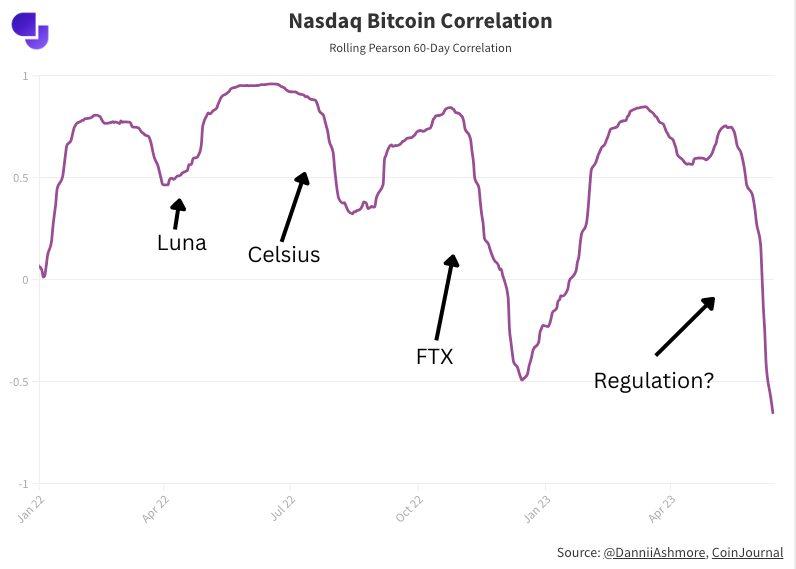
    Clearly, the two have moved in lockstep. But two episodes jump out: the first is November 2022, when Bitcoin fell and the Nasdaq surged. The second is this past month. We discussed the 10% jump in the Nasdaq over the last month. However, Bitcoin has fallen 9% in the same timeframe. This marks a clear departure from what we would expect. Plotting the correlation (using 60-Day Pearson) shows this more directly:

    I touched on November 2022 above, and the swift fall in correlation can be seen on the chart. This was when FTX collapsed, sending the crypto market into a tailspin. At the same time, however, stocks raced upwards as softer inflation numbers were met by lower expectations around the future path of interest rates. 

    There were also less dramatic (but equally temporary) decouplings between Bitcoin and stocks in April/May 2022 and June/July 2022. On the chart below, I have pencilled in incidents which occurred during these periods:

    Indeed, what is different about November (FTX) and today is that we see a Bitcoin fall happening at the same time as a Nasdaq surge. While the Luna and Celsius incidents hurt crypto immensely, they came as stocks were also struggling and so the effect is not as dramatic in terms of correlation breaks (although is still tangible on the chart).
    But today, we are seeing the biggest break in the correlation trend over the last couple of years – surpassing even FTX. The 60-Day Pearson currently sits at -0.66, whereas the lowest it hit during the FTX crisis was -0.49. 

    Regulatory crackdown is suppressing prices

    The reason is obvious. The great regulatory crackdown in the US is freaking the market out, and for very good reason. The two biggest crypto companies on the planet, Binance and Coinbase, were both sued last week. 

    Crypto.com has suspended its institutional exchange, citing weak demand amid the regulatory woes. eToro and Robinhood pulled a bunch of tokens from their platforms following confirmation from the SEC that it viewed them as securities. Liquidity is dropping like a stone

    I wrote in-depth about the concern following the announcement of the Coinbase lawsuit last week, so I won’t rehash it here (that analysis is here). While I believe Bitcoin should be able to weather the storm long-term, the picture appears far murkier for other cryptocurrencies. 

    Make no mistake about it, the crypto industry faces a massive problem as long as lawmakers continue to turn the screw. The crisis very much feels existential for a lot of the crypto market. 

    Regarding Bitcoin, enthusiasts dream of a day when it can decouple and claim that title of uncorrelated hedge asset, or a store-of-value, akin to gold. I’ve done a lot of work around what that hypothetical future could look like, or what could lead the market to that point. But for now this remains just that: hypothetical.  Because while the correlation is at its lowest point in five years, it is not being driven by fundamentals and thus will inevitably spike back up. This is nothing more than the market reacting to what is a very bearish development around regulation in the US. 

    It’s not how investors hoped a decoupling would come. But if anyone doubted the market’s fear over the regulatory woes, or questioned why Bitcoin had not fallen more, looking at the break in correlation paints a very clear picture of how detrimental Gary Gensler’s games have been to the cryptocurrency industry. 

    In truth, it is not hyperbole to say that this is the most out of whack Bitcoin’s correlation has ever been whilst trading as a mainstream financial asset. Because back when it last happened in 2018, Bitcoin traded with such thin liquidity that its price action is largely irrelevant to draw conclusions from going forward. 

    Source link

  • Report: Bitcoin mining stocks – extreme volatility and underperforming Bitcoin

    Report: Bitcoin mining stocks – extreme volatility and underperforming Bitcoin

    Key Takeaways

    • Bitcoin mining stocks have traded with significantly more volatility than Bitcoin itself
    • Mining stocks have underperformed, as rising energy costs and increased competition has cut into profits
    • Miners also overleveraged during the pandemic, purchasing new equipment with debt and holding onto Bitcoin stashes as prices fell
    • Fees on the network rose with the Ordinals protocol and thus provided miners relief, but have since fallen back to normal levels

    Anyone remotely interested in the cryptocurrency world will attest to the fact that Bitcoin is incredibly volatile. At one point in March 2020, it was $4,600. By November 2021, at the peak of the bull market pandemic, it hit $68,000. A year after that, it was back down to $15,500. And it is currently ticking along around the $27,000 mark.

    As we said, volatile. And yet, there is something even more volatile: Bitcoin mining stocks. 

    First, a quick explainer into Bitcoin mining for the uninitiated. For those familiar with how the industry works, you can skip this little introduction. 

    Bitcoin miners are in the middle of what is a peculiar economic model. Miners act as “volunteers”, validating transactions on the Bitcoin blockchain. Because Bitcoin is a decentralised network, there is no central authority to maintain the blockchain, hence the need for these “volunteers” to validate transactions. 

    I put quotation marks around the word “volunteers” because miners get paid for their work, so don’t really have a claim to the volunteer title. Vitally, miner revenue comes in the form of Bitcoin. This revenue stream is split into two streams – the block reward subsidy, which halves every four years, and transaction fees. 

    The bottom line is that miners pay a cost to maintain the blockchain, in the form of energy/electricity, and receive revenue in return, in the form of Bitcoin.

    Mining share price performance

    Two things have been true about the performance of bitcoin mining stocks to date. The first is that they are extremely correlated with the price of Bitcoin itself. The second is that they have shown far greater volatility. 

    The Valkyrie Bitcoin Miners ETF is a good way to demonstrate the performance of mining stocks. It was launched in February 2022 and allocates at least 80% of holdings to companies which derive at least 50% of their revenue or profit from bitcoin mining operations. 

    Launched as the bear market started to engulf crypto, it has underperformed Bitcoin significantly, down 59% while Bitcoin is down 37% in the same timeframe. However, since the start of the year when markets have been a bit softer, it has outperformed: up 142% against Bitcoin’s rise of 62%. 

    Why have mining stocks suffered?

    This has been the pattern that has consistently held: mining stocks almost trade like a levered bet on Bitcoin. Obviously, their entire business depends on the popularity of Bitcoin. Not only is their revenue literally denominated in it, but the more people use Bitcoin, the more transactions there are to be validated and the more lucrative mining is. 

    As a result, mining stocks have struggled immensely during the bear market. Despite rebounding this year as crypto markets have turned more optimistic in line with the macro climate and expectations around the future path of interest rates, mining stocks are still far below the prices at which they traded at 18 months ago. 

    There are a few reasons why the fall has been more than one would have perhaps expected. The first is resource management. Bitcoin miners get paid in Bitcoin, but they can sell their holdings if they wish. As prices surged during the pandemic, on-chain data shows that this did not occur. Instead, miners largely held onto their stash. 

    We looked at this in a recent piece, and the below chart presents this well. It displays a relatively constant pattern of miners offloading Bitcoins. However, the behaviour or speed of selling does not waver as Bitcoin’s price spikes immensely, rising from $5,000 in March 2020 to $68,000 in November 2021. This is seen by the huge uptick in miner reserves in USD terms, while there is no change to the trajectory of reserves in BTC terms. 

    In essence, it implies that miners did not monetise an increased amount of their Bitcoin as those Bitcoins appreciated in dollar terms. The more Bitcoin you hold, the more volatile your stock is going to be. 

    In retrospect, this seems a mistake. While miners were always going to struggle with the price of Bitcoin falling so violently, a refusal to diversify their holdings meant they were betting even heavier on Bitcoin’s price holding. That proved to be a bad bet. 

    Bitcoin hash rate is at all-time highs

    Not only did miners not sell much Bitcoin as it rose in price, but many invested in more equipment as mining revenues surged in line with the rocketing prices during COVID. Even worse, many miners also turned to debt to finance new equipment – equipment which was selling for bloated prices as more and more miners entered the game. 

    This equipment has since fallen in price, just as the Bitcoin price has. The below chart shows the growth in hash rate on the network – a measure of the total computing power mining Bitcoin. The rise has been incessant. 

    While greater hash power is excellent for Bitcoin overall and is vital for the security of the network, it does make things more challenging for miners. More hash power in essence means more competition. 

    Due to the wonderful kaleidoscope of incentives laid out by Satoshi Nakamoto in their Bitcoin whitepaper, this also means a difficulty adjustment will kick in – meaning the more miners on the network, the harder it is to mine Bitcoins. This is necessary in order to keep Bitcoin on track to hit its final supply of 21 million bitcoins in 2140. Otherwise, an increase in miners would validate transactions quicker and hence more Bitcoin would be released into circulation. 

    This sounds complicated, and the intricacies of it are. But the bottom line is that more hash power on the network means it requires more energy to mine Bitcoin – another thing which is eating into the bottom line of miners. 

    And what happened to energy costs over the last year? Surging inflation and the war in Ukraine has sent electricity prices aggressively upward. The below chart shows the movement in the US, the most popular mining destination. 

    This means that miners are getting double squeezed – on the revenue side, a falling Bitcoin price is obviously reducing their revenue, while on the cost side, the price of energy has also risen. Higher costs and falling revenue is…not good. And down goes the share price. 

    Are Bitcoin mining fees rising?

    One point mentioned in crypto circles recently has been the increase of transaction fees on the Bitcoin network. As we covered recently, this can be attributed to increased activity on the network as a result of the Bitcoin Ordinals protocol. In other words, Bitcoin NFTs and memes, which exploded onto the scene in recent months. 

    The only issue is, this spike in fees proved to be brief. The below chart shows how the percentage of miner revenue derived from fees has fallen right back down to earth. 

    While the Ordinals protocol was certainly a bonus for miners, its effect has worn off and it appears unlikely to disrupt the age-old pattern: as the price of Bitcoin rises in bull markets, more people use the Bitcoin network, meaning more transaction fees. In bear markets, the opposite happens. This is what the below chart shows – the percent of miner revenue derived from fees tracks the Bitcoin price quite well (remember, the other part of revenue is the block subsidy award, which is pre-set and price agnostic, halving every four years).

    Final thoughts

    To wrap this mining report up, the reality is that miners will always suffer when the price of Bitcoin is falling, and outperform when it rises. This is because more people use Bitcoin when prices are rising, meaning more transactions and more revenue. 

    In the last year, miners have also been fighting a battle on the costs front, as inflation and an energy crisis have pumped the cost of electricity up, even if the worst of that may be in the rear window. Then there is the fact that many miners overleveraged themselves by purchasing more equipment at heightened prices on debt. Not to mention the decision by many to hold their revenue in Bitcoin rather than monetise into fiat. 

    Competition is now also fierce, input costs rising incessantly, the hash rate on the network near all-time highs. Put it this way: the days of college students mining on laptops are long gone.

    All these factors have contributed to what has been an extremely challenging environment for miners over the past year. It also explains why mining stocks are even more volatile than one of the most volatile mainstream financial assets: Bitcoin itself. 

    Source link

  • Bitcoin, Ether prices up as stocks tank on new bank fears

    Bitcoin, Ether prices up as stocks tank on new bank fears

    • Bitcoin (BTC) and Ethereum (ETH) prices rose nearly 2% respectively as stocks plunged.
    • The S&P 500 was down 1.5% as two bank stocks plummeted.
    • BTC and ETH gains saw altcoins in the top 10 cryptocurrencies by market cap up.

    Bitcoin (BTC) price moved above $28,500 again on Tuesday, rising more than 2% in early morning trades during the US trading session. The upside was yet another attempt by Bitcoin bulls to establish a fresj footing in the key price range.

    Elsewhere, the price of Ethereum (ETH) rose above $1,860 to hit a new 24-hour high as crypto spot markets climbed. The Ether token was 1.9% up at the time of writing, gains that were being mirrored across the top 10 cryptocurrencies by market cap list.

    BTC and ETH have traded to year-to-date highs above $31,000 and $2,100 respectively.

    Stocks tank on bank fears

    US stocks opened lower on Tuesday as stock prices of another two US banks plunged amid the latest turmoil in the banking sector. The S&P 500 was down 1.5% while Nasdaq was shedding 1.3%.

    After share prices of First Republic Bank fell in the lead up to its takeover by JPMorgan, Tuesday saw prices of Pacwest (PACW) and Western Alliance (WAL) stocks bleed massively.

    At about 12:30 pm ET, the PACW and WAL share prices were down 26% and 20% respectively.

    The two bank stocks had plummeted more than 30% earlier as investor concerns around the turbulence within the US banking system resurfaced following the losses that followed the collapse of Silicon Valley Bank.

    Also on investors’ minds this week is the Fed’s meeting that kicked off on Tuesday. While the market has the anticipated 25bps interest rate hike baked in for after the FMC meeting, what the central bank says in relation to what next is seen as key.

    Economist Mohamed A. El-Erian, commented on the market outlook, stating via a tweet:

    The roller coaster continues with, this time around, a 20 bps drop in the yield on 2-year Treasuries.  With such a key market segment continuing to be in urgent need of stabilization, it remains to be seen if the Fed serves this function tomorrow or, instead, is again a source of volatility.”

    Barry Knapp of Ironsides Macroeconomics says the Fed’s approach to the inflation question is fraught and dubious. The central bank has to consider what the market is telling it. He shared his views in an interview with CNBC’s Squawk Box.


    Source link

  • Bitcoin correlation with stocks rises again, normal service resumed

    Bitcoin correlation with stocks rises again, normal service resumed

    Key Takeaways

    • Bitcoin had deviated slightly from stocks over the last couple of weeks 
    • Correlation has bounced back since
    • Tech-heavy Nasdaq continues to trade in lockstep with Bitcoin as investors in both asset classes look to shifting expectations around interest rates 

    It’s been an odd few weeks in the market. The banking wobbles over the last few weeks, triggered by the bank run on the crypto-friendly Silicon Valley Bank (SVB), caused everything to go a little wonky. 

    One of the most curious aspects of this was a deviation from the normal Bitcoin/stocks relationship. Or, sort of. Bitcoin raced upwards while markets digested the banking news, with the correlation – at least on a short-term rolling 30-day metric – dipping as per the below chart. 

    The chart also shows, however, that the correlation has since come back up. 

    As I wrote in a deep dive at the time, we have seen these cases of temporarily dipping correlation a few times over the last year, most notably with the FTX crash in November, as well as the Celsius and LUNA crashes before it. 

    But in each case, the correlation roared back. The above chart shows that it is beginning to do the same again this time. And the chart below shows that no matter what you swing it, the relationship here is pretty close (and forgive the axis crime on this one, please). 

    What happens next?

    The interesting question is what will happen going forward. The key development recently has been with regard to expectations around the future path of interest rates. 

    The forecasts have been transformed. With hiking interest rates exposing the mismanagement of the aforementioned collapsed banks, the trouble has led to the market forecasting a pullback in plans to hike further. 

    Instead of future hikes, there are now cuts in the pipeline, or at least according to the probabilities implied by fed futures. 

    And it was the transition into this new interest rate paradigm, occurring last year as inflation began to roar and it became clear that central banks needed to act, which kicked the correlation up between stocks and Bitcoin. 

    It is not that one is controlling the other, it is that Jerome Powell is controlling both. Tech stocks are particularly sensitive to interest rates, given the sector is valued so much by discounting future cash flows – and a lack of current profit – which is why the correlation, and bloodbath in 2022, was so strong between Bitcoin and the Nasdaq. 

    Whether a potential pivot back off this uber-tight monetary policy sparks a deviation in correlation going forward is yet to be seen. Perhaps it will to a certain extent, but at the same time, it remains difficult to come up with a strong argument that Bitcoin is ready to truly deviate. 

    A decoupling remains the ultimate bull vision for the asset, and perhaps it will get there one day in the future. But there is not much evidence, beyond blind hoping by those in the sector, that this is imminent. 

    Over a multi-year time horizon into the future? That is anyone’s guess. But if the past couple of years has taught us anything, it is that stocks and Bitcoin are paired at the hip, especially tech stocks. The past couple of weeks, and the resumption of this trend, is actually more of a reminder of this than a proof against the theory.

    Source link

  • Bitcoin, stocks eye recovery after ECB news jolts markets

    Bitcoin, stocks eye recovery after ECB news jolts markets

    • Bitcoin retested the $25,000 area, while S&P 500 had gained about 1% after plunging on ECB interest rate hike news.
    • The ECB on Thursday surprised with a 50 basis point rate hike.
    • Reports that JPMorgan and Morgan Stanley are looking to help First Republic Bank buoyed stocks.

    Bitcoin and stocks have recovered slightly after trading lower as investors reacted to the latest monetary policy news from the European Central Bank (ECB.)

    On Thursday, markets were digesting recent events around US banks and the possible ramifications to the Federal Reserve’s next move on its rate hikes when the ECB announced a surprise 50 basis points interest rate hike. Stocks reacted lower and so did the crypto market, with crypto analyst Michael van de Poppe suggesting the Fed could follow suit at its meeting next week. 

    S&P 500, Bitcoin recover after ECB news

    The S&P 500 staged a slight recovery, thanks to the resurgence of regional bank shares.

    Despite trading down 0.7% at one point, the benchmark index was up 1% at 12:20 pm ET, while the Dow Jones Industrial Average that had initially plunged by more than 300 points, reversed and was hugging gains with just over 100 points, or 0.3% higher. Elsewhere, the Nasdaq Composite was up by 1.5%.

    While US stocks have rebounded higher amid reports that banking giants JPMorgan and Morgan Stanley were coming to the aid of embattled lender First Republic Bank, concerns remain and investors continue to be cautious. 

    Bitcoin toyed with resistance around $25,000 on Thursday as cryptocurrencies continued to track events around the stock market.

    The flagship cryptocurrency, which traded lower earlier in the day amid the highlighted broader market downswing, showed it’s still highly correlated to equities despite last week’s spike that had some observers suggesting a rising decorrelation.

    Indeed, as CoinJournal analyst Dan Ashmore argues in our deep dive published today, Bitcoin could eventually decouple from other risk assets. However, that’s an outlook that mostly doesn’t apply to the current trading scenario, with the two assets largely in lockstep.


    Source link