Tag: takes

  • FARTCOIN price dips 20% as top whale takes profit

    FARTCOIN price dips 20% as top whale takes profit

    FARTCOIN price dips 20% as top whale takes profit

    • A large-scale holder has just offloaded 3 million FARTCOIN.
    • The meme token’s price has dropped 20% on the 24-hour chart.
    • Meme cryptos have plunged after the latest criticisms from Solana’s co-founder.

    Digital tokens recorded mixed performances in the past 24 hours, with most coins plunging.

    The meme token space witnessed multiple activities.

    While Gemini announced DOGE and SHIB as collaterals, a dramatic move shocked the Fartcoin community.

    According to Lookonchain, address 24BLFj has dumped a massive 3 million FARTCOIN tokens, pocketing $3.65 million.

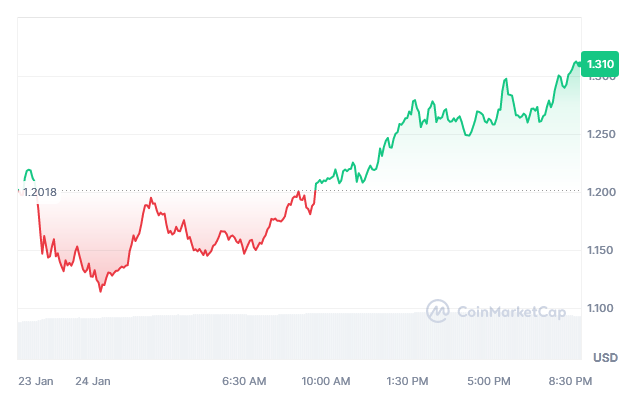
    The investor sold at $1.22 as Fartcoin plunged from the intraday high of $1.4017.

    The meme cryptocurrency fell to $1.1253, a 19.71% decline from the daily peak.

    While Solana co-founder’s latest criticism of meme assets contributes to FARTCOIN’s weakness, the whale sell-off adds to the selling pressure.

    Anatoly Yakovenko said NFTs and meme cryptocurrencies lack intrinsic value.

    Meanwhile, this whale has invested in Fartcoin since late February, accumulating 8.89 million coins at discounted prices.

    Notably, the whale spent $0.26 on average to purchase the assets between 26 February and 21 March.

    The strategic investment, worth only $2.31 million, has grown to a massive profit of $8.07 million, a 349% ROI.

    While the large-scale offload has impacted the markets, it also shows that the investor played a long game with FARTCOIN.

    Most importantly, the sale could indicate dwindling confidence in FARTCOIN’s short-term performance.

    Is the meme token set for further declines?

    Fartcoin has plummeted continuously from $1.6843 on 23 July.

    Nevertheless, the whale has not dumped all his stash.

    They still hold FARTCOIN worth approximately $2.15 million (1.89 million coins).

    Thus, the offload signals a potential strategy change, not a complete exit. The investor could be bracing for more returns in a rebound.

    Most importantly, the sale reflects a calculated move.

    While panic sellers dump all their assets at once, the smart whale takes partial profits while waiting for any future rally.

    FARTCOIN price outlook

    The meme coin trades at $1.18 with a bearish structure.

    The 50% increase in daily trading volume signals intensified trader activity in FARTCOIN.

    That signals players seeking opportunities in the prevailing volatility or exiting their positions.

    The prevailing broad market sentiments support continued struggle for Fartcoin.

    Meme coin market overview

    The meme cryptocurrency space endured a bloodbath on Tuesday, with Dogecoin, Shiba Inu, and PEPE losing up to 10% on their daily charts.

    The seven-day timeframe also confirms bearish dominance.

    Only PENGU (+8.5%) and SPX (+18%) exhibit 7D days among the top meme coins by value.

    CoinGecko data shows the meme coins’ market cap plunged 4.6% the previous day to $79.55 billion.

    The substantial daily trading volume dip indicates dwindling interest in themed digital coins.

    The latest critique by Solana co-founder Anatoly Yakovenko magnified bearish sentiments in the meme crypto space.

    While meme activity has fueled Solana’s growth, Yakovenko blasted the asset class.

    He boldly said that “memecoins and NFTs are digital slop and have no intrinsic value.”

    Nevertheless, meme cryptocurrencies have proven crucial for the digital assets economy, often used as a proxy for broad market sentiments.


    Source link

  • Strategy buys 6,220 Bitcoin for $739.8M, takes total holdings past $43B

    Strategy buys 6,220 Bitcoin for $739.8M, takes total holdings past $43B

    Strategy buys 6,220 Bitcoin for $739.8M, takes total holdings past $43B

    • $740.3M raised via equity sales across four security classes.
    • 1.6M MSTR shares sold under $21B ATM authorisation.
    • Strategy’s BTC yield for 2025 stands at 20.8% year-to-date.

    Strategy has added another 6,220 Bitcoin to its corporate balance sheet, spending $739.8 million during the week ending July 20, 2025.

    The purchase was funded through the company’s ongoing at-the-market (ATM) equity offerings.

    With this latest acquisition, the firm now owns 607,770 BTC—worth over $43 billion at current prices—making it the largest institutional holder of Bitcoin worldwide.

    The firm, chaired by billionaire Michael Saylor, paid an average of $118,940 per Bitcoin in its latest purchase, as disclosed in a filing published on Monday.

    This represents a significant premium over its historical average acquisition cost of $71,756 per BTC.

    Strategy issues 1.6M MSTR shares in latest equity round

    Between July 14 and July 20, Strategy raised approximately $740.3 million across four different security classes.

    The majority of funds—$736.4 million—were generated from the sale of 1,636,373 MSTR common shares.

    The company also issued 5,441 STRK preferred shares with an 8.00% strike, raising $700,000. Another 2,000 STRF shares were sold at a 10.00% strike, bringing in $200,000. Additionally, 31,282 STRD preferred shares, also with a 10.00% stride, were issued for $3.0 million in proceeds.

    All four instruments fall under large multi-billion-dollar issuance programmes. Both the MSTR and STRK share classes are authorised for up to $21 billion each.

    These programmes demonstrate Strategy’s continued ability to convert equity into Bitcoin reserves at scale without relying on traditional financing channels.

    BTC acquisition cost shows 20.8% YTD return for Strategy

    Bitcoin prices remain significantly higher than Strategy’s average cost basis of $71,756, giving the firm a year-to-date return of 20.8% on its BTC holdings.

    At current market prices—just above $118,000—Strategy’s crypto treasury continues to outperform many traditional corporate investments.

    This yield figure is particularly notable as Bitcoin has consolidated after hitting an all-time high of $123,000 last week.

    Although prices have since pulled back slightly, the bullish market structure remains intact.

    Analysts have observed a pennant formation following BTC’s strong rally in July, typically a continuation pattern that suggests potential for further upside.

    Despite short-term market volatility, Strategy’s long-term accumulation approach has proven resilient.

    The latest purchase reinforces its strategy of treating Bitcoin as a primary treasury asset and a long-term store of value.

    Market reacts as Saylor signals continued BTC accumulation

    Michael Saylor has maintained a consistent narrative around Bitcoin being a superior store of value.

    On Saturday, just days after the most recent BTC buy, he posted on X (formerly Twitter): “Stay humble, stack sats.” The phrase has been interpreted as a signal that Strategy’s accumulation is far from over.

    The company’s approach, combining equity capital markets with ongoing BTC purchases, serves as a blueprint for institutional crypto exposure.

    As regulatory clarity and institutional infrastructure improve, Strategy’s model could influence how other publicly listed firms handle treasury allocation.

    Bitcoin’s latest rally, paired with corporate participation at this scale, continues to shift market sentiment toward long-term adoption.

    While the token’s price has slipped slightly from its recent peak, its resilience above the $115,000 level is being closely watched by traders and institutional investors alike.

    Source link

  • Manta Network (MANTA), SUI, and Pullix (PLX) soar as crypto market takes a hit

    Manta Network (MANTA), SUI, and Pullix (PLX) soar as crypto market takes a hit

    • MANTA, SUI, and PLX defy market downturn, showcasing resilience amid Bitcoin’s decline.
    • Manta Network surges on Bithumb listing and successful airdrop, capturing investor interest.
    • Pullix’s PLX presale gains momentum, offering an innovative “Trade-to-Earn” concept.

    In the midst of a crypto market downturn triggered by Bitcoin’s recent price decline, some altcoins are defying the trend and experiencing significant growth. Manta Network (MANTA), Sui (SUI), and Pullix (PLX) have emerged as standout performers, showcasing resilience amid the broader market challenges.

    Read along as we delve into the reasons behind Bitcoin’s slump and explore the notable rises of MANTA, SUI, and the ongoing presale of PLX.

    Bitcoin’s decline and crypto market plunge

    As Bitcoin faces increased volatility, the entire crypto market has witnessed a notable downturn. Bitcoin briefly dropped leading to millions in liquidations. Although BTC price has regained $40,000, the recent decline in Bitcoin’s price, coupled with broader market uncertainties, led to double-digit losses for various altcoins.

    Investors are grappling with the impact of these market movements, which have contributed to a cautious sentiment and a temporary loss of support for many cryptocurrencies.

    Manta Network (MANTA): defying the odds

    Amid the crypto market turmoil, Manta Network (MANTA) stands out with a remarkable surge. Recent positive developments, including a listing on Bithumb and a successful airdrop for early supporters, have contributed to MANTA’s significant price increase. The token has seen a 30% surge in a single day.

    MANTA price chart

    The token’s resilience in the face of market challenges positions it as a noteworthy player in the decentralized finance (DeFi) landscape, garnering attention from investors seeking alternatives. Surprisingly, Manta’s surge comes against the backdrop of a major DDoS attack.

    SUI token: a rising star

    SUI, another altcoin in focus, has experienced notable growth despite the broader market uncertainties. The recent achievement of surpassing Bitcoin in Total Locked Value (TVL) following the approval of a spot Bitcoin ETF has propelled SUI into the spotlight.

    With a surge of over 8% in the last 24 hours and more than 70% in the last 30 days, SUI is capturing the interest of investors looking for promising opportunities beyond the traditional crypto heavyweights.

    SUI price chart

    Pullix (PLX): shaping the future of crypto trading

    Pullix, an innovative player in the crypto space, is currently in its presale stage, challenging the status quo of traditional exchanges. PLX, the native token of the Pullix ecosystem currently in its presale stage, introduces a novel concept of “Trade-to-Earn,” enabling users to earn rewards from the platform’s daily revenues.

    The platform’s hybrid approach, combining the strengths of centralized and decentralized exchanges, aims to address liquidity issues and provide a comprehensive trading experience.

    The PLX presale is gaining momentum and attracting investors in droves. As of the latest update, Pullix has raised $4,364,732, with a remaining supply of 15.1%. In the current presale stage, the PLX token is going for $0.08, with a price increase expected in a couple of days.

    The presale, scheduled to progress through stages, offers users the opportunity to participate in the early growth phases of the platform. With a fixed supply of 200,000,000 PLX tokens and a strategic allocation across presale, rewards, team, exchange listings, and marketing, Pullix aims to create a robust and sustainable ecosystem.

    Conclusion

    In a crypto market characterized by fluctuations, Manta Network (MANTA), SUI, and Pullix (PLX) emerge as notable players exhibiting resilience and growth.

    While Bitcoin’s recent decline has created a challenging environment, these altcoins showcase the dynamism and diversity within the crypto space. As investors navigate uncertainties, the unique features and positive developments surrounding MANTA, SUI, and Pullix contribute to their standing as intriguing options in the evolving landscape of digital assets.

    Source link

  • Maker (MKR), THORChain (RUNE) skyrocket; Bitcoin takes $27k again

    Maker (MKR), THORChain (RUNE) skyrocket; Bitcoin takes $27k again

    • Maker (MKR) and THORChain (RUNE) prices rose sharply as Bitcoin retested $27k.
    • MKR could spike towards $2k while RUNE eyes buy-side liquidity above $2.01

    The cryptocurrency market flipped higher on Thursday, with gains for Bitcoin (BTC) and most altcoins sending the total market cap up by 3.1% as at the time of writing. BTC traded above $27k again, benefiting from overall positivity in risk asset markets.

    With stocks also edging higher following a retreat for yields and oil, two notable performers in crypto were Maker (MKR) and THORChain (RUNE).

    Maker price breaks to highest level since May 2022

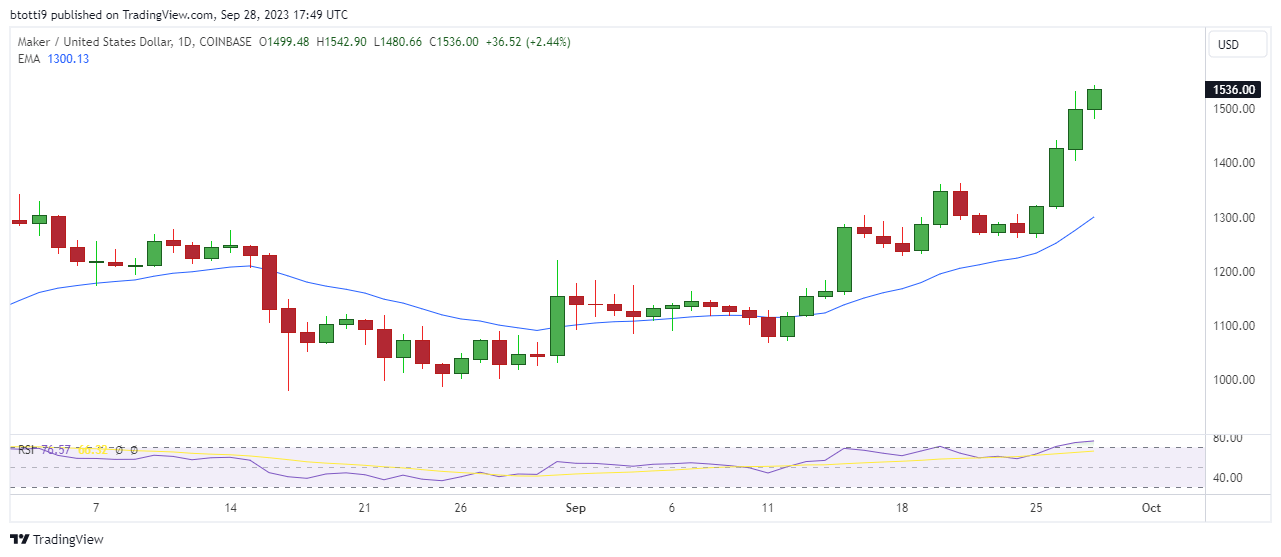
    Maker (MKR) broke higher following this week’s impressive gains, trading to intraday highs of $1,542.90 on Coinbase. Bulls were looking for a fourth consecutive green candle on the daily chart, with 24-hour gains of 6% and weekly uptick of 16%. MKR price has jumped nearly 48% in the past 30 days.

    Amid the gains is a surge in on-chain activity, particularly in active address count that stood at a 10-week high as of Thursday. Interest in MKR could see bulls seek out $2,000 – especially if the overall market picture supports further upside momentum.

    Maker (MKR) price chart. Source: TradingView

    THORChain (RUNE) eyes breakout above $2

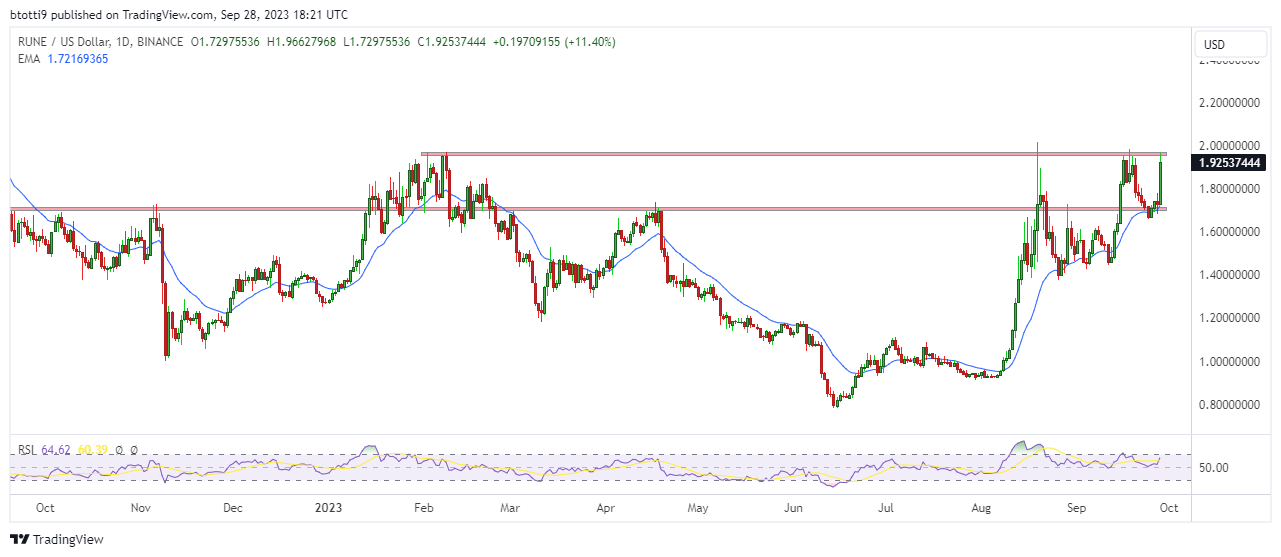
    THORChain (RUNE) price is one of outperformers today, with the altcoin’s value breaking beyond $1.9 as buying pressure mounted.

    RUNE got rejected at $1.98 on September 18, eventually slipping to lows of $1.65. Today’s gains sees the cryptocurrency pierce the resistance around $1.74, with the 20-day EMA acting as support near $1.72.

    For RUNE, there could be an urgency among buyers if price breaks above $2.01. If the expected buy-side liquidity plays out, we could see RUNE/USD eye $3.

    THORChain (RUNE) price chart. Source: TradingView

    However, while bulls might eye a fresh break to $3.00, they face tough resistance at this week’s supply wall that’s part of a horizontal hurdle that also thwarted buyers in February. A pullback is therefore likely given potential profit taking, in which case the primary support could be in the region of $1.72 to $1.66.


    Source link

  • Bitcoin correlation with stocks at 5-year low as regulatory crackdown takes toll

    Bitcoin correlation with stocks at 5-year low as regulatory crackdown takes toll

    Key Takeaways

    • Our Head of Research, Dan Ashmore, digs into Bitcoin’s relationship with stocks
    • Correlation between Bitcoin and the Nasdaq is at its lowest point since 2018
    • The Nasdaq is up 10% in the last month as stocks have surged off softer forecasts around interest rates and the macro climate
    • Bitcoin is down 9% in the same time frame, the US regulatory crackdown spreading fear about crypto’s future in the country 
    • Ashmore writes that the break in correlation surpasses what was seen in November 2022 amid the FTX collapse, when Bitcoin fell to $15,000 while stocks increased off positive inflation readings

    After ten consecutive interest rate hikes, the US Federal Reserve this week paused its rate hiking policy. The move was nearly unanimously anticipated by the market and movement after the meeting was relatively minimal.  

    However, over the past month, markets have been flying. The S&P 500 is up 6% in the last 30 days, now only 8.8% off an all-time high, despite being 27% below the mark in October. The Nasdaq is up 10% over the same timeframe – that is 15% below its all-time high from November 2021 but a tremendous resurgence considering it shed a third of its value in 2022.  

    And yet, something is being left behind: Bitcoin. 

    Bitcoin is now trading below $25,000 for the first time in three months. I put together a deep dive in March analysing the its underlying price movement to show how tightly it trades with the stock market. This was at a time when Bitcoin was rallying and banks were wobbling amid the Silicon Valley Bank fiasco. Suddenly, it was fashionable to declare Bitcoin as decoupling from the stock market. Ultimately, that wasn’t true. However, something very interesting has happened in the last month. 

    First, take a look at the path of the Nasdaq and Bitcoin since the start of 2022, which roughly coincides with the start of the bear market: 

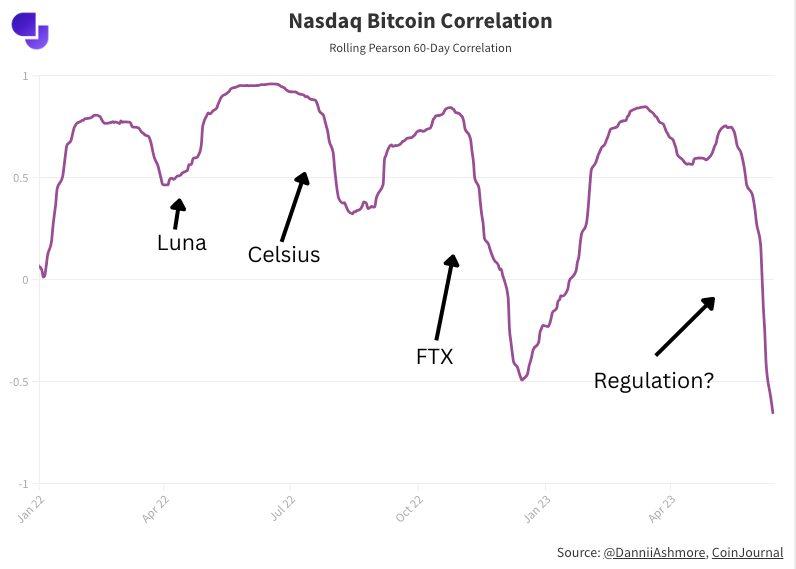
    Clearly, the two have moved in lockstep. But two episodes jump out: the first is November 2022, when Bitcoin fell and the Nasdaq surged. The second is this past month. We discussed the 10% jump in the Nasdaq over the last month. However, Bitcoin has fallen 9% in the same timeframe. This marks a clear departure from what we would expect. Plotting the correlation (using 60-Day Pearson) shows this more directly:

    I touched on November 2022 above, and the swift fall in correlation can be seen on the chart. This was when FTX collapsed, sending the crypto market into a tailspin. At the same time, however, stocks raced upwards as softer inflation numbers were met by lower expectations around the future path of interest rates. 

    There were also less dramatic (but equally temporary) decouplings between Bitcoin and stocks in April/May 2022 and June/July 2022. On the chart below, I have pencilled in incidents which occurred during these periods:

    Indeed, what is different about November (FTX) and today is that we see a Bitcoin fall happening at the same time as a Nasdaq surge. While the Luna and Celsius incidents hurt crypto immensely, they came as stocks were also struggling and so the effect is not as dramatic in terms of correlation breaks (although is still tangible on the chart).

    But today, we are seeing the biggest break in the correlation trend over the last couple of years – surpassing even FTX. The 60-Day Pearson currently sits at -0.66, whereas the lowest it hit during the FTX crisis was -0.49. 

    Regulatory crackdown is suppressing prices

    The reason is obvious. The great regulatory crackdown in the US is freaking the market out, and for very good reason. The two biggest crypto companies on the planet, Binance and Coinbase, were both sued last week. 

    Crypto.com has suspended its institutional exchange, citing weak demand amid the regulatory woes. eToro and Robinhood pulled a bunch of tokens from their platforms following confirmation from the SEC that it viewed them as securities. Liquidity is dropping like a stone

    I wrote in-depth about the concern following the announcement of the Coinbase lawsuit last week, so I won’t rehash it here (that analysis is here). While I believe Bitcoin should be able to weather the storm long-term, the picture appears far murkier for other cryptocurrencies. 

    Make no mistake about it, the crypto industry faces a massive problem as long as lawmakers continue to turn the screw. The crisis very much feels existential for a lot of the crypto market. 

    Regarding Bitcoin, enthusiasts dream of a day when it can decouple and claim that title of uncorrelated hedge asset, or a store-of-value, akin to gold. I’ve done a lot of work around what that hypothetical future could look like, or what could lead the market to that point. But for now this remains just that: hypothetical.  Because while the correlation is at its lowest point in five years, it is not being driven by fundamentals and thus will inevitably spike back up. This is nothing more than the market reacting to what is a very bearish development around regulation in the US. 

    It’s not how investors hoped a decoupling would come. But if anyone doubted the market’s fear over the regulatory woes, or questioned why Bitcoin had not fallen more, looking at the break in correlation paints a very clear picture of how detrimental Gary Gensler’s games have been to the cryptocurrency industry. 

    In truth, it is not hyperbole to say that this is the most out of whack Bitcoin’s correlation has ever been whilst trading as a mainstream financial asset. Because back when it last happened in 2018, Bitcoin traded with such thin liquidity that its price action is largely irrelevant to draw conclusions from going forward. 

    Source link

  • legendary investor Peter Lynch takes a side

    legendary investor Peter Lynch takes a side

    peter lynch picks stocks over crypto
    • Peter Lynch reveals that he does not own any cryptocurrency.
    • He’s sticking to his ‘buy what you know’ investment strategy.
    • Lynch regrets not investing in Apple and Nvidia in recent years.

    Bitcoin has massively outperformed equities since the start of this year but legendary investor Peter Lynch continues to prefer the latter.

    Lynch does not own any cryptocurrency

    On Tuesday, the Vice Chairman of Fidelity Management & Research confirmed that he’s not exposed to cryptocurrencies.

    Interestingly, Lynch is familiar with the technology that powers the crypto space. Still, he said today on CNBC’s “Squawk Box”:

    I do understand blockchain. I know how it works. But what bitcoin is going to be, I have no idea. I don’t own any bitcoin or ether coin.

    Lynch is keeping away from BTC even though he knows the total supply of it will be cut in half next year – an event that usually translates to higher price.

    Lynch is sticking to ‘buy what you know’

    Bitcoin has now slipped back to the $27,000 level but is still keeping above a key support suggesting the bullish sentiment is still there.

    But for years, Fidelity’s Peter Lynch has recommended that investors “buy what they know” – and to him, that means stocks. Explaining how to pick stocks and when to pull out of them, he said:

    Look at the company, the balance sheet. What’s the reason stock should be higher? When companies go from crappy to semi-crappy to good, stock goes up. When business gets terrific, get out.

    Lynch expressed regret today for not investing in a number of large-cap tech companies in recent years, particularly Apple Inc and Nvidia Corporation.

    Source link