Tag: trade

  • US SEC, CFTC clear path for registered firms to trade spot crypto

    US SEC, CFTC clear path for registered firms to trade spot crypto

    US SEC, CFTC clear path for registered firms to trade spot crypto

    • Top US regulators have jointly cleared a path for spot crypto trading.
    • The move is a stark reversal from the previous, more skeptical administration.
    • Registered exchanges are now invited to engage with the SEC and CFTC.

    The floodgates to the heart of the American financial system have been thrown open.

    In a landmark and coordinated move, the nation’s top markets watchdogs have given their official blessing for registered trading platforms to deal in spot crypto assets, a stark and powerful reversal that signals a new, pro-innovation era for the digital asset industry.

    The joint statement from the Securities and Exchange Commission (SEC) and the Commodity Futures Trading Commission (CFTC) on Tuesday is the clearest sign yet of the tectonic shift in Washington’s approach to cryptocurrency.

    Under the previous administration, the industry was met with hesitation and skepticism.

    Now, under regulators appointed by the avowedly pro-crypto President Donald Trump, a wide and clear path is being paved for digital assets to integrate into the existing financial system.

    A coordinated push from the top

    This is not a tentative step, but a coordinated sprint.

    The agencies revealed that under the SEC’s “Project Crypto” and the CFTC’s ongoing “crypto sprint,” their leaders are actively pushing to fulfill President Trump’s mandate to establish the US as the world’s preeminent crypto hub.

    The regulators declared their unified view that existing, regulated exchanges “are not prohibited from facilitating the trading of certain spot crypto asset products.”

    This includes CFTC-registered designated contract markets (DCMs) and SEC-registered national securities exchanges (NSEs).

    In a clear invitation to Wall Street, the agencies are now encouraging such entities to contact their staff to figure out how to move forward.

    The philosophy behind the move was articulated by the leaders themselves.

    “Market participants should have the freedom to choose where they trade spot crypto assets,” said SEC Chairman Paul Atkins in a statement.

    His counterpart at the CFTC, Acting Chairman Caroline Pham, echoed this sentiment, calling the joint statement “the latest demonstration of our mutual objective of supporting growth and development in these markets, but it will not be the last.”

    Clearing the path as Congress deliberates

    While the statement did not detail which specific cryptocurrencies would be covered, referring only to “certain spot crypto asset products,” its intent is unmistakable.

    The regulators are acting decisively, using their existing authorities to open the financial system to crypto now, even as Congress continues its slow and deliberate work on a more sweeping set of market rules.

    This move also directly addresses one of the most persistent and problematic holes in US crypto oversight: the CFTC’s historical lack of clear authority to fully regulate the spot market, where the actual assets are changing hands.

    By inviting registered firms to engage, the agencies are effectively building a regulatory bridge while the legislative foundation is still being laid.

    The message to the financial world is clear: the era of waiting is over, and the time to build is now.

    Source link

  • Market update: Bitcoin rises after US-EU announce framework trade agreement

    Market update: Bitcoin rises after US-EU announce framework trade agreement

    Market update: Bitcoin rises after US-EU announce framework trade agreement

    • Bitcoin (BTC) traded above $119,430 Monday, up 1.24%, after a US-EU trade deal was announced.
    • The US-EU deal sets a 15% tariff, avoiding a threatened 30% rate, and includes a $600B EU investment pledge.
    • Bitcoin’s realized market capitalization crossed the $1 trillion threshold for the first time, per Glassnode.

    Bitcoin (BTC) pushed higher in early Asian trading on Monday, trading above $119,430, as bullish momentum continued to build following a series of significant institutional milestones and a breakthrough trade agreement between the United of States and the European Union over the weekend.

    A transatlantic truce: US and EU strike a deal

    In a major development for global markets, US President Donald Trump and European Commission President Ursula von der Leyen announced a framework trade agreement at a summit in Turnberry, Scotland.

    The deal sets a 15% US import tariff on EU goods, a significant de-escalation that averts a previously threatened 30% rate.

    The agreement also includes a commitment for $600 billion in EU investment into US energy and defense sectors over the next three years, a move aimed at reducing Europe’s reliance on Russian fuel.

    However, existing tariffs on steel and aluminum will remain at 50% for the time being.

    This easing of transatlantic trade tensions has provided a positive backdrop for risk assets, including cryptocurrencies.

    Bitcoin is up 1.24% in early Asian hours, and the CoinDesk 20 (CD20) Index, a broad measure of the largest digital assets, has risen 2.37% to 4,099.18, extending its recent recovery.

    Bitcoin’s institutional bedrock deepens

    The positive macro news comes as Bitcoin continues to consolidate its recent gains, holding steady above the $118,000 mark after hitting a new record high of $122,700 last week.

    This powerful rally has triggered some predictable selling from long-term holders, while simultaneously drawing in new buyers and fresh capital, creating a dynamic market environment.

    A key indicator of the market’s growing maturity and value was highlighted by on-chain analytics firm Glassnode, which reported that Bitcoin’s realized market capitalization had crossed the $1 trillion threshold for the first time.

    This metric, which measures the total value of all Bitcoin based on the price at which each coin last moved on-chain, is seen as a more fundamentally grounded valuation than the simple market cap.

    Further evidence of the massive scale of institutional activity came to light on Friday, when Galaxy Digital announced it had executed a staggering $9 billion BTC transaction on behalf of a Satoshi-era investor.

    The sale, which involved 80,000 BTC, was reportedly part of an estate planning strategy and represents one of the largest single Bitcoin transfers in history.

    The fact that the market was able to absorb this massive sale without a significant price downturn is seen by many as a testament to how much of the Bitcoin supply is illiquid, held tightly by long-term “HODLers.”

    A market on the verge of a supply-shock rally, it seems, can readily absorb an extra $9 billion being placed up for sale.

    As Bitcoin’s price has climbed, its dominance, which measures its market share relative to the total crypto market, has edged down slightly to 60.98%. This suggests a modest rotation of capital into altcoins as traders’ risk appetite grows.

    The bullish sentiment is also being reflected in prediction markets. Polymarket bettors now give Bitcoin a 24% chance of hitting $125,000 before the end of July, an increase from 18% earlier in the week, as traders weigh the impact of these positive macro tailwinds and the growing on-chain conviction.

    Broader Market Snapshot

    • ETH: Ether is trading at $3,867.76, up 3%, amidst strong on-chain fundamentals.

    • A significant 28% of the total ETH supply is now staked, balances on exchanges are at eight-year lows (indicating a preference for holding over selling), and new buyer inflows are on the rise.

    • Gold: In a classic “risk-on” move, gold is down for a fourth straight day, trading around $3,335 in early Asia.

    • Despite its impressive 28% year-to-date gain, recent progress on US–EU and US–China trade deals is reducing the immediate demand for safe-haven assets ahead of this week’s US Federal Open Market Committee (FOMC) meeting.

    • Nikkei 225: Asia-Pacific markets traded mixed on Monday, with investors also awaiting further details of ongoing US–China trade talks.

    Source link

  • will Bitcoin price soar past $100K as trade tensions ease?

    will Bitcoin price soar past $100K as trade tensions ease?

    Trump speech looms: can Bitcoin leverage exchange outflows, safe haven status for $100K?

    • Trump acknowledged that the existing 145% US tariff on Chinese imports is ‘too high’.
    • Currently, the US and China are locked in a steep tariff battle.
    • Bitcoin and Ethereum have shown strong performance during periods of dovish monetary policy and reduced inflation.

    US President Donald Trump has signaled a willingness to lower tariffs on Chinese goods.

    The announcement comes amid escalating speculation about how such a policy shift could impact inflation, interest rates, and digital assets like Bitcoin and Ethereum.

    Trump’s comments have already sparked renewed interest among crypto investors, who see a potential rally in the making.

    Speaking in a recent CNBC interview, President Trump acknowledged that the existing 145% US tariff on Chinese imports is “too high” and has effectively crippled bilateral trade.

    “At some point, I’m going to lower them,” he said, adding that China is eager to resume business with the United States.

    Trump’s remarks suggest that trade talks between the two global powers could be back on the table, with hopes of a more balanced economic relationship.

    Currently, the US and China are locked in a steep tariff battle, with Beijing retaliating by imposing a 125% duty on American goods.

    These tit-for-tat tariffs have disrupted global supply chains and contributed to higher prices for consumer goods ranging from electronics to clothing.

    Industry analysts believe that easing these levies could reduce inflationary pressure, thereby influencing the Federal Reserve’s monetary policy, particularly in holding back further interest rate hikes.

    From a crypto market perspective, the implications are significant.

    Historically, digital assets such as Bitcoin and Ethereum have shown strong performance during periods of dovish monetary policy and reduced inflation.

    With tariff reduction on the horizon, crypto investors are betting on a resurgence in prices.

    Bitcoin, for instance, recently dipped below $80,000 but has since bounced back, trading above $94,000 at press time.

    Analysts predict that if sentiment continues to improve, Bitcoin could breach the $100,000 milestone, triggering a broader market rally.

    Beyond Bitcoin, altcoins like Ethereum (ETH), Ripple (XRP), and Solana (SOL) also stand to gain from a more favorable economic environment.

    Reduced trade tension often translates to increased risk appetite, driving more capital into speculative assets like cryptocurrencies.

    Trump’s comments also hint at a broader economic recalibration.

    Lower tariffs could ease operational costs for American businesses and improve consumer sentiment, factors that indirectly feed into the crypto economy by increasing liquidity and investor confidence.

    While a final decision is yet to be made, the mere prospect of US–China trade normalization has already set the tone for a volatile yet potentially bullish phase in the crypto markets.

    As always, traders are advised to keep a close eye on policy shifts that could influence macroeconomic indicators and, by extension, digital asset prices.

    Source link

  • Bitcoin decouples? Crypto gains while gold pauses amid trade uncertainty

    Bitcoin decouples? Crypto gains while gold pauses amid trade uncertainty

    Bitcoin nears $94K, eyes Breakout as gold stalls; ETF flows surge

    • Bitcoin rallied to $93,600 (+12.2% weekly) despite mixed US-China trade signals.
    • US Spot Bitcoin ETFs saw nearly $1.3 billion net inflows this week, signaling strong institutional demand.
    • Analysts suggest Bitcoin is decoupling from risk assets, acting more like “digital gold.”

    The cryptocurrency market showed renewed vigor recently, with Bitcoin pushing towards $94,000, although the rally encountered some friction Wednesday following cautious remarks from US Treasury Secretary Scott Bessent regarding the timeline for a comprehensive US-China trade deal.

    Despite this, strong institutional inflows and a potential divergence from traditional risk assets are fueling speculation about Bitcoin’s next major move.

    Bitcoin (BTC) climbed 2.6% over the preceding 24 hours and logged a 12.2% gain over the past seven days, reaching levels near $93,600 – territory not seen since early March.

    While Bitcoin led the charge, broader crypto market strength was evident.

    The CoinDesk 20 index, tracking top digital assets (excluding stablecoins, memecoins, and exchange tokens), rose 4.2% over 24 hours.

    Altcoins like Sui (SUI) posted impressive 24% gains, with Cardano (ADA) and Chainlink (LINK) also advancing around 7%.

    Crypto-related equities, after a strong start, saw gains moderate throughout the day.

    Mining firms Bitdeer (BTDR) and Core Scientific (CORZ) pared back double-digit advances to close up roughly 4%, while Coinbase (COIN) and MicroStrategy (MSTR) finished with gains of 2.1% and 1.4%, respectively.

    The backdrop for this rally included seemingly conflicting signals on the trade front. Earlier in the week, President Donald Trump suggested tariffs on China would “come down substantially” post-deal.

    However, Secretary Bessent tempered expectations on Wednesday, stating no unilateral offer to cut tariffs had been made and predicting a full resolution would likely take “two to three years to achieve.”

    Decoupling debate: Bitcoin mirrors gold amid uncertainty?

    This persistent trade uncertainty, paradoxically, might be contributing to Bitcoin’s strength relative to traditional markets. Some analysts believe the market may be moving past the initial shock of tariff threats.

    “Markets priced in the initial tough stances and tariff threats, which kept a lid on risk appetite over the past two months,” Paul Howard, director at crypto trading firm Wincent, told CoinDesk.

    “History suggests that once the opening volleys pass, more constructive developments and easing volatility typically follow,” he added, suggesting this environment could ultimately support risk assets like crypto.

    The narrative of Bitcoin acting as “digital gold” – a hedge against macroeconomic uncertainty and potential currency debasement – appears to be gaining traction.

    Institutional conviction: ETF flows surge past $1 billion this week

    Underscoring the renewed interest, particularly from larger players, has been the significant turnaround in flows for US-listed spot Bitcoin ETFs.

    According to SoSoValue data, these funds have attracted nearly $1.3 billion in net inflows so far this week alone, marking their strongest daily inflow on Tuesday since mid-January.

    “This [crypto] rally isn’t retail-driven hype—it’s institutional capital positioning ahead of what many see as a new monetary and political regime,” asserted Matt Mena, crypto research strategist at digital asset manager 21Shares.

    “More investors are turning to it not just as a speculative asset, but as a flight to safety amid rising uncertainty across traditional markets.”

    Gold pauses, bitcoin poised? Historical patterns eyed

    Adding another layer to the bullish case is the recent performance of traditional gold.

    After a remarkable run that saw it surge 35% over four months to breach $3,500 per ounce, gold prices pulled back Wednesday, down roughly 2.5% to around $3,290.

    Some analysts interpret this stalling action in gold, following its massive rally, as potentially bullish for Bitcoin.

    Charles Edwards, founder of Capriole Investments, highlighted this dynamic.

    Posting a chart on X (formerly Twitter), he noted that historically, Bitcoin’s major upward moves have often followed significant gold rallies, albeit with a lag of a few months.

    “Bitcoin is showing significant strength,” Edwards stated.

    “We have decoupled from risk assets and the market is now starting to front-run the fact that bitcoin is digital gold. If risk assets were to decay further from here, BTC is the ultimate QE [quantitative easing] hedge.”

    Eyes on $95K: resistance looms despite bullish momentum

    Despite the strong price action and positive indicators, technical hurdles remain.

    Matt Mena from 21Shares cautioned that Bitcoin faces near-term resistance around the critical $95,000 level.

    He suggested a potential pullback could occur before a decisive breakout above this zone. Successfully clearing $95,000 is seen by many traders as key to unlocking further significant upside potential.

    The combination of renewed institutional demand, the compelling “digital gold” narrative gaining traction as traditional gold pauses, and supportive historical patterns suggests Bitcoin may be gearing up for its next major leg higher, with the $95,000 level serving as the immediate gateway.

    Source link

  • Bitcoin gains 12%, mirrors gold as trade war, recession fears mount

    Bitcoin gains 12%, mirrors gold as trade war, recession fears mount

    Bitcoin gains 12%, mirrors gold as trade war, recession fears mount

    • Bitcoin gained 12% in two weeks to April 22, showing resilience amid US-China tariffs.
    • Observers note Bitcoin decoupling from stocks, behaving more like gold (safe haven).
    • US plans for a Strategic Bitcoin Reserve potentially bolster its asset status (Nansen CEO).

    Bitcoin has demonstrated notable strength in recent weeks, seemingly shrugging off the escalating trade tensions between the US and China that have unsettled broader financial markets.

    This resilience, marked by a significant price increase, is fueling observations that the cryptocurrency is increasingly behaving like a traditional safe-haven asset, akin to gold, rather than mirroring the volatility often seen in tech-heavy indices like the Nasdaq.

    Divergence amid trade turmoil

    In the two weeks leading up to April 22, Bitcoin registered a solid 12% price gain.

    This upward movement occurred even as the trade dispute intensified, with the US imposing tariffs reported up to 125% on China, prompting reciprocal measures from Beijing.

    Unlike many other assets sensitive to global trade disruptions, Bitcoin appeared relatively insulated, strengthening the argument for its potential role as a store of value during geopolitical uncertainty.

    Alex Svanevik, CEO of crypto intelligence firm Nansen, highlighted this trend, noting Bitcoin’s apparent “decoupling” from traditional stock markets.

    “Unlike altcoins and major indexes like the S&P 500, Bitcoin has remained relatively stable despite the global trade tensions,” Svanevik observed, according to the analysis.

    However, he cautioned that while resilient to specific trade issues, Bitcoin remains susceptible to broader macroeconomic headwinds, particularly the growing fears of a potential economic recession.

    Bolstering the safe-haven narrative: US reserve plans

    Adding another layer to Bitcoin’s evolving status is the concept of a potential US Strategic Bitcoin Reserve.

    Plans outlined in a presidential executive order suggest the government intends to hold Bitcoin, initially comprising assets seized in criminal investigations.

    More significantly, the order details potential future strategies for acquiring more Bitcoin, possibly funded through tariff revenues or by re-evaluating the Treasury’s gold certificates to generate surplus funds, potentially avoiding the need to sell existing gold reserves.

    Svanevik believes such “regulatory developments will play a significant role in Bitcoin’s growth as a global asset,” potentially enhancing its legitimacy and appeal.

    Recession shadow looms despite crypto gains

    While Bitcoin charts its course, the macroeconomic outlook remains clouded. Concerns about a potential US recession are intensifying, acting as a significant counterweight to bullish sentiment in risk assets.

    A recent report from JPMorgan notably increased its estimated probability of a US recession occurring in 2025 from 40% to 60%.

    The report underscored that existing tariffs, particularly citing the high 145% tariff on China in this context, continue to pose a “significant threat to global growth.”

    Against this backdrop, the Federal Reserve is anticipated to begin easing monetary policy, likely starting in September 2025 with further rate cuts expected through January 2026.

    While monetary easing could stimulate the economy, it might also influence demand dynamics for assets perceived as riskier, potentially including Bitcoin, depending on how investors weigh inflation hedges versus growth prospects.

    Navigating an uncertain future

    Bitcoin’s trajectory appears increasingly shaped by a complex interplay of factors.

    Its resilience during the recent trade friction supports the narrative of it maturing into a gold-like store of value.

    Continued institutional interest and potential government actions like the Strategic Reserve could further solidify this perception.

    However, the looming threat of a broader economic downturn and ongoing regulatory developments, particularly in the US, remain critical variables.

    As global economic anxieties persist, Bitcoin’s ability to maintain its appeal as a hedge against turbulence will be closely watched.

    Source link

  • Bitcoin drops below $90k as Trump confirms trade tariffs

    Bitcoin drops below $90k as Trump confirms trade tariffs

    Dogecoin and other major altcoins dip

    • This is the lowest Bitcoin has dropped since November 2024
    • Trump’s trade tariffs are likely impacting crypto market prices as investors look elsewhere to trade
    • Two crypto hacks days apart have worsened investor sentiment

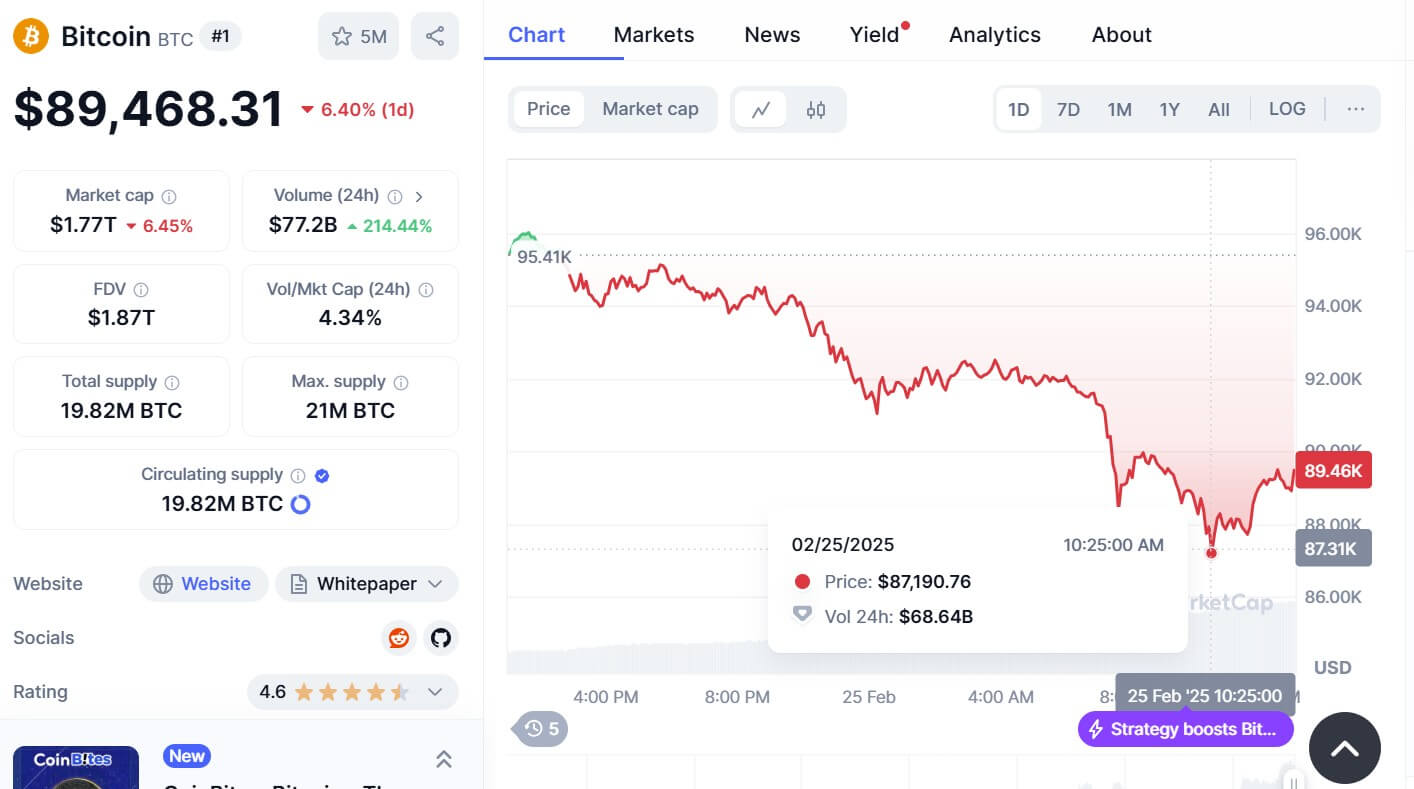
    Bitcoin’s price has dropped below the $90,000 mark, signalling the lowest decline for the number one crypto asset since November 2024.

    Bitcoin’s price at $87,000. Source: CoinMarketCap

    On February 25 at 10:25 UTC, Bitcoin was trading at around $87,190, according to data from CoinMarketCap. At the time of publishing, it has risen slightly but remains under $90,000, a key figure to stay in bullish territory.

    According to Arthur Hayes, BitMEX’s co-founder, Bitcoin could drop to $70,000 if large hedge funds sell their positions in Bitcoin exchange-traded funds (ETFs).

    Impact of Trump’s tariffs

    The drop in value comes amid uncertainty about inflation, US President Donald Trump’s policies, and geopolitical events.

    Yesterday, Trump confirmed 25% trade tariffs on Canada and Mexico, causing the market to react as investors look to other avenues to put their money.

    According to James Toledano, COO at Unity Wallet, many believed that Bitcoin’s price would continue rising once Trump entered the White House, adding to CoinJournal:

    “But the reality is that the price has gone south, likely due to tariff trade wars, fragile peace talks in Eastern Europe, and fears around DeepSeek’s impact on the US tech sector. But this could also just be a momentary lapse of pricing reason.”

    Security breach at Bybit

    Last week, Hong Kong-based crypto exchange Bybit was the target of a major hack, resulting in the loss of nearly $1.5 billion worth of Ethereum from a single wallet.

    Despite Ben Zhou, Bybit’s founder and CEO, saying it had “fully closed the ETH gap,” raising funds to cover the losses and boost investor confidence, the fact remains that investors are shaken.

    Not only that, but neobank Infini suffered a $50 million hack yesterday. According to reports, insider access enabled the hacker to manipulate the platform’s smart contract it had developed after retaining administrative privileges unbeknownst to Infini.

    Following the theft, the hacker converted the stolen USDC into Dai and then purchased 17,696 Ethereum, valued at around $49 million at the time.

    “Additionally, global macroeconomic uncertainty and a downturn in traditional markets have weighed on Bitcoin, as risk assets remain highly sensitive to external pressures,” said Toledano.

    “Note, the S&P 500 which is the bellwether for the equities market is down over 4% over the last month and over 2% this past week alone. While 2 and 4 percentage points mean little in the cryptosphere, these figures are notable in TradFi from a loss perspective.”

    Source link

  • BlackRock’s Bitcoin ETF options brings in nearly $2b in trade on day one

    BlackRock’s Bitcoin ETF options brings in nearly $2b in trade on day one

    • Bitcoin hit a record of more than $94,000 following the launch of options contracts on BlackRock’s IBIT
    • 289,000 contracts were Calls and 65,000 were Puts, meaning investors were bullish on a Bitcoin price rise
    • Joe Constori said the market is bullish that Bitcoin’s price will reach $100,000 by the end of 2024

    Options contracts on BlackRock’s iShares Bitcoin Trust (IBIT) saw “unheard-of” notional exposure levels, helping push Bitcoin to a record of over $94,000.

    Taking to X, Bloomberg ETF analyst James Seyffart, said:

    “Final tally of $IBIT’s 1st day of options is just shy of $1.9 billion in notional exposure traded via 354k contracts. 289k were Calls & 65k were Puts. That’s a ratio of 4.4:1. These options were almost certainly part of the move to the new #Bitcoin all time highs today.”

    Buying calls is bullish as investors only profit if the price of Bitcoin goes up. With the new options contract, investors can speculate on price movements by trading shares at predetermined prices.

    Joe Constori, head of growth at Theya and institutional lead at the Bitcoin Layer, said on X that “TLDR; the market is bullish that Bitcoin’s price ends the year well over $100k.”

    Bloomberg’s senior ETF analyst Eric Balchunas added:

    “$1.9b is unheard of for Day One. For context, $BITO did $363m and that’s been around for four years. And also this is with 25,000 contract position limits.”

    Increasing institutional interest

    The launch of BlackRock’s options contracts comes as institutional interest in Bitcoin rises. With the IBIT options, investors can gain exposure to new avenues of investment while managing their risk through the call and put options without owning the underlying asset.

    In January, the US Securities and Exchange Commission (SEC) approved the first 11 spot Bitcoin exchange-traded fund (ETFs). Since then, the market has grown with BlackRock leading the way.

    At the end of October, BlackRock’s IBIT reached $30 billion in net assets in a record 293 days. Two weeks later, it reached $40 billion in net assets in 211 days, showcasing rising interest in crypto investments.


    Source link

  • Metaplanet partners with SBI VC Trade to enhance Bitcoin strategy

    Metaplanet partners with SBI VC Trade to enhance Bitcoin strategy

    • Japanese investment firm Metaplanet has announced a partnership with SBI VC Trade, a subsidiary of financial services behemoth SBI Group.
    • Partnership will help boost Metaplanet’s Bitcoin strategy, including compliance.
    • Metaplanet has acquired 360 Bitcoin (BTC) as it targets becoming ‘Asia’s MicroStrategy’

    In an announcement on Sept. 2, Metaplanet said its collaboration with SBI VC Trade is part of the company’s quest to enhance its Bitcoin strategy with support from Japan-based firms. This includes trading, custody and management of Metaplanet’s Bitcoins.

    Metaplanet is a publicly-traded company listed on the Tokyo Stock Exchange and the partnership with the SBI crypto arm offers a route to further compliance.

    “A key element of this partnership is access to a compliant corporate custody service that prioritizes tax efficiency and offers the potential to utilize Bitcoin as collateral for financing,” Metaplanet said in a statement.

    The alliance with SBI VC Trade aligns with Metaplanet’s vision of becoming a leading modern financial services firm. It also adds flexibility to Metaplanet’s corporate strategy, bolstering its efforts to accumulate more BTC via equity and debt financing.

    Metaplanet will update its stakeholders of any financial o material impact that arises from the partnership, part of the statement read.

    BTC as a corporate strategy

    The partnership with SBI VC Trade comes amid Metaplanet’s increasing bet on Bitcoin as part of its corporate strategy. In April 2024, the company disclosed its addition of BTC as a core treasury asset and committed an initial 1 billion Japanese yen to buying Bitcoin.

    Over the next months, the strategic pivot has seen the industry dub Metaplanet as “Asia’s MicroStrategy” in a nod to its target to mirror the US-listed MicroStrategy’s embrace of the digital asset.

    Currently, the Michael Saylor-led company has acquired a total of 226,500 BTC. This accounts for just over 1% of the total supply of Bitcoin and makes MicroStrategy the largest holder of BTC among publicly-traded companies.

    On the other hand, Metaplanet holds a total of 360 BTC, having increased its holdings with a series of purchases over the past two months.

    Source link

  • M2 crypto exchange to allow UAE residents to trade crypto using bank accounts

    M2 crypto exchange to allow UAE residents to trade crypto using bank accounts

    M2 crypto exchange to allow UAE residents to trade crypto using bank accounts
    • M2 enables UAE residents to trade BTC and ETH directly with bank accounts.
    • Integration supports dirham deposits, withdrawals, and market-responsive trading.
    • UAE has strict regulations to ensure consumer protection and market transparency.

    In a significant development for the digital asset market in the United Arab Emirates (UAE), M2, a prominent crypto exchange, has announced that UAE residents can now buy and sell Bitcoin (BTC) and Ethereum (ETH) directly using their bank accounts.

    This new integration facilitates the direct conversion of UAE dirhams into BTC and ETH through M2’s spot market, marking a milestone in the accessibility of virtual assets in the region.

    M2 users can seamlessly convert dirhams into BTC and ETH and vice versa

    In an announcement shared with Cointelegraph, the M2 exchange highlighted that the new feature will enable users to convert dirhams into Bitcoin and Ether seamlessly through the trading pairs listed on M2’s spot markets.

    Additionally, the platform supports the deposit and withdrawal of dirhams, offering users greater flexibility in managing their assets.

    The M2 team emphasized that this integration would enable users to “swiftly adapt to market changes,” allowing them to easily convert their local currency into crypto.

    This is particularly beneficial for everyday investors who may not be fully immersed in the complexities of the trading environment.

    According to M2, the higher levels of familiarity and significant trading volumes of BTC and ETH make these cryptocurrencies ideal entry points for new investors looking to enter the digital asset space.

    UAE has the strictest regulatory framework globally

    Regulated by the UAE government, which is known for its stringent consumer protection measures, this move reflects the country’s commitment to safeguarding its residents in the evolving crypto landscape.

    The UAE has established a reputation for having one of the strictest regulatory frameworks globally, prioritizing consumer protection. In 2022, Dubai’s Virtual Asset Regulatory Authority (VARA) mandated greater transparency in crypto advertisements to better protect consumers.

    Moreover, in 2023, the UAE introduced a federal law aimed at preventing fraud in the crypto market, imposing fines of up to 10 million AED ($2.7 million) for violations.

    Commenting on the integration, Kimmel, an executive at M2, noted that the ADGM’s licensing process was demanding due to its high standards for multilateral trading facility permits. However, he affirmed that this rigorous due diligence ensures that licensed platforms meet the country’s security and transparency standards, thereby fostering trust among UAE users.

    Despite the challenges associated with the licensing process, the UAE continues to be a strategic region for the crypto industry.

    Favourable tax policies, access to global markets, and a safe environment for innovation make the UAE an attractive destination for crypto businesses.

    This new development by M2 is set to further enhance the accessibility and appeal of virtual assets in the UAE, making it easier for residents to participate in the burgeoning crypto market.

    Source link