Tag: trades

  • Bitcoin trades near $119K after new all-time high; Coinbase rebrands wallet to ‘Base App’

    Bitcoin trades near $119K after new all-time high; Coinbase rebrands wallet to ‘Base App’

    Bitcoin trades near $119K after new all-time high; Coinbase rebrands wallet to 'Base App'

    Bitcoin is holding steady above the $118,800 mark as the market digests its recent powerful rally to a new all-time high of over $122,000.

    While on-chain data now indicates that the first wave of heavy profit-taking has begun, particularly among short-term holders sitting on significant gains, some analysts believe that historical patterns still suggest room for another push higher, though they are also warning that “overheating” signals are beginning to flash.

    In a recent report, on-chain analytics firm Glassnode highlighted that “short-term holders are now sitting on significant unrealized profits,” a condition that is pushing key indicators “towards overheated territory.”

    The Short-Term Holder Relative Unrealized Profit metric recently hit 15.4%, breaching a key statistical threshold (+1 standard deviation) before cooling slightly. Historically, this level “often marks the beginning of top formation,” according to Glassnode.

    The firm also pointed to the Realized Profit to Loss Ratio, which recently spiked to a staggering 39.8, “well above the +2 standard deviation threshold,” signaling a period of intense profit-taking from successful traders.

    Although this ratio has since declined to a more moderate 7.3, the elevated reading remains consistent with behavior typically seen in the late stages of a bull market.

    “So far, both the Percent of Spent Volume in Profit and the Realized Profit to Loss Ratio have signaled the first wave of excessive profit-taking,” the report concluded.

    While this doesn’t necessarily mark a definitive market top, Glassnode cautions that “such top formations tend to unfold across multiple waves,” with the next major resistance level for Bitcoin projected to be around the $130,000 mark.

    The great rotation: traders move into altcoins

    As Bitcoin’s near-term upside appears increasingly constrained by this profit-taking pressure, some traders are beginning to rotate their capital into major altcoins.

    Ethereum (ETH) surged an impressive 7.5% in the past 24 hours, outpacing Bitcoin and breaking out of a recent consolidation phase.

    Analysts have pointed to the recent advancement of the GENIUS Act, a stablecoin regulation bill, as a potential catalyst for ETH’s strong performance.

    Solana (SOL) also saw a significant jump, up 5%, buoyed by fresh on-chain data showing that Galaxy Digital had accumulated $55 million worth of SOL within a tight two-hour window, withdrawing the tokens from multiple centralized exchanges.

    This rotation into major altcoins like ETH and SOL suggests that while Bitcoin’s broader market structure remains intact, traders are seeking opportunities for higher returns in other parts of the crypto ecosystem.

    Coinbase’s big rebrand: from ‘Wallet’ to ‘Base App’

    In a significant development for the broader crypto ecosystem, Coinbase has officially rebranded its popular Wallet product as the ‘Base App’.

    This move confirms speculation that had been swirling since the company scrubbed its X profile earlier this week.

    The rebranding positions the app as a central gateway into the burgeoning Base ecosystem, which is now being pitched as a full-stack, on-chain platform designed for mainstream adoption.

    The rebrand was officially announced during Coinbase’s “A New Day One” event, which also unveiled a broader vision for the Base ecosystem, now built around three key pillars: the existing Layer-2 network, Base Chain; a new developer toolkit suite dubbed Base Build; and the newly launched Base App.

    Unlike its predecessor, the Coinbase Wallet, the new Base App is designed to be much more than just a place to store crypto.

    It will integrate chat functionalities, payments, trading, and a mini-app marketplace that supports a wide range of social and financial experiences.

    This is not Coinbase’s first attempt at a wallet makeover (long-time crypto users will remember its original wallet, “Toshi”), but it is arguably its most ambitious.

    With the Base ecosystem increasingly distancing itself from the parent Coinbase brand, the new app appears designed to emphasize Base’s distinct identity as a more decentralized, open ecosystem—one that is anchored in the core values of crypto but packaged in a user-friendly way for the everyday consumer.

    Source link

  • Bitcoin trades near $109K amid low conviction; Trump Media files for diversified crypto ETF

    Bitcoin trades near $109K amid low conviction; Trump Media files for diversified crypto ETF

    Bitcoin trades near $109K amid low conviction; Trump Media files for diversified crypto ETF

    Bitcoin continues to trade in a narrow range as the Asian trading day begins on Wednesday, with the world’s largest digital asset changing hands above $108,900.

    This period of consolidation comes as market observers point to a lack of strong conviction, even as a new filing reveals plans from Trump Media & Technology Group to launch a diversified ‘Crypto Blue Chip ETF’.

    Bitcoin is holding its ground, and the CoinDesk 20 index, a broad measure of the largest digital assets, is up 1.7% to over 3,100, according to CoinDesk market data.

    However, the current price action feels more like a drift than a decisive rally.

    According to market observers, what separates Bitcoin’s current position from a sustained push past the $110,000 mark is a lack of clear market conviction.

    In a recent report, on-chain analytics firm Glassnode highlighted several indicators of this hesitancy.

    Spot trading volumes for Bitcoin continue to linger below their usual statistical bands, and inflows into spot Bitcoin ETFs have contracted sharply from their recent highs.

    Furthermore, institutional investors appear cautious, despite sitting on significant unrealized gains, as shown by elevated ETF Market Value to Realized Value (MVRV) ratios.

    Trading firm Wintermute, in a market update from earlier this week, described this environment as a “barbell market.”

    They pointed to a stark divide between renewed enthusiasm in high-beta, high-risk assets like memecoins, and a preference for the stability of established large-cap tokens like Bitcoin and Ethereum.

    Notably, last year’s “narrative darlings,” such as AI and DePIN (Decentralized Physical Infrastructure Networks) tokens, have lost investor attention.

    This suggests that traders are either rotating into the speculative frenzy of memecoins—many of the major ones like DOGE, SHIB, and PEPE are up over 8% in the last week—or they are staying put in the perceived safety of BTC and ETH, which are seen as battle-tested and secure.

    With global equity markets largely shrugging off recent geopolitical uncertainties, Bitcoin’s current hesitancy underscores a lingering caution among crypto traders.

    The market seems to be awaiting a clearer directional signal before making a decisive move higher, and things are likely to remain range-bound until that catalyst appears.

    Trump Media’s crypto gambit: the ‘Blue Chip ETF’

    Adding a new dimension to the crypto investment landscape, Trump Media & Technology Group (DJT) has revealed plans to launch another exchange-traded fund (ETF), this one designed to hold more than just Bitcoin and Ether.

    The Truth Social parent company, founded by President Donald Trump, filed on Tuesday to create the “Truth Social Crypto Blue Chip ETF.”

    According to the filing, the proposed fund would be composed of 70% Bitcoin and 15% Ether, complemented by an 8% allocation to Solana, 5% to Cronos, and 2% to XRP.

    The filing stated that the proposed fund would trade on the New York Stock Exchange’s Arca platform, a popular venue for ETFs.

    This news follows a move by Trump Media last month to file for two other ETFs: one that would invest 75% of its assets in Bitcoin and the remainder in Ether, and another that would be comprised solely of Bitcoin.

    In all three instances, Trump Media has indicated that the launches would happen “later this year.” Back in March, Crypto.com announced that it would partner with Trump Media to offer these ETFs.

    This series of filings underscores Trump Media’s deepening commitment to the digital asset space, following its announcement in May of a plan to raise $2.5 billion to purchase Bitcoin for its corporate treasury.

    As of the latest market data, Bitcoin was trading just below $109,000, while Ether was changing hands above $2,600.

    The other components of the proposed ETF, Solana, Cronos, and XRP, were trading at about $151, 10 cents, and $2.30, respectively.

    Shares of Trump Media (DJT) rose close to 3% on Tuesday following the filing, though they remain down more than 40% for the year 2025.

    Source link

  • BTC trades stably near $105.5K; institutional ETF inflows reached $2.2B last week

    BTC trades stably near $105.5K; institutional ETF inflows reached $2.2B last week

    BTC trades stably near $105.5K; institutional ETF inflows reached $2.2B last week

    Bitcoin (BTC) is trading steadily above the $105,500 mark as the Asian trading day gets underway on Wednesday.

    This comes after a slight correction from the $107,000 level it held during US business hours.

    Despite the significant geopolitical upheaval of the past few weeks, including a US strike on Iran that surprised both geopolitical experts and prediction market bettors, Bitcoin has once again demonstrated its resilience as a store of value.

    CoinDesk market data shows that the asset class has remained remarkably stable over the last month, up a modest 1%.

    A disciplined climb: HODLers stand firm

    However, this return to a price point that is within striking distance of Bitcoin’s all-time high of nearly $111,000 (hit in May) feels different this time, according to market observers.

    It’s characterized by a sense of discipline rather than the euphoria that often accompanies bull runs.

    Unlike the breakout above $100,000 in December 2024, which triggered a significant wave of profit-taking, long-term investors now appear content to sit on their unrealized gains.

    This observation is supported by analysis from Glassnode in their weekly note.

    “HODLing appears to be the dominant market mechanic,” the Glassnode analysts wrote.

    They pointed to a surge in the supply held by long-term holders, which has now reached 14.7 million BTC, coupled with historically low levels of realized profits.

    This on-chain activity strongly indicates a limited desire to sell, even as Bitcoin trades just below its record highs.

    Further reinforcing this narrative of restraint, metrics such as the adjusted Spent Output Profit Ratio (aSOPR) are hovering just above the breakeven point, according to Glassnode.

    This suggests that the coins currently being spent are, for the most part, recent acquisitions involved in tactical trades rather than representing a broad distribution or sell-off by long-term holders.

    Meanwhile, Glassnode data also shows that the “Liveliness” metric continues to decline, a clear sign that older, long-held coins remain dormant in their wallets.

    The institutional undercurrent: steady demand meets rising leverage

    This patience from seasoned investors is being met with persistent institutional demand.

    In its daily markets update, trading firm QCP highlighted this trend, noting that market data indicates a substantial $2.2 billion in net inflows into spot Bitcoin ETFs just last week.

    QCP described the overall tone of these flows as “constructive” and pointed out that dedicated crypto treasury companies such as Strategy and Metaplanet continue to accumulate Bitcoin.

    These steady institutional inflows are quietly but fundamentally reshaping the market’s structure.

    Bitcoin’s realized cap—a metric that measures the price at which coins last moved on-chain—has grown to an impressive $955 billion.

    This growth is widely seen as a sign that real, committed capital, not just fleeting speculation, is flowing into the asset.

    A fragile equilibrium: the standoff in the market

    However, not everything is calm beneath the surface. QCP’s report also noted that leveraged long positions have been on the rise, with funding rates turning positive across major perpetual futures markets.

    This indicates that short-term traders are increasingly using leverage to bet on further price increases.

    Glassnode, in its analysis, warns that this situation may not be sustainable indefinitely. “The market may need to move higher, or lower, to unlock additional supply,” the firm wrote, suggesting that the current equilibrium between the unwavering conviction of long-term holders and the increasing leverage of short-term traders won’t hold forever.

    Even major political news, such as the US Senate’s approval of the White House’s “Big Beautiful Bill,” has failed to produce a significant price reaction from Bitcoin.

    This has led to a market that feels less like a stampeding bull run and more like a tense standoff. On one side are the long-term holders who are refusing to sell, and on the other are the short-term traders piling into leveraged positions.

    This fragile equilibrium has market observers on the edge of their seats, wondering where the next major catalyst will come from and whether it will make Bitcoin’s next move an explosive one.

    Source link

  • BTC trades near $107,500 as market awaits $15B+ options expiry

    BTC trades near $107,500 as market awaits $15B+ options expiry

    Bitcoin holds above $107K ahead of major quarterly options expiry

    • Bitcoin (BTC) held steady above $107,500 ahead of a major options expiry on Friday.
    • 38% of Deribit’s $40B in BTC options open interest will expire, with a “max pain” price of $102,000.
    • Bitcoin’s implied volatility has dropped from 50% in April to 38%, signaling increased market confidence.

    Bitcoin traded within a narrow range during US hours on Thursday, holding steady above the $107,000 mark as traders positioned themselves ahead of a significant quarterly options expiry scheduled for Friday.

    While the broader crypto market saw slight declines, Bitcoin’s stability belied the underlying tension of a massive volume of derivatives contracts nearing their conclusion.

    The top cryptocurrency was last changing hands around $107,500, down a negligible 0.2% over the past 24 hours.

    In contrast, the CoinDesk 20—an index tracking the top 20 digital assets excluding stablecoins, exchange coins, and some memecoins—lost 0.9% during the same period, indicating some weakness in the altcoin market.

    Market participants are keenly focused on Friday’s event, which is set to be one of the largest options expiries of the year.

    “This Friday marks one of the largest option expiries of the year on Deribit,” Jean-David PĂ©quignot, chief commercial officer at the popular derivatives exchange Deribit, told CoinDesk.

    He noted that the total open interest for Bitcoin options currently stands at a staggering $40 billion, and a substantial 38% of these contracts are set to expire on Friday.

    A key metric that traders are watching is the “max pain” price, which is the strike price at which the largest number of options (both puts and calls) would expire worthless, theoretically causing the maximum financial loss for option holders.

    “Max pain price for Friday is at $102,000, with a put/call ratio of 0.73,” PĂ©quignot said. This suggests a potential gravitational pull towards the $102,000 level as the expiry approaches.

    Volatility eases, but caution remains

    Despite the looming expiry, market volatility has shown signs of calming down.

    Bitcoin’s implied volatility, as measured by the Deribit DVOL index, has dropped to 38% from the 50% levels seen during a wild April.

    According to PĂ©quignot, this could signal that “the market is increasingly confident in the cryptocurrency’s macro-hedge role.”

    However, an analysis of put-call skews reveals no clear directional bias among traders in the short term, indicating a state of market neutrality.

    PĂ©quignot emphasized that the $105,000 level for Bitcoin is pivotal from a technical standpoint, suggesting that “technicals suggest caution if support fails.”

    He also noted that “low open interest in perps [perpetual futures] and fairly depressed Bitcoin implied volatility and skew are indicative of limited expectations for sharp price movements going into Friday’s expiry.”

    Crypto stocks show divergent performance

    In the equity markets, several crypto-related stocks managed to post gains on Thursday.

    Core Scientific (CORZ) was a standout performer, surging more than 33% following a report from The Wall Street Journal suggesting that the Bitcoin miner may soon be acquired by AI Hyperscaler CoreWeave (CRWV).

    Other notable gainers included Circle (CRCL), Coinbase (COIN), Riot Platforms (RIOT), and Hut 8 (HUT), which were all higher by 5%-7%. In contrast, Strategy (MSTR) was down nearly 1%.

    While stablecoins like USDT and USDC have been dominating US headlines recently, thanks to the GENIUS Act and Circle’s (CRCL) blockbuster IPO, a quieter but equally significant strategic adoption of these assets is reshaping cross-border finance in Asia.

    Behind the scenes, stablecoins are already playing an important role in the region’s financial plumbing.

    Asian banks are increasingly viewing stablecoins not just as a speculative asset class, but as a defensive tool to guard against potential deposit flight and to protect against lost transaction revenue.

    Amy Zhang, Head of Asia at Fireblocks, explained in a recent interview with CoinDesk that major banks across Korea, Japan, and Hong Kong are proactively exploring the creation of their own local-currency stablecoins to mitigate these emerging threats.

    “If I’m not one of the banks banking Circle or banking Tether, am I going to lose deposits?” Zhang told CoinDesk, articulating the core concern driving this exploration.

    “That’s a huge risk for banks.”

    This strategic consideration highlights a deeper, more utility-focused integration of digital assets that is unfolding in the East, often away from the glare of Western market speculation.

    Source link

  • Bitcoin trades near $105K amid low volatility; analysts offer mixed outlooks

    Bitcoin trades near $105K amid low volatility; analysts offer mixed outlooks

    Bitcoin trades near $105K amid low volatility; analysts offer mixed outlooks

    • Bitcoin (BTC) trades around $104.5K, down 2% weekly, amid market uncertainty and Mideast tension fears.
    • CryptoQuant warns BTC could revisit $92K or $81K if demand keeps falling.
    • Glassnode sees “quiet” blockchain as network maturation, with institutions driving large-value transfers.

    Bitcoin (BTC) is trading steadily above the $104,500 mark as the Asian trading week gets into full swing.

    Despite the ominous backdrop of a potential looming war in the Middle East, the leading cryptocurrency has remained relatively flat on the day with negligible price movement.

    In fact, over the past full week, Bitcoin is down only a modest 2%, according to CoinDesk market data.

    This apparent calm, however, is prompting a vigorous debate among market analysts: Is this a sign of underlying strength, or is something more precarious brewing beneath the surface?

    Three new reports released this week from prominent crypto analytics firms CryptoQuant and Glassnode, along with trading firm Flowdesk, all paint a similar picture of current surface conditions: low volatility, tight price action, and subdued on-chain activity.

    A notable shift in market dynamics is also evident, with retail participation reportedly waning while institutional players—ranging from Bitcoin ETF investors to large “whale” holders—are increasingly shaping the structure of market flows.

    It is CryptoQuant, however, that is sounding the most urgent cautionary note.

    In its June 19 report, the firm argued that Bitcoin could soon revisit the $92,000 support level, or potentially fall as low as $81,000, if current trends of deteriorating demand continue.

    According to CryptoQuant, while spot demand for Bitcoin is still increasing, it is doing so at a rate well below its established trend. Inflows into Bitcoin ETFs have reportedly dropped by more than 60% since April, and whale accumulation has halved during the same period.

    Furthermore, short-term holders, who are typically newer market participants, have shed approximately 800,000 BTC since late May.

    CryptoQuant’s demand momentum indicator, which tracks directional buying strength across key investor cohorts, is now reading a negative 2 million BTC – the lowest level ever recorded in the firm’s dataset.

    Glassnode’s counterpoint: a maturing network, not weakness

    Glassnode, while acknowledging similar on-chain signals, arrives at a far less dire conclusion.

    In its weekly on-chain update, the firm concedes that the Bitcoin blockchain is currently “quiet,” meaning that transaction counts are down, network fees are minimal, and miner revenue is subdued.

    However, Glassnode posits that this may not necessarily indicate weakness but could instead be a reflection of the network’s ongoing evolution.

    They point out that on-chain settlement volume remains high but is increasingly concentrated in large-value transfers.

    This suggests that the Bitcoin blockchain is progressively being utilized by institutions and whales for significant transactions, rather than for smaller, everyday retail activity.

    Furthermore, Glassnode notes that the derivatives market now dwarfs on-chain activity, with futures and options volumes regularly exceeding spot market volumes by a factor of 7 to 16 times.

    This shift, they argue, has brought with it more sophisticated hedging strategies, better collateral management practices, and an overall more mature, albeit less frenetic, market structure.

    The rise of crypto treasury companies: a new financial engineering?

    Adding another layer to the evolving market structure, a new report from Presto Research argues that Crypto Treasury Companies (CTCs)—such as Michael Saylor’s MicroStrategy (now Strategy) and Japan’s Metaplanet—are more than just leveraged Bitcoin ETFs.

    Presto suggests they represent a new form of financial engineering that may carry less risk than many investors assume.

    Strategy’s latest capital raise, which secured nearly $1 billion via perpetual preferred shares, demonstrates how Bitcoin’s inherent volatility can be leveraged to an issuer’s advantage.

    These securities, along with convertible bonds and at-the-market equity sales, allow CTCs to fund aggressive crypto accumulation strategies without triggering the margin risks typically associated with leveraged positions.

    Presto points out that Strategy’s Bitcoin holdings are unpledged, and Metaplanet’s bonds are unsecured.

    This means that collateral liquidation—the primary trigger for past crypto industry blowups like Celsius and Three Arrows Capital—is largely absent in these structures.

    While this doesn’t eliminate risk entirely, it fundamentally changes its nature.

    The real challenge for CTCs, Presto argues, is not the crypto exposure itself but the discipline required to manage dilution, cash flow, and capital timing effectively.

    Metaplanet’s “bitcoin yield” metric, which measures BTC per fully diluted share, reflects this crucial focus on delivering shareholder value.

    As long as CTCs can adeptly manage the financial mechanics underpinning their accumulation strategies, Presto believes they will continue to earn Net Asset Value (NAV) premiums, similar to high-growth companies in traditional markets.

    However, if they miscalculate, the very tools that fuel their ascent could just as easily accelerate their fall.

    Source link

  • Bitcoin trades around $105K amid Middle East tensions: what’s next?

    Bitcoin trades around $105K amid Middle East tensions: what’s next?

    Bitcoin trades around $105K amid Middle East tensions; options skew negative

    • Bitcoin (BTC) trades around $105K, stuck in a range due to Israel-Iran conflict uncertainty.
    • BTC options show decisive flip to puts, signaling heightened investor anxiety and downside hedging.
    • Despite near-term jitters, Bitcoin’s current cycle gain of 656% is impressive given its larger market cap.

    Bitcoin (BTC) is trading around the $105,000 mark as the Asian trading week gets underway, caught in a holding pattern as market participants grapple with uncertainty over whether the Israel-Iran conflict will escalate into a broader regional war.

    While near-term sentiment is dominated by geopolitical anxieties and signs of market “overheating,” longer-term perspectives and discussions around potential network upgrades offer a more nuanced picture for the leading cryptocurrency.

    The current market stasis, with Bitcoin seemingly “stuck in this range,” is largely attributed to the precarious geopolitical situation, according to a recent note from trading firm QCP Capital.

    In a Friday note published on Telegram, QCP highlighted that risk reversals have “flipped decisively.”

    This means front-end BTC put options (which protect against price drops) are now commanding premiums of up to 5 volatility points over equivalent call options (which bet on price increases).

    This is a clear indicator of heightened investor anxiety and an increased demand for hedging against potential downside risks.

    Despite this defensive shift in options market positioning, QCP noted that Bitcoin has demonstrated notable resilience.

    Even amid recent volatility, which saw over $1 billion in long positions liquidated across major crypto assets, on-chain data reportedly shows that institutional buying continues to provide meaningful support for prices.

    Nevertheless, QCP emphasized that markets remain “stuck in a bind,” awaiting clarity on geopolitical outcomes, and warned that the digital asset complex will likely remain tightly linked to headline-driven sentiment shifts for the foreseeable future.

    Adding to the near-term caution, a separate report from on-chain analytics firm CryptoQuant (as referenced in a related context, though not directly quoted in this specific source text) has suggested that certain metrics indicate the BTC market is “overheating.”

    This includes surging demand approaching previous peaks and a slowing pace of accumulation by large “whale” holders.

    These indicators suggest the recent rally, which pushed prices to a record near $112,000, might be nearing a short-term consolidation point, with $120,000 identified as a key resistance.

    Long-term perspective: cycle gains and maturation

    While recent volatility underscores short-term anxiety, data from Glassnode offers some reassurance for investors concerned about Bitcoin’s longer-term direction.

    Bitcoin’s current cycle gain stands at an impressive 656%.

    While this is lower than the returns seen in previous bull markets (1076% in 2015–2018 and 1007% in 2018–2022), it is arguably more notable given Bitcoin’s significantly larger market capitalization today.

    This suggests that investor demand is still keeping pace reasonably well with BTC’s maturation as an asset class, even as near-term macroeconomic jitters dominate current market sentiment.

    Beyond ‘spam’: the OP_Return debate and Bitcoin’s evolution

    Shifting focus to network-level discussions, Alex Thorn of Galaxy Research, in a recent note, addressed the sometimes contentious debate around OP_Return (a Bitcoin protocol feature allowing small amounts of arbitrary data on the blockchain).

    Thorn suggested that the furor over this feature was largely driven by a “loud but small group of critics” and that their reactions, characterized by “wild accusations of the ‘death of Bitcoin’,” were misplaced given the historically low levels of mempool congestion (the queue of unconfirmed transactions).

    On-chain data indicates that the mempool is virtually empty compared to a year ago.

    This counters the narrative prevalent in 2023 that a congested blockchain was suffocating Bitcoin, a notion that now appears significantly overstated.

    Thorn further highlighted the irony of labeling arbitrary data as “spam,” reminding observers that Bitcoin’s pseudonymous creator, Satoshi Nakamoto, famously embedded arbitrary text—the “chancellor on brink of second bailout” headline—in the blockchain’s very first (genesis) block.

    Instead of focusing on such debates, Thorn argued that the Bitcoin community’s attention would be better directed towards potential network upgrades like CheckTemplateVerify (CTV).

    CTV is a proposed opcode that would enable more sophisticated and strict spending conditions, often referred to as “covenants.”

    “We continue to believe [CTV] is a conservative but powerful opcode that would greatly enhance the ability to build better, safer methods of custody,” Thorn wrote.

    He also noted that around 20% of Bitcoin’s hashrate has already signaled support for this upgrade.

    Bitcoin upgrades are known to require extensive consensus-building within the community, a reflection of its open-source and decentralized ethos.

    Thorn emphasized that this cautious, deliberate approach to evolution remains critical for ensuring Bitcoin’s broader adoption and scalability in the long run.

    Source link

  • BTC trades at $109.7K after weekend surge; Ethereum’s Pectra upgrade boosts institutional staking

    BTC trades at $109.7K after weekend surge; Ethereum’s Pectra upgrade boosts institutional staking

    BTC trades at $109.7K after weekend surge; Ethereum's Pectra upgrade boosts institutional staking

    • Bitcoin (BTC) trades near $110K (at $109.7K), challenging recent “summer stagnation” predictions after a 3.26% weekend surge.
    • QCP Capital noted BTC was “stuck in a tight range,” with signs of fatigue like softening open interest and tapering ETF inflows.
    • Bitcoin’s breakout coincides with US-China trade talks and a $22B US Treasury bond auction, injecting market uncertainty.

    Bitcoin (BTC) is currently trading just shy of the $110,000 mark, changing hands at around $109,700 as the Asian trading week continues.

    This upward momentum challenges a prevailing market narrative that had anticipated a period of summer stagnation, and it comes even as analysts point to underlying signs of market fatigue.

    Meanwhile, developments in the Ethereum ecosystem suggest a significant shift towards institutional adoption, particularly in staking.

    Bitcoin’s surprise move: breaking out of the “tight range”

    The recent price action for Bitcoin has caught some market watchers by surprise. Over the weekend, the leading cryptocurrency surged 3.26%, climbing from $105,393 to $108,801.

    This move was accompanied by a significant spike in hourly volume, reaching 2.5 times the 24-hour average, according to CoinDesk Research’s technical analysis model.

    Bitcoin decisively broke above the $106,500 level, establishing new support at $107,600, and continued its ascent into Monday’s session, briefly touching $110,169.

    This rally comes on the heels of a recent note from QCP Capital which had emphasized suppressed volatility and a lack of immediate catalysts for a major price move.

    QCP’s Telegram note had pointed to one-year lows in implied volatility and a pattern of subdued price action, stating that BTC had been “stuck in a tight range” as summer approached.

    They suggested that a clean break below $100,000 or above $110,000 would be necessary to “reawaken broader market interest.”

    Even with this breakout, QCP had warned that recent macroeconomic developments had failed to spark strong directional conviction.

    “Even as US equities rallied and gold sold off in the wake of Friday’s stronger-than-expected jobs report, BTC remained conspicuously unmoved, caught in the cross-currents without a clear macro anchor,” the note stated.

    “Without a compelling narrative to spark the next leg higher, signs of fatigue are emerging. Perpetual open interest is softening, and spot BTC ETF inflows have started to taper.”

    This context makes Bitcoin’s current push towards $110,000 all the more noteworthy.

    The breakout also coincides with a tense macroeconomic backdrop, including ongoing US-China trade talks in London and a significant $22 billion US Treasury bond auction later this week, both of which have injected uncertainty into global markets.

    While these events could drive fresh volatility, QCP cautioned that recent headlines have mostly led to “knee-jerk reactions” that quickly fade.

    The pressing question now is whether Bitcoin’s move above $110,000 has genuine staying power or if the rally is running ahead of its underlying fundamentals.

    Ethereum’s institutional awakening: staking takes center stage

    While Bitcoin navigates its price dynamics, Ethereum (ETH) is experiencing a potentially transformative shift, with signs pointing towards accelerating institutional adoption, particularly in the realm of staking.

    Critics of Ethereum have often highlighted centralization risks within its ecosystem, but this narrative is reportedly fading as institutional infrastructure matures and recent protocol upgrades directly address past limitations.

    “Market participants will pay for decentralization because it’s in their economic interest from a security and principal protection standpoint,” Mara Schmiedt, CEO of institutional Ethereum staking platform Alluvial, told CoinDesk.

    “If you look at [decentralization metrics] all of these things have massively improved over the last couple of years.”

    Alluvial co-founded Liquid Collective, a protocol designed to facilitate institutional staking, which currently has $492 million worth of ETH staked.

    While this figure may seem modest compared to Ethereum’s total staked volume of around $93 billion, its significance lies in the fact that it originates predominantly from institutional investors.

    “We’re really on the cusp of a truly massive shift for Ethereum, driven by regulatory momentum and the ability to unlock the advantages of secure staking,” Schmiedt noted, highlighting a pivotal moment for the second-largest cryptocurrency.

    Central to Ethereum’s increasing institutional readiness is the recent Pectra upgrade, a development Schmiedt described as both “massive” and “underappreciated.”

    “I think Pectra has been a massive upgrade. I actually think it’s been underappreciated, just in terms of the tremendous amount of change it introduces into the staking mechanics,” Schmiedt said.

    A key component of Pectra, Execution Layer (EL) triggerable withdrawals, provides a crucial compatibility upgrade for institutional participants, including Exchange Traded Fund (ETF) issuers.

    This feature enables partial validator exits directly from Ethereum’s execution layer, aligning with institutional operational requirements such as T+1 redemption timelines.

    “EL triggerable withdrawals create a much more effective path to exit for large-scale market participants,” Schmiedt added.

    Ultimately, she expressed strong confidence in Ethereum’s institutional appeal, stating, “I think we’ll see that a lot more [ETH] in institutional portfolios going forward.”

    Source link

  • Bitcoin trades near $107K despite national guard deployment in Los Angeles

    Bitcoin trades near $107K despite national guard deployment in Los Angeles

    BTC price holds steady above $106K amid US domestic tensions, eyes $107K resistance

    • Bitcoin (BTC) climbed towards $107K over the weekend, trading around $106,332 despite U.S. domestic unrest.
    • President Trump deployed 2,000 National Guard troops to Los Angeles amid an immigration-related standoff.
    • BTC showed strong support at $105,400 and broke resistance around $106,100 with strong volume.

    Bitcoin (BTC) continued its steady ascent over the weekend, trading above $105,623.12 and pushing towards the $107,000 mark, even as domestic tensions escalated in the United States, notably in Los Angeles.

    The cryptocurrency market appeared largely unfazed by the unsettling headlines, showcasing a degree of resilience that underscores its growing perception as a hedge against uncertainty.

    The backdrop to Bitcoin’s steady performance was a significant immigration-related standoff in Los Angeles.

    According to a report by CNBC, the situation saw over 100 arrests as clashes persisted between protesters and federal agents.

    This prompted President Trump to authorize the deployment of 2,000 National Guard troops to the area.

    By Sunday morning, elements of the 79th Infantry Brigade had arrived on-site, as confirmed by Northern Command.

    The potential for further escalation was highlighted by Defense Secretary Pete Hegseth, who warned that US Marines stationed at Camp Pendleton could also be mobilized if the violence continued.

    Despite these significant domestic developments, Bitcoin’s price action remained remarkably stable, hovering around $106,332 by Sunday.

    This suggests that crypto investors are, for now, treating the unrest as a localized regional event rather than a systemic crisis capable of derailing the digital asset market.

    Technical picture: consolidation with bullish undertones

    Bitcoin traded within a relatively narrow range over the weekend, fluctuating approximately $1,057 between a low of $105,043 and a high of $106,101, before pushing to its current level around $106,332.

    The price demonstrated a strong rebound after a brief dip below $105,100, with buying interest re-emerging robustly around the $105,400 support level, according to CoinDesk Research’s technical analysis model.

    An early attempt to break out above the $106,100 mark encountered selling pressure, which created a high-volume resistance zone.

    While this upward move was initially short-lived due to some profit-taking, Bitcoin managed to hold onto its gains.

    The overall consolidation structure remains bullish, with a consistent pattern of higher lows hinting at the potential for a sustained push towards the $107,000 level, should the immediate resistance break cleanly.

    This tendency for Bitcoin to attract buyers during dips, despite broader macroeconomic headwinds, further underscores its perceived role as a hedge in times of rising uncertainty.

    Key technical levels and market dynamics

    A closer look at the technical indicators provides further insight into Bitcoin’s recent price action and potential near-term movements:

    • Trading range: BTC traded within a $1,288 range (representing 1.22% of its value) between a low of $105,043.65 and a 24-hour high of $106,332.

    • Resistance break: Initial resistance observed around the 105,900–106,100 zone was decisively broken as prices surged beyond this area with strong trading volume during the early afternoon.

    • Support holds: The support level at $105,400 held firm despite several retests, reinforcing the prevailing bullish sentiment in the market.

    • Breakout and stabilization: A clear breakout to $106,332 occurred around 13:48, which was followed by minor profit-taking activity before the price stabilized above the $106,000 mark.

    • Ascending trend: The hourly chart reveals an ascending trend characterized by consistent higher lows, a pattern that invalidates earlier interpretations of a “pump and dump” scenario.

    • Next target: With current momentum intact, market analysts suggest that BTC may test the $107,000 resistance level, provided that the current support near $105,800 continues to hold.

    This technical picture, combined with Bitcoin’s apparent decoupling from localized domestic strife, paints a cautiously optimistic outlook for the leading cryptocurrency as it navigates a complex global landscape.

    Source link

  • Bitcoin hits $54,900 as BlackRock’s IBIT trades $1B

    Bitcoin hits $54,900 as BlackRock’s IBIT trades $1B

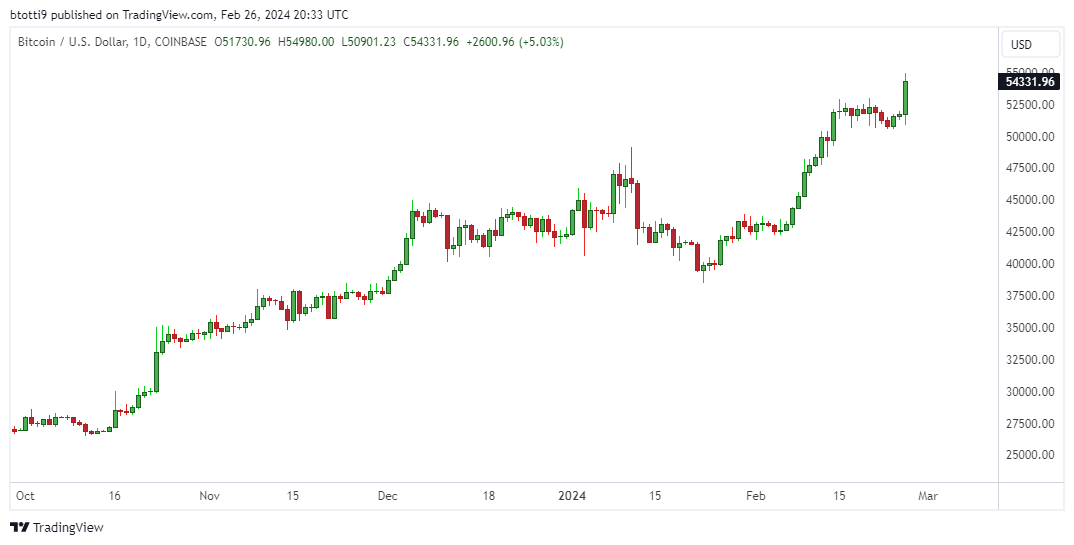
    • Bitcoin hits $54,900 for first time since 2021 as BlackRock’s IBIT trades $1 billion shares.
    • BTC price is rising amid analyst predictions for a halving explosion.

    Bitcoin is eyeing a pre-halving breakout as its price jumped above $54,900 for the first time since early December 2021.

    On crypto exchange Coinbase, Bitcoin price reached highs of $54,980. The more than 6% gains pushed the benchmark cryptocurrency’s market cap to over $1.06 trillion.

    BTC breaks above $54k as IBIT trades $1 billion ETF shares

    In the ETF market, BlackRock’s iShares Bitcoin Trust ($IBIT) traded over $1 billion and analysts are saying the momentum is set to fuel further gains for BTC price. Bloomberg ETF analyst shared that the performance ranked $IBIT 11th amongst all ETFs.

    “MILESTONE $IBIT has traded $1b worth of shares today so far.. which ranks it 11th among all ETFs (Top 0.3%) and Top 25 among stocks. Insane number for newbie ETF (esp one w ten competitors). $1b/day is big boy level volume, enough for (even big) institutional consideration,” Balchunas posted on X.

    According to entrepreneur and investor Anthony Pompliano, “Bitcoin is a runaway train with no brakes for as long as ETF inflows dwarf the bitcoin produced by the network.”

    With the Bitcoin halving coming up, this number of BTC mined will be halved, creating a supply shock that could catapult BTC price to prices very few imagined a few years back.

    With the countdown to Bitcoin halving roughly 52 days out, the breakout performance for BTC on Monday has the market buzzing.

    Earlier in the day, Bitcoin price broke above $53k as MicroStrategy announced it had acquired an additional 3,000 BTC. Purchased for $155 million, the fresh buy saw the company’s Bitcoin portfolio hit 193,000 BTC.

    Michael Saylor revealed that the company bought bitcoin at the average price of $51,813.

    Bitcoin traded around $54,331 at 3.30 pm ET on Monday.


    Source link