Tag: upgrade

  • Mantle targets new ATH after hitting $1.77 amid ZK rollup upgrade

    Mantle targets new ATH after hitting $1.77 amid ZK rollup upgrade

    Mantle Price New Peak

    • Mantle surged by 15% to reach a record high of $1.77.
    • The total value locked exceeded $2 billion, making Mantle the largest ZK rollup by TVL.
    • Mantle’s transaction volumes also soared, with hundreds of thousands of daily transactions.

    Mantle Network’s native token, MNT, surged to a record all-time high of $1.77 on September 17, 2025, driven by the successful completion of its mainnet upgrade to a zero-knowledge (ZK) rollup architecture in a landmark development for Ethereum’s Layer 2 ecosystem.

    This price gain comes as other cryptocurrencies like PancakeSwap and Filecoin also edge higher.

    Mantle completes ZK rollup upgrade

    Mantle’s transition from an optimistic rollup to a full ZK rollup represents a pivotal evolution in its infrastructure with the upgrade, enabling the network to generate validity proofs for state transitions without disclosing underlying data, thereby bolstering security and reducing reliance on fraud-proof challenges.

    This shift addresses longstanding limitations of optimistic models, where transactions assume validity until contested, potentially delaying finality.

    “With today’s mainnet upgrade, the journey is complete: Mantle is now the world’s largest ZK rollup by TVL, with over $2 billion secured by Succinct’s technology,” said Edward Li, growth and business development lead at Succinct.

    Mantle’s total value locked (TVL) stood at approximately $218 million prior to the upgrade as  post-implementation having ballooned to over $2 billion, cementing its status as the world’s largest ZK rollup by this metric.

    By incorporating EigenLayer’s , Mantle ensures robust decentralization without overburdening the base chain, a hybrid approach that has drawn praise from developers seeking EVM-compatible environments.

    Mantle price outlook and token performance

    The announcement catalyzed an immediate price rally for Mantle, with MNT climbing over 15% to breach its previous peak of $1.68 set last month.

    According to trading data from major exchanges like Binance and Coinbase, MNT’s market capitalization surpassed $5.4 billion, ranking it among the top 30 cryptocurrencies.

    Analysts have also related the price surge to a number of factors, like renewed institutional interest in ZK technologies amid Ethereum’s Dencun upgrade.

    Mantle’s ecosystem incentives, including yield-bearing stablecoins like mETH and upcoming products such as crypto index funds, also boosted price.

    Mantle price chart by TradingView

    Looking at Mantle’s price chart, the cryptocurrency trades around $1.64, slightly lower than the $1.77 all-time high.

    Selling pressure contributed to the decline in MNT price.

    However, bulls are targeting a new ATH amid a bull flag pattern as Mantle’s ZK framework unlocks cross-rollup interoperability.

    With over 5.86 million active accounts already, predictions suggest total value locked could double by year-end, driven by partnerships with EigenLayer and Succinct.

    Nonetheless broader market challenges might persist, including competition from established ZK players like Polygon zkEVM and potential regulatory scrutiny on restaking mechanisms.

    In this case, the price levels to watch could include $1.40 and $1.09.

    Source link

  • BTC trades at $109.7K after weekend surge; Ethereum’s Pectra upgrade boosts institutional staking

    BTC trades at $109.7K after weekend surge; Ethereum’s Pectra upgrade boosts institutional staking

    BTC trades at $109.7K after weekend surge; Ethereum's Pectra upgrade boosts institutional staking

    • Bitcoin (BTC) trades near $110K (at $109.7K), challenging recent “summer stagnation” predictions after a 3.26% weekend surge.
    • QCP Capital noted BTC was “stuck in a tight range,” with signs of fatigue like softening open interest and tapering ETF inflows.
    • Bitcoin’s breakout coincides with US-China trade talks and a $22B US Treasury bond auction, injecting market uncertainty.

    Bitcoin (BTC) is currently trading just shy of the $110,000 mark, changing hands at around $109,700 as the Asian trading week continues.

    This upward momentum challenges a prevailing market narrative that had anticipated a period of summer stagnation, and it comes even as analysts point to underlying signs of market fatigue.

    Meanwhile, developments in the Ethereum ecosystem suggest a significant shift towards institutional adoption, particularly in staking.

    Bitcoin’s surprise move: breaking out of the “tight range”

    The recent price action for Bitcoin has caught some market watchers by surprise. Over the weekend, the leading cryptocurrency surged 3.26%, climbing from $105,393 to $108,801.

    This move was accompanied by a significant spike in hourly volume, reaching 2.5 times the 24-hour average, according to CoinDesk Research’s technical analysis model.

    Bitcoin decisively broke above the $106,500 level, establishing new support at $107,600, and continued its ascent into Monday’s session, briefly touching $110,169.

    This rally comes on the heels of a recent note from QCP Capital which had emphasized suppressed volatility and a lack of immediate catalysts for a major price move.

    QCP’s Telegram note had pointed to one-year lows in implied volatility and a pattern of subdued price action, stating that BTC had been “stuck in a tight range” as summer approached.

    They suggested that a clean break below $100,000 or above $110,000 would be necessary to “reawaken broader market interest.”

    Even with this breakout, QCP had warned that recent macroeconomic developments had failed to spark strong directional conviction.

    “Even as US equities rallied and gold sold off in the wake of Friday’s stronger-than-expected jobs report, BTC remained conspicuously unmoved, caught in the cross-currents without a clear macro anchor,” the note stated.

    “Without a compelling narrative to spark the next leg higher, signs of fatigue are emerging. Perpetual open interest is softening, and spot BTC ETF inflows have started to taper.”

    This context makes Bitcoin’s current push towards $110,000 all the more noteworthy.

    The breakout also coincides with a tense macroeconomic backdrop, including ongoing US-China trade talks in London and a significant $22 billion US Treasury bond auction later this week, both of which have injected uncertainty into global markets.

    While these events could drive fresh volatility, QCP cautioned that recent headlines have mostly led to “knee-jerk reactions” that quickly fade.

    The pressing question now is whether Bitcoin’s move above $110,000 has genuine staying power or if the rally is running ahead of its underlying fundamentals.

    Ethereum’s institutional awakening: staking takes center stage

    While Bitcoin navigates its price dynamics, Ethereum (ETH) is experiencing a potentially transformative shift, with signs pointing towards accelerating institutional adoption, particularly in the realm of staking.

    Critics of Ethereum have often highlighted centralization risks within its ecosystem, but this narrative is reportedly fading as institutional infrastructure matures and recent protocol upgrades directly address past limitations.

    “Market participants will pay for decentralization because it’s in their economic interest from a security and principal protection standpoint,” Mara Schmiedt, CEO of institutional Ethereum staking platform Alluvial, told CoinDesk.

    “If you look at [decentralization metrics] all of these things have massively improved over the last couple of years.”

    Alluvial co-founded Liquid Collective, a protocol designed to facilitate institutional staking, which currently has $492 million worth of ETH staked.

    While this figure may seem modest compared to Ethereum’s total staked volume of around $93 billion, its significance lies in the fact that it originates predominantly from institutional investors.

    “We’re really on the cusp of a truly massive shift for Ethereum, driven by regulatory momentum and the ability to unlock the advantages of secure staking,” Schmiedt noted, highlighting a pivotal moment for the second-largest cryptocurrency.

    Central to Ethereum’s increasing institutional readiness is the recent Pectra upgrade, a development Schmiedt described as both “massive” and “underappreciated.”

    “I think Pectra has been a massive upgrade. I actually think it’s been underappreciated, just in terms of the tremendous amount of change it introduces into the staking mechanics,” Schmiedt said.

    A key component of Pectra, Execution Layer (EL) triggerable withdrawals, provides a crucial compatibility upgrade for institutional participants, including Exchange Traded Fund (ETF) issuers.

    This feature enables partial validator exits directly from Ethereum’s execution layer, aligning with institutional operational requirements such as T+1 redemption timelines.

    “EL triggerable withdrawals create a much more effective path to exit for large-scale market participants,” Schmiedt added.

    Ultimately, she expressed strong confidence in Ethereum’s institutional appeal, stating, “I think we’ll see that a lot more [ETH] in institutional portfolios going forward.”

    Source link

  • Stacks (STX) prepares for Nakamoto upgrade: here’s what to expect

    Stacks (STX) prepares for Nakamoto upgrade: here’s what to expect

    Stacks (STX) prepares for Nakamoto upgrade: here’s what to expect

    Stacks, the largest Bitcoin layer-2 network, is on the verge of a transformative upgrade known as Nakamoto. As the Nakamoto upgrade approaches, Stacks’ native token, STX, currently trading at $1.80, is up 68% from its August lows.

    Scheduled to begin this week, the Nakamoto upgrade promises to be a pivotal event for the platform, heralding significant changes in transaction efficiency and expanding use cases.

    Stacks Nakamoto upgrade

    The Stacks Nakamoto upgrade is set to drastically reduce average transaction times from 10 minutes to mere seconds.

    Such a leap in efficiency opens the door to a range of new applications, including the creation and utilization of liquid stacking tokens. These tokens can now be seamlessly integrated into Decentralized Finance (DeFi) platforms, allowing users to deposit, borrow, and leverage liquidity with greater ease.

    In addition to improved transaction speeds, the Nakamoto upgrade will introduce sBTC, a new asset pegged 1:1 to Bitcoin.

    Unlike wrapped Bitcoin (wBTC), which relies on a central custodian, sBTC aims to provide a decentralized alternative. This enhancement promises increased censorship resistance, cost efficiency, and robust security features.

    By simplifying Bitcoin’s use in DeFi, non-fungible tokens (NFTs), and gaming, sBTC is expected to differentiate itself from existing solutions and attract more creators to the ecosystem.

    The anticipated upgrade is not only poised to revolutionize transaction processes but also to bolster the DeFi and NFT sectors within the Stacks network.

    As developers roll out the Nakamoto upgrade, the Stacks is likely to see increased adoption and innovation, positioning it as a significant player in the evolving landscape of Bitcoin layer-2 solutions.


    Source link

  • can Bedrock upgrade trigger fresh optimism?

    can Bedrock upgrade trigger fresh optimism?

    • The Bedrock upgrade could be a major positive for Optimism, boosting the price of OP.
    • Increased adoption of Optimism could see further demand for OP, helping its price.
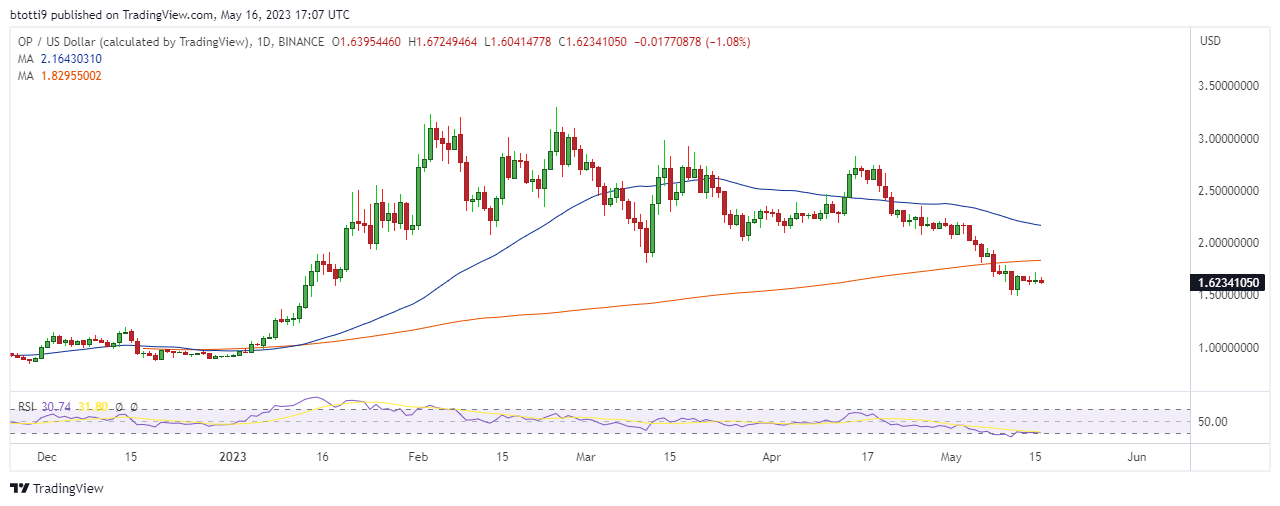
    • OP price was down 3% in the past 24 hours and 23% in the past two weeks as the token traded near $1.63 at the time of writing.

    Optimism (OP), a Layer 2 scaling solution for Ethereum, has seen the price of its native token fall by 23% so far in May (as of 16 May, 2023).

    The decline comes amid a broader sell-off in the cryptocurrency market, with Bitcoin (BTC) struggling for a foothold above $27,000 and Ethereum (ETH) retesting support areas near $1,800.

    Sentiment across the broader crypto market continues to lean bearish after last week’s downturn. Optimism price could therefore fluctuate with overall market outlook, particularly as cryptocurrencies are likely to react to macroeconomic news.

    But one thing that could aid an uptick in positivity for the altcoin’s price is the upcoming Bedrock upgrade.

    Optimism price outlook- when is the Bedrock upgrade?

    On Monday, the L2 platform announced the expected release date for the launch as 6 June 2023.

    Bedrock is a major upgrade to the Optimism network that will make it faster, cheaper, and more secure.

    Among the things to come with the Bedrock upgrade are network improvements to the effect of full EVM compatibility, higher scalability and reduced transaction fees.

    Optimism (OP) price prediction

    Looking at OP price, it’s down nearly 3% in the past 24 hours, 23% in the past two weeks and nearly 39% in the past 30 days. 

    As CoinJournal recently highlighted in a price prediction for Optimism, Tron and Stacks, it appears the bears have the upper hand. This outlook remains with the current price at $1.63 being -49% from the all-time high of $3.22 reached on 24 February 2023.

    OP price chart. Source: TradingView

    While price reaction to the confirmation wasn’t great, a flip in sentiment over the next two weeks could see OP/USD take a new leg to the upside.

    Again, a successful upgrade could help boost the price of OP, with Optimism becoming a more attractive option for developers and users and increasing demand for the OP token. OP is currently oversold, but faces key resistances around $1.82 and $2.16.

    On the downside, especially if the bearish technical picture holds, the token’s price could fall to $1.15 and $0.87.


    Source link

  • Optimism token OP hits all-time high Bedrock upgrade news

    Optimism token OP hits all-time high Bedrock upgrade news

    • OP has rallied over 30% in the past 24 hours, reaching a new all-time high of $2.97 on Coinbase
    • Optimism is outperforming major coins even as cryptocurrencies rally on Thursday.
    • Gains for Optimism comes amid buying pressure after news of an upgrade proposal planned for activation on 15 March.

    Optimism is rallying again as excitement around the Ethereum layer 2 scaling solution increased following a major news announcement.

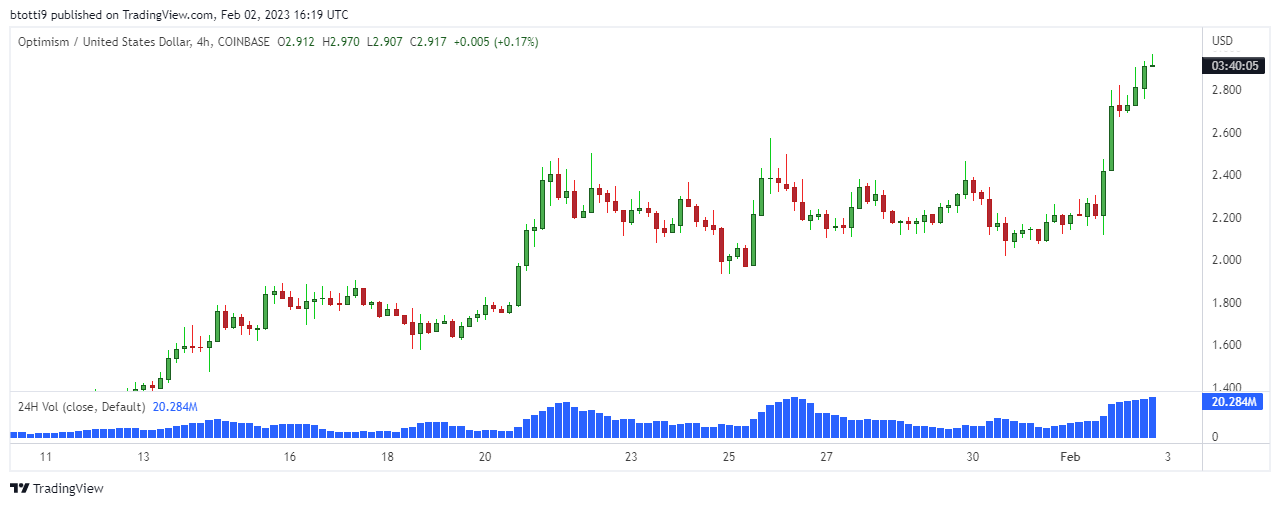
    As shown on the 4-hour chart below, OP reached a new all-time high of $2.97 on Coinbase. As of 11:20 am ET on 2 February, the platform’s native token OP was trading at $2.91, still up by more than 32% in the past 24 hours.

    Chart showing Optimism price rally to new all-time high on Coinbase. Source: TradingView.According to data from CoinGecko, the OP token price is up 205% in the past 30 days, outshing major coins. About 75% of the gains have come in the past two weeks as platform’s market capitalization steadily rose to currently stand around $625 million.

    Why OP token price is surging

    Optimism’s gains in the past few hours have come as buying pressure ramped up ahead of what promises to be groundbreaking network upgrade.

    On Wednesday, the Optimism Foundation released a proposal seeking to deploy an upgrade to the protocol’s mainnet. According to the proposal, the upgrade targets improving network performance via the Optimism Collective: Bedrock.

    It is the first major upgrade to the Optimism protocol and brings a rollups architecture to the protocol, with  transaction batching one of the main features highlighting the huge impact the upgrade could have for the blockchain’s performance.

    This upgrade offers a new level of modularity, simplicity, and Ethereum equivalence for Layer 2 solutions, providing unprecedented performance and functionality,” the Optimism Foundation wrote.

    Improvements set to be added via the Bedrock release include reduced transaction fees, high throughput and improved sync speeds.

    According to the team, the upgrade will not impact most users as the Optimism mainnet is “already EVM-equivalent.” However, some users including those running full and archive nodes have to take action in preparation for the upgrade.

    The Bedrock proposal is expected to go through a two-week voting period, with deployment to the mainnet scheduled for 15 March if it passes.


    Source link