Tag: Volatility

  • Kiyosaki defends Bitcoin and warns Wall Street as crypto volatility returns

    Kiyosaki defends Bitcoin and warns Wall Street as crypto volatility returns

    Kiyosaki defends Bitcoin and warns Wall Street as crypto volatility returns

    • Kiyosaki accused Wall Street of promoting paper assets that benefit insiders.
    • He said gold, silver, and Bitcoin provide value outside institutional control.
    • His Bitcoin forecast puts the price at $250,000 by 2026.

    As volatility grips the crypto market again, Rich Dad Poor Dad author Robert Kiyosaki has stepped up in defence of Bitcoin and decentralised assets.

    Amid renewed price swings and public doubt over digital currencies, Kiyosaki argued that Bitcoin remains a hedge against centralised financial systems and inflation.

    He described it as “people’s money,” contrasting it with what he calls “fake money” issued by the US Federal Reserve and Treasury.

    While Warren Buffett’s past criticisms labelling Bitcoin as “gambling” resurfaced online, it was Kiyosaki’s response that reignited debate across financial communities.

    His message was clear: the fault lies not with crypto, but with a broken fiat system that he believes Wall Street continues to uphold.

    Fiat risks and distrust in institutions

    Kiyosaki has long rejected the idea that centralised institutions should be the backbone of wealth.

    In his view, the real danger to investors is not Bitcoin’s volatility, but the ongoing reliance on a system driven by inflation and debt.

    He warned that assets like stocks and bonds, frequently promoted by institutional investors, are just as vulnerable to collapse.

    According to him, the core issue is trust. While traditional markets claim to offer safety, Kiyosaki sees them as tools that enrich the powerful while exposing regular people to risk.

    This, he argues, is why decentralised assets like Bitcoin and Ethereum are gaining ground—they provide financial autonomy in an unstable environment.

    He classifies gold and silver as “God’s money” and Bitcoin as “people’s money,” highlighting their independence from government control and printing presses.

    With Bitcoin capped at 21 million coins, Kiyosaki says it offers protection that fiat currencies simply cannot match.

    Kiyosaki’s challenge to the financial establishment

    As Wall Street continues to sell institutional products, Kiyosaki is urging people to reconsider what really holds value.

    He questioned how long investors can trust paper-based assets in a world where central banks can print currency without limits.

    He emphasised that real-world necessities cannot be replaced with financial abstractions.

    “You cannot live in a paper house, drive using paper fuel, or eat paper food,” he wrote, pointing to the artificial nature of fiat-based wealth.

    By comparison, assets like Bitcoin offer a limited-supply, decentralised alternative that he believes is better suited to survive economic instability.

    Bitcoin prediction and market direction

    Amid the broader market uncertainty, Kiyosaki has also made a bold forecast. He predicts Bitcoin could reach $250,000 by 2026, a significant rise from its current level around $95,600.

    While this projection is speculative, it aligns with his belief that decentralised assets will outperform as trust in fiat continues to erode.

    Though Warren Buffett’s view of Bitcoin as speculative persists, Kiyosaki’s message offers a pointed challenge to the financial status quo.

    His comments reflect a growing shift in investor sentiment, where control, transparency, and scarcity are seen as more valuable than institutional assurance.

    Source link

  • JPMorgan says Bitcoin is undervalued compared to gold as volatility plummets

    JPMorgan says Bitcoin is undervalued compared to gold as volatility plummets

    The report suggests this shift is making Bitcoin more credible, much like traditional assets. It’s solidifying its role as both an investment and a store of value in mainstream markets.

    In fact, corporate treasuries now hold more than 6% of the total Bitcoin supply.

    Publicly traded companies are also gaining exposure by being included in stock indices, which brings in more money without them having to directly trade crypto.

    Following up on that, JPMorgan’s analysis also shows that Bitcoin is undervalued by about $16,000 when you compare it to gold, using models that account for volatility.

    Their report puts an implied price target for Bitcoin at roughly $126,000.

    This suggests there’s a lot of room for the price to grow as the market catches up to Bitcoin’s new stability and its growing role with institutional investors.

    Even though Bitcoin’s price has been resiliently holding above $111,000, this valuation gap means there’s still a lot of potential for it to appreciate further as more people adopt it and its volatility stays low.

    Market dynamics and future outlook

    In their analysis, JPMorgan also points to a shift in market dynamics. Passive capital, which is the money coming from index funds that buy shares in companies holding Bitcoin, is creating a steady demand.

    This helps shield Bitcoin from being driven solely by speculative trading.

    They also noted that the 200-day moving average has been a strong technical support level, which reinforces a long-term bullish outlook even with small, short-term price swings.

    Still, some indicators show that traders are keeping cautious hedging positions in the options markets. This reflects a more short-term bearish sentiment, even though the overall trend remains positive.

    Source link

  • BTC recovers to $107K after weekly volatility; focus shifts to US economic data

    BTC recovers to $107K after weekly volatility; focus shifts to US economic data

    BTC recovers to $107K after weekly volatility; focus shifts to US economic data

    • Bitcoin (BTC) is trading above $107K Thursday, up 0.7%, after a sharp rebound from below $100K earlier in the week.
    • Markets pivoted from “flight-to-safety” on Mideast tensions to a “risk-on in full force” rally.
    • US GDP and unemployment data this week, plus quarterly options/futures expiry, could bring more volatility.

    Bitcoin (BTC) is trading firmly above the $107,000 mark as the Asian trading day gets underway on Thursday, with the broader digital asset market also showing strength.

    This impressive performance comes at the end of a tumultuous week that saw markets swing dramatically from fear over Middle East conflict to a powerful risk-on rally, lifting crypto, tech stocks, and broader market sentiment in tandem.

    Looking back at the week’s events, what began as a sell-off driven by escalating tensions – with Israel and Iran trading rocket fire and a US bombing campaign on Iran’s nuclear facilities – has transformed into a textbook risk-on rally.

    The initial anxiety has given way to a surge in investor confidence, seemingly brushing off the geopolitical dangers that loomed just days ago.

    “War drums fade, risk appetite roars,” wrote the trading firm QCP Capital in its June 25 market note, perfectly capturing the sudden and dramatic shift in mood.

    Traders appeared to have priced in a resolution or simply stopped waiting for one. Instead of flight-to-safety, the move was risk-on in full force.

    This pivot was visible across multiple asset classes.

    US equities surged, oil prices retraced back to their pre-conflict levels, and shares of crypto exchange Coinbase jumped 12% on positive regulatory news.

    For Bitcoin, the strong rebound above $107,000 signals not just relief from the recent tension but a renewed sense of upward momentum, even as savvy investors keep one eye on the macroeconomic calendar and the other on potential global flashpoints.

    Navigating the swings: key data and volatility ahead

    The recent price action has been nothing short of volatile. “It’s been a week of sharp swings in crypto,” commented Gracie Lin, CEO of OKX Singapore.

    Bitcoin dipped below $100,000 earlier in the week when Middle East tensions rattled the markets, but rebounded quickly after news of a ceasefire – now trading just below its all-time high in a sharp reversal.

    Lin points to a series of upcoming US economic data releases, including GDP figures and unemployment claims due later this week, as the next potential catalysts for Bitcoin’s price movement.

    “Recent PMI numbers have held steady, but continued weakness in housing is raising questions about the broader economy,” she said.

    If Thursday’s GDP or unemployment claims come in weaker than expected, bitcoin could benefit as investors look for hedges against traditional market weakness.

    Adding another layer of potential turbulence, the quarterly expiration of Bitcoin futures and options is scheduled for June 27.

    These events often bring increased price swings as traders close out or roll over their positions. “Another bout of volatility is expected,” Lin warned.

    The bigger picture

    While short-term volatility is expected, QCP Capital, in its analysis, is looking beyond the week’s sharp swings to spotlight the structural forces that are driving Bitcoin’s evolution into a recognized macro asset.

    They point to significant institutional momentum, highlighted by events like ProCap’s $386 million BTC purchase and Coinbase’s recent regulatory win under the EU’s MiCA framework.

    “If this accumulation trend persists,” QCP wrote, “bitcoin may not just rival gold as a macro hedge but potentially in total market capitalisation.”

    This suggests a long-term bullish outlook underpinned by growing institutional adoption.

    Still, QCP adds a crucial note of caution: “Geopolitics remains an ever-present undercurrent.”

    While markets have largely shrugged off the recent Israeli strikes, new concerns are mounting over NATO–Russia tensions.

    With Western nations increasing their defense budgets and President Trump set to attend the upcoming NATO summit, the next geopolitical shock may not originate from the Middle East.

    For now, Bitcoin is riding the powerful wave of risk-on enthusiasm.

    But just beneath the surface, the fundamental battle between short-term volatility and long-term conviction, between the fading sound of war drums and the steady rhythm of institutional buying sprees, continues to define this dynamic market.

    Source link

  • Sonic, Four, SPX6900 surge amid market volatility

    Sonic, Four, SPX6900 surge amid market volatility

    • Sonic price rose, and Four, SPX6900, led crypto gains despite market turbulence.
    • Top coins rebound as equities stabilise, signalling renewed investor confidence.
    • SPX6900’s meme coin momentum underscores its volatile yet captivating market presence.

    The cryptocurrency market suffered massive selling over the weekend as Bitcoin dropped amid the US bombing of Iran’s nuclear sites.

    But as BTC looks to bounce, the top gainers among the 100 largest coins by market cap are Sonic, Four, and SPX6900.

    Despite a turbulent weekend marked by sell-offs, broader crypto declines, these tokens are leading the rebound with double-digit gains.

    Sonic trades at $0.28, Four is at $2.57, and SPX at $1.07.

    Crypto investors eye uptick

    Crypto investors are cautiously optimistic as top cryptocurrencies stage a recovery following a weekend sell-off that saw Bitcoin dip below $100,000.

    According to market data, Bitcoin rebounded from $98,286 to $102,852, while Ethereum and Solana also moved above key levels.

    This bounce aligns with equities shrugging off losses, as global markets looked to stabilize despite ongoing geopolitical tensions.

    However, the Fear & Greed Index, which has fallen to 37, suggests a shift from neutral sentiment towards fear.

    Investors are now eyeing whether the uptick in crypto prices can sustain momentum, with altcoins like Sonic, Four, and SPX6900 fueling speculation due to their outsized gains.

    Four, Sonic, SPX6900, trend among top gainers

    Among the top gainers, Four (FORM) posted a modest yet steady 10% increase, reaching $2.57 with a robust 24-hour trading volume of $35.9 million.

    Elsewhere, Sonic (S) traded at approximately $0.27, with the price slightly off the $0.29 seen earlier in the day.

    Sonic price edged 9% surge, bolstered by a 41% rise in trading volume.

    This activity suggests a bullish reversal from its $0.25 support level, with analysts predicting further upside if DEX participation grows.

    Sonic price chart by CoinMarketCap

    SPX6900, a Solana-based meme coin, stole the spotlight with a 10x rally in the past year.

    However, profit taking has it around $1.07 from its all-time peak of $1.77  after a recent 37% plunge in the past week.

    Despite its declines, SPX6900’s $985 million market cap sees it rank in the top 100 and is likely to bounce.

    The coin is up around 6% in the past 24 hours to trade at $1.06.

    If bulls go higher, SPX could break to $2. However, a potential drop to $0.90 and lower remains if support falters.

    Overall, the S, FORM, and SPX tokens’ performances underscore the dynamic interplay of technical strength and speculative fervor driving the crypto market today.

    As markets navigate ongoing uncertainty, Sonic, Four, and SPX6900 exemplify the high-risk, high-reward nature of cryptocurrencies.

    Source link

  • Bitcoin trades near $105K amid low volatility; analysts offer mixed outlooks

    Bitcoin trades near $105K amid low volatility; analysts offer mixed outlooks

    Bitcoin trades near $105K amid low volatility; analysts offer mixed outlooks

    • Bitcoin (BTC) trades around $104.5K, down 2% weekly, amid market uncertainty and Mideast tension fears.
    • CryptoQuant warns BTC could revisit $92K or $81K if demand keeps falling.
    • Glassnode sees “quiet” blockchain as network maturation, with institutions driving large-value transfers.

    Bitcoin (BTC) is trading steadily above the $104,500 mark as the Asian trading week gets into full swing.

    Despite the ominous backdrop of a potential looming war in the Middle East, the leading cryptocurrency has remained relatively flat on the day with negligible price movement.

    In fact, over the past full week, Bitcoin is down only a modest 2%, according to CoinDesk market data.

    This apparent calm, however, is prompting a vigorous debate among market analysts: Is this a sign of underlying strength, or is something more precarious brewing beneath the surface?

    Three new reports released this week from prominent crypto analytics firms CryptoQuant and Glassnode, along with trading firm Flowdesk, all paint a similar picture of current surface conditions: low volatility, tight price action, and subdued on-chain activity.

    A notable shift in market dynamics is also evident, with retail participation reportedly waning while institutional players—ranging from Bitcoin ETF investors to large “whale” holders—are increasingly shaping the structure of market flows.

    It is CryptoQuant, however, that is sounding the most urgent cautionary note.

    In its June 19 report, the firm argued that Bitcoin could soon revisit the $92,000 support level, or potentially fall as low as $81,000, if current trends of deteriorating demand continue.

    According to CryptoQuant, while spot demand for Bitcoin is still increasing, it is doing so at a rate well below its established trend. Inflows into Bitcoin ETFs have reportedly dropped by more than 60% since April, and whale accumulation has halved during the same period.

    Furthermore, short-term holders, who are typically newer market participants, have shed approximately 800,000 BTC since late May.

    CryptoQuant’s demand momentum indicator, which tracks directional buying strength across key investor cohorts, is now reading a negative 2 million BTC – the lowest level ever recorded in the firm’s dataset.

    Glassnode’s counterpoint: a maturing network, not weakness

    Glassnode, while acknowledging similar on-chain signals, arrives at a far less dire conclusion.

    In its weekly on-chain update, the firm concedes that the Bitcoin blockchain is currently “quiet,” meaning that transaction counts are down, network fees are minimal, and miner revenue is subdued.

    However, Glassnode posits that this may not necessarily indicate weakness but could instead be a reflection of the network’s ongoing evolution.

    They point out that on-chain settlement volume remains high but is increasingly concentrated in large-value transfers.

    This suggests that the Bitcoin blockchain is progressively being utilized by institutions and whales for significant transactions, rather than for smaller, everyday retail activity.

    Furthermore, Glassnode notes that the derivatives market now dwarfs on-chain activity, with futures and options volumes regularly exceeding spot market volumes by a factor of 7 to 16 times.

    This shift, they argue, has brought with it more sophisticated hedging strategies, better collateral management practices, and an overall more mature, albeit less frenetic, market structure.

    The rise of crypto treasury companies: a new financial engineering?

    Adding another layer to the evolving market structure, a new report from Presto Research argues that Crypto Treasury Companies (CTCs)—such as Michael Saylor’s MicroStrategy (now Strategy) and Japan’s Metaplanet—are more than just leveraged Bitcoin ETFs.

    Presto suggests they represent a new form of financial engineering that may carry less risk than many investors assume.

    Strategy’s latest capital raise, which secured nearly $1 billion via perpetual preferred shares, demonstrates how Bitcoin’s inherent volatility can be leveraged to an issuer’s advantage.

    These securities, along with convertible bonds and at-the-market equity sales, allow CTCs to fund aggressive crypto accumulation strategies without triggering the margin risks typically associated with leveraged positions.

    Presto points out that Strategy’s Bitcoin holdings are unpledged, and Metaplanet’s bonds are unsecured.

    This means that collateral liquidation—the primary trigger for past crypto industry blowups like Celsius and Three Arrows Capital—is largely absent in these structures.

    While this doesn’t eliminate risk entirely, it fundamentally changes its nature.

    The real challenge for CTCs, Presto argues, is not the crypto exposure itself but the discipline required to manage dilution, cash flow, and capital timing effectively.

    Metaplanet’s “bitcoin yield” metric, which measures BTC per fully diluted share, reflects this crucial focus on delivering shareholder value.

    As long as CTCs can adeptly manage the financial mechanics underpinning their accumulation strategies, Presto believes they will continue to earn Net Asset Value (NAV) premiums, similar to high-growth companies in traditional markets.

    However, if they miscalculate, the very tools that fuel their ascent could just as easily accelerate their fall.

    Source link

  • Bitcoin traders brace for FOMC meeting as volatility looms

    Bitcoin traders brace for FOMC meeting as volatility looms

    • FOMC expected to hold rates at 4.25%–4.50%, CME tool shows 95.6% odds.
    • Swissblock flags $97K–$98.5K as key resistance zone.
    • Powell’s comments could tilt Bitcoin towards breakout or correction.

    Bitcoin is trading just below $94,000 as investors prepare for Wednesday’s Federal Open Market Committee (FOMC) meeting and Jerome Powell’s post-meeting press conference.

    Source: CoinMarketCap

    The Fed is widely expected to keep its benchmark interest rate steady at 4.25%–4.50%, with CME FedWatch Tool data showing a 95.6% probability of a rate hold.

    Despite this consensus, traders are bracing for volatility triggered by Powell’s comments on the economic outlook, inflation, and rate trajectory, which could sway risk sentiment across digital assets.

    Market participants are especially focused on forward guidance, as recent economic data and geopolitical tensions have clouded expectations for rate cuts later this year.

    Trading volume dips, ETF inflows slow ahead of Fed event

    Bitcoin’s recent sideways movement reflects a cautious market mood.

    ETF inflows have cooled, and leverage appears to be winding down as traders await clarity.

    Analysts at Swissblock describe the environment as a “battle of resistance” and note that high open interest and negative funding rates point to intensified bearish bets.

    They flag the $97,000–$98,500 range as a critical resistance zone.

    A break above could trigger short liquidations, but a failed rally might trap bullish traders if momentum fades.

    Liquidation data also supports this tension. As price hovers within a tight range, derivatives traders appear to be betting on a volatile move in either direction.

    Risk appetite has cooled, but significant positioning remains open, suggesting market participants are preparing for a breakout or breakdown, depending on Powell’s tone.

    Powell’s guidance could determine market direction

    While no change in rates is expected this week, traders are looking for hints on the Fed’s stance for June and beyond.

    In previous meetings, Powell’s words have caused major swings in crypto markets.

    December 2023 saw a hawkish turn that led to a broad sell-off in risk assets, and some fear that a repeat could materialise if Powell signals further tightening or ignores recent signs of economic slowdown.

    Market sentiment has been dampened by soft GDP data and renewed trade tensions with China.

    The impact of President Donald Trump’s recent tariff rhetoric has raised concerns that rate cuts previously expected in June may now be delayed.

    Veteran trader Mathew Dixon noted that expectations for a June cut have already flipped to a hold, further pressuring sentiment.

    Gold’s recent rally is also seen as a sign of risk-off positioning. According to analysts, this suggests investors are hedging against potential shocks from the Fed’s announcement.

    Bitcoin price action hinges on macro signals

    Bitcoin is currently consolidating near local support as traders weigh macroeconomic uncertainty.

    Degens, or high-risk crypto traders, are reportedly building long positions, anticipating a price move.

    However, some analysts warn that market makers may push prices lower to trigger stop losses before a potential upside.

    Swissblock’s analysis supports this view, suggesting that any breakout could be preceded by a final liquidity sweep.

    Historical data offers mixed signals. Three of the last five FOMC announcements have coincided with Bitcoin rallies, but this week’s event is clouded by more complex macro conditions.

    The unresolved US-China tensions, weaker consumer demand, and political pressure around inflation all weigh heavily on market sentiment.

    BitMEX co-founder Arthur Hayes has previously argued that a shift back to quantitative easing could ignite a parabolic Bitcoin rally.

    But in the absence of dovish signals, Bitcoin could retest recent lows in a sharp pullback.

    With no clear catalyst either way, the market remains delicately balanced, awaiting Powell’s next move.

    Source link

  • Bitcoin network difficulty reaches record high amid price volatility

    Bitcoin network difficulty reaches record high amid price volatility

    Bitcoin network difficulty reaches record high amid price volatility
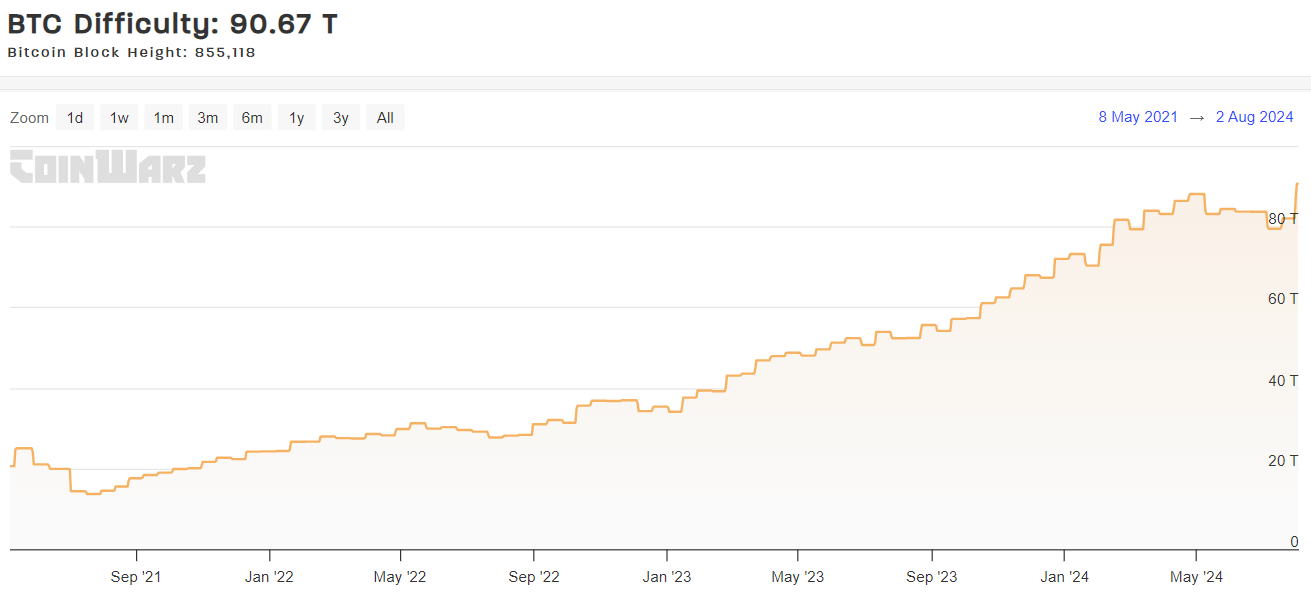
    • Bitcoin’s network difficulty hits a record high of 90.67 trillion as of August 2, 2024.
    • Bitcoin’s hash rate reached a record 677 EH/s on July 27th, boosting network security.
    • Bitcoin’s RSI at 44 suggests potentially oversold conditions; the price may test $58,000

    Bitcoin has set a new record for network difficulty, reaching 90.67 trillion on August 2, 2024 according to data on CoinWarz.

    This milestone represents a significant rebound following three months of declining difficulty, signalling renewed confidence among miners in the cryptocurrency’s network.

    The increased difficulty implies that mining new Bitcoin blocks now requires more computational power, potentially driving up operational costs and influencing Bitcoin’s future supply and pricing dynamics.

    Bitcoin’s hashrate also hit an all-time high

    On July 27th, Bitcoin’s hashrate surged to a record 677 EH/s, reflecting a robust and secure network infrastructure. This peak suggests intensified competition among miners and strengthens the network’s resilience against potential security threats.

    A high hashrate not only indicates increased mining activity but also has the potential to positively impact Bitcoin’s price by boosting investor confidence.

    BTC price under increased bear pressure

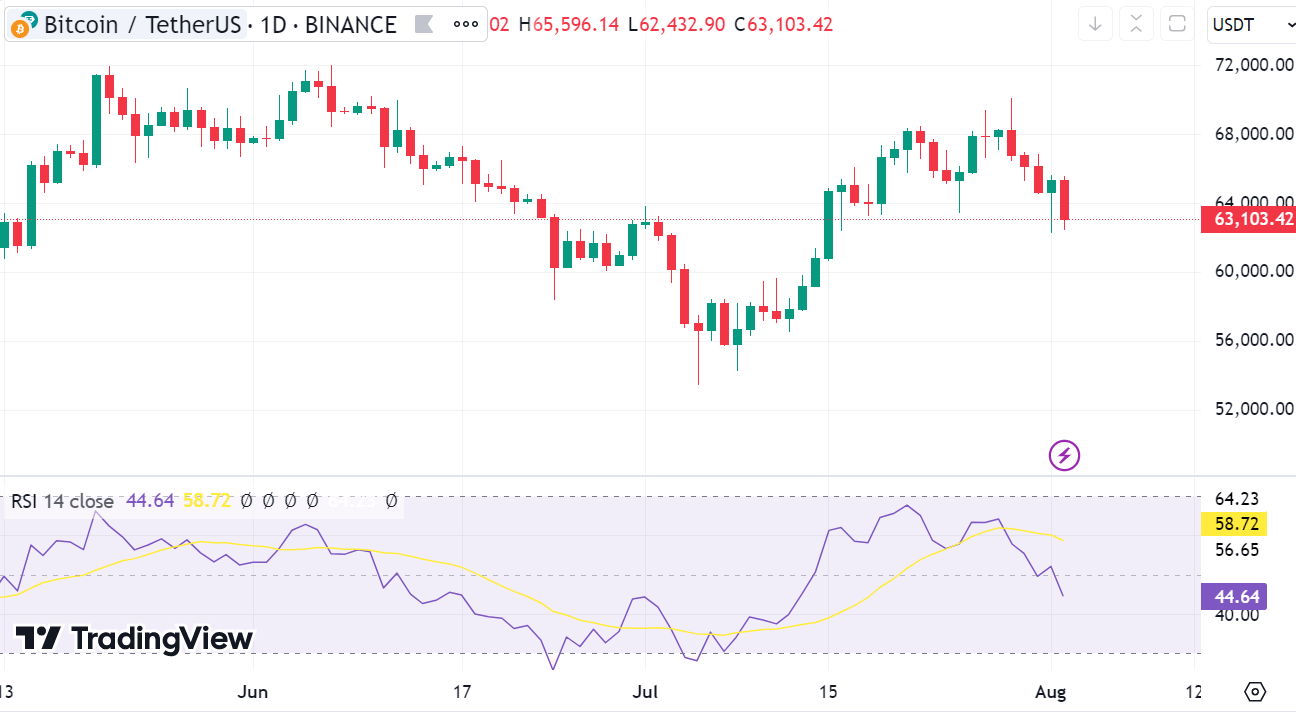
    Currently, Bitcoin is trading at $63,103.42, showing a 0.17% increase over the past 24 hours. The cryptocurrency has been fluctuating between $62,248 and $65,593, suggesting a mild recovery trajectory despite recent volatility.

    If this trend continues, Bitcoin may avoid the $62,000 resistance level, potentially paving the way for new highs.

    However, the Relative Strength Index (RSI) for Bitcoin is at 44.64, indicating that the cryptocurrency is approaching oversold conditions.

    Bitcoin price

    A declining RSI points to diminishing bullish momentum, and if bearish forces intensify, Bitcoin might test its next support level at $58,000. Further declines could follow if market pressure persists.

    Overall, Bitcoin’s rising network difficulty and hashrate highlight a strengthened and competitive mining environment. These factors are essential for evaluating the network’s health and security as Bitcoin navigates through ongoing price volatility.

    Source link

  • BTC hovers at $30k amid lowest historical volatility for 2023

    BTC hovers at $30k amid lowest historical volatility for 2023

    • BTC price is near the $30k mark, which bulls may be desperate to protect.
    • Bitcoin’s  historical volatility is at its lowest level in 2023.
    • Short-term bullish target could be above $34k, while major support is near $28.2k.

    Bitcoin’s price remains above $30,000 on Monday, but is seeing “remarkably little volatility.” According to a key technical analysis indicator for this measure, the prices are tightly squeezed to suggest a breakout in either direction could be big.

    Bitcoin price outlook: Bollinger Bands

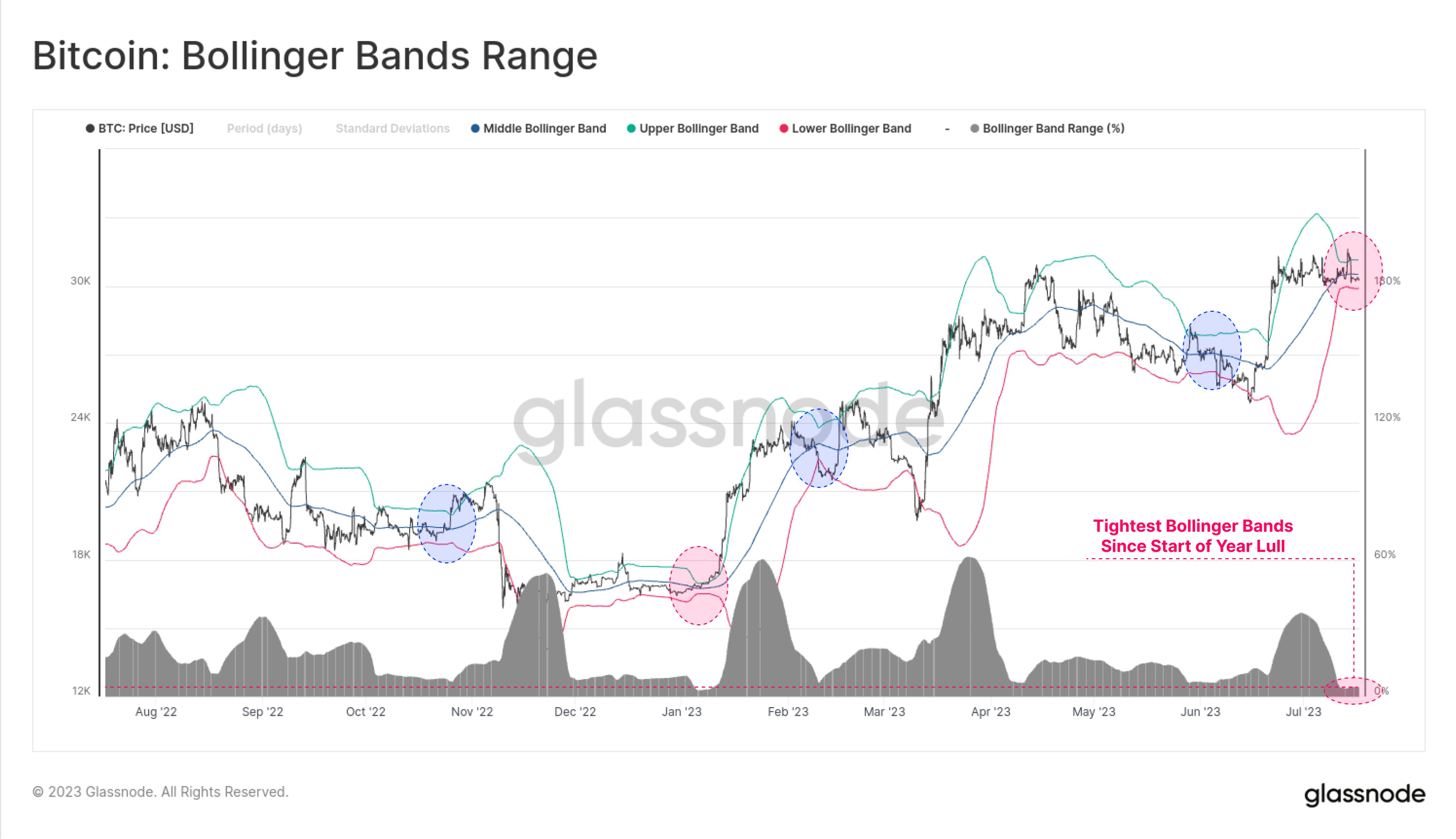
    According to on-chain data and analytics provider Glassnode, the Bollinger Bands are tightly squeezed and a price range of only 4.2% separates the upper and lower bands. The platform notes that this outlook has Bitcoin at its quietest since early January.

    The digital asset market continues to see remarkably little volatility, with the classic 20-day Bollinger Bands experiencing an extreme squeeze. A price range of just 4.2% separates the upper and lower Bollinger bands, making this is the quietest #Bitcoin market since the lull in early January,” Glassnode analysts tweeted, sharing the chart below.

    Bitcoin price Bollinger Bands range. Source: Glassnode on Twitter. 

    In technical analysis, the Bollinger indicator offers a chart outlook where price trends reflect the market’s volatility. Traders use the indicator to identify overbought or oversold market conditions.

    Bitcoin recently broke from above the upper bands and currently fluctuates beneath the middle trendline. Support of the lower Bollinger bands is around the crucial $30k level.

    Data shows BTC price has declined from highs of $30,400 late Sunday, touching intraday lows of $30.079 on Monday morning. Currently at around $30,180, the top cryptocurrency by market cap is down about 0.5%.

    While accumulation around the current prices is staggering, bulls have to hold above this psychological support base. If not, bears could push lower first before a likely short squeeze catapults BTC/USD to potentially news YTD highs of $34k. The key downturn levels to watch in the short term are at $28,200 and $25,600.


    Source link

  • Report: Bitcoin mining stocks – extreme volatility and underperforming Bitcoin

    Report: Bitcoin mining stocks – extreme volatility and underperforming Bitcoin

    Key Takeaways

    • Bitcoin mining stocks have traded with significantly more volatility than Bitcoin itself
    • Mining stocks have underperformed, as rising energy costs and increased competition has cut into profits
    • Miners also overleveraged during the pandemic, purchasing new equipment with debt and holding onto Bitcoin stashes as prices fell
    • Fees on the network rose with the Ordinals protocol and thus provided miners relief, but have since fallen back to normal levels

    Anyone remotely interested in the cryptocurrency world will attest to the fact that Bitcoin is incredibly volatile. At one point in March 2020, it was $4,600. By November 2021, at the peak of the bull market pandemic, it hit $68,000. A year after that, it was back down to $15,500. And it is currently ticking along around the $27,000 mark.

    As we said, volatile. And yet, there is something even more volatile: Bitcoin mining stocks. 

    First, a quick explainer into Bitcoin mining for the uninitiated. For those familiar with how the industry works, you can skip this little introduction. 

    Bitcoin miners are in the middle of what is a peculiar economic model. Miners act as “volunteers”, validating transactions on the Bitcoin blockchain. Because Bitcoin is a decentralised network, there is no central authority to maintain the blockchain, hence the need for these “volunteers” to validate transactions. 

    I put quotation marks around the word “volunteers” because miners get paid for their work, so don’t really have a claim to the volunteer title. Vitally, miner revenue comes in the form of Bitcoin. This revenue stream is split into two streams – the block reward subsidy, which halves every four years, and transaction fees. 

    The bottom line is that miners pay a cost to maintain the blockchain, in the form of energy/electricity, and receive revenue in return, in the form of Bitcoin.

    Mining share price performance

    Two things have been true about the performance of bitcoin mining stocks to date. The first is that they are extremely correlated with the price of Bitcoin itself. The second is that they have shown far greater volatility. 

    The Valkyrie Bitcoin Miners ETF is a good way to demonstrate the performance of mining stocks. It was launched in February 2022 and allocates at least 80% of holdings to companies which derive at least 50% of their revenue or profit from bitcoin mining operations. 

    Launched as the bear market started to engulf crypto, it has underperformed Bitcoin significantly, down 59% while Bitcoin is down 37% in the same timeframe. However, since the start of the year when markets have been a bit softer, it has outperformed: up 142% against Bitcoin’s rise of 62%. 

    Why have mining stocks suffered?

    This has been the pattern that has consistently held: mining stocks almost trade like a levered bet on Bitcoin. Obviously, their entire business depends on the popularity of Bitcoin. Not only is their revenue literally denominated in it, but the more people use Bitcoin, the more transactions there are to be validated and the more lucrative mining is. 

    As a result, mining stocks have struggled immensely during the bear market. Despite rebounding this year as crypto markets have turned more optimistic in line with the macro climate and expectations around the future path of interest rates, mining stocks are still far below the prices at which they traded at 18 months ago. 

    There are a few reasons why the fall has been more than one would have perhaps expected. The first is resource management. Bitcoin miners get paid in Bitcoin, but they can sell their holdings if they wish. As prices surged during the pandemic, on-chain data shows that this did not occur. Instead, miners largely held onto their stash. 

    We looked at this in a recent piece, and the below chart presents this well. It displays a relatively constant pattern of miners offloading Bitcoins. However, the behaviour or speed of selling does not waver as Bitcoin’s price spikes immensely, rising from $5,000 in March 2020 to $68,000 in November 2021. This is seen by the huge uptick in miner reserves in USD terms, while there is no change to the trajectory of reserves in BTC terms. 

    In essence, it implies that miners did not monetise an increased amount of their Bitcoin as those Bitcoins appreciated in dollar terms. The more Bitcoin you hold, the more volatile your stock is going to be. 

    In retrospect, this seems a mistake. While miners were always going to struggle with the price of Bitcoin falling so violently, a refusal to diversify their holdings meant they were betting even heavier on Bitcoin’s price holding. That proved to be a bad bet. 

    Bitcoin hash rate is at all-time highs

    Not only did miners not sell much Bitcoin as it rose in price, but many invested in more equipment as mining revenues surged in line with the rocketing prices during COVID. Even worse, many miners also turned to debt to finance new equipment – equipment which was selling for bloated prices as more and more miners entered the game. 

    This equipment has since fallen in price, just as the Bitcoin price has. The below chart shows the growth in hash rate on the network – a measure of the total computing power mining Bitcoin. The rise has been incessant. 

    While greater hash power is excellent for Bitcoin overall and is vital for the security of the network, it does make things more challenging for miners. More hash power in essence means more competition. 

    Due to the wonderful kaleidoscope of incentives laid out by Satoshi Nakamoto in their Bitcoin whitepaper, this also means a difficulty adjustment will kick in – meaning the more miners on the network, the harder it is to mine Bitcoins. This is necessary in order to keep Bitcoin on track to hit its final supply of 21 million bitcoins in 2140. Otherwise, an increase in miners would validate transactions quicker and hence more Bitcoin would be released into circulation. 

    This sounds complicated, and the intricacies of it are. But the bottom line is that more hash power on the network means it requires more energy to mine Bitcoin – another thing which is eating into the bottom line of miners. 

    And what happened to energy costs over the last year? Surging inflation and the war in Ukraine has sent electricity prices aggressively upward. The below chart shows the movement in the US, the most popular mining destination. 

    This means that miners are getting double squeezed – on the revenue side, a falling Bitcoin price is obviously reducing their revenue, while on the cost side, the price of energy has also risen. Higher costs and falling revenue is…not good. And down goes the share price. 

    Are Bitcoin mining fees rising?

    One point mentioned in crypto circles recently has been the increase of transaction fees on the Bitcoin network. As we covered recently, this can be attributed to increased activity on the network as a result of the Bitcoin Ordinals protocol. In other words, Bitcoin NFTs and memes, which exploded onto the scene in recent months. 

    The only issue is, this spike in fees proved to be brief. The below chart shows how the percentage of miner revenue derived from fees has fallen right back down to earth. 

    While the Ordinals protocol was certainly a bonus for miners, its effect has worn off and it appears unlikely to disrupt the age-old pattern: as the price of Bitcoin rises in bull markets, more people use the Bitcoin network, meaning more transaction fees. In bear markets, the opposite happens. This is what the below chart shows – the percent of miner revenue derived from fees tracks the Bitcoin price quite well (remember, the other part of revenue is the block subsidy award, which is pre-set and price agnostic, halving every four years).

    Final thoughts

    To wrap this mining report up, the reality is that miners will always suffer when the price of Bitcoin is falling, and outperform when it rises. This is because more people use Bitcoin when prices are rising, meaning more transactions and more revenue. 

    In the last year, miners have also been fighting a battle on the costs front, as inflation and an energy crisis have pumped the cost of electricity up, even if the worst of that may be in the rear window. Then there is the fact that many miners overleveraged themselves by purchasing more equipment at heightened prices on debt. Not to mention the decision by many to hold their revenue in Bitcoin rather than monetise into fiat. 

    Competition is now also fierce, input costs rising incessantly, the hash rate on the network near all-time highs. Put it this way: the days of college students mining on laptops are long gone.

    All these factors have contributed to what has been an extremely challenging environment for miners over the past year. It also explains why mining stocks are even more volatile than one of the most volatile mainstream financial assets: Bitcoin itself. 

    Source link

  • ‘hold on to it and stomach the volatility’

    ‘hold on to it and stomach the volatility’

    michael saylor view on bitcoin price
    • MicroStrategy Inc narrowed its bitcoin-related loss in the first quarter.
    • Its executive chairman Michael Saylor remains bullish as ever on bitcoin.
    • Bitcoin is currently up roughly 70% versus the start of the year 2023.

    Bitcoin has lost about 7.0% in recent weeks but Michael Saylor – the Executive Chairman of MicroStrategy Inc remains convinced as ever in its long-term potential.

    Michael Saylor on MicroStrategy’s Q1 results

    Earlier this week, the Nasdaq-listed firm said impairment loss related to its bitcoin holdings narrowed more than 90% sequentially to $18.9 million in the first quarter. According to Saylor:

    Bitcoin is the ultimate digital scarcity network. It’s moved up about 50% on average over the last three years. The key with bitcoin is to be able to hold on to it and stomach the volatility.

    MicroStrategy now owns a total of about 140,000 bitcoins. Naturally, therefore, the recent surge in BTC that’s still up some 70% for the year has been a meaningful tailwind for the company.

    “MSTR” has more than doubled since the start of 2023.

    Why is bitcoin price on the rise this year?

    Saylor attributes strength in the price of bitcoin this year partially to inflation that’s still running at an annualised rate of 5.0% in the United States – well above the Fed’s 2.0% target.

    The recent bank failures, he added, have also hurt confidence in the fiat currencies. On CNBC’s “Closing Bell: Overtime”, Saylor said:

    Bitcoin is a bank in cyberspace run by incorruptible software. So, the phase be your own bank has emerged as an investment idea in the United States.

    Interestingly, he dubbed the ongoing crypto crackdown a benefit for bitcoin as well since it has established a reputation as the safe-haven asset.

    Source link