Tag: Volatility

  • Bitcoin supply is dwindling, yet volatility will be the biggest benefactor

    Bitcoin supply is dwindling, yet volatility will be the biggest benefactor

    Key Takeaways

    • Long-term holders are accumulating Bitcoin, with two-thirds of the supply stagnant for over a year
    • Our Head of Research, Dan Ashmore, writes that liquidity on the demand side is also drying up, with order books thin and stablecoins fleeing exchanges
    • This will kick up volatility in the short-term, leaving Bitcoin open to aggressive moves to both the upside and downside
    • Long-term the impact of a dwindling supply is a different discussion, but for now, risk is elevated in the already-risky crypto markets

    A lot is made of the demand for Bitcoin. Are institutions giving up on it following a disastrous 2022 that saw the entire crypto sector go up in flames? Is the market moving back in now that interest rate forecasts have softened following the relentless rate hikes over the past year?

    But rather than the demand, it is the supply of Bitcoin that is often the more intriguing to look at. Famously sporting a fixed cap of 21 million coins, Bitcoin’s supply schedule is coded into the underlying blockchain. This quality has given rise to a million different theories around the future place – and price – of Bitcoin in the world. 

    But there is another interesting analytical angle to Bitcoin: before the anonymous Satoshi Nakamoto launched Bitcoin in 2009, the world never had an asset that provided so much visibility over the supply distribution. The nature of the blockchain is that, while the individual holders are anonymous, the distribution of all coins is available for the world to see at all times. So, let’s have a look. 

    Long-term holders are accumulating Bitcoin

    Central to many Bitcoin bulls’ long-term thesis is the idea that long-term holders will suck up supply, leading to an inexorable price rise. 

    Looking at current holdings, two-thirds of the supply has not moved in a year. That is certainly a large number, and we will get into what that means in the next paragraph. Pushing the timeline further out, over half the supply (53.6%) has been stagnant for over two years, 39.7% has not moved in 3+ years, and 28.6% has been idle for 5 years or longer. 

    What does this mean for price?

    These are large numbers by any stretch. It is impossible to compare them to other asset classes, given that none are trackable on a ledger like the blockchain. Perhaps only commodities such as precious metals can compete with the above numbers, yet that is only speculation. 

    But what does it mean? Is this a bullish sign? Well, yes and no. The immediate conclusion is that less supply means less demand is needed to push the price up, and the cap at 21 million Bitcoins certainly means if that demand keeps rising, the price has nowhere to go but up. 

    However, there are mitigating factors here. The first is the reality that some of the above “long-term holders” are in fact just lost coins, be it through people who have passed away, forgotten about their coins or lost access to their wallets. 

    Bitcoin creator Satoshi Nakamoto is one of those, the mysterious enigma holding approximately 1.1 million bitcoins, equivalent to a mammoth 5.2% of the supply. None of his/her/their coins have moved since they were mined back in the first eighteen months of Bitcoin’s existence. 

    Not to get too tangential, but below is the value of Nakamoto’s holdings over the last 13 years, assuming a stash of 1.1 million Bitcoin from mid-2010. That is a lot of capital that holders must surely hope never floods the market. 

    Volatility to rise with less liquidity 

    Regarding the impact of these large stashes of Bitcoin which are “removed” from circulation, the greatest impact – for now, at least – may be on the volatility rather than price. 

    In the following chart, I have plotted the amount of Bitcoin sitting on exchanges, currently at a 5-year low. 

    Not only is the amount of Bitcoin on exchanges dwindling, but stablecoins are doing the same. Over half of the balance of stablecoins have flooded out of exchanges since December. 


    This means liquidity on both the demand and supply side of Bitcoin is thin – and the same conclusion will be reached if an order book is downloaded from an exchange. Liquidity has dried up hugely, especially since FTX went under in November.

    This lack of liquidity only serves to jack up the already sky-high volatility in the Bitcoin market, exacerbating moves to both the upside and the downside. This is part of the reason why volatility recently spiked to its highest level since mid-2022, and also a factor in Bitcoin’s massive run-up this year. 

    By definition, it takes less to move a thin market, and with forecasts around the future path of monetary policy shifting to a more optimistic stance in recent months, Bitcoin has moved up with minimal resistance in its path. 

    While the supply-side dry-up is intriguing in the long-term, looking into that with regard to Bitcoin’s future performance is a different discussion entirely.  In the short-term, capital has fled crypto markets at an unprecedented pace, and we are now in a spot where the market is primed for violent moves in either direction. Like always in crypto, the short-term is difficult to predict, however, and the risk remains extreme – perhaps even more so currently than normal.

    Source link

  • Don’t be fooled by Bitcoin’s recent calm, volatility is coming: Opinion

    Don’t be fooled by Bitcoin’s recent calm, volatility is coming: Opinion

    Key Takeaways

    • Bitcoin has been tightly range-bound for last month, its 10% fall this week its biggest move since the banking crisis
    • Dan Ashmore, our Head of Research, warns that volatility will return before long
    • Over 50% of stablecoins have left exchanges and orderbooks are thin, he writes, meaning there is less needed to move the price
    • T-bills paying 5% have pulled capital from the space, leaving Bitcoin more open to big price moves
    • Direction will depend on interest rate policy, with economy at crucial juncture

    Bitcoin has pulled back over the last week, the orange coin dipping 10% from just north of $30,000 to $27,200. But the remarkable thing about this price move is how unremarkable it is. 

    Bitcoin has been extremely tightly bound since the banking crisis subsided over the last month, its daily moves notably gentle compared to its usual extreme volatility. This relatively benign 10% move – Bitcoin has printed a 10% candle in seconds before – amounts to the largest move since the banking crisis subsided and Bitcoin propelled upwards as interest rate forecasts softened. 

    In fact, when you plot the average of the last 30 days of price moves, this past month is now close to flat, but history shows that it has never stayed around that placid level for long. 

    We can be particularly certain that volatility will return this time around. That is because one of the key factors in heightened volatility is as prominent as ever in the Bitcoin markets: a lack of liquidity. 

    With less liquidity, there is less money needed to move prices. And right now, liquidity is as thin as it has been in quite a while. 

    Since the exit of Alameda in the aftermath of the disastrous FTX collapse, order books have been shallow. Looking at stablecoin balances on exchanges is another indicator of this. I put together a deep dive recently analysing the extraordinary outflow of stablecoins from exchanges: 45% of the total balance has fled exchanges in the last four months. The updated figure is over 50% of stablecoins gone since December. 

    In a world where interest rates have ballooned at the fastest rate in recent memory, while yields in the crypto space fall, perhaps this is not surprising. T-bills are now paying over 5%, while crypto investors have seen countless blowups in the space – Celsius, Terra and FTX – while sentiment has collapsed and fear flooded the market. 

    When there is a US government-guaranteed investment paying 5.1%, why would anyone hold a stablecoin with the risks that flooded the market over the last year?

    And so, while Bitcoin has been trotting a relatively peaceful path over the past month, the party on the charts will return before long. With thin liquidity comes heightened volatility, meaning if there is a trigger in the market, Bitcoin’s price could very likely move further than what it otherwise would. 

    In fact, looking at the volatility metrics, while it has dipped in the last two weeks, realised volatility was the highest since June 2022 earlier this month. So while the price moves have been cancelling each other out as Bitcoin oscillates within a tight window, counter-intuitively, the volatility is still high. 

    The trillion-dollar question, of course, is which direction will it go.

    I’m not smart enough to predict that with any degree of confidence in the short term, but whichever way it moves, it will depend on macro conditions. Bitcoin continues to hold the stock market’s hand, its correlation with the tech-heavy Nasdaq especially high. 

    With financial markets still so dependent on interest rates, the word of Jerome Powell and the Federal Reserve will remain key. Backing out probabilities from Fed futures, the market seems to be betting that the Fed has perhaps one more hike in it before shutting up show on this period of tight monetary policy. 

    As we saw last month with the banking crisis, this plan could change quickly. It really is a macro climate of unprecedented nature, this mix of high inflation and generationally quick rate hikes, even if coming from such a low base. 

    Risk assets will have their day again, it’s just a question of when. In the short term, it is hard to say, but whichever way the sentiment goes, don’t expect Bitcoin to remain asleep for very long. 

    Source link

  • Bitcoin price falls below $29K, no surprise given volatility and liquidity metrics

    Bitcoin price falls below $29K, no surprise given volatility and liquidity metrics

    Key Takeaways

    • Bitcoin has softened fallen from $30,000 to close to $28,000
    • Our head of research looks into the data, arguing the move should not be a surprise
    • Bitcoin’s fixed supply and lack of dividends or earnings means price is entirely demand-driven
    • Thin liquidity in the Bitcoin market exaggerates every move, with 45% of stablecoins leaving exchanges in the last 4 months
    • Correlation with stocks remains high, with high UK inflation creating pause for thought
    • Market has also peeled back slightly on forecasts for interest rate cuts, and Bitcoin has followed

    I have lost count of the number of times I’ve been asked “Why is Bitcoin going up?”, or “what is driving this Bitcoin sell-off?”. 

    For many assets, it’s clear as day as to what is driving the price action over any given trading period. Earnings forecast missed by 10%? Hello, red candle. Warren Buffett announced a mass purchase of your stock? Buckle in; we’re heading north. 

    For Bitcoin, it’s a little tougher. There are no dividends or dividend forecasts; Bitcoin pays no yield. Nor are there earnings. Additionally, the supply doesn’t waver, instead it follows a pre-determined schedule set by Satoshi Nakamoto in October 2008, governing it block by block in ten-minute intervals. 

    With the supply set in stone and out of the picture, and the absence of any periodic yield/forecasts derived from dividends or earnings, this means that the Bitcoin price is all about demand. And that is very difficult to predict. Bitcoin gonna Bitcoin, is often about the best reasoning that can be given. 

    But there are factors we can assess. One is liquidity, which I touched on in a recent deep dive as Bitcoin surged beyond $30,000 for the first time in ten months. Order book liquidity is as thin as it has been in a year, while overall capital has fled the crypto space at large. Take a look at the balance of stablecoins on exchanges:

    That is 45% of the stablecoin balance taking the exit door in the last four months, the balance as low as it has been since October 2021. 

    With Bitcoin already uber-volatile (VIX metric blows that of any “normal” asset out of the water), this amps up its propensity for violent moves even further. In simple terms, thinner liquidity means it takes less action to move the price. 

    Why is the Bitcoin price currently falling?

    So, it is often difficult to ascertain why Bitcoin is moving, as this thin liquidity and capricious demand combine to make it very sensitive. 

    But sometimes, we can make educated guesses as to what moves Bitcoin on any given day. This is one of those moments. 

    Macro conditions have long been the key for Bitcoin. Again, a little chart to show this:

    Despite some temporary optimism that Bitcoin was decoupling as investors fled a collapsing (fiat) bakning system for the safe haven that is Bitcoin, the orange coin is very much moving in tandem with high-risk assets, such as tech stocks listed on the Nasdaq.

    I wrote a deep dive at the time of the banking crisis as to why Bitcoin’s dip in correlation with stocks was just a temporary blip. Looking at the data, it appears to have come back up.

    And looking at wider financial markets in the last few days, optimism over the economic climate has pulled back. UK inflation was released yesterday, holding firm in the double digits, fuelling the expectation that the Bank of England will hike further. 

    Over in the US, Atlanta Federal Reserve president said he expected another 25 bps hike, casting another bit of doubt for the market that hikes may not be done quite yet. 

    Not to mention a rally can’t go on forever. Bitcoin has been on a tear this year, up 74% year-to-date. It’s an asset which has always oscillated, so it’s not a surprise that it is finally showing a bit of weakness. And a fall from $30,000 to $28,000 is merely a drop in the ocean compared to what it is capable of. 

    A true Bitcoin red candle cannot be ruled out here, given the volatility and thin liquidity, just like it could suddenly surge further north. As financial markets adjust to new data all the time, like the all-important inflation readings and FOMC minutes, Bitcoin will continue to move like a levered bet on tech stocks. 

    As for what direction it will move in, that is anyone’s guess. I don’t have a crystal ball, and I won’t make any predictions just for the sake of it, because I simply don’t know. Not many people do right now, with the world in a precarious state economically. Inflation is still high, yet interest rates are apparently coming to the end of the tightening cycle. 

    Soft landing, hard landing, something in between? The future will tell. But whatever happens, the volatility of the world’s biggest cryptocurrency is very real, and abrupt price reversals and large swings won’t stop anytime soon. Bitcoin gonna Bitcoin. 


    Source link

  • Volatility lowest since January, but until it drops further, Bitcoin serves no purpose

    Volatility lowest since January, but until it drops further, Bitcoin serves no purpose

    • Bitcoin’s volatility is a massive problem, writes our head of research, Dan Ashmore
    • The volatility is the lowest since January, but that doesn’t provide much solace with regards to Bitcoin’s actual utility
    • For Bitcoin to deliver on its potential, it needs to become boring, with volatility closer to gold’s famously steady return profile

    It’s relatively calm in Bitcoin markets right now, but that won’t last long. And it’s a massive, problem. 

    First, let us look at the short-term volatility, because I noticed over the last few days that is has come down a little. Plotting the 1-month volatility on an annualised basis, we are at the lowest mark since January, when this little Bitcoin surge was kicked off. 

    OK, fine. 

    But don’t confuse that with a steady market. The crypto markets remain highly capricious and capable of swinging back and forth and eye-watering speed. Volatility is still close to 50%, which in the context of any regular market, is truly insane. 

    Perhaps plotting the daily returns of Bitcoin against that of Tesla shows this better. Tesla is just about the most extreme member of the S&P 500, its stock price more volatile than its CEO’s Twitter feed. Comparing your volatility to Tesla is like comparing your ability to run a football team to Todd Boehly (seriously, wtf). 

    And yet, Bitcoin’s daily price changes not only match Tesla, but commonly exceed it. 

    Indeed, if we plot Bitcoin’s volatility back over a longer time period, we see that these fallow periods do occur, but rarely last long. Bitcoin and volatility are like Frank Lampard and Chelsea, apparently – occasionally apart, but you know that before long, they will be back. And they are terrible for each other. 

    Make no mistake about it, volatility is one of Bitcoin’s greatest drawbacks. It is difficult to imagine the asset ever achieving anything remotely close to a store-of-value status while it oscillates back and forth like it does. 

    If the ultimate vision for Bitcoin is some sort of digital gold, it has a hell of a long way to go. Flipping the earlier comparison from Tesla to gold is more apt, and puts the chasm between the two assets up in lights:

    Obviously, this could all change in the future. I don’t have a crystal ball. Regarding Bitcoin’s ultimate vision, it simply has to, because as it currently stands, Bitcoin is not achieving anything. 

    The arguments commonly point to the developing world. Bitcoin can offer a greater place to store one’s financial wealth, they argue. Again, this may prove true in time, but even a collapsing currency like the Argentinian peso is not as volatile as Bitcoin. A gradual decline such as the peso (and I am using gradual a bit liberally there, admittedly) is at least easier to plan for than Bitcoin, which can quite literally be 20% lower in the space of a couple of minutes. 

    While Bitcoin is capable of these massive price moves, it isn’t in a place to help anyone. That argument is currently better served to stablecoins, pegged to fiat currencies like the US dollar, which can be equally accessible but don’t swing in price (at least, the prudently-designed ones don’t). Now, their flaws could fill a whole new article which I won’t get into here, but the point is this: Bitcoin is literally useless while its volatility is as high as it currently is. 

    My friends often poke fun at me for chatting about gold, or doing analytical pieces on its price drivers. Boomer, they call me. And that’s fair – gold is boring as f**k, and watching its price chart is like watching paint dry. But that is kind of the point, isn’t it? Gold is a store of value, and therefore it should not be printing gains and losses that get Robinhood investors all hyped up. Otherwise, it wouldn’t be doing its job. 

    Bitcoin is the same. It needs to take a leaf out of gold’s book and become boring. Until that happens, there is no point to this mythical asset beyond wild speculation. 

    Source link

  • Bitcoin price, volatility and profits are all the highest since June 2022

    Bitcoin price, volatility and profits are all the highest since June 2022

    Key Takeaways

    • Bitcoin has broken $30,000 for the first time since June 2022
    • Volatility is also at its highest point since June
    • Liquidity is the lowest it has been all year, meaning less is needed to move Bitcoin up (and down)
    • 45% of stablecoins have fled exchanges in last four months, with market depth has not recovered from Alameda bankruptcy in November
    • Interest rate forecasts have flipped, providing positive impetus as market bets tight monetary policy is coming to an end
    • Low liquidity and positive interest rate expectations have kicked Bitcoin up past $30K
    • Week ahead brings data on inflation, Fed minutes and earnings, and Bitcoin could move violently again depending on how it shakes out

    Throw a mask on and stay beyond a 2-metre radius, because it feels like 2021 again. 

    At least, looking at the cryptocurrency market, that is. Bitcoin has turned back the years to rally to its highest price since last summer, despite the economy feeling like it’s falling down all around us. $30,000 has officially been breached. 

    Not only is the price at its highest point in ten months, but the volatility and profits have also ramped up to the highest points since before the house of cards all came down, while the supply on the market is dwindling.

    But why? And will all this continue or will Bitcoin fall back down to Earth? Let’s dig into the data to see if there is an answer. 

    Price

    First, what makes the headlines pop: the price.  

    Bitcoin breached $30,000 Monday evening for the first time since June 2022. To refresh the memory, that was the week of the Celsius crash, the crypto lender announcing on June 12th 2022 that it was suspending withdrawals, having been caught up in the LUNA contagion. 

    Billions of customer assets were locked, and the Bitcoin price spiralled downwards, dropping below $30,000, and then $20,000, in the days afterwards. Monday was the first time it has taken back the $30,000 mark. 

    The key to this resurgence? Interest rate forecasts, primarily (but not just interest rates…as we will get into in the next section). 

    The forecast of the future path of interest rates has completely flipped in the last month or so, providing impetus for this leg up in Bitcoin as the market bets that we are finally ready to pivot off the aggressive hiking of rates that has been ongoing since last April. 

    Last year’s transition to a new paradigm of tight monetary policy signalled an abrupt end to the decade-long bull market across financial markets, pulling risk assets down in price across the board. 

    Crypto didn’t help its case with several scandals along the way – LUNA, Celsius and FTX to name a few – but the macro conditions have certainly not been kind either, with the Nasdaq shedding a third of its value last year, its worst return since 2008. 

    But following the banking collapse, the market is betting that the Fed simply cannot continue with the interest rate forecasts going forward. The below chart shows interest rate expectations for the July meeting – the right side shows the forecast from six weeks ago, which has completely flipped compared to the forecast today (purple bars on the left). 

    Volatility 

    But it’s not just the price that is rising. Volatility is also at its highest point since it picked up following the collapse of Celsius last June. The below chart shows this, and then we will see why this is not a coincidence that it is coinciding with a relentless price rise. 

    The elevated volatility is a direct consequence of the liquidity being so low. I crafted together a deep dive on this two weeks ago, but liquidity in cryptocurrency markets is as low as it has been all year. 

    45% of the stablecoin balance on exchanges has fled in the last four months, with the resultant balance the lowest since October 2021. 

    This is matched by market depth dropping down too, yet to recover from the evaporation of Alameda into thin air last November. 

    And this gets to the crux of the issue: the thin liquidity exacerbates moves both to the downside and upside. This is a fancy way of saying it elevates volatility, which is exactly what we seeing recently for Bitcoin. 

    And this exacerbation of any price move, coupled with the positive spin coming out of the interest rate forecasts, means Bitcoin is getting a hell of a push up the charts – with liquidity so shallow that there is minimal resistance. 

    In short, liquidity is down, and volatility is up. And with the most important thing in markets right now, i.e. the interest rate forecast, flipping positive, we get a violent upward price move. 

    “The low liquidity has left the market vulnerable to massive moves”, says Max Coupland, director of CoinJournal. “Luckily for crypto investors, the flip in interest rate expectations has meant prices have accelerated upwards, but looking at the week ahead, this may change if the economic data comes in below forecasts. Bitcoin is always volatile, but it feels particularly primed for big moves at the moment”.  

    Profit

    Finally, profit. It doesn’t take a genius to work out that with the Bitcoin price at its highest point in nine months, the profit position for investors is also looking a little rosier than it has in the past. 

    When assessing the price at which Bitcoins last moved at compared to the current price, it can be deduced that 76.2% of the Bitcoin supply is in profit. That marks the highest point in a year, back before the transition to a tight monetary policy and the LUNA scandal of last May.  

    What happens next?

    But will this all persist? Or is it just a bear market rally?

    Well, the uber-low liquidity is likely not going to shift in the short-term, at least. This means that volatility will remain elevated and moves to both the downside and upside will be elevated. 

    But with volatility high, which direction will it go? I won’t pretend I know the answer to that, but the week ahead has some key data coming out that will drive the price one way or another – and perhaps very significantly so. 

    First is the CPI data out Wednesday. Inflation has come down every month since June 2022 yet this is the first inflation reading to come out following the optimism that interest rate hikes are soon coming to an end. A hot reading could spook the market into thinking that the Fed may think about hiking further, however, especially after the banking troubles of the last month have subsided. 

    Also on Wednesday is the FOMC minutes, which will give a direct insight into the plans of the Fed. This, and the inflation reading, are absolutely vital economic indicators, and have been what has moved markets all year long. That won’t change. 

    Throw in Thursday’s producer price index (PPI) and earnings season kicking off on Friday, and the price moves ahead could be extreme. Bitcoin is very volatile right now and the economy is at a watershed moment, with plenty of data coming out in the week ahead. 

    Buckle your seat belts and get your popcorn ready.

    If you use our data, then we would appreciate a link back to https://coinjournal.net. Crediting our work with a link helps us to keep providing you with data analysis research.

    Source link

  • Bitcoin volatility rising as $4.2 billion options set to expire Friday

    Bitcoin volatility rising as $4.2 billion options set to expire Friday

    Key Takeaways

    • Bitcoin volatility is the highest point since July 2022
    • Liquidity is extremely thin which is pushing volatility higher and accentuating price moves
    • $4.2 billion of options expire Friday, with bull set to profit following the recent surge up to $28,000

    Yesterday, I wrote a piece looking at how the correlation between Bitcoin and the stock market, notably tech stocks, has come back up. The relationship had loosened amid the banking turmoil that struck financial markets, triggered by the collapse of Silicon Valley Bank.

    As well as rising correlation, the market is also swinging wildly – the volatility is as high as it has been since July 2022, around the time Celsius sent evaporated into thin air and sent the market into mayhem.

    Why is volatility rising?

    The volatility spike is not surprising in light of the glut of liquidity currently in the markets. We crafted up a piece on this earlier this week, assessing how 45% of stablecoins had flowed out of exchanges in the last four months, with the balance now at the lowest point since October 2021. 

    It gives context to the recent Bitcoin price rise. With less liquidity in the markets, moves are naturally more violent, and Bitcoin has surged up to $28,000, now up 68% on the year. 

    While the move to the upside has been exacerbated by this thin liquidity, the opposite also holds true: the downside risk is elevated when markets are so thin. 

    It paints a picture of high risk for an asset that already oscillates wildly at the best of times. 

    Derivatives add to volatility

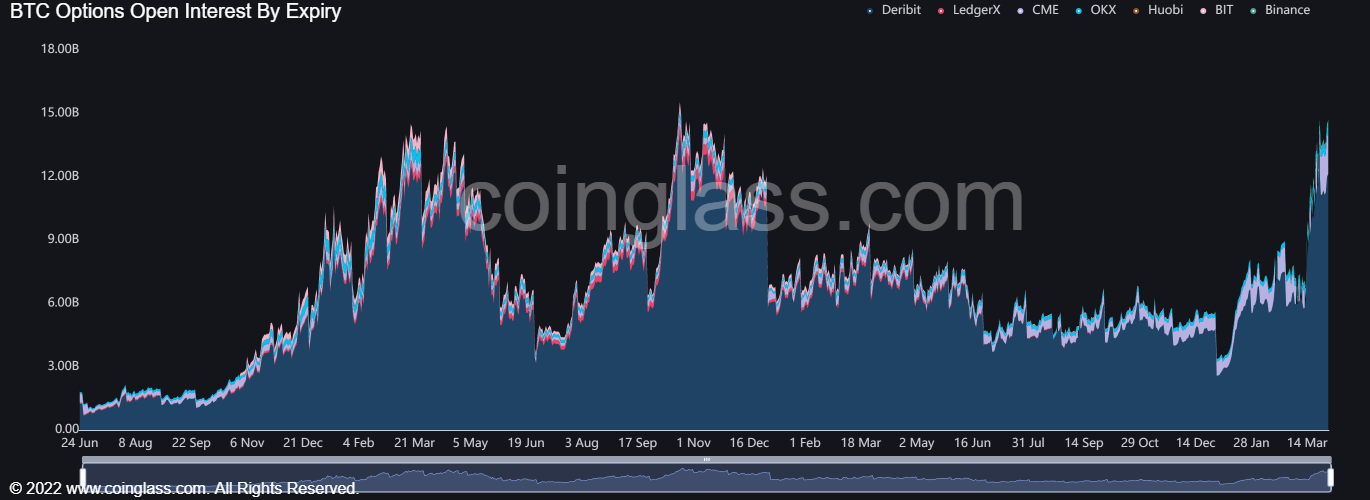
    Another factor? Derivatives open interest is absolutely soaring, with the below chart from Coinglass showing that options open interest is at its highest point since November 2021. 

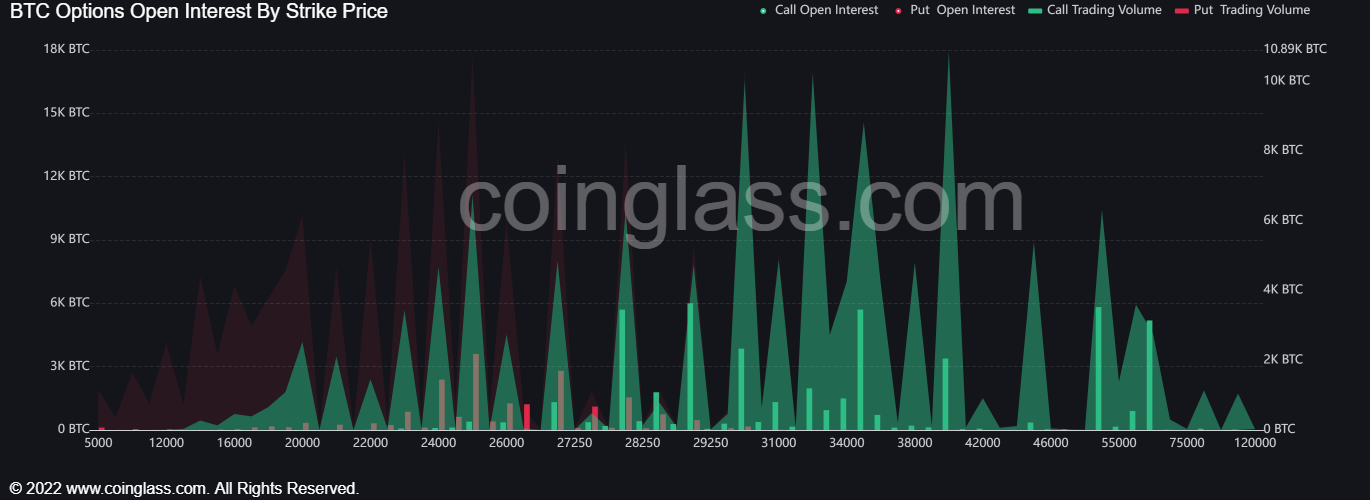
    As I write this on March 31st, a mammoth $4.2 billion of Bitcoin options are set to expire. The below chart also shows the strike prices of the options – with a call/put ratio of 2.09 and Bitcoin currently trading close to $28,000, it will be a profitable day for many traders. 

    Digging into the numbers, there are 97,300 call options expiring at a strike price of $28,000 or less, compared to 24,500 put options. The dollar split is over $2 billion in favour of calls. 

    Looking at strike prices of the next level up, it is pretty much all call options. Between $28,000 and $32,000 there are 48,000 call options against 400 put options with a $1.4 billion split in favour of calls. 

    After a year of bears dominating, there will finally be some bulls primed to profit. 

    Indeed, looking at the Bitcoin spot holdings, it is showing more positive news all across the market. In December, the majority of Bitcoins were in loss-making positions, when comparing the market price to the price at which they last moved. 

    Today, however, 74% of the supply is in profit when using the same metric. 


    With interest rate policy expectations softening, Bitcoin has finally been allowed room to run. However, with thin liquidity and high volatility comes risk, although when it comes to Bitcoin, risk is hardly a foreign concept.

    Source link

  • Crypto volatility back to FTX levels, with $791 million of liquidations in 4 days as SVB collapse rocks market

    Crypto volatility back to FTX levels, with $791 million of liquidations in 4 days as SVB collapse rocks market

    Key Takeaways

    • Crypto volatility is back up to levels last seen when FTX collapsed in November
    • $791 million of liquidations rocked investors between Thursday and Sunday
    • $383 million of longs were liquidated on Thursday and Friday, the largest 48-hour number of the year
    • News that deposits will be made whole at SVB propelled the market upwards late on Sunday, with $150 million of short sellers liquidated as Bitcoin retook $22,000
    • Despite Fed move stablising prices and 2023 showing a bounceback, the long-term implications for the crypto market are negative here and should concern investors

    For once, it’s not crypto doing the collapsing. Trad-fi was feeling left out of the party, evidently, as the banking sector wobbled in a big way this weekend. 

    Silicon Valley Bank (SVB) is no more, in what amounts to the largest collapse of a US bank since 2008, when Lehman Brothers pulled its best Satoshi Nakamoto impression and disappeared into the ether (pun not intended). 

    While the drama may have centred in trad-fi, crypto bounced around aggressively over the weekend as a variety of knock-on effects rumbled. SVB was a crypto-friendly bank, as was Silvergate, which was announced to also be winding down last night. 

    This, as well as the fact that the entire financial markets wobbled, meant crypto faced a storm. We have dug into some of the movements here at https://coinjournal.net/ to sum up the carnage. 

    Liquidations 

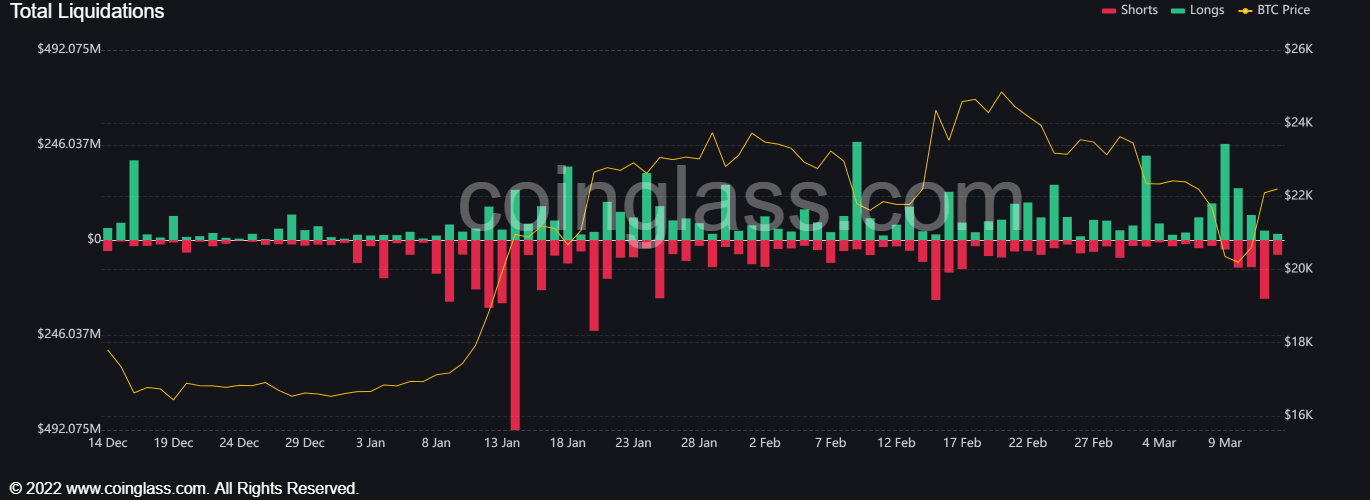
    With violent price swings, liquidations were inevitable. Longs got caught out badly on Thursday and Friday, as the Bitcoin price fell south of $20,000. 

    There were $249 million of long liquidations across exchanges on Thursday, with Friday bringing an additional $134 million. The $383 million of long liquidations was the most in any 48 hour period this year. 

    Volatility

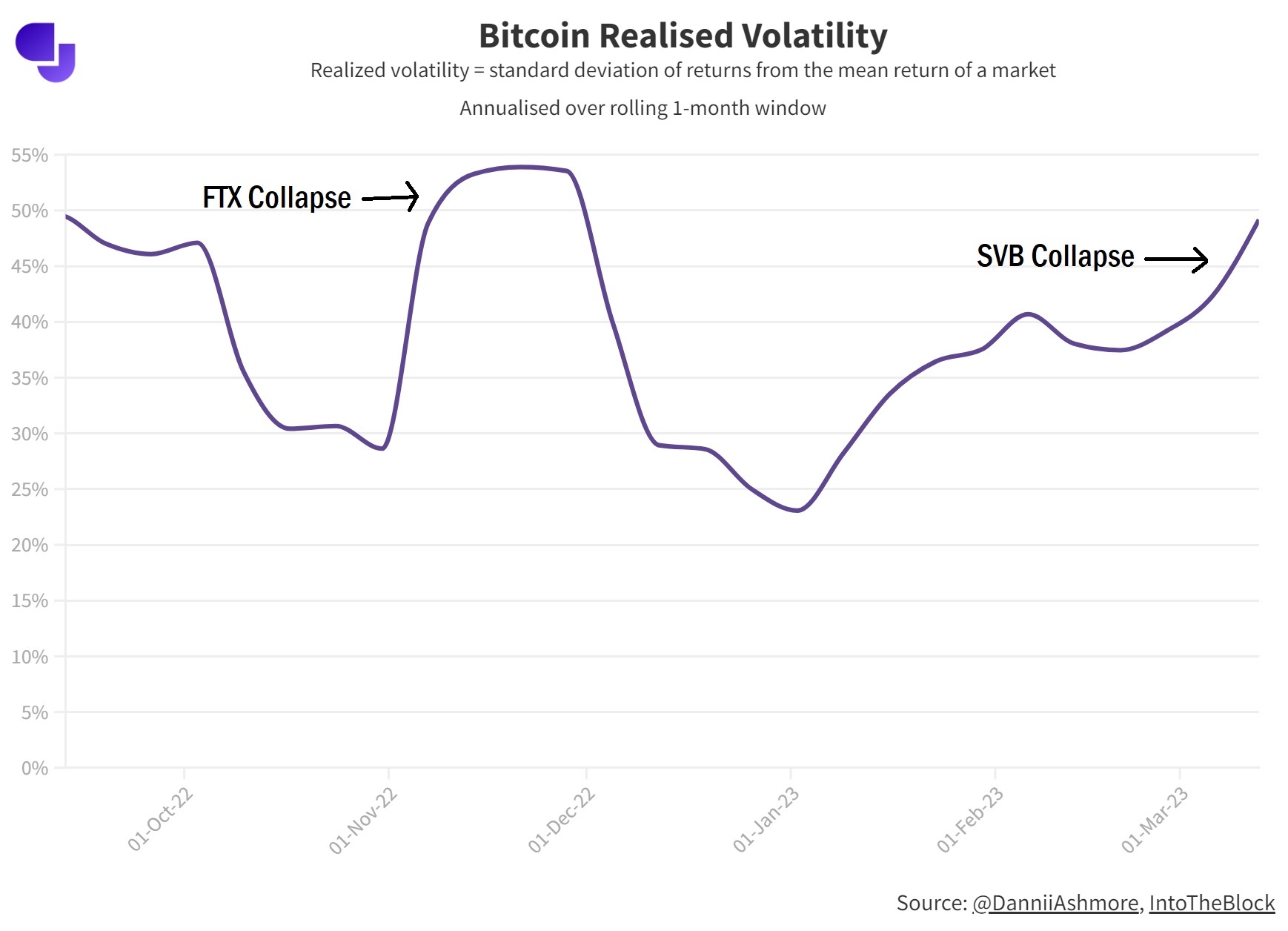
    Obviously, liquidations stem from volatility. Looking at Bitcoin to dissect the extent of the movements, the volatility is now back up to levels last seen when FTX collapsed in November. 

    The chart below shows that the metric had been rising steadily, before SVB going poof kicked it back up to a mark 3-Day volatility mark of 50%, last seen when Sam Bankman-Fried’s fun and games were revealed to the public.

    “We have been seeing relatively muted action in the crypto markets since the FTX collapse last November” said Max Coupland, Director of CoinJournal. “The SVB event served to kick volatility back up to levels we last saw amid all the crypto scandals of last year – not only FTX, but Celsius, LUNA etc. The difference with this event is that the crash was sparked in trad-fi for a change”.

    Crypto bounces back

    But all is well that ends well. Or something along those lines, as despite SVB going under, the Fed announced last night, after a weekend of chaos, that all deposits at SVB would be made whole. 

    The bail-out (if you can call it that, as SVB is still going under) quelled up fear in the markets that the issue could become systemic. Crypto roared back, with Bitcoin spiking back up to $22,000 at time of writing. And this time, it was shorts who got caught offside, with $150 million liquidated across the market Sunday. 

    Perhaps the biggest winner of all was the world’s second-biggest stablecoin, USDC. 25% of the stablecoin’s reserves are backed by cash. Crucially, 8.25% ($3.3 billion) of reserves were (are) trapped in SVB, with the stablecoin dipping below 90 cents on several major exchanges over the weekend. 

    At press time, the peg has been largely restored as the crypto market bounces upward, with Bitcoin north of $24,000.  

    What next for crypto?

    And so, the immediate storm appears to have been weathered in cryptoland. 

    Nonetheless, the past few days present as yet another crushing blow. Three of the big crypto banks – SVB, Silvergate and Signature – are now no more. These banks allowed crypto firms to offer on-ramping from fiat into crypto 24/7 through their settlement services, in contrast to the regular banking hours of the banking sector. 

    Liquidity and volume thus may dip even further in the crypto market, after a year that has already seen volumes, prices and interest in the space freefall. 

    Despite the Fed stepping in to shore up deposits and hence stabilising the stablecoin market and wider crypto prices, the long-term future of the cryptocurrency industry in the US has taken another heavy body blow this weekend. And with the US being the biggest financial market in the world, that is very bad news. 

    Coupled with the regulatory clampdown by the SEC in the last few months, 2023 has followed 2022 in creating a more hostile and bearish environment for the sector at large. 

    So crypto investors may have seen a bounceback in prices in the last few months, but this appears to be largely macro-driven correlation with the stock market, as the underlying events in the industry – regulation, more bankruptcies, and crypto-friendly banks shuttering – have not been positive. 

    If you use our data, then we would appreciate a link back to https://coinjournal.net. Crediting our work with a link helps us to keep providing you with data analysis research.


    Source link

  • Dogecoin, Shiba Inu Holders Turns To These Coins To Avoid Price Volatility

    Dogecoin, Shiba Inu Holders Turns To These Coins To Avoid Price Volatility

    Investors releasing Dogecoin and Shiba Inu to buy Bitgert (BRISE) and Centcex (CENX).

    Source link