Tag: Wallets

  • UAE makes Bitcoin wallets a crime risk in global tech crackdown

    UAE makes Bitcoin wallets a crime risk in global tech crackdown

    UAE makes Bitcoin wallets a crime risk in global tech crackdown

    • The UAE’s Federal-Decree Law No. 6 of 2025 came into effect on 16 September.
    • Article 62 places APIs, explorers, and decentralised platforms under Central Bank control.
    • Article 61 regulates all marketing, emails, and online posts about crypto services.

    In a sharp pivot from its crypto-friendly image, the United Arab Emirates has enacted sweeping new legislation that classifies basic cryptocurrency infrastructure, including Bitcoin wallets, as potentially criminal unless licensed by the Central Bank.

    Legal experts from Gibson Dunn have flagged the law’s scope as unusually broad, warning that its language introduces significant risk for global technology providers.

    This shift, embedded in Federal-Decree Law No. 6 of 2025, comes into force from 16 September and carries global consequences for developers and platforms offering crypto access.

    The law replaces the 2018 banking statute and significantly widens the definition of financial activity. What sets this legislation apart is not only its scope but also its enforcement teeth.

    Penalties for non-compliance range from fines of AED 50,000 to AED 500,000,000 (up to $136,000,000) and may include imprisonment.

    Importantly, this applies not just to entities operating within the UAE but also to those whose products are accessible from within the country.

    Licensing now applies to wallets, APIs and even analytics

    The most consequential element of the new law is found in Article 62. It grants the Central Bank control over any technology that “engages in, offers, issues, or facilitates” financial activity.

    The wording is broad enough to encompass self-custodial wallets, API services, blockchain explorers, analytics platforms, and even decentralised protocols.

    This marks a fundamental change in how crypto infrastructure is regulated in the UAE.

    Previously, licensing obligations focused on traditional financial entities, but the updated framework shifts this focus to include software and data tools.

    According to developer analysis, even public-facing tools such as CoinMarketCap and open-source Bitcoin wallets may now require licensing to remain accessible within the UAE.

    For the first time, developers may face criminal penalties for offering unlicensed crypto tools, even if they are based abroad.

    This extension of jurisdiction signals a new regulatory posture that treats access to crypto as tightly as its ownership or exchange.

    Communications and marketing now fall under regulation

    The crackdown does not stop at financial infrastructure. Article 61 of the same law defines the marketing, promotion, or advertising of financial services as a licensable activity.

    In practice, this means that simply hosting a website, publishing an article, or sharing a tweet about an unlicensed crypto service could be considered a legal violation if that content reaches UAE residents.

    This change dramatically expands the compliance footprint for companies and developers.

    Gibson Dunn highlights that these provisions materially broaden the enforcement perimeter, especially for firms with no formal presence in the UAE.

    The law applies to communications that originate outside the country but are accessible inside it.

    The result is a regulatory landscape where developers, content creators, and infrastructure providers must weigh whether their platforms are indirectly accessible by users in the UAE.

    In many cases, avoiding legal exposure may require disabling access or halting service altogether.

    Dubai’s free zones no longer shield crypto services

    Over recent years, the UAE has positioned itself as a hub for blockchain innovation.

    Jurisdictions such as Dubai’s Virtual Assets Regulatory Authority (VARA) and Abu Dhabi Global Market (ADGM) attracted global attention with purpose-built crypto licensing frameworks.

    However, the new federal law overrides these free-zone arrangements, asserting Central Bank control nationwide.

    Federal law supersedes any rules introduced by the UAE’s free zones, effectively dissolving the regulatory arbitrage that once drew companies to Dubai.

    The broader context includes the country’s history of digital restrictions.

    For instance, WhatsApp voice calls remain blocked across the UAE, reinforcing a consistent policy approach to centralised control over communications and digital tools.

    While this may bring the UAE in closer alignment with international pressure from groups like the Financial Action Task Force, it also puts crypto service providers in a difficult position.

    In other jurisdictions facing similar pressure, firms have withdrawn entirely to avoid enforcement risk.

    Enforcement begins in 2026, with further rules expected

    Entities have a one-year window from 16 September 2025 to come into compliance. This grace period may be extended at the discretion of the Central Bank.

    During this time, further regulations are expected to clarify how these broad rules will be applied in practice.

    Despite this, the scope of the law is already causing concern.

    The language around facilitation and communication, combined with the severe penalties under Article 170, suggests that firms offering crypto tools globally must now consider the risk of incidental exposure to UAE users.

    For software developers and platform operators, this marks a significant departure from the norms of decentralised access and open-source innovation.

    Source link

  • Bitcoin faces quantum risk: why SegWit wallets may offer limited protection

    Bitcoin faces quantum risk: why SegWit wallets may offer limited protection

    Bitcoin faces quantum risk: Why SegWit wallets may offer limited protection

    • SegWit wallets delay public key exposure until the point of transaction.
    • Holding Bitcoin in SegWit addresses offers temporary protection if left untouched.
    • Critics believe practical quantum computing remains decades away.

    Quantum computing’s long-theorised threat to Bitcoin is resurfacing in the crypto conversation.

    The idea that a powerful enough quantum machine could break cryptographic security and expose Bitcoin keys has moved from theoretical chatter to practical concern.

    Bitcoin analyst Willy Woo recently suggested a short-term safeguard: store Bitcoin in SegWit addresses for the next seven years.

    While the tactic has sparked debate, the broader community remains divided over whether quantum computers are a real, imminent threat or just the latest tech-driven scare.

    SegWit offers delayed public key exposure

    Segregated Witness (SegWit), introduced on 23 August 2017, is a protocol upgrade that changes how data is stored in Bitcoin transactions. Woo suggests that SegWit’s delayed public key exposure could act as a deterrent against quantum attacks.

    Unlike Taproot, which exposes the public key immediately within the address, SegWit only reveals it during transaction execution.

    This delay makes it harder for a quantum computer to reverse-engineer the private key from the public one before the transaction is completed.

    Under current conditions, exposing a public key does not present much of a problem. However, if and when quantum computing advances to the point of real-time decryption capabilities, the exposure window of Taproot wallets could be a key vulnerability.

    In contrast, SegWit’s hashing conceals the public key behind a layer of encryption until absolutely necessary. This may keep Bitcoin more secure during this anticipated transition period.

    Hodling in SegWit comes with major constraints

    While the SegWit method may offer protection, it carries a critical limitation. According to Woo, users must not move their Bitcoin from the SegWit address.

    Any outgoing transaction would expose the public key, potentially inviting a quantum attack if executed during the transaction.

    As such, this method is not viable for active traders or anyone needing liquidity in the short term. It is a static defence mechanism, not a dynamic solution.

    This approach effectively puts Bitcoin in a vault. It is safe but inaccessible. It is also only as secure as the continued absence of real-time quantum decryption.

    If a breakthrough comes earlier than anticipated, even SegWit-held coins could be compromised during withdrawal. Woo acknowledges that this is only an intermediary measure.

    It is meant to bridge the gap until a quantum-resistant Bitcoin protocol becomes available.

    Experts disagree over SegWit’s efficacy

    Not everyone agrees that SegWit provides any meaningful protection. Charles Edwards, founder of digital asset fund Capriole, has dismissed the idea as ineffective.

    He argues that SegWit is not a quantum-safe model and relying on it could delay necessary network upgrades.

    According to Edwards, the belief that Bitcoin has a seven-year buffer period could create complacency, weakening pressure to accelerate work on quantum-resistant algorithms.

    This disagreement underscores a broader lack of consensus in the crypto space on how seriously the community should take quantum risk.

    Although protocol upgrades are under development, there is concern among developers that current initiatives are progressing too slowly.

    Some argue that existing security layers were not built with quantum capabilities in mind, making them structurally vulnerable regardless of transaction format.

    Sceptics say quantum fears are overblown

    Despite the alarm, some in the community believe the risk is being overstated. Critics point to quantum computing’s persistent technical limitations.

    In a post in February, Bitcoin advocate Adrian Morris claimed quantum tech is “barely viable”, citing issues with thermodynamics, memory, and persistent calculations.

    Others argue that traditional financial systems and major banks would be far more attractive targets for early quantum attacks than a decentralised network like Bitcoin.

    Woo notes that Bitcoin held by custodians, such as ETFs or treasury firms, may be better shielded in the interim. This is only true if those institutions take proactive steps to secure their holdings.

    Until a comprehensive upgrade is implemented, the quantum debate will continue to shape discourse around Bitcoin’s long-term security.

    Source link

  • Bitcoin wallets dormant for 15 years suddenly move BTC

    Bitcoin wallets dormant for 15 years suddenly move BTC

    • Satoshi era bitcoin wallets dormant since 2009, have just moved 250 BTC to new wallet addresses.
    • The five wallets transfered BTC in batches of 50 coins each.
    • Bitcoin price traded around $63,500, having touched highs above $64,000 across major exchanges.

    Several Bitcoin (BTC) miner wallets that have been dormant for over 15 years suddenly woke up and have moved 250 BTC worth over $15 million.

    The so-called ‘Satoshi era’ wallets are miner addresses created in the years that Bitcoin creator Satoshi Nakamoto actively mined BTC. Such wallets date back to 2009 – five of which just transferred 50 bitcoin each to new addresses.

    On-chain transactions tracker Whale Alert highlighted each of the five 50 BTC wallet movements early Sept. 20. In total, five wallets had transferred coins worth $15.9 million to new wallets.

    Lookonchain shared a screenshot of Whale Alert’s posts about the dormant coins. In this case, each of the miner addresses received bitcoin as mining rewards in 2009. Not one of these wallets transacted since that first transaction.

    Notably, none of the new wallets had moved the coins to a crypto exchange as of writing.

    In March 2024, a Bitcoin wallet dormant for over 12 years, suddenly woke up to move 500 BTC. Another wallet dormant for over 10 years, suddenly activated in April 2023.

    Bitcoin price

    The movement by these ‘Satoshi era’ BTC wallets come as Bitcoin price recovered to above $64,000 amid market reaction to this week’s Federal Reserve interest rate cut. The benchmarket cryptocurrency has over the past few months struggled to break higher – with a major dip to below $50k seen on August 5, 2024.

    Commenting on price outlook, crypto analyst Ali Martinez says its likely traders may want to take profits at current prices.

    BTC price tounched highs of $64,140 on Coinbase early Friday, September 20, 2024. However, it changed hands around $63,513 at the time of writing.


    Source link

  • 10.3k wallets increased to 10+ BTC starting February 2022

    10.3k wallets increased to 10+ BTC starting February 2022

    • Bitcoin addresses holding 10 or more BTC grew 71% in just over a year.
    • According to on-chain data, 10,279 new BTC wallets joined the cohort holding 10+ bitcoin between February 2022 and March 2023.
    • Wallets with 10-100 bitcoin cumulatively hold over 4.4 million BTC, or roughly 23% of supply.

    While cryptocurrency prices fell sharply as the bear market of 2022 saw massive contagion across the industry, the number of addresses holding 10+ bitcoins kept rising. Wallets in this category grew 71% between February 2022 and March 2023.

    10.3k addresses with 10+ BTC added since February 2022

    According to the latest data from crypto analytics platform Santiment, the number of addresses with more than 10 BTC have increased by 10,279 since February 2022.

    Per the data, total bitcoin holdings within this cohort remain largely stagnant. However, a 71% increase in the amount of addresses for the past year or so sees these wallets’ overall holdings approach the all-time highs reached in 2019. 

    Currently at 155,000 addresses, the number of bitcoin wallets with 10 or more BTC are just 2,000 less than the all-time high of September 2019, Santiment tweeted on Thursday.

    Looking into bitcoin distribution data as of 30 March, about 139,864 wallets hold between 10-100 bitcoin, with total holdings of over 4.43 million coins for 23% of supply. Another 14,033 wallets currently hold 100-1000 BTC, accounting for just over 20% of supply at 3.9 million BTC.

    On-chain data also shows the largest whales, with 1k-10k bitcoin and 10k-100k BTC holdings, number 1,906 and 112 respectively. Cumulatively, these wallets hold about 6.9 million coins to account for roughly 35% of bitcoin supply.


    Source link

  • Alameda wallets sell multiple tokens for Bitcoin

    Alameda wallets sell multiple tokens for Bitcoin

    • Alameda Research addresses sent millions worth of tokens to decentralised exchanges and crypto mixers on Wednesday.
    • According to on-chain data, the tokens were swapped into USDT before being converted into Bitcoin.
    • The Alameda wallets sprung into life a few days after FTX co-founder Sam Bankman-Fried was released on a $250 million bail.

    Crypto wallets linked to Alameda Research, the quant trading arm of collapsed cryptocurrency exchange FTX, were massively active on Wednesday, on-chain data shows.

    The Alameda addresses, as data shared online showed, actively sold several small cap cryptocurrencies, swapping these for Bitcoin and in some cases Ethereum.

    Alameda sells millions worth of tokens

    According to details shared on Twitter by Martin Lee, a data journalist at blockchain analytics platform Nansen, there were multiple odd transactions that seemed to swap tokens in Alameda wallets for Ethereum and Tether stablecoin USDT.

    The funds were then sent to new wallets via decentralised exchanges (DEXs), including ChangeNow and FixedFloat.

    Elsewhere, on-chain data shared by blockchain research firm Arkham Intelligence pointed to Alameda wallets offloading over $1.7 million in various tokens.

    According to the platform, the sales happened on the open market – a scenario that likely was behind the sharp drop in prices for several tokens. The Ethereum-based cryptocurrencies the wallets sold include Ether (ETH), Curve (CRV), USD Coin (USDC), Dai (DAI), and convex (CVX).

    The tokens were sent to two wallets, swapped for USDT and then converted into BTC, blockchain sleuth ZachXBT tweeted on Wednesday.

    The Alameda wallets came alive after weeks of dormancy, with these transactions intensifying as former FTX CEO Sam Bankman-Fried settled at home following released from jail on a $250 million bail. The sale of multiple tokens also coincided with a sharp price decline for Solana (SOL).


    Source link

  • Bitcoin wallets with 100+ coins hit new one-year high

    Bitcoin wallets with 100+ coins hit new one-year high

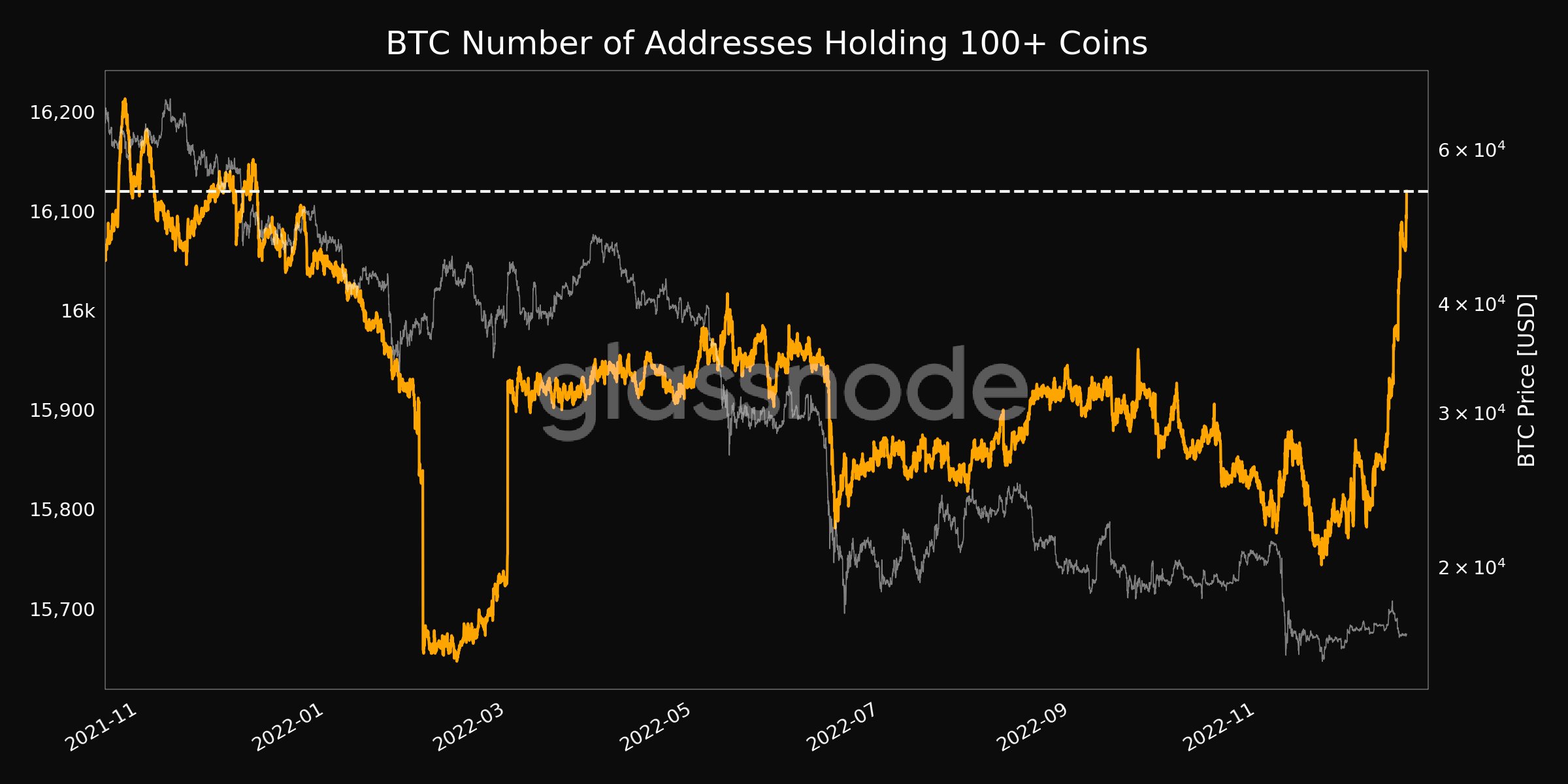
    • Bitcoin addresses with 100 or more coins hit 16,120 on 19 December 2022.
    • Each address is worth $1.67 million at current prices, increasing the number of Bitcoin millionaires to the highest level since December 2021.
    • Data also shows hodling is on the rise despite crypto winter, with 46% of BTC last active in 2+ years and 1.6 million coins last active in 1-3 months.

    Bitcoin continues to consolidate around $16,700 after weathering recent sell-off pressure. Bears remain very much in the picture, given last week’s jump to above $18,000 and then the sharp fall to current levels.

    But there’s an opportunity in the midst of all the contagion – and that is what Bitcoiners are capitalizing on.

    Addresses with 100+ coins hit 1 year high

    According to the on-chain and exchange flows monitoring platform Glassnode, sharks and whales have aggressively added to their overall holdings in the past few days.

    Indeed, as the flagship cryptocurrency’s price hovers above its notable base on Monday, on-chain alerts for BTC indicate that addresses with 100+ bitcoins now hold the most coins since last December. Per the data, large accounts with at least $1,670,000 worth of BTC as of 19 December 2022 had jumped to 16,120.

    This is a new all-time high, with the last 1-year high being 16,106 addresses recorded on 23 December 2021.

    Bitcoin addressed holding 100 or more BTC reach one year high. Source: Glassnode

     46% of Bitcoin last active 2+ years

    As large investors scoop Bitcoin on the cheap, the number of hodlers (people who buy Bitcoin and hold onto their assets long term regardless of market conditions) has also increased. As CoinJournal recently reported, whales have been busy, buying over $726 million worth of BTC despite the FTX contagion.

    The latest data on this metric shows that the amount of BTC supply last active 2+ years has 46.3%, a 22-month high. According to Glassnode, 7.5 million BTC was being HODLed (the metric also counts lost coins) as Monday 19, December 2022. The last time the measure of hodled or lost BTC was this high was in January 2021.

    Meanwhile, the number of coins last active 1-3 months is now more than 1,603,380 bitcoins. The moving average translates to a 3-month high for the number of coins that have not moved for the last 30 to 90 days.


    Source link

  • Anon Wallets Shift 226 Billion Shiba Inu Just Hours Before SHIB Reached This Milestone

    Anon Wallets Shift 226 Billion Shiba Inu Just Hours Before SHIB Reached This Milestone


    article image

    Yuri Molchan
    Mysterious whales have transferred more than 226 bilion Shiba Inu prior to this major event for SHIB
    Contents

    Twitter user @shibaplay_ has shared that in the past 24 hours, two massive transactions of Shiba Inu were performed. In these transfers, two lumps of slightly more than 100 billion meme coins were moved.

    In the meantime, SHIB has been added by this popular crypto payment gateway to its prepaid cards that can be used to pay for accessing Netflix and to buy goods on the Amazon behemoth.

    Whale moves 226 million SHIB

    The source reported that Shib transfers worth $1,221,947 and $1,049,707 have been performed not long ago, amounting to 121,829,226,162 and 104,656,752,200 meme coins.

    These were followed by another 200 billion SHIB tokens shifted in three chunks – 70, 70 and 60 billion coins.


    Ads

    Judging by data from Etherscan, these whales have been redistributing their crypto riches. Around 120 billion SHIB from these transfers were staked.

    SHIBwhales_098u2h3jewroik4wr5t
    Image via Twitter

    SHIB added by FCF Pay for crypto cards

    As reported by the Twitter account of the FCF Pay crypto payment gateway, today they added Shiba Inu for their prepaid debit cards. Prior to that, users were able to top these cards only using stablecoins.

    Previously, the company posted news on Twitter that their crypto debit card could be used for accessing goods and services on Amazon and Netflix. Now, it means that SHIB fans can pay these two giants with their favorite meme coin.


    Source link