
The Canadian government has proposed banning Bitcoin and other crypto ATMs, arguing the machines have become a primary on-ramp for fraudsters and money launderers rather than a convenient access point for everyday users.
The government’s Spring Economic Update 2026, published on April 28, says crypto ATMs are a “primary method for scammers to defraud victims and for criminals to place their cash proceeds of crime,” and explicitly states that the government “proposes to ban crypto ATMs.”
The proposal states that Canadians will still be able to buy virtual currencies from brick-and-mortar money services businesses, but the standalone kiosks that have proliferated in malls, gas stations and corner stores would be phased out.
The move adds to a broader push by Ottawa to clamp down on what it frames as retail-facing crypto risks as fraud cases surge, while bringing more of the digital asset sector under tighter federal oversight. Authorities say the move is aimed at cutting off one of the most common channels used in scams that have increasingly targeted Canadians.
The policy is of particular note given Canada’s early role in the sector. The world’s first publicly available Bitcoin ATM went live in a Vancouver coffee shop in 2013, making Canada the birthplace of the Bitcoin ATM.

Spring Economic Update 2026. Source: Government of Canada
Since then, the country has grown into one of the most crypto-ATM-dense markets globally, a status regulators say has given it disproportionate exposure to fraud. Coin ATM Radar data estimates that Canada accounts for 10.1% of global crypto ATMs, second only to the United States.
A months-long CBC investigation and internal Financial Transactions and Reports Analysis Centre of Canada (FINTRAC) analysis posted April 28 found that crypto ATMs have become the principal method used by domestic and foreign criminal fraudsters to extract money from Canadian scam victims and push those funds into the crypto ecosystem.
Law enforcement agencies told CBC they have seen a clear uptick in cases where victims are instructed to feed cash into these machines under the guise of paying tax debts, securing romance relationships or recovering hacked accounts.
Related: Canada revokes 47 crypto money licenses, vows to continue
Ban forms part of broader crypto regulatory push
The proposed ATM ban sits within a broader effort to tighten controls around high-risk corners of Canada’s crypto market while drawing core infrastructure more firmly into the regulatory perimeter.
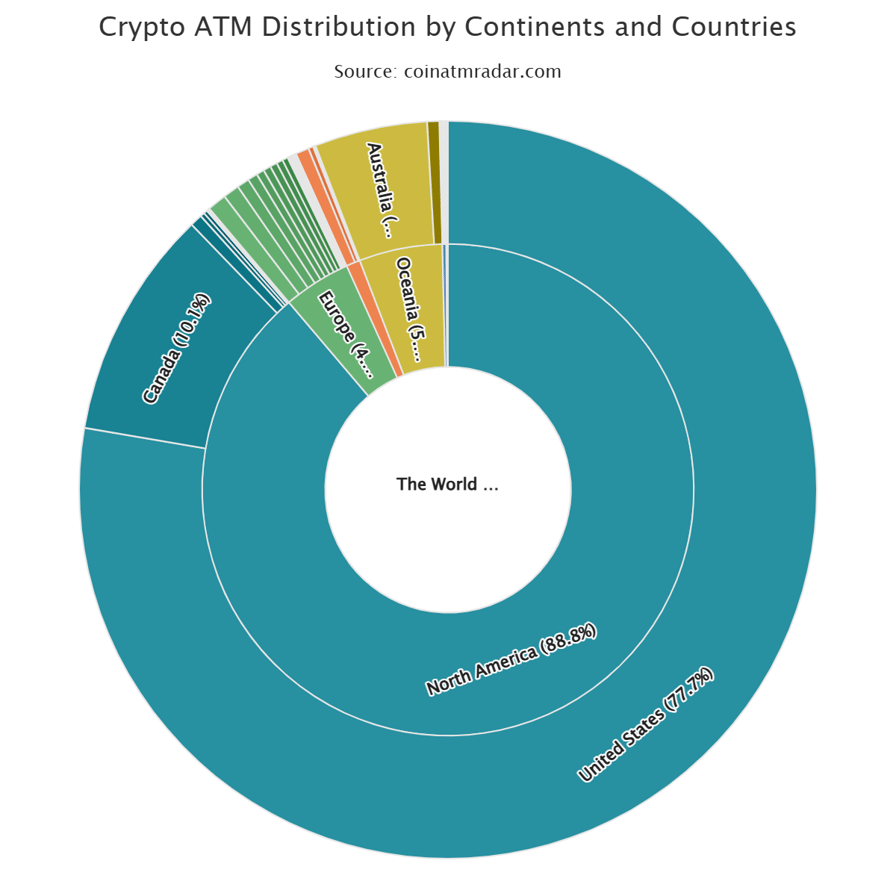
Crypto ATM distribution by continents and countries. Source: Coin ATM Radar
The same Spring Economic Update bolsters a new Financial Crimes Agency and gives FINTRAC more tools to refuse or revoke registrations for non-compliant money services businesses, including crypto companies.
In parallel, Ottawa has enacted a federal stablecoin framework in Bill C-15 that makes the Bank of Canada the supervisor and requires fiat-referenced issuers to register, fully back reserves and redeem at par, with most rules kicking in after regulations are finalized ahead of an expected 2027 start date.
Lawmakers are also advancing Bill C-25 to bar cryptocurrency donations in federal politics over concerns about traceability and foreign interference, as the country adopts a regulation-first approach to target retail-facing abuse risks and pull core digital asset rails under federal oversight.
Magazine: Bitcoin will not hit $1M by 2030, says veteran trader Peter Brandt