
A coalition of privacy and internet freedom advocates led by the Tor Project has announced a new crypto funding campaign to support censorship-resistant digital infrastructure.
The first-of-its-kind Web3 crowdfunding campaign for internet freedom tools will support 10 nonprofit projects working across privacy, censorship circumvention, secure communications and public-interest digital infrastructure, according to the campaign leaders, Tor Project and Funding the Commons.
The campaign, which kicks off May 19, accepts crypto contributions in Bitcoin (BTC), Ethereum (ETH), Zcash (ZEC), Monero (XMR) and Golem (GLM).
The campaign comes as privacy advocates argue that internet freedom is being eroded on a global scale. Internet shutdowns, including long-term systemic censorship, affected more than half of the world’s population in 2025.
Meanwhile, governments around the world are “increasingly exerting control over the technology that people depend on to access the free and open internet,” Freedom House reported.
Quadratic funding model for fairness
An initial $115,000 matching pool supported by Cake Wallet, Zcash Community Grants, Logos and Octant will amplify donations made through June 18 using a “participatory matching model” to reward broad community participation rather than large single donors.
The campaign uses quadratic funding, a model that rewards breadth of participation over donation size, meaning 10 donors giving $10 each outweigh one donor pledging $100.
The model increases support for projects backed by broader community participation, “giving more people a meaningful voice in how funds are distributed,” the coalition said.
Related: Privacy advocates slam reCAPTCHA update they say locks out de-Googled phones
“Quadratic funding is one of Web3’s answers to how critical infrastructure gets funded: Institutional money follows community signals, not the other way around,” said David Casey, director of Funding the Commons.
The Tor Project is a nonprofit with a mission to advance human rights and freedoms online by encrypting internet traffic through free and open-source tools such as Tor Browser.
Global internet freedom declines
Global internet freedom has declined for 15 consecutive years, with conditions deteriorating in almost 40% of the 72 countries assessed in Freedom House’s 2025 Freedom on the Net study.
Asia was the primary hotbed for digital censorship, with governments in 10 Asian countries, including China, India, North Korea, Thailand and Myanmar, imposing more than 50 new restrictions and affecting roughly 2 billion people.
Internet freedom in the West is also under greater threat, with the US withdrawing from the Freedom Online Coalition — an alliance explicitly committed to defending human rights and openness on the internet — in January.
Netizens are increasingly turning to virtual private networks, or VPNs, to circumvent censorship, but more than a dozen countries actively block or criminalize VPN use, while many others impose partial restrictions.
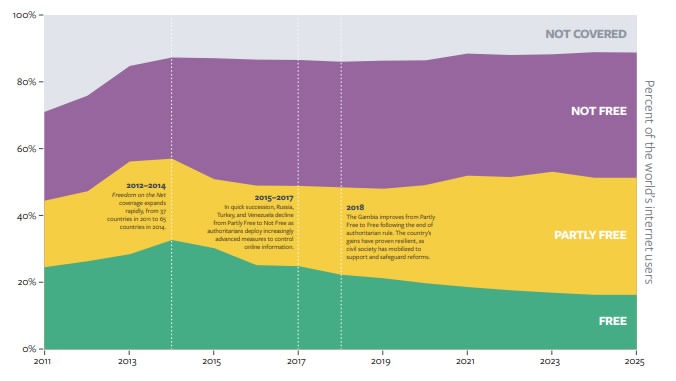
The erosion of internet freedom over the past 15 years. Source: Freedom House
In January, Iran imposed a nationwide internet blackout to suppress mass protests over the economic crisis, leading to a surge in usage of Bitchat, a decentralized peer-to-peer Jack Dorsey project that enables communication over Bluetooth.
Magazine: Guide to the top and emerging global crypto hubs: Mid-2026