Brian Armstrong posted an eight-point blueprint for upgrading global finance Monday, which closely tracks Coinbase’s expansion into stocks, prediction markets and stablecoin infrastructure, as the exchange continues its push to become an “everything” platform.
The Coinbase CEO’s priorities, posted Monday on X, include tokenized real-world assets, 24/7 global trading, stablecoin payments, AI-powered compliance, open access, capital formation, regulation and sound money.
Coinbase is broadening beyond crypto trading into payments, tokenized assets and financial infrastructure as exchanges compete to capture a larger share of global capital markets. The exchange is positioning itself against rivals like Binance and Kraken, which offer equity perpetuals and synthetic stock exposure under varying regulatory frameworks.
Some of Armstrong’s priorities already align with live products, while others remain aspirational. Armstrong’s call for “tokenization of real-world assets” and “24/7 global trading,” for example, aligns with Coinbase’s March rollout of stock perpetual futures for non-US traders, offering round-the-clock, leveraged exposure to Apple, Nvidia and major indices in 26 European countries.
The company earlier launched perpetual futures contracts for institutional clients via Coinbase International Exchange, extending crypto-style derivatives into equity products, though access remains restricted to accredited investors in select jurisdictions rather than “every person” globally as Armstrong envisions.
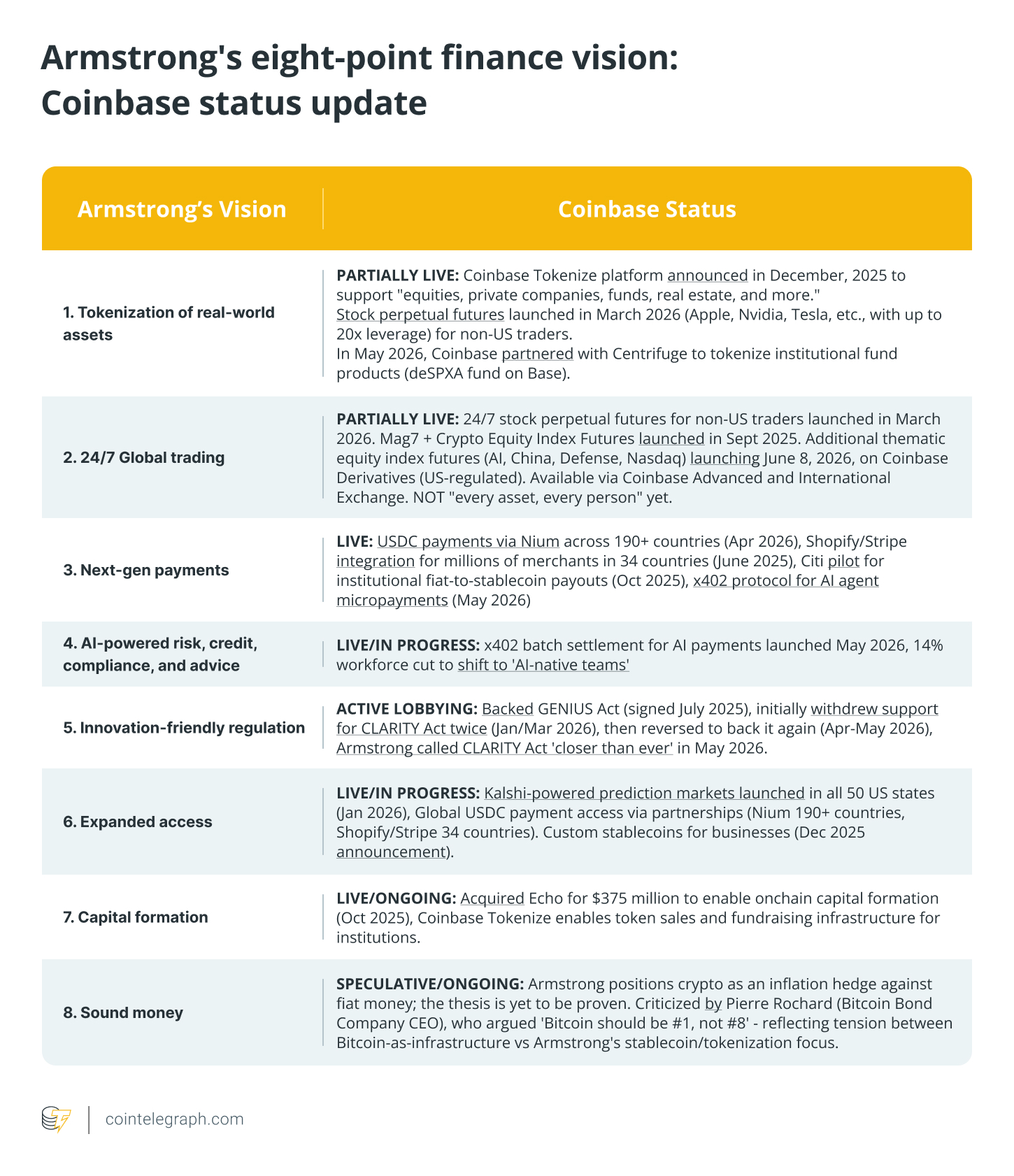
Brian Armstrong’s 8-point finance vision.
On “next-gen payments,” Coinbase partnered with Singapore fintech Nium in April to integrate USD Coin stablecoin settlement across more than 190 countries, enabling businesses to fund cross-border payouts on demand without prefunding multi-jurisdiction accounts.
The company also collaborated with Shopify and Stripe in June 2025 to roll out USDC payments to millions of merchants across 34 countries, with automatic fiat conversion and zero foreign-exchange fees.
In October 2025, Coinbase announced a collaboration with Citigroup to explore fiat-to-stablecoin payout methods for institutional clients, further integrating crypto infrastructure with traditional finance systems.
Related: KuCoin launches perpetual futures tracking Tesla and Strategy stocks
Expanding access and capital formation
Armstrong’s mention of expanded access through “open protocols” and capital formation also reflects live initiatives. Coinbase launched Kalshi-powered prediction markets in all 50 US states in January, allowing users to trade event contracts on sports, politics and culture.
The launch puts Coinbase in a market Bernstein estimates will reach $240 billion in volume this year and $1 trillion annually by 2030.
The priority for “innovation-friendly regulation” tracks Coinbase’s lobbying for the Digital Asset Market Clarity Act. After publicly withdrawing support twice, Armstrong said that CLARITY was closer than ever in early May after Senate compromises on stablecoin yield and decentralized finance provisions.
Coinbase also championed the Guiding and Establishing National Innovation for US Stablecoins (GENIUS) Act, signed into law in July 2025, to establish federal stablecoin oversight with one-to-one dollar backing requirements.
On “AI-powered risk, credit, compliance,” Coinbase backed the x402 payment protocol in May, adding batch settlement to enable AI agents to authorize micropayments below $0.0001. The feature launched weeks after Armstrong cut 14% of Coinbase’s workforce, citing a shift to “smaller AI-native teams” using automation tools to boost output.
Related: Binance launches SpaceX-linked perpetual futures ahead of IPO
Sound money as an inflation hedge
Armstrong’s final point, “sound money” as an inflation hedge, drew pushback from Pierre Rochard, chief executive of The Bitcoin Bond Company, who stated that Bitcoin should be the top priority, rather than left for last.
The pushback reflects a deeper divide: Bitcoin advocates believe it should be the foundation of a new financial system, not just a backup option when fiat currencies fail.
“Bitcoin is #1,” echoed Blockstream chief executive Adam Back, who was rumored to be Bitcoin’s anonymous creator Satoshi Nakamoto earlier this year.
Magazine: Guide to the top and emerging global crypto hubs — Mid-2026