Japan’s central bank is in focus this week as its next interest-rate meeting comes amid new 40-year yen lows against the US dollar.
Key points:
- The Japanese yen is approaching new 40-year lows against the US dollar, nearly beating its latest record from last week.
- The Bank of Japan will decide on interest-rate changes on July 31, with rates already at 1%, their highest since September 1995.
- Analysts have been warning that the yen carry trade could unwind again, repeating a major crypto headwind from 2024.
Dollar-yen seeks to reclaim 40-year record
Data from TradingView showed USD/JPY approaching 164 on Tuesday, just a fraction below new 40-year highs seen last week.
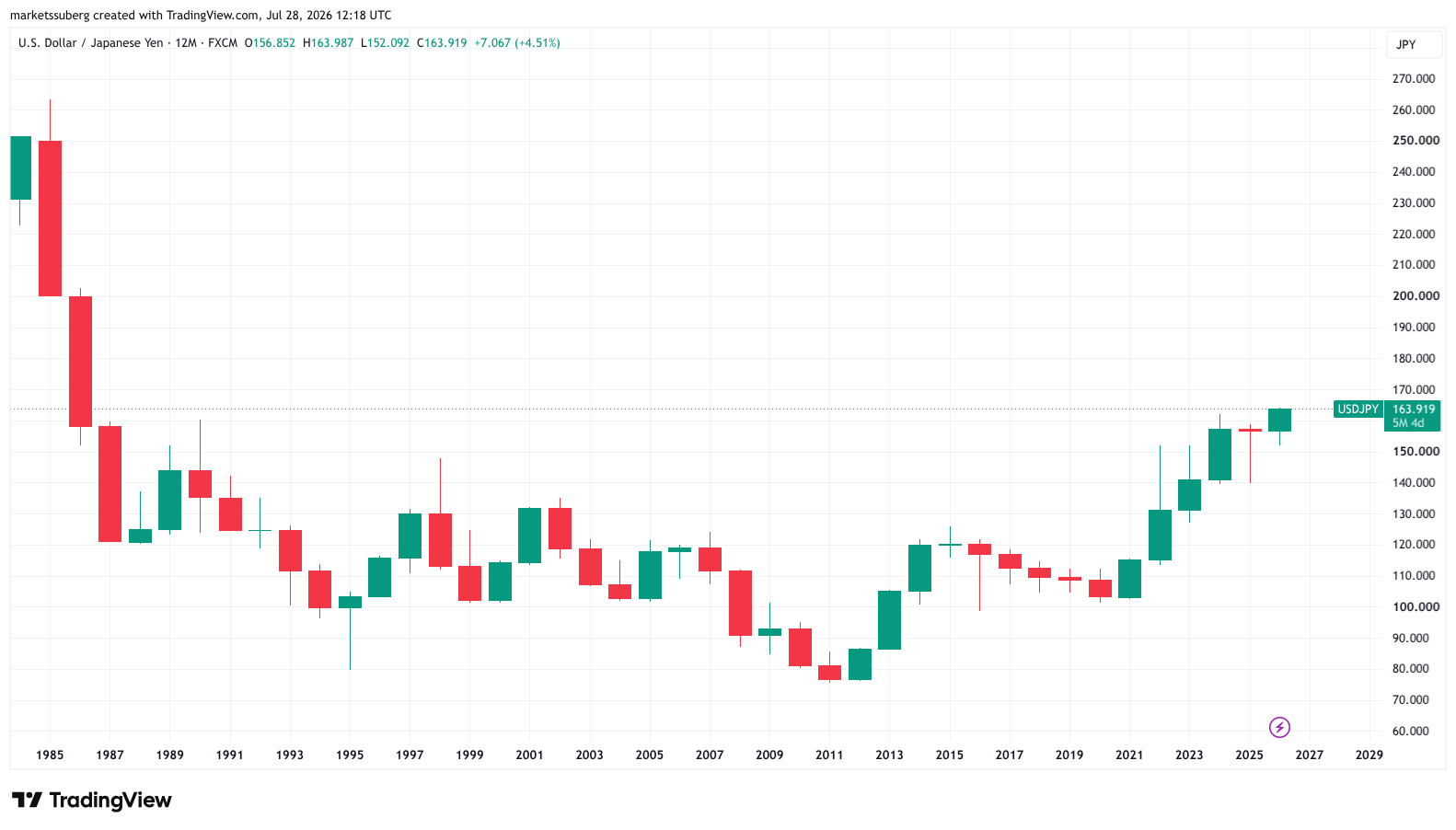
USD/JPY 12-month chart. Source: Cointelegraph/TradingView
The yen’s status as a funding currency is making BoJ monetary policy have an outsized influence on global markets. Japan’s currency markets are characterized by minimal capital controls and unmatched liquidity among non-dollar currencies.
Japan’s persistent current account and trade surpluses in earlier decades along with systemically low interest rates have made JPY the most important global funding currency. However, since Japanese inflation picked up in 2022, this has created the risk of carry trade unwinds accompanied by a liquidity crunch.
On Thursday and Friday, the Bank of Japan (BoJ) will decide on whether to adjust its benchmark rate, which at 1.0% is currently at its highest since 1995.
Markets expect rates to stay the same, with market-implied probabilities of a rate hold at 98%, given that policymakers enacted their latest raise in June. Prediction service Polymarket puts the odds of no change at 99% as of Tuesday.
At the time, however, the BoJ suggested that fresh hikes would come later. In a summary from the June meeting, it referenced inflationary trends in the form of the Consumer Price Index (CPI), coupled with historically low rates in place for the past three decades, as grounds for the change.
“As for the future conduct of monetary policy, given that underlying CPI inflation has been approaching 2% and financial conditions have been accommodative, it is appropriate for the Bank to continue to raise the policy interest rate and adjust the degree of monetary accommodation, in response to developments in economic activity and prices as well as financial conditions,” BoJ said.
Since then, a concurrent headwind, the weakening of the yen, has gathered pace, staying above the key 160 level against the dollar despite a dip following the June rate hike.
The BoJ previously noted the potential for a weaker yen to weigh on CPI growth, constricting consumer spending power.
“Attention should also be paid to the point that, with firms’ behavior shifting more toward raising wages and prices recently, exchange rate developments are, compared to the past, more likely to affect prices, and that such moves could affect underlying CPI inflation through changes in inflation expectations,” its Outlook for Economic And Prices document, issued after its April meeting, read.
Yen carry trade unwind risks global spread
For crypto traders, developments in the yen are of key importance. The yen carry trade, which can act as a liquidity source for crypto markets, is heavily influenced by BoJ moves to stabilize the yen’s exchange rate against the dollar. As Cointelegraph reported, interventions in August 2024 sparked a snap “unwinding” of the carry trade, with an immediate detrimental impact on Bitcoin and altcoins.
Related: Rate path still divides investors: Five things to know in Bitcoin this week
Now, with USD/JPY building on new 40-year highs, concerns of a repeat are growing.
“That trade only works if two conditions remain intact. Japanese interest rates remain exceptionally low. The yen remains broadly stable or continues depreciating,” analyst Ricky Ho wrote in his latest X commentary on Monday.
Ho said that carry-trade unwinds are “rarely gradual” thanks to high amounts of leverage deployed by participants.
He warned that any changes in BoJ policy could thus have wider-reaching consequences for a global economy already accustomed to the Japanese economic status quo.
“Ultimately, we think investors remain too focused on whether the BOJ hikes in September, October or December. The more important issue is that the direction of policy has fundamentally changed,” Ho said.