The leader in news and information on cryptocurrency, digital assets and the future of money, CoinDesk is a media outlet that strives for the highest journalistic standards and abides by a strict set of editorial policies. CoinDesk is an independent operating subsidiary of Digital Currency Group, which invests in cryptocurrencies and blockchain startups. As part of their compensation, certain CoinDesk employees, including editorial employees, may receive exposure to DCG equity in the form of stock appreciation rights, which vest over a multi-year period. CoinDesk journalists are not allowed to purchase stock outright in DCG.
Vachon-Desjardins allegedly operated as an “affiliate” of the NetWalker ransomware gang, which sells “Ransomware-as-a-Service” (RaaS) to affiliates like Vachon-Desjardins, who carry out the attack themselves, sharing a percentage of the booty with the developers.
“As market-moving news over the last two weeks has demonstrated, large amounts of time between margining periods causes risk to build up in the system, resulting in market swings at next open and lack of clarity over participants’ ability to cover their capital requirements,” Harrison wrote.
The leader in news and information on cryptocurrency, digital assets and the future of money, CoinDesk is a media outlet that strives for the highest journalistic standards and abides by a strict set of editorial policies. CoinDesk is an independent operating subsidiary of Digital Currency Group, which invests in cryptocurrencies and blockchain startups. As part of their compensation, certain CoinDesk employees, including editorial employees, may receive exposure to DCG equity in the form of stock appreciation rights, which vest over a multi-year period. CoinDesk journalists are not allowed to purchase stock outright in DCG.
Projects like BAYC have acted like potent contrast dyes injected into the corpus of art NFTs, helping to delineate the borderline between JPEG-as-underlying-asset poker chips and digital fine art. And now that the line has been drawn so clearly, it remains for the NFT community’s serious artists and the platforms providing their marketplace infrastructure to create a safe and inviting space for art lovers to show, buy, sell and trade their highly innovative digital work.
Waves (WAVES) continued its price rally further into this week, even as its top crypto rivals wobbled between losses and gains elsewhere in the market.
A 230% Waves boom
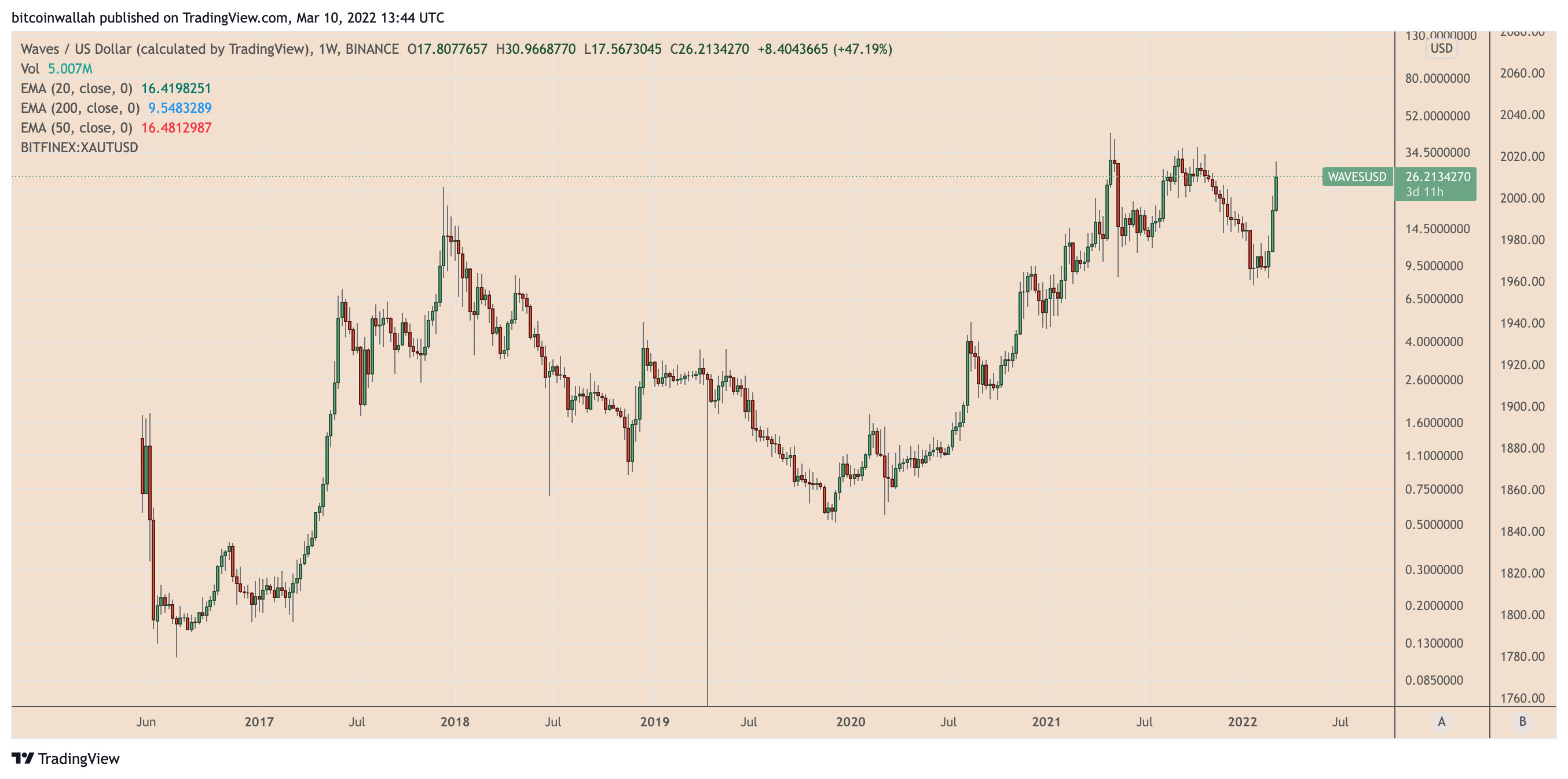
The WAVES/USD trading pair surged by nearly 75% this week to reach around $31, its best level since Oct. 28, 2021. Its rally came as a part of an upside retracement move that saw it rising by a little over 230% in three weeks.
WAVES/USD weekly price chart. Source: TradingView
In contrast, Waves’ top rival in the smart contracts sector, Ethereum, underperformed, with its native token Ether (ETH) dropping by almost 2% in the last three weeks. Similarly, Bitcoin (BTC), the leading cryptocurrency by market capitalization, underperformed in the same period, rising by a little over 1%.
Neutrino buys the Waves dip
As Cointelegraph covered earlier, Waves’ price rally might have surfaced in the wake of back-to-back optimistic updates, including the launch of a $150 million fund to support Waves-based decentralized application projects and the partnership with Allbridge to facilitate interoperability between Waves and other blockchains.
In addition, the period of Waves’ uptrend also coincided with an increase in its inflow to Neutrino’s smart contract. Notably, the supply of Waves tokens into the algorithmic stablecoin protocol increased from 43.38 million on Feb. 15 to as high as 51.80 million on March 8.
The total number of Waves tokens in Neutrino smart contract as of March 10, 2022. Source: Defi Llama
As of March 10, Neutrino held about 47.31 million Waves tokens in its smart contract, with the total value locked coming out to be worth $1.35 billion, almost 60% of the total value locked inside the Waves ecosystem.
Notably, Neutrino enables the creation of multiple decentralized stablecoins that maintain their U.S. dollar-peg by collateralizing Waves stored in Neutrino’s official smart contracts. The first such stablecoin is Neutrino USD (NUSD).
Over the past 30 days, Neutrino issued more than $135 million worth of NUSD, backed by reserves that surged from around $530 million to — as mentioned above — $1.35 billion. Meanwhile, an increasing amount of Waves tokens supplied into Neutrino’s smart contracts underscored that it was one of the most active Waves buyers since Feb. 10.
NUSD market capitalization in the past 30 days. Source: CoinMarketCap
As Waves’ price boomed, Neutrino appeared to have kept the tokens in its “reserves fund” to provide backing to NUSD in the event of the next price drop, thus limiting its downside bias.
‘Triple top’ setup
Technically, Waves may be sketching out a triple top against the U.S. dollar as its price comes closer to testing its all-time high near $42 for the third time since May 2021.
In detail, triple tops form when the price form three peaks with pullback moves towards a so-called “swing low” in between. First, they show that markets cannot penetrate the peak areas, i.e., they cannot find new buyers near/at the top level. Later, the price falls back to the swing low.
As a result, if Waves fail to close above its first and second top, its likelihood to drop towards the swing-low area between $11 and $13 — the range that has been supporting the three peaks — will be high.
The views and opinions expressed here are solely those of the author and do not necessarily reflect the views of Cointelegraph.com. Every investment and trading move involves risk, you should conduct your own research when making a decision.
The leader in news and information on cryptocurrency, digital assets and the future of money, CoinDesk is a media outlet that strives for the highest journalistic standards and abides by a strict set of editorial policies. CoinDesk is an independent operating subsidiary of Digital Currency Group, which invests in cryptocurrencies and blockchain startups. As part of their compensation, certain CoinDesk employees, including editorial employees, may receive exposure to DCG equity in the form of stock appreciation rights, which vest over a multi-year period. CoinDesk journalists are not allowed to purchase stock outright in DCG.
The leader in news and information on cryptocurrency, digital assets and the future of money, CoinDesk is a media outlet that strives for the highest journalistic standards and abides by a strict set of editorial policies. CoinDesk is an independent operating subsidiary of Digital Currency Group, which invests in cryptocurrencies and blockchain startups. As part of their compensation, certain CoinDesk employees, including editorial employees, may receive exposure to DCG equity in the form of stock appreciation rights, which vest over a multi-year period. CoinDesk journalists are not allowed to purchase stock outright in DCG.
If some observers are right, cryptocurrency mergers and acquisitions may soon become a “man bites dog” story.
This much is clear: Deal activity in the crypto sector is heating up. As mainstream adoption of cryptocurrencies grows, so has the number of mergers and acquisitions in the digital assets market. New deals or partnerships that blur the lines between traditional finance and crypto finance are announced daily. The total value of crypto-related M&A rose to $55 billion in 2021 from $1.1 billion a year earlier, according to PricewaterhouseCoopers.
Some cash-rich crypto companies have also begun to acquire traditional finance assets. In January, crypto exchange Coinbase bought FairX, a U.S.-based derivatives platform. In Europe, cryptocurrency trading and payments firm BCB Group said it would buy Sutor Bank, a 100-year-old German bank.
Public blockchain networks, which were once an anathema to traditional financial institutions, are now an acceptable topic of conversation on Wall Street. According to analysts at Bank of America, the Solana blockchain could become the “Visa of the digital asset ecosystem.”
In such a market, it doesn’t seem crazy to wonder if Visa itself, or another storied incumbent, could look to acquire or build influence over blockchains such as Solana to try to ward off a competitive threat from this new technology. In fact, Visa has been dipping its toes into the crypto ocean in areas such as stablecoins, NFTs (non-fungible tokens) and startup incubation.
CoinDesk spoke to several industry figures and asked them whether traditional finance companies could look to invest, buy a stake in or even start buying up coins to try to influence or control blockchain-based protocols. We asked them what are the barriers for financial institutions to buy coins or a stake in a network and whether traditional finance could try to absorb crypto finance in order to survive.
Surprisingly, some of them predicted the opposite: that crypto companies flush with cash might make more deals for traditional players, and acquisitions like BCB’s would no longer seem unusual. Wild as it may sound, Changpeng “CZ” Zhao, CEO of leading crypto exchange Binance, recently said he’s eyeing non-crypto acquisitions in order to “make the crypto industry bigger.”
As referred to above, there is precedent for such table-turning acquisitions from the dotcom era two decades ago, when early internet on-ramp AOL took over media dinosaur Time Warner (although the fate of the combined company might serve as a cautionary tale for would-be crypto empire builders).
Here’s what the experts said:
Hany Rashwan
Co-founder and CEO of crypto ETP issuer 21Shares
Judging by history, I would predict that M&A will go the other direction. Crypto companies are cash-rich fast movers that are building a fundamentally 10 times better product than traditional finance. We are looking at a lot of traditional finance assets that look very cheap right now.
Legacy incumbents with a poor track record on innovation typically have an inability to monetize, retain and grow innovative fast-moving startups. Internet history is littered with examples of these incompatibilities in a lot of different styles, from AOL’s $164 billion “merger of equals” with Time Warner in 2001 to Yahoo’s value-destroying acquisition by yet another legacy media company, Verizon, in 2017.
It is hard to see a slow-moving incumbent that lacks innovation and technology culture to somehow both acquire and expand a cutting-edge crypto startup company.
While there are no disclosure rules in crypto, it will be difficult for an outside party to come into these ecosystems and “control” without the implicit buy-in from the specific community that is underpinning the protocol, DAO (decentralized autonomous organization) or foundation targeted. When the community can just pick up, copy the project (fork) and leave, community buy-in and support will be so much more important than how a normal hostile takeover happens in the traditional world.
It’ll be quite difficult for these traditional companies to stage a hostile takeover of a top crypto community without creating an ugly backlash and exodus from the community. In many cases, it would be as silly as some company in 1996 trying to take over and control the internet. Traditional players can and should build applications on top of these technologies and protocols. We have already seen top banks experiment with settlement and clearing on blockchains, and I would expect to see more experimentation from these players in the future.
Paul McCaffery
Head of alternative capital sales/co-head of equities at U.S. investment bank Keefe, Bruyette & Woods (KBW)
I do think you might see an increase in crypto firms acquiring banks for their charters and funding as the crypto balance sheet and earnings profile matures. However, I think that even after [Wednesday’s] presidential executive order, we need actual regulatory clarity for this to really pick up any steam.
Right now, many crypto firms are making a lot of money and just funneling it all into customer acquisition, but that isn’t going to last. Fees will compress as incumbents get more involved in the crypto space, and when profitability expectations increase, these firms will have to make more money on their lending/deposit-oriented activities.
Separately, I can see a scenario, though, where we get some regulatory clarity around digital assets at some point, and if stablecoin issuance has to go through federally insured deposit institutions such as the [President’s Working Group] report suggested in November, bank charters could become additive to certain crypto platforms (i.e. think like a Circle or Gemini, anyone who issues a coin).
For now, the hurdles [for traditional players looking at crypto] remain lack of regulatory clarity, onerous capital requirements (i.e. banks as relates to 100%+ risk weightings) and ill-suited GAAP (generally accepted accounting principles) intangible asset accounting rules. Clarity on these items will also be required to see real appetite for the traditionals.
I also think the public market traditional finance group is currently constrained by the loftier private market valuations at this point. However, I would imagine you will see increasing participation from bank and payment companies in blockchain networks, like Tassat and USDF. There are already hundreds of banks that have expressed interest in Tassat and USDF.
James Stickland
CEO of institutional crypto trading platform Elwood Technologies
These two events would have been unimaginable even two years ago.
Further, these worlds are already colliding. For example, Coinbase, a publicly listed crypto company, bought BRD wallet, merging a decentralized wallet with their centralized one.
Ultimately, we will see further mergers between traditional and digital-native companies, but I think it’s unlikely to be in the form of buying tokens instead, forming long-standing partnerships. This trend will only continue as we see more institutions entering the digital asset market.
Oliver von Landsberg-Sadie
Founder and CEO of crypto trading and payments services firm BCB Group
Traditional finance simply can’t ignore the speed and efficiency that blockchain is bringing to payments. The improvements that this technology has made on the speed and costs of remittances is disrupting the market and payment companies, and banks have a number of options to adapt to this new reality. We are seeing the crucial role of partnerships throughout the industry, but we have yet to see if traditional players will maintain their position with current strategies to increase their leverage on these faster, cheaper networks.
This raises questions on how much control could traditional finance expect to achieve beyond internal blockchain innovation and M&A, leaving options such as acquiring enough coins on a blockchain to influence its future development. The decentralized structure of blockchain is designed to push back any centralized control, though this will be continually tested by the technological and financial firepower of leading stakeholders and from those with the most to lose and gain.
So far, we have seen incredible resilience in maintaining the integrity of decentralized networks and traditional finance will continue to enable centralized finance to access the crypto markets. We are starting to see a hybrid approach where the parallel systems of CeFi (centralized finance) and DeFi (decentralized finance) can work harmoniously together while taking on the best each has to offer.
TradFi (traditional finance) may want to eat DeFi, but its eyes may be bigger than its stomach.
Thomas B. Michaud
President and CEO of KBW
The collision between blockchain and payments is gaining traction (witness the growing collaboration that has been announced).
The current payment system was essentially developed in the 1970’s. It is time for modernization, and blockchain offers a contemporary alternative to how payments are made, especially in a B2B context.
Regulation is coming. The gap between innovation and regulation is about as wide as I have ever seen it. Expect the gap to narrow with the government stepping up to provide guardrails and guidance to the industry.
More likely than M&A activity, I believe the near future is going to be driven by joint ventures and collaboration. Fintechs and traditional financial institutions have a great deal to offer each other, but a JV reduces risk and allows for substantial upside for both parties.
JVs also allow for the usage to expand faster as more financial institutions are able to offer the product and services.
Elie Bonin
Head of digital assets trading at market maker GHCO
I believe we are in the wake of a silent revolution. Bit by bit, renowned companies get exposure to crypto, be it by owning coins or by accepting tokens as a means of payment.
Crypto is not only about money and cheap transactions, it is also about decentralized consensus and infrastructure maintenance; it is a formidable opportunity for companies to reduce operational costs. As robots replaced men, blockchain will replace companies’ computers and databases. They will simply need to operate logic on top of these.
In these times of meek economic growth, my take is that governments perceive this as a potential pool of growth and innovation, which leads to favorable regulations here and there.
With this in mind, should you be a private company, you truly only have three choices: to ignore the whole crypto topic and endure the opportunity cost; to partake in its evolution by eventually becoming what we call a chain validator, reaping transaction fees as an additional source of revenue; or to convert themselves by building products directly on the blockchain
Having said that, should we take the example of Visa and Mastercard, their profit margins are respectively 51% and 46%. There is no rush for them to [make] a pro-crypto transformation. For the likes of the banks, because of the immense regulatory hurdles, I frankly doubt we see serious involvement from them any time soon. Simply getting crypto profits from an exchange to a bank account gives them cold feet.
Being involved in a blockchain as such does not necessarily give you control over it. As Vitalik [Buterin, one of the co-founders of the Ethereum blockchain] said in a paper, the goal of crypto economics is to avoid this new technology encountering the usual human governance and decision-making issues.
In the case of Ethereum and Bitcoin, upgrades are subject to a rough consensus that involves all the vested interests. Owning a substantial part of the coins will not grant you additional decisional power. A private company that would like to delve and get actively involved into crypto should keep this in mind: They agree to delegate to the community the power to decide on certain topics.
The likes of Visa and Mastercard could achieve inorganic growth through crypto, tapping into new markets, but without the certainty to achieve control over it, no matter the amount invested.
Frank Schuil
CEO and co-founder of crypto exchange Safello
It’s clear that traditional financial players will acquire their way into a market if needs be. We can look at the acquisitions of Tink by Visa and Aia by Mastercard to see a real-life example of the companies’ ability to adapt to change, in this case open banking.
Influence over decentralized protocols is much harder to do, and it’s a losing game. Influence over one protocol leads to copycats; we have seen that numerous times in our industry. And efforts to build centralized solutions to compete with decentralized solutions have proven to be futile time and time again, as well.
Instead the companies’ leading the payment space today will adapt to the technology through make-or-buy decisions and/or lobby to outlaw their competition. We see similar efforts underway in the United States, where legislation is proposed by the SEC (Securities and Exchange Commission) to curtail the DeFi market.
The size and maturity of the crypto industry makes it unlikely that TradFi will eat the entire industry. There will be those financial institutions that adapt and those who won’t. The analogy here is closer to how the internet impacted TradFi than for instance PSDII/open banking. There are 6,008 banks in Europe alone, how many of them have the competencies, appetite and go-to-market timeline luxury to do this themselves? How many will hold out while customer demand gets stronger both on the retail and corporate side? It’s likely going to be a frenzy once MiCA regulation comes into effect to power TradFi offerings with crypto capabilities. (MiCA, or Markets in Crypto Assets. is the European Commission’s proposed set of regulations.) We will gladly help them, it’s a foundational principle of our company.
Compliance is the biggest thing holding adoption back. In Europe, this will change with MiCA. Until then, TradFi will need to keep it off balance sheet and partner up or sit on the sidelines.
UPDATED (March 10 16:56 UTC): Edits and updates quotes from Elwood Technologies CEO.
The market capitalization of gold-backed crypto tokens increased by 60% in 2022 to surpass $1 billion for the first time in history, according to Arcane Research in its latest weekly report.
Gold shines, Bitcoin disappoints
In 2022, investors have been rushing to the perceived safety of gold-backed crypto assets, whose value is pegged to the price of gold.
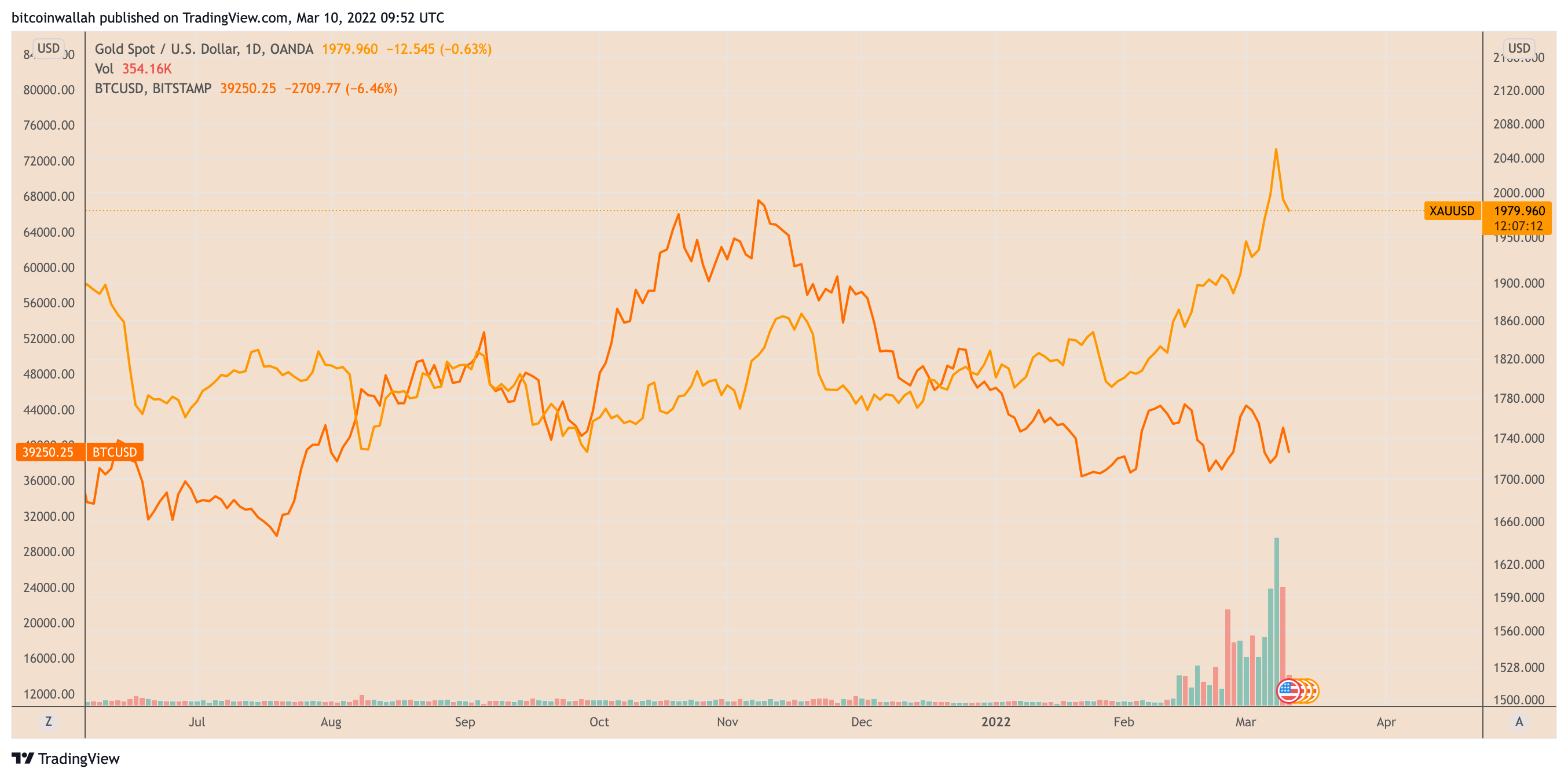
Namely, PAX Gold (PAXG), Tether Gold (XAUT) and similar precious metal-backed digital assets have been climbing in value as investors “diversify inflation bets” within the crypto sector, explains Arcane Research. PAXG is also outperforming Bitcoin (BTC) this year, as shown in the chart below.
XAU/USD versus BTC/USD daily price chart. Source: TradingView
Gold, itself, rose by almost 14% YTD to nearly $2,050 an ounce, its highest level since August 2020. Arcane noted:
“The rallying gold price seems to have attracted more crypto investors to the gold-backed tokens […] since they allow crypto investors to diversify inflation bets through familiar crypto market infrastructure.”
PAXG outperforms XAUT
PAX Gold contributed the most — around $500 million — while swelling the gold tokens’ market valuation to over $1 billion. In comparison, its top rival, Tether Gold witnessed minimal growth, Arcane noted while citing the chart below.
Gold-backed tokens’ market cap. Source: CoinGecko, Arcane Research
Currently, the total market cap of PAX Gold is a little over $607 million, up 85% YTD. Similarly, Tether Gold’s market valuation rose to nearly $211 million, up just 9.20% in the same period.
Intelligent money behind the gold-token rally
Alexander Tkachenko, founder and CEO of VNX — a Luxembourg-based, FMA-regulated tokenized gold investment platform, explains that intelligent investors have been more cautious when investing in cryptocurrencies. He adds that their decision to invest in gold-backed tokens shows their inclination to adopt regulated digital assets amid the ongoing macro uncertainty.
Tkachenko said:
Not all gold-backed tokens are of good value. Therefore, investors should be careful not to get a “paper index,” but look for tokens that are linked to physical gold and are “secure” — issued by regulated issuers and can demonstrate the gold reserves.
PAXG’s issuer is Paxos, a New York State-chartered trust company regulated by the New York State Department of Financial Services (NYDFS). That translates into lesser overhead risks, especially when confirming that each PAXG in circulation is 100% backed by an ounce of gold.
However, XAUT doesn’t appear to have been regulated by any regulator in any jurisdiction inside or outside the United States. Its whitepaper also states that “no regulatory authority has examined or approved” its claims of being backed by gold.
The views and opinions expressed here are solely those of the author and do not necessarily reflect the views of Cointelegraph.com. Every investment and trading move involves risk, you should conduct your own research when making a decision.