Category: NEWS

  • Bitcoin shrimps to fish added 254% of mined BTC last month

    Bitcoin shrimps to fish added 254% of mined BTC last month

    • Bitcoin’s price struggles aside, last month saw more entities with less than 100 BTC buy 2.54X of all coins mined.
    • Glassnode data shows these entities added 2,286 BTC per day.
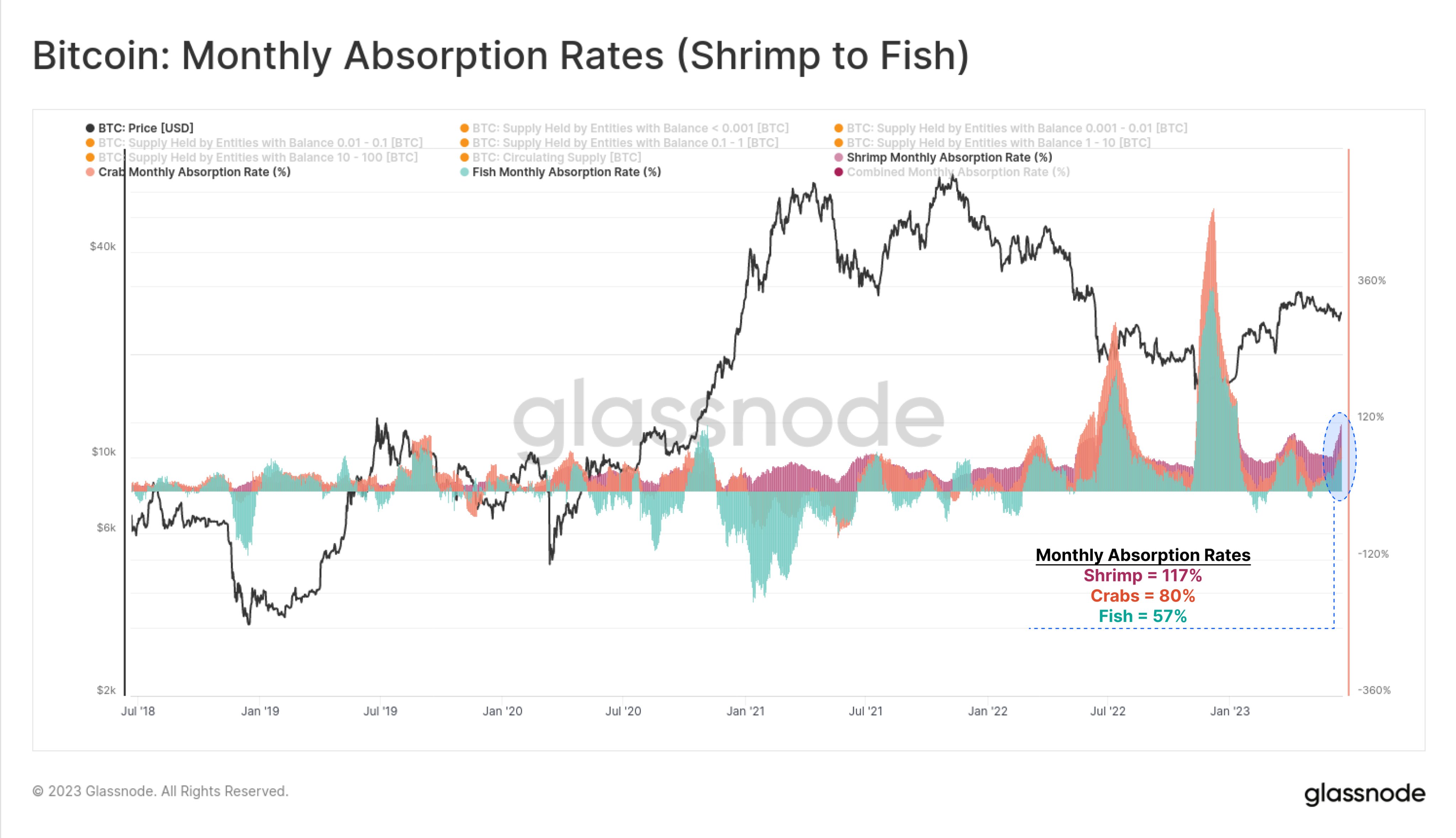
    • Shrimps increased their BTC holdings by 117% last month, while crabs added 80% and fish bought 57% of mined bitcoin.

    It appears Bitcoin (BTC) wallet addresses with under 100 BTC have used the recent dump in the flagship cryptocurrency’s value to add to their positions.

    According to on-chain data shared by Glassnode, the cohorts from shrimps (less than 1 BTC) to fish (less than 100 BTC), purchased 2.54x of daily mined supply over the past month. With the current daily mined coins at approximately 900, these entities scooped 2,286 BTC per day.

    Shrimps and crabs increase total BTC holdings 117% and 80% respectively

    As can be seen in the chart below, the monthly absorption rates for shrimps, crabs and fish was 117%, 80% and 57% respectively. That’s a massive 254% in terms of the share of mined coins – shrimps, crabs and octopus and fish added to their total holdings last month. With Bitcoin price around $26,300, that’s more than $60 million worth BTC per day.

    Bitcoin monthly distribution rates for shrimps, crabs, octopus and fish. Source: Glassnode

    Shrimps now hold 1.26 million BTC, or 6.6% of the total circulating supply, up from roughly 4.86% a year ago. Crabs account for 2.03 million BTC, which is 10.5% of circulating supply. The cohort’s total holdings have increased from 8.7% from a year ago.

    Meanwhile, the supply held by whale entities continued to decline and stood at 34.4% as of June 2023. This is a decline of 45% since Bitcoin’s first halving in 2012, when whales accounted for 62.7% of total BTC supply. 

    Whales currently hold approximately 6.64 million BTC, down from a peak of 7.8 million BTC in 2016.


    Source link

  • China will lead crypto’s next bull market

    China will lead crypto’s next bull market

    • Arthur Hayes says the crypto autumn rally will be catalysed by Chinese traders.
    • According to the BitMEX co-founder, a weakening of the yuan amid massive credit issuance will drive capital into crypto markets.
    • He notes that “Hong Kong will be the conduit through which Chinese capital is allowed to own crypto.”

    Arthur Hayes, the co-founder and former CEO of crypto exchange BitMEX, believes the next crypto market rally will be shaped by the Chinese trader.

    In an opinion laid out in his latest blog post, Hayes highlights that the US Securities and Exchange Commission (SEC)’s current crackdown on crypto might be a negative trigger. The crypto market is likely to freak out and crater even further due to this.

    However, according to the entrepreneur, it is not the US but China that could hold the baton as crypto heads into the next bull market. And the one catalyst to watch out for would be the “return of the Chinese trader” amid the weakening of the Chinese yuan.

    The return of the Chinese crypto trader through the financial pipes of Hong Kong will reignite the market at the same time the broke-ass American mass affluent are effectively shut out,” Hayes wrote in the blog post published June 16.

    Hayes explains how China leads the next bull rally

    The current market setup is much like the summer of  2015, that “nuclear bear market” whose catalyst was the implosion of Mt. Gox

    Just as then, the 2022 bear market that included the implosion of FTX has volatility and trading volumes dried up and the sideways price action excruciatingly boring. Indeed, compared to 2015 when Bitcoin price traded near $200 for a long time, 2023 is seeing this with prices ranged below $30k since the breakdown in November 2022.

    But in August of 2015, the PBOC suddenly sparked a rally in China’s interest for Bitcoin with a “shock” devaluation vs. the USD. From August to November of 2015, the price of Bitcoin tripled, with Chinese traders driving the market higher. I believe something similar could happen in 2023,” Hayes noted.

    According to the BitMEX co-founder, the above is an outlook he sees materializing as the world’s second-largest economy embarks on an insane credit issuance spree. On why selling now amid concerns around the US regulatory environment “is misplaced.” Why?

    At some point, the selling will stop, and then we get the dreaded sideways. The boring sideways price action will reign until something jump starts the degen spirits of crypto traders.”

    That trigger, he says, will be a slowdown in China’s economy and the subsequent money printing spree that will weaken the yuan and see massive inflows into crypto. He explained:

    The less the Chinese economy grows, the more credit will be issued. Then the currency will weaken, capital will be allowed to “flee” into appropriate vehicles, and finally, the crypto capital markets will be provided with the spark to hopefully start the autumn rally.”

    To weaken the currency, Hayes says the Peoples Bank of China (PBOC) will look to encourage credit growth sectors of the economy deemed “good.” These areas include semiconductors, artificial intelligence (AI), clean energy, and property. The central bank will allow these “good” sectors to access higher loan quotes, with banks “instructed to lend a certain amount of yuan to these sectors.”

    The weakening of the yuan, and the focused approach to attracting crypto and blockchain in Hong Kong are going to be key factors, he added. It is a trajectory that best suits HODLers. The crypto bull summed up his market outlook:

    I have predicted before and continue to believe that Hong Kong will be the conduit through which Chinese capital is allowed to own crypto financial assets.” 

    Source link

  • Bitcoin correlation with stocks at 5-year low as regulatory crackdown takes toll

    Bitcoin correlation with stocks at 5-year low as regulatory crackdown takes toll

    Key Takeaways

    • Our Head of Research, Dan Ashmore, digs into Bitcoin’s relationship with stocks
    • Correlation between Bitcoin and the Nasdaq is at its lowest point since 2018
    • The Nasdaq is up 10% in the last month as stocks have surged off softer forecasts around interest rates and the macro climate
    • Bitcoin is down 9% in the same time frame, the US regulatory crackdown spreading fear about crypto’s future in the country 
    • Ashmore writes that the break in correlation surpasses what was seen in November 2022 amid the FTX collapse, when Bitcoin fell to $15,000 while stocks increased off positive inflation readings

    After ten consecutive interest rate hikes, the US Federal Reserve this week paused its rate hiking policy. The move was nearly unanimously anticipated by the market and movement after the meeting was relatively minimal.  

    However, over the past month, markets have been flying. The S&P 500 is up 6% in the last 30 days, now only 8.8% off an all-time high, despite being 27% below the mark in October. The Nasdaq is up 10% over the same timeframe – that is 15% below its all-time high from November 2021 but a tremendous resurgence considering it shed a third of its value in 2022.  

    And yet, something is being left behind: Bitcoin. 

    Bitcoin is now trading below $25,000 for the first time in three months. I put together a deep dive in March analysing the its underlying price movement to show how tightly it trades with the stock market. This was at a time when Bitcoin was rallying and banks were wobbling amid the Silicon Valley Bank fiasco. Suddenly, it was fashionable to declare Bitcoin as decoupling from the stock market. Ultimately, that wasn’t true. However, something very interesting has happened in the last month. 

    First, take a look at the path of the Nasdaq and Bitcoin since the start of 2022, which roughly coincides with the start of the bear market: 

    Clearly, the two have moved in lockstep. But two episodes jump out: the first is November 2022, when Bitcoin fell and the Nasdaq surged. The second is this past month. We discussed the 10% jump in the Nasdaq over the last month. However, Bitcoin has fallen 9% in the same timeframe. This marks a clear departure from what we would expect. Plotting the correlation (using 60-Day Pearson) shows this more directly:

    I touched on November 2022 above, and the swift fall in correlation can be seen on the chart. This was when FTX collapsed, sending the crypto market into a tailspin. At the same time, however, stocks raced upwards as softer inflation numbers were met by lower expectations around the future path of interest rates. 

    There were also less dramatic (but equally temporary) decouplings between Bitcoin and stocks in April/May 2022 and June/July 2022. On the chart below, I have pencilled in incidents which occurred during these periods:

    Indeed, what is different about November (FTX) and today is that we see a Bitcoin fall happening at the same time as a Nasdaq surge. While the Luna and Celsius incidents hurt crypto immensely, they came as stocks were also struggling and so the effect is not as dramatic in terms of correlation breaks (although is still tangible on the chart).

    But today, we are seeing the biggest break in the correlation trend over the last couple of years – surpassing even FTX. The 60-Day Pearson currently sits at -0.66, whereas the lowest it hit during the FTX crisis was -0.49. 

    Regulatory crackdown is suppressing prices

    The reason is obvious. The great regulatory crackdown in the US is freaking the market out, and for very good reason. The two biggest crypto companies on the planet, Binance and Coinbase, were both sued last week. 

    Crypto.com has suspended its institutional exchange, citing weak demand amid the regulatory woes. eToro and Robinhood pulled a bunch of tokens from their platforms following confirmation from the SEC that it viewed them as securities. Liquidity is dropping like a stone

    I wrote in-depth about the concern following the announcement of the Coinbase lawsuit last week, so I won’t rehash it here (that analysis is here). While I believe Bitcoin should be able to weather the storm long-term, the picture appears far murkier for other cryptocurrencies. 

    Make no mistake about it, the crypto industry faces a massive problem as long as lawmakers continue to turn the screw. The crisis very much feels existential for a lot of the crypto market. 

    Regarding Bitcoin, enthusiasts dream of a day when it can decouple and claim that title of uncorrelated hedge asset, or a store-of-value, akin to gold. I’ve done a lot of work around what that hypothetical future could look like, or what could lead the market to that point. But for now this remains just that: hypothetical.  Because while the correlation is at its lowest point in five years, it is not being driven by fundamentals and thus will inevitably spike back up. This is nothing more than the market reacting to what is a very bearish development around regulation in the US. 

    It’s not how investors hoped a decoupling would come. But if anyone doubted the market’s fear over the regulatory woes, or questioned why Bitcoin had not fallen more, looking at the break in correlation paints a very clear picture of how detrimental Gary Gensler’s games have been to the cryptocurrency industry. 

    In truth, it is not hyperbole to say that this is the most out of whack Bitcoin’s correlation has ever been whilst trading as a mainstream financial asset. Because back when it last happened in 2018, Bitcoin traded with such thin liquidity that its price action is largely irrelevant to draw conclusions from going forward. 

    Source link

  • Bitcoin price dips below $25k after Fed decision- what next?

    Bitcoin price dips below $25k after Fed decision- what next?

    • Bitcoin price fell below $25,000 after the Fed rate pause news.
    • An analyst points out that the decline saw bulls lose a 7-month trendline support and $20k-$22k could be next.
    • The main resistance zone is between $26k and $28.3k, which can be touched if BTC bounces back.

    Bitcoin price broke below the $25,000 level overnight Wednesday as bulls failed to hold a key support zone, with the new price weakness coming after the US Federal Reserve’s interest rate pause decision.

    Bitcoin had consolidated near $26k ahead of the Fed’s decision. However, as the markets reacted to the news, BTC dipped past $25,500, losing a major trendline that has acted as upside support for the past seven months.

    Analyst share short term Bitcoin price prediction

    Bitcoin’s decline below $25k now puts bulls at risk of further rot, a scenario that could crystalise if bears take control. In this case, downside pressure could allow sellers to target new lows.

    Crypto analyst Captain Faibik says:

    $BTC Bulls have lost the 7-Month Major Trendline, Not a good Sign..!! Is it a TRAP or Bears are back in the Town? If it’s a trap and Bitcoin bounces back, reclaiming the 26.7k resistance, we could witness a Bullish Rally towards 31k. If Bears are back, Bitcoin may face more downward pressure, possibly testing the 20-22k area.”

    Bitcoin price chart shared by Captain Faibik on Twitter

    Another analyst, Ali, says BTC has its most important support area in the $22.7k-23.6k region. On the upside, the main resistance zone lies between $26k and 28.3k. This suggests a bounce could see Bitcoin reclaim this zone and possibly look to retest the $30k area.

    Bitcoin sits on thin ice! Notice the most important support zone is between $22,785 and $23,595 where 1.34 million wallets hold 450,000 $BTC. On the flip side, #BTC faces stiff resistance between $26,000 and $28,250 where 5.18 million wallets bought 2.1 million BTC,” the analyst tweeted.

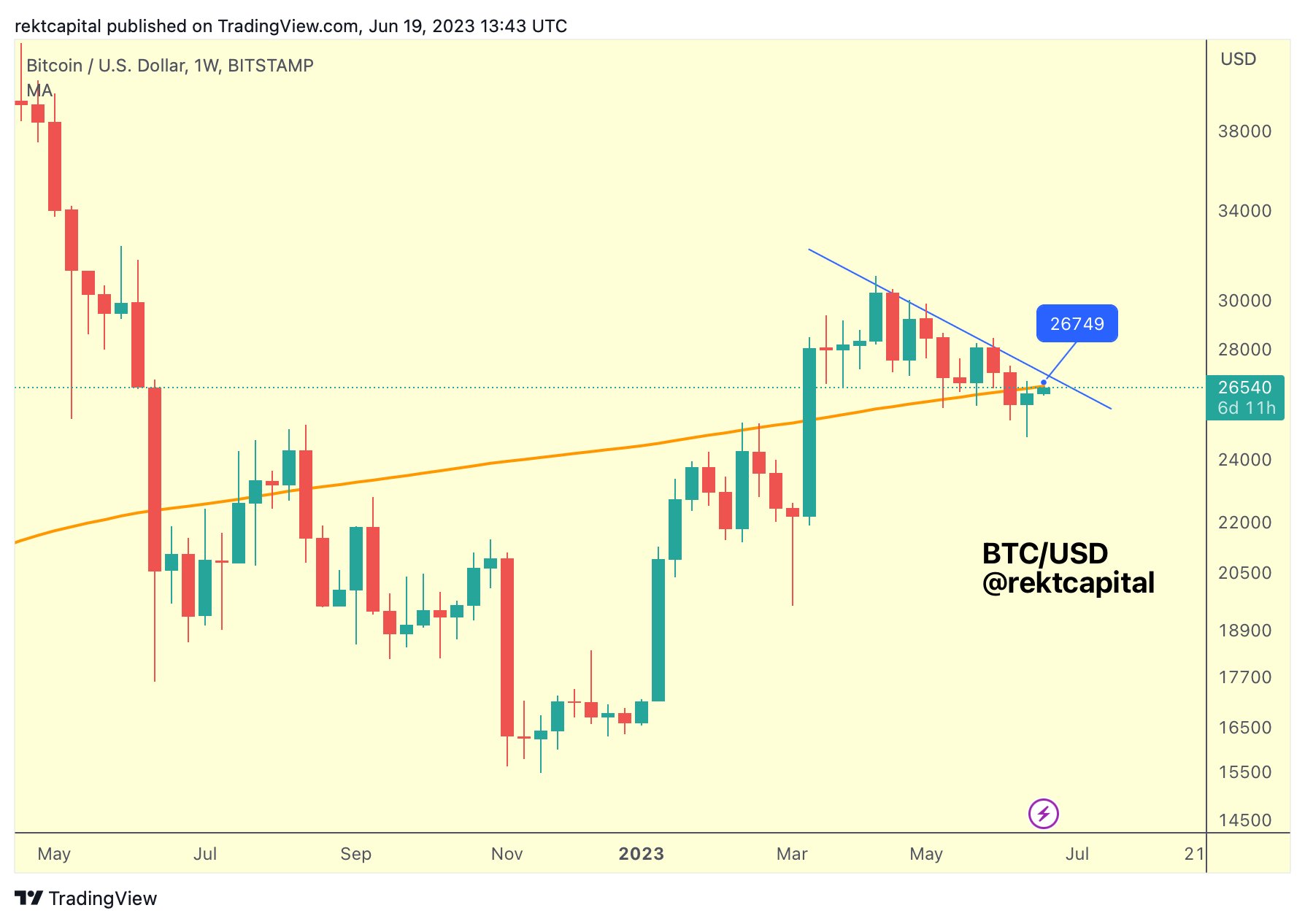
    While the sub-$25k level offers a buy the dip opportunity, crypto analyst Rekt Capital notes that the loss of $26,600 threatens turning it into stiff resistance. A rejection of this level after the Weekly Close below could mean “lower $20000s await.”

    Bitcoin traded at $24,878 early Thursday morning, about 4% down as altcoins mirrored the losses. The total crypto market cap was down 3.8%, with Ethereum trading at $1,674 and XRP at $0.47 – down 6% and 7.3% respectively at the time of writing.


    Source link

  • what is saw token the new memecoin – sponsored post

    what is saw token the new memecoin – sponsored post

    Buy $SAW

    The intention with SAW is to provide an environment not only beneficial to the holder but also to all communities.

    Buy $SAWOpen TerminalCommunityChart

  • Crypto industry ‘destined’ to be BTC-focused due to regulators, says Michael Saylor

    Crypto industry ‘destined’ to be BTC-focused due to regulators, says Michael Saylor

    Key takeaways

    Crypto industry will be BTC-focused

    MicroStrategy co-founder Michael Saylor believes that the cryptocurrency industry is destined to become BTC-focused. He made this statement during an interview with Bloomberg.

    According to Saylor, Bitcoin is the only major cryptocurrency that has been excluded as a security by the US Securities and Exchange Commission (SEC). He pointed out that the regulatory agency doesn’t see a legitimate path forward for cryptocurrencies

    Saylor also added that cryptocurrency exchanges would fuel a price surge in Bitcoin in the near term. He stated that;

    “[The SEC’s] view is crypto exchanges should trade and hold pure digital commodities like Bitcoin, and so the entire industry is kind of destined to be rationalized down to a Bitcoin-focused industry with maybe a half a dozen to a dozen other proof of work tokens. The next logical step is for Bitcoin to 10x from here and then 10x again.”

    Bitcoin’s market dominance increases to 47%

    Bitcoin began the year with a market dominance of 40%. However, thanks to the rally experienced in the last few months, Bitcoin’s market dominance now stands above 47%. 

    Saylor believes that Bitcoin’s market dominance will reach 80% as more institutional funds will enter the market after confusion and anxiety over crypto disappear. 

    MicroStrategy has been buying more bitcoins despite the ongoing bear market. In March, the company purchased 6,455 bitcoins worth $150 million. Saylor’s company currently holds more than 138,900 bitcoins.

    The world’s leading cryptocurrency has been underperforming in recent days. At press time, the price of Bitcoin stands at $26,001, down by more than 3% in the last seven days.

    The broader cryptocurrency market has also seen its total cap increase since the start of the year. At the start of the year, the total cryptocurrency market stood above $700 billion. The total cryptocurrency market cap has since climbed past the $1 trillion mark.

    Source link

  • Here’s why the Nasdaq 100 and Bitcoin correlation has faded

    Here’s why the Nasdaq 100 and Bitcoin correlation has faded

    • Bitcoin price has crashed by about $6,000 from its highest point this year.

    • Nasdaq has moved into a strong bull market because of AI.

    • The Federal Reserve will conclude its two-day meeting on Wednesday.

    Nasdaq 100 and Bitcoin prices have moved in the opposite direction in the past few weeks. The tech-heavy Nasdaq 100 index has soared to the highest level since April last year. In all, it has jumped by almost 40% from the lowest level this year. 

    Bitcoin price, on the other hand, has been stuck at the important support level at $25,200. It has dropped by more than $6,000 from its highest level this year. In the past, Nasdaq 100 and Bitcoin had a close correlation because they are often seen as high-risk assets.

    Regulatory concerns

    The main reason why the Nasdaq 100 and Bitcoin price correlation has faded is the ongoing crackdown in the United States. On Monday last week, the Securities and Exchange Commission (SEC) filed a major lawsuit against Binance, the biggest company in the industry.

    The agency accused the company of deceptive practices, commingling funds, and offering its services in the United States illegally. Then on Tuesday, the SEC filed a lawsuit against Coinbase, the biggest company in the US. It accused Coinbase of listing unregistered securities to American customers.

    The regulatory crackdown comes at a time when the crypto industry has gone through a challenging period. Last November, FTX, a major crypto exchange filed for bankruptcy, costing invetors billions of dollars. 

    Crypto companies argue that the SEC and other policymakers have not issued clear guidance about the crypto industry. For example, Coinbase questioned why the SEC allowed it to go public if it offered illegal products.

    Why Nasdaq 100 index is soaring

    On the other hand, the Nasdaq 100 index is soaring because of FOMO and the ongoing artificial intelligence hype. A closer look at the top movers in the Nasdaq 100 index shows that they have a thing to do with AI.

    Nvidia share price has jumped by more than 180% this year, giving it a market cap of over $1 trillion. Tesla, which is also investing in AI, has soared by over 110% while Broadcom, Amazon, and Palo Alto Networks have risen by more than 70%.

    Therefore, there is a likelihood that investors are rotating from the high-risk crypto industry to invest in stocks. Stocks are widely seen as being less risky than cryptocurrencies. 

    Still, there is a likelihood that cryptocurrencies will bounce back later this month as the regulatory concerns ease. As we have seen in the past, these cases tend to take years to conclude. 

    How to buy Bitcoin

    eToro


    Buy BTC with eToro today

    CEX.IO


    Buy BTC with CEX.IO today

    Source link

  • Ordinals and enterprise adoption drove network revenues for Bitcoin and Ethereum in May: Report

    Ordinals and enterprise adoption drove network revenues for Bitcoin and Ethereum in May: Report

    • Bitcoin revenue jumped 249% YoY in May, while Ethereum network fees rose 53.7% in May, according to a research report by the ETC Group.
    • Ordinals and enterprise adoption drove network revenues for Bitcoin and Ethereum respectively.
    • Regulation and macroeconomics remain key factors even as benefits of tokenisation attracts major banks.

    The current market outlook for Bitcoin and crypto continues to suffer from the flurry of activities around the actions of the US Securities and Exchange Commission (SEC) after it sued Binance and Coinbase. 

    While June started off with wild volatility that has pegged prices below key levels, a new report suggests the market headwinds in May did little to slow down network revenue generation for the world’s two largest blockchains by market cap over the month.

    Bitcoin and Ethereum network growth

    The report by German-based ETP (exchange-traded products) issuer ETC Group highlights a significant jump in network revenue for both Bitcoin and Ethereum over the past month. 

    ETC Group Research team’s Tom Rodgers (Head of Research) and Hanut Singh (a Research Analyst at ETC Group and formely with CoinJournal), shared the outlook via an overview of the biggest trends and events in crypto over the month – from regulation to macroeconomics and adoption as signaled by on-chain data.

    Writing in the Digital Assets and Metaverse Monthly Review: May 2023, Rodgers and Hanut noted that although continued headwinds saw the total crypto market cap flatline near $1.1 trillion. 

    On the macro level, the uncertainty around the US debt ceiling debate weighed on crypto markets. Elsewhere, the regulatory front saw the non-friendly approach by the US SEC and UK’s Financial Conduct Authority (FCA) continue to impact sentiment. 

    However, despite these factors, there was noteworthy growth in terms of network revenue for the leading blockchains.

    “…revenues generated by the two largest blockchains by market cap rose substantially in May due to increasing user bases and new technological developments, most notably Ordinals for Bitcoin, and increasing adoption for Ethereum enterprise solutions,” the ETC Group research team wrote.

    Ordinals helped push Bitcoin revenue up 249% YoY in May

    According to the ETC Group report, the weekly revenue on the Bitcoin network increased by 249% year over year in May. This was largely driven by the spike in Ordinals, which as CoinJournal reported here, saw BTC miners record multi-year highs in transaction revenue.

    The demand for the Bitcoin Ordinals meant transaction fees amounted to 29.57% of monthly revenue for miners – the last time it was that high was during the 2017 bull market that had seen the first real foray into crypto by institutional investors.

    Ethereum network fees jumped 53.7% in May

    For Ethereum, renewed interest in staking was visible in May despite the fears of a major withdrawal rout after the Shapella upgrade. Indeed, as the ETC Group report highlights, the supply of staked ETH on the mainnet rose from 14% to almost 20% at the end of the month. About $46 billion worth of ETH was staked, representing a 200% jump in the percentage of supply locked on the network.

    This has happened even as ETH supply has declined since the Merge. Meanwhile, monthly fees rose by 53.7% in the month – from $241 million in April to $448 million in May. Increased demand for Ethereum blockspace is behind the jump in total network fees, the researchers noted.

    Crypto regulation in the US

    While US presidential candidates Ron DeSantis (R) and Robert F. Kennedy Jr. (D) have indicated support for Bitcoin, the overall outlook on US crypto regulation remains largely hostile even with bipartisan engagements.

    The SEC recently ramped up its crackdown with the lawsuits against Binance and Coinbase, even as the crypto community highly anticipates the outcome of another high profile case between the SEC and Ripple Labs over the XRP token.

    This even as Asia emerged as a strong destination for crypto, led by Hong Kong’s recent regulatory guidelines that have seen OKX, Huobi and other exchanges apply for licenses. The adoption of the MiCA rules by Europe was also a notable event that could make the bloc attractive to more US-based crypto businesses.

    Tokenisation sees major banks eye blockchain adoption

    May also witnessed increased institutional interest in blockchain amid further growth in tokenisation.

    Interest peaked after State Street, the second-oldest US bank, hinted at a move likely to help bring $1.4 trillion worth of assets onto the blockchain via tokenisation of ETFs. The issue of tokenisation and its benefits had also previously been highlighted by the Bank of New York Mellon. 

    That’s also the view of Citibank, which has suggested tokenisation could see up to $4 trillion of liquid and illiquid assets brought on-chain.

    Source link

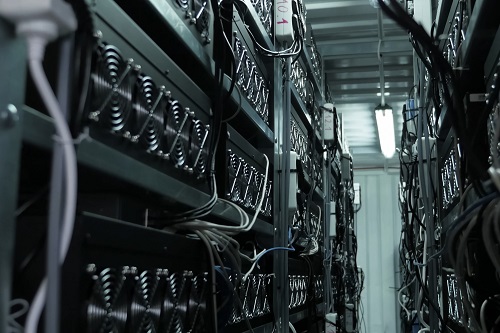
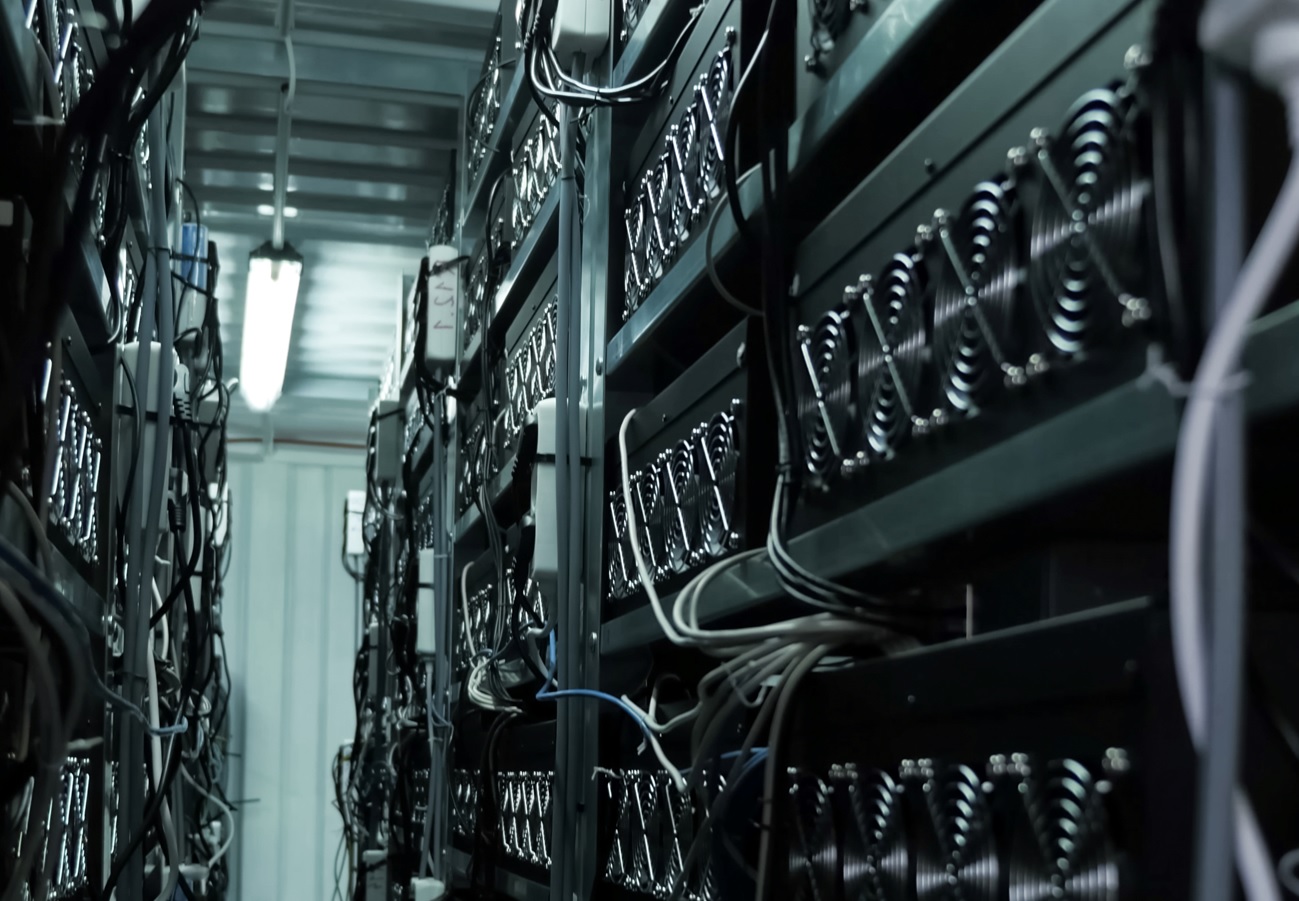
  • Solo Bitcoin miner wins 6.25 BTC block reward

    Solo Bitcoin miner wins 6.25 BTC block reward

    • A solo Bitcoin miner earned the 6.25 BTC block reward after beating the odds to solve block 793607.
    • The miner reportedly used an Antminer S9 with about 17 TH.
    • At today’s Bitcoin mining difficulty and with 17 TH, a solo miner would need an average of 450 years to land a block.

    With Bitcoin price struggling below $26,000, and the wider crypto market impacted by recent regulatory events, there’s has been very little to cheer Bitcoiners.

    But for a solo BTC miner, a lucky break had them strike gold with the winning of a block reward. According to on-chain data, the miner beat staggering odds to mine block 793607 and earn the 6.25 BTC block reward.

    BTC miner with single Antminer S9 hits jackpot

    The solo miner reportedly achieved the once-in-a-life-time feat using a single Antminer S9 and accounted for only 17 terahashes (TH). Their “lottery” win was worth about $160,000 at the time of block reward.

    Congratulations to miner 151XTfHBfaDqoNWGGeYobNX2YzFFWuB5YD with only ~17TH for solving the 275th block at http://solo.ckpool.org! That is likely a single S9 miner. A miner of this size would only solve a block once every ~450 years on average,” tweeted Con Kolivas, a CGMiner software engineer and the admin of Solo CKPool.  

    It’s not the first time a solo miner has hit such a jackpot, with CKPool apparently seeing seven such instances since January. However, the feat is increasingly difficult as the Bitcoin hashrate and mining difficulty have increased.

    According to data from Blockchain.com, the current Bitcoin mining difficulty is 51.23 trillion hashes. Mining difficulty looks at how difficult it is to mine the next block, that is how many hashes a miner must generate to find and solve a valid block. The current difficulty is at all-time highs and has most blocks solved by major mining pools and companies.

    The difficulty adjusts every 2016 blocks (about two weeks’ time) and can go up or down. The next adjustment expected on June 14 will see the difficulty jump by about 2.92% to 52.73 T.


    Source link

  • FATPICKLE THE NEW MEMECOIN THAT IS PUMPING HARD – SPONSORED POST

    FATPICKLE THE NEW MEMECOIN THAT IS PUMPING HARD – SPONSORED POST

    FATPICKLE THE NEW MEMECOIN THAT IS PUMPING HARD – SPONSORED POST

    CHART https://www.dextools.io/app/en/ether/pair-explorer/0x192d930c00b14e29e7f7b531d74ade18ba628b83

    CA: 0x877dd180f71369d9bd70e658baba110a55ee3f1f

    https://t.me/fat_pickleportal

    In the vast and ever-evolving world of cryptocurrencies, a new player has emerged with a unique offering that sets it apart from the meme coin crowd. Fat Pickle ($FATP) is making waves as a promising crypto currency, backed by a team with a track record of successful multimillion-dollar projects and collaborations, including GALA games. With an impressive market cap growth from 50k to 600k within days of its launch on June 10th, Fat Pickle is capturing the attention of investors seeking potential gains in a dynamic market.

    SOLID TEAM WITH PROVEN SUCCESS
    One of the key factors that set Fat Pickle apart is its exceptional team. Comprised of experienced professionals who have previously worked on multimillion-dollar projects, their expertise lends credibility to the project. Having collaborated with GALA games, a prominent name in the gaming industry, the team has demonstrated their ability to navigate the complexities of the crypto space and deliver successful ventures. This solid foundation instills confidence in the community and enhances the potential for Fat Pickle’s success.

    RENOUNCED CONTRACT AND VERIFIED LIQUIDITY
    Security and transparency are crucial in the cryptocurrency realm, and Fat Pickle ensures these essential elements. The contract for Fat Pickle ($FATP) has been renounced, reducing the risks associated with rug pulls and providing reassurance to investors. Additionally, the liquidity pool (LP) has been locked, safeguarding the funds and creating a secure environment for trading.

    CEX CONFIRMATION AND DEFLATIONARY MECHANISM
    The confirmation of listing on a centralized exchange (CEX) signifies the growing recognition and acceptance of Fat Pickle within the wider crypto community. This development opens doors to increased liquidity and exposure, enabling more traders to access and invest in $FATP.
    Innovatively, Fat Pickle employs a deflationary mechanism through a 6.9 percent sell burn. This mechanism reduces the circulating supply of $FATP with each transaction, creating scarcity and potentially driving the value of the token higher over time. This deflationary feature incentivizes holding and rewards investors as the supply decreases.

    PICKLE FLIP
    Beyond being a mere investment opportunity, Fat Pickle aims to engage its community through a unique mini betting game called “Pickle Flip.” This game promises to add an element of entertainment and interactivity to the $FATP ecosystem, further solidifying its position as more than just a meme coin. The launch of Pickle Flip introduces an innovative use case and fosters engagement, amplifying the movement surrounding Fat Pickle.
    Conclusion

    Fat Pickle ($FATP) is not just another meme coin but a crypto currency with a promising future. With a team boasting a successful track record, a renounced contract, verified liquidity, CEX confirmation, and deflationary mechanisms, Fat Pickle offers a unique proposition to crypto enthusiasts. Additionally, the introduction of the Pickle Flip betting game adds an interactive layer to the project, enhancing community involvement and reinforcing the movement behind Fat Pickle. While any investment comes with risks, Fat Pickle presents an opportunity for those willing to embrace the potential rewards of this emerging crypto asset.