Category: NEWS

  • Crypto critics: Why do they bother? Can FUD be useful?

    Crypto critics: Why do they bother? Can FUD be useful?

    “Anyone who says that David Gerard personally stopped their crypto getting into Wikipedia is a fuckwit,” says editor, Wikimedia spokesman and professional crypto hater David Gerard in his typically no-nonsense fashion.

    “There are a lot of fuckwits.”

    When Gerard is not passionately arguing against cryptocurrencies in Wikipedia editor discussions, the author of the 2017 self-published hit Attack of the 50 Foot Blockchain can be found prosecuting the case against Bitcoin, blockchain and crypto on the BBC or in the Financial Times.

    Even among the most notable crypto critics, Gerard stands out. He‘s hated Bitcoin and blockchain for more than a decade since BTC was first discussed as an alternative funding source for Wikileaks after mainstream payment processors cut it off.

    David Gerard
    Crypto critic David Gerard.

    For Gerard, like a number of other critics, the problem with Bitcoin isn’t just that it’s a hyped-up Ponzi scheme or a glorified database with no genuine use case — he sees it as philosophically and politically wrong.

    “I saw that Bitcoin was created by internet libertarians and figured that would predict everything about it,” he tells Magazine. “I was correct. People who think they don‘t need to know what they‘re talking about and can reinvent it all from first principles are certain to fuck up in predictable ways, and they have.”

    For Gerard — who leans left and describes himself as “liberal” — Bitcoin appears to be a right-wing Libertarian project and that’s reason enough to oppose it.

    “Libertarianism as a political ideology is fundamentally childish and dumb as hell. Growing up in Australia, I didn‘t even believe this shit was real — I thought Libertarianism was some sort of savage Swiftian satire, not a thing people would actually believe. Then I got on the internet, and oh well.”

    Crypto dystopians

    Gerard isn’t the only professional Bitcoin hater out there, with the sector attracting more well-known skeptics and vehement opponents than most. That may be partly because the crypto community seems to hang on their every salvo and negative tweet in a sort of sadomasochistic relationship.

    The crypto haters are loud and proud, from gold bug Peter Schiff tweeting in delight at every price drop in his attempts to flog gold to economist Nouriel Roubini shouting bad-tempered invective about criminal Ponzi-like bubbles. They’re not all a bunch of Luddites either: Some have impressive credentials like Nobel Prize-winning economist Paul Krugman or Nassim Taleb who wrote the celebrated book The Black Swan but went on to interject the word ‘Bitdiot’ into every other tweet.

    Crypto critics
    Crypto critics: Saving you from becoming wealthy since 2011.

    And, there are plenty of grassroots opponents, too, like the zeitgeist style criticisms from NFT haters in the art community who see it as environment-destroying cancer or those in the gaming community who picture it as a shameless cash grab from game developers trying to squeeze another dollar out of users.

    The question is: Why do crypto critics bother? What is it about the sector that both fascinates and repels them? Why don’t they just say, “meh, it’s not for me,” and get on with their lives?

    Endless cavalcade of conmen

    I ask Gerard, who spends much of his waking hours scanning the internet for negative crypto news stories to feed into his blog. Gerard sold 14,000 copies of Attack — an almost unheard-of number for a self-published book in the United Kingdom — so a certain degree of professional success is undoubtedly part of the appeal. He’s transformed the book into a blog that averages 1000-3000 hits a day, while particularly strong stories like his reports on El Salvador’s Bitcoin Law can get 10,000 hits.

    He says that he just can’t look away. “There‘s always stuff to cover, but it is fascinating — it‘s such an endless cavalcade of grifters, suckers and suckers who think they‘re the grifter,” he says.

    “The moral core of Attack is that scams and scammers are bad and reprehensible. But, the hilarious stupidity is inexhaustible. There‘s always another story to tell about dumb crooks.”

    “If crypto people would like me to stop, probably the first thing they need to do is stop feeding me material.”

    A long time ago, in a former brothel

    By curious coincidence around about the same time that the Cypherpunks were dreaming up e-cash outside the control of governments in the mid-1990s, Gerard and I were uni student housemates in a shabby former brothel in Brunswick, Australia. I hadn’t seen him since until he popped up in an interview for the film Cryptopia.

    Back then, he was a greasy-haired music nerd and student newspaper editor who got into a massive fight with local Scientologists after running an expose on the cult-like aspects of the church and revealing its secrets about the alien Xenu who… well, you can look it up. The Scientologists were incensed and stole all the print copies. Gerard then started up the Australian Critics of Scientology webpage to get the material out.

    Scientology
    In the mid-1990s, web pages looked like this.

    Given the almost certain legal action from the church, hosting such a site was a risky endeavor. Gerard enlisted the help of a young hacker and Cypherpunk named Julian Assange, who was the system administrator of a free speech devoted ISP called Suburbia.net.

    He recounted the experience in a recent podcast, noting that Assange had “titanium balls. Depleted uranium nutsack, it was incredible.”

    “For about four years there he was getting legal threats, investigators coming around […] I will say that he stood by me absolutely reliably at that time, in what most people would call quite trying circumstances. I think that‘s because we both have the sort of inclination, the sort of person whose response to any slight whatsoever is ‘bring it on.’ Neither of us knew how to back down.”

    Assange later said the experience with the Scientology site helped him realize how a certain platform called Wikileaks could work.

    Gerard was as passionate then about fighting the cult of Scientology as he is today about fighting crypto, and it’s hard not to conclude that he sees himself as the lone voice of reason fighting against indoctrination and insanity in both cases. In a similar fashion, both Schiff and Roubini famously predicted the global financial crisis and now take pride in their ability to see through what they believe is the hype of blockchain and expose its hollow core.

    Cobie
    Crypto influencer Cobie took aim at crypto critic Amy Castor this week. She responded: ”I must have touched a nerve. Poor little babies.”

    Unlike many critics, Gerard actually does his research and is quite well informed about issues in the space, so if you can handle his relentlessly negative approach and frequently 100% wrong conclusions about how irredeemably terrible everything in crypto is, you’ll probably find at least some crypto news on his blog you won’t have seen elsewhere. In fact, anyone enthusiastic about crypto should probably follow at least a couple of skeptics to ensure they‘re getting the other side of the story.

    Filmmaker Torsten Hoffman tells Magazine he featured Gerard in his award-winning 2020 Cryptopia documentary because “some of his points are well informed.”

    “In the film, his take on corporate blockchain projects was spot on. They are often just disguised centralized database projects that the chief technology officer re-branded into blockchain in order to get the budget approved and a NYT headline.”

    But, Gerard and one or two others are the exceptions that prove the rule. By and large, crypto critics appear to have no idea what they’re talking about. Taleb wrote an academic paper suggesting that the main Bitcoin blockchain will die because all the Bitcoin will move to the Lightning Network. Krugman has been recycling the same views he had more than a decade ago that Bitcoin‘s a bubble based on nothing that sets the monetary system back 300 years and is comparable to Bernie Maddoff‘s Ponzi scheme.

    Nothing like good criticism

    Economics Professor Jason Potts, the co-director of the Blockchain Innovation Hub at RMIT in Melbourne, believes there‘s nothing like good criticism to sharpen your ideas and thinking. The trouble is, most of the current crop of crypto critics offer arguments that are nothing like good criticism.

    “I think criticism has an incredibly important role in any intellectual endeavor. You‘re developing ideas and you need critics of ideas to help shape their development,” he says. “My perspective is that in the blockchain space, kind of since the beginning, the self-identified critics have been pretty underwhelming.”

    Jason Potts
    If you haven‘t read our interview with Jason Potts about the future of blockchain, you‘re missing out.

    Potts believes that the rapid evolution of the technology and the concepts involved means anyone not immersed in the topic risks being left behind.

    “This is such a fast moving experimental space where just the knowledge gap between the frontiers and what we knew before is so vast, that unless you‘re actually involved in the space and building, it‘s really easy just to fundamentally misunderstand what’s going on.”

    Loving the haters

    So, why is it that the crypto community actively seems to enjoy the haters? Roubini has appeared at crypto conferences around the world, where he‘s dragged out like an ill-tempered performing monkey to rehash the same arguments for money in debates against crypto proponents from BitMEX founder Arthur Hayes to Bitcoin Cash’s Roger Ver.

    And, Schiff‘s following seems to be overwhelmingly Bitcoiners. When his son Spencer decided to go all-in on Bitcoin rather than gold, the elder Schiff put up a Twitter poll asking: “Whose advice do you want to follow? A 57-year-old experienced investor/business owner who‘s been an investment professional for over 30 years or an 18-year-old college freshman who‘s never even had a job.”

    The fact that 81% of 83,000 respondents picked “the kid” suggests a large part of his 650,000 Twitter followers are actually just Bitcoiners that love to hate-read his posts.

    It’s possible that the fascination comes from a perverse sense of pride and enjoyment in listening to the haters, given Bitcoin has been declared dead by the media 446 times. Yet, the price keeps going up year after year as more and more institutions come on board. Vindication is a great feeling.

    Hoffman, who‘s currently working on re-releasing his 2015 documentary Bitcoin: The End Of Money As We Know It, points out that Schiff exploits this dynamic for his own ends.

    “Let‘s give the man some credit. He‘s a master troll. His crusade against Bitcoin — and Bitcoiners crusade against Schiff — just helps with getting more retweets, podcast downloads and page views. See, we‘re talking about him right here”

    Rumor has it that Roubini could almost retire off a few more crypto conference appearances.

    Torsten
    Cryptopia filmmaker Torsten Hoffman.

    “Roubini has allegedly made a nice side career with six-digit speaking fees ranting about crypto,” says Hoffman. “That doesn‘t make everything he says wrong, but maybe we should look at people 40 years younger when it comes to understanding the crypto economy.”

    BitMEX founder Arthur Hayes said something similar after the famed Tangle in Tapei debate with Roubini in 2019.

    “It was quite clear that Roubini is a one-trick pony,” he added. “He increases his publicity by being hyper-critical of Bitcoin regardless of the actual facts. And that is why the media trots him out whenever they need someone to bash Bitcoin and the cryptocurrency industry.”

    Hayes, of course, later pleaded guilty on charges related to Anti-Money Laundering provisions and agreed to pay a $10 million fine, which lends some credence to Roubini’s criticism that “BitMEX is just an example of everything that is sick and wrong in the industry.”

    The old guard

    Everything new has its critics, of course. When mobile phones came out, anyone seen carrying one was reviled. When MP3 players arrived, no one thought carrying around a flash drive with three albums of low-quality music files was going to take off.

    But, as Potts points out, disruptive tech also has to fight against those who benefit from the existing system.

    “A lot of what is coming as criticism of the Bitcoin blockchain, crypto space is really just straight-up standard defensive maneuvers from existing power structures, and that doesn‘t strike me as an effective critique, that strikes me as just defensive of the status quo,” says Potts.

    Potts says Berkshire Hathaway’s Warren Buffet and Charlie Munger are a case in point. Buffett thinks Bitcoin is “rat poison squared” and Munger compared it to venereal disease:

    “They‘re invested in a previous set of institutional technologies and business models that are heavily reliant on the ways in which money and payments and registries and incentive structures organizations work. This is highly disruptive […] Therefore, just for purely shareholder self interest reasons, they don‘t like it.”

    Krugman has been quite explicit about the need to defend the existing financial order against Bitcoin since he first criticized it in the New York Times in September 2011.

    Krugman
    Paul Krugman has been wrong about Bitcoin since long before you heard about it.

    He argued that if Bitcoin became a reserve currency, its fixed supply would mean central bankers couldn‘t inflate the money supply to stimulate the economy. In 2013, he approvingly quotes Charlie Stross in a blog post titled “Bitcoin is evil.”

    “BitCoin looks like it was designed as a weapon intended to damage central banking and money issuing banks, with a Libertarian political agenda in mind—to damage states ability to collect tax and monitor their citizens financial transactions.”

    Bitcoiners like to respond to his criticisms by pointing to his 1998 prediction that “By 2005, it will become clear that the internet’s impact on the economy has been no greater than the fax machine’s.”

    “He‘s far smarter than I ever will be,” says Potts “But, he‘s been very brave and making a lot of claims out loud that, in retrospect, they‘ve just been laughably wrong.”

    “There are other economists, people like Larry White and others, macro monetary specialists and theorists who provide far more nuanced and sharper critique and are advancing an interesting critique of the space.”

    Scams and fraud

    The lack of regulation and a plethora of get-rich-quick investors who don’t understand the tech make crypto easy pickings for scammers. This is a driving motivation for critics like the Twitter influencer Mr Whale — whose bearish and contrarian takes have seen him amass over 430,000 followers — and independent “nocoiner” journalist Amy Castor. (Both declined to be interviewed for this piece.)

    They believe the entire industry is wracked with financial fraud, from the QuadrigaX scandal (involving lost wallet keys, sudden death and an insolvent exchange) to the truth about the stablecoin issuer behind Tether.

    While many journalists in crypto have reservations about Tether, some critics believe that it is an unquestionable fact Tether is unbacked and essentially printed $83 billion in USDT out of thin air.

    This appears to be the logic behind Castor’s most famous and often referenced tweet, which makes no sense from a Bitcoin proponent‘s perspective, but makes total sense if you believe that everything about crypto is manipulated:

    “When you see the price of Bitcoin hitting new highs like this, it means large holders are cashing out—ahead of the crash, which they all know is coming.”

    Amy Castor
    Amy Castor‘s famed tweet that turned into a meme.

    Tether has survived a New York Attorney General’s investigation and court case about its reserves, so if it is a perpetual money printing machine, they‘ve done very well to keep it going. Of course, given some of the stuff that really does go on in crypto, that‘s not a non-zero possibility.

    Political enemies

    As Gerard’s hatred of Libertarians suggests, a reaction to the perceived politics of Bitcoin is a strong motivation for many. While technology is arguably politically neutral, that’s not how crypto critics see it.

    David Golumbia wrote The Politics of Bitcoin: Software as Right-Wing Extremism, which argues that Bitcoin was borne out of the right-wing conspiratorial Libertarian culture of the Cypherpunks and that the technology itself is inherently right wing.

    I‘ve interviewed Golumbia at length on the subject and found him to be a fascinating and insightful person with deep background knowledge, but even leaving aside the highly contested idea the Cypherpunks were right wing, the contention seems a little bit similar to arguing that because the Volkswagen Beetle was the brainchild of Adolf Hitler (and Ferdinand Porsche) then everyone who drives one must be a Nazi.

    Gerard, however, believes the basic thesis is correct and says it informed a chapter of his book. Curiously, he also doesn’t think Ethereum fans are any less right wing than Bitcoiners.

    “‘ETH is left wing’ is nonsense. Buterin espouses basic Silicon Valley techno-libertarianism with subtle anarcho-capitalism underneath that pretends to hide its power level. His parents are ardent ancaps and brought him up with this stuff. His main sponsor is Peter Theil. He might be ‘left’ of the most rabid Bitcoin ancaps, but not of any sort of political spectrum outside the weird world of crypto.”

    As you might expect, Potts reacts strongly against the characterization of crypto as inherently right wing and says both left and right are involved in crypto as a way to overcome the centralization of power, whether political or monopolistic corporations.

    “It‘s both a left-wing and a right-wing story about trying to remove concentrations of power, whether its political power or market power from systems,” he says.

    “The fundamental story of a lot of different people involved in the space and a lot of different political or motivational backgrounds that generally share the same overarching narrative is that we don‘t like centralization of power. And, we don‘t like arbitrary control of systems.”

    “The critics are the ones that are defending the status quo. And, I just find it sort of ironic that‘s the real battle here. I don‘t see it as a left versus right story, I see it as a protection of the status quo, political hierarchies, versus an attempt to innovate with new institutions. And, I would love the critics to represent that idea.”

  • ‘Institutional demand’: Large transactions on Cardano up 50X in 2022

    ‘Institutional demand’: Large transactions on Cardano up 50X in 2022

    Crypto intelligence firm IntoTheBlock reports that the number of large transactions on the Cardano blockchain has increased by more than 50X this year. 

    Large Transaction Volume (LTV) refers to aggregated volume from transactions denominated in Cardano’s native ADA token valued at more than $100,000. Since Jan. 1, LTV has increased from 1.35 billion ADA per day to 69 billion ADA (worth $81.4 billion) changing hands on Cardano on Mar. 28.

    That’s a 51-fold increase in about three months and marks one of the highest volume levels since mid-2018, according to IntoTheBlock. In a Mar. 29 tweet, the firm said that such high volume indicates “increasing institutional demand.”

    While other metrics such as average transaction size and volatility remain relatively stagnant according to the data analytics firm, total addresses have been increasing since the start of 2022. The year began with about 3.4 million addresses, which has now grown to 5 million. While only seven DApps appear on DeFi Llama currently, co-founder Charles Hoskinson said many more are expected following due to a hard fork expected mid year.

    Total value locked (TVL) is currently at $303 million according to DeFi app tracker DeFiLlama, just shy of the $326 million all-time high set on Mar. 24.

    Hoskinson gave a rousing keynote speech at Binance Blockchain Week in Dubai on Monday in which he spoke of the need for decentralization and the difficulties in coordination it entails. He said that “we are entering a new era,” with Web3 but the problem is that “unlike with Web2, there’s no leader” to make decisions for the industry.

    “If we’re truly decentralized, we have to somehow come together and figure this out. We have to write some sort of constitution for these things; we have to decide ‘What is the Bill of Rights for the use of cryptocurrency and blockchain technology?’”

    Related: ETF provider WisdomTree launches Solana, Cardano, Polkadot ETPs

    “There are two paths before us — one, we keep our integrity and we look to decentralization, find these things, understand these things,” he said. “Or, two, we ignore it. In which case we’ll have custodians, we’ll have escort keys, highly centralized, highly optimized consensus algorithms that can be reset at any time. The few will be in control of the many.

    “This is the decision, and I don’t make that decision — all of you do.”

  • Waves (WAVES) hits record high – What do indicators say

    Waves (WAVES) hits record high – What do indicators say

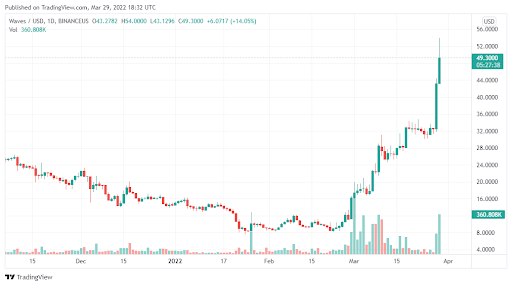
    Waves (WAVES) has hit record highs in a recent bullish run that appears to be stronger than ever. The coin has smashed past several key indicators and looks like bulls still have a lot of room to run. So, what should you expect next? More on this to follow but first, here are some notable developments:

    • Waves had rallied nearly 50% in 24 hours though it retreated slightly.

    • The 24-hour surge is part of a weekly uptrend that we saw last week.

    • The coin has now smashed past its all-time highs.

    Data Source: Tradingview 

    Waves (WAVES) – What comes next?

    The rally today came on major news from the platform. Waves will now begin operations in the US and is setting aside a lot of money to bring in developers to the ecosystem. But this is not the only thing. Over the last 2 weeks, the coin has been rising and rising. 

    It has gone past several resistance zones and unleashed a bullish momentum that has taken it well above its ATH. Although it is likely Waves will pull back, we do not see this happening in the coming days. 

    In fact, waves is likely to test $60 in the days ahead before any sell-off even comes into the picture. The coin has for now paired all losses reported this year and is looking forward to Q2 with a vengeance.

    Should you buy Waves (WAVES) now?

    There is no doubt WAVES is on the run. Every indicator is bullish right now, so it’s the best time to buy for any short-term trader. Q2 also promises to be a very big period for this token. 

    $60 is well in sight in the near term and as such, this gives investors a very good opportunity to make decent returns as they take advantage of this bullish sentiment.

  • Dogelon Mars (ELON) is expected to maintain a bullish trend – Here’s what to know

    Dogelon Mars (ELON) is expected to maintain a bullish trend – Here’s what to know

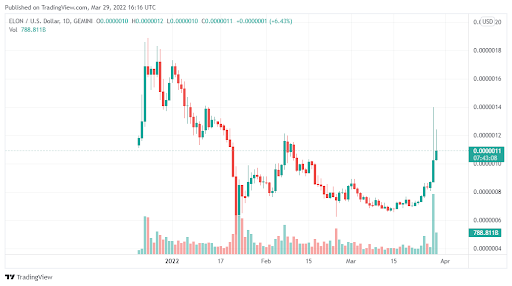
    Over the past week, Dogelon Mars (ELON) has been one of the main meme coin performers. The toke is up nearly 40% in a week or so and has shown significant bullish momentum. But how long can it sustain gains before a major sell-off? More analysis in the post but here are some important facts first.

    • Dogelon Mars has outperformed the entire market by almost 15% in the past week.

    • The coin has closed higher in the last four days in a row

    • In the last two days alone, ELON has surged by over 25%.

    Data Source: Tradingview 

    Dogelon Mars (ELON) – Can bulls maintain the uptrend?

    Despite this recent surge, it seems like the price action has been bouncing off two crucial support and resistance zones. In fact, ELON has tried to surge past the overhead resistance zone of $0.0000012, but bulls have not managed to get enough demand. The coin is however getting closer and closer and could break through in the coming days. 

    If this happens, then we should have a sustained upward breakout that could deliver minimal gains of about 30%. Also, the sentiment in the crypto market is showing good signs. This means that investor appetite towards meme coins, which are largely speculative assets, is returning. For this reason, it is likely that in the near term, ELON will report more and more gains.

    Is Dogelon Mars a good buy now?

    The key for short-term traders is to watch the $0.0000012 price. If the meme coin can rise above this, then it is likely that more gains will come. We are looking at an upswing of around 30% before any pullback. 

    So, with that in mind, Dogelon is a good buy. But from a long-term point of view, it would be best to wait until sentiment in the crypto market has fully stabilised before jumping in.

  • Gnosis (GNO) price rallies 50%+ after CowSwap users claim COW airdrop

    Gnosis (GNO) price rallies 50%+ after CowSwap users claim COW airdrop

    This week Gnosis (GNO) price notched a swift 50%+ rally after the project took another step forward in its transition to the Coincidence of Wants Procotol, or CoW, an interface that offers traders protection from miner extracted value (MEV).

    Data from Cointelegraph Markets Pro and TradingView shows that the price of GNO has gained 86% over the past seven days, rising from a low of $308 on March 21 to an intraday high at $574 on March 28.

    GNO/USDT 4-hour chart. Source: TradingView

    Three reasons for the rapid price increase for GNO are the release of the CowSwap (COW) token, which was airdropped to Gnosis holders, traders’ appreciation of the MEV-protection offered by the protocol and the potential for GNO holders to receive additional airdrops in the future.

    COW drops!

    The most recent price surge appears primarily connected to the official release of COW, the native token of the CowSwap protocol which offers traders MEV-protection.

    COW tokens were airdropped to GNO holders based on the number of tokens held or staked during a snapshot that was taken back in early January, with 5% of COW tokens going to GNO holders who could receive an extra 5% if they had locked their GNO tokens on the protocol for a period of one year.

    At the time of writing, COW has been listed on Uniswap and is trading at a price of $1.35.

    MEV protection features add value to GNO and COW

    The main draw of the CowSwap protocol is the MEV-protections offered that can help traders get better terms on swaps and avoid being front run or the victim of a sandwich attack.

    Miner extracted value is a sort of “invisible” tax that occurs on the Ethereum (ETH) network where miners can increase their profitability by including, excluding or re-ordering transactions within the block they produce.

    This feature allows miners to conduct certain exploits including front-running, back-running and transaction sandwiching, which help to increase profits at the expense of traders.

    According to data from flashbots, more than $605 million in value has been extracted by miners using this process since January 2020 — a figure which CowSwap looks to help mitigate moving forward through its introduction of MEV protection.

    Related: Gnosis (GNO) continues uptrend after vCOW airdrop and rebrand to CoW Protocol

    Future airdrops could give a long-term boost to GNO price

    A third factor helping to boost the demand for GNO is the prospect of additional airdrops coming to GNO holders and stakers.

    This includes an allocation of the soon-to-be-released SAFE token for Gnosis Safe, a platform in the Gnosis ecosystem that is designed to securely manage digital assets.

    According to data from Dune Analytics, there is currently more than $77 billion worth of value held in Gnosis Safe contracts, a substantial amount that hints at the amount of trust various depositors have in the protocol.

    Total USD value of assets stored in Gnosis Safe. Source: Dune Analytics

    Documentation released by Gnosis Safe indicates that 20% of SAFE tokens will be distributed to the GNO community via direct distribution to GNO holders and a substantial deposit into the GnosisDAO treasury.

    VORTECS™ data from Cointelegraph Markets Pro began to detect a bullish outlook for GNO on March 23, prior to the recent price rise.

    The VORTECS™ Score, exclusive to Cointelegraph, is an algorithmic comparison of historical and current market conditions derived from a combination of data points including market sentiment, trading volume, recent price movements and Twitter activity.

    VORTECS™ Score (green) vs. GNO price. Source: Cointelegraph Markets Pro

    As seen in the chart above, the VORTECS™ Score for GNO began to pick up on March 23 and hit a high of 78 around nine hours before the price increased 78% over the next four days.

    The views and opinions expressed here are solely those of the author and do not necessarily reflect the views of Cointelegraph.com. Every investment and trading move involves risk, you should conduct your own research when making a decision.

  • SHIB v ApeCoin: Which is a better buy today?

    SHIB v ApeCoin: Which is a better buy today?

    With hype a key price driver during alt-season, ApeCoin could be better.

    • Shiba Inu is a meme coin that took the markets by storm in 2021 after it rallied by millions of percentages.

    • ApeCoin is the new kid on the block in terms of hype, driven by its connection to the bored Ape NFT community.

    • Now that alt-season is starting, ApeCoin makes for a better buy for investors looking to capitalize on the hype. 

    Shiba Inu SHIB/USD is a meme coin that came to prominence in 2021. It went on to record gains of over 48,000,000%. Shiba Inu was largely driven by the hype around meme coins that Elon Musk triggered in 2020. Shiba Inu continues to be one of the meme coins that hold a lot of potential going into the future.

    That’s because there are lots of investors who are still betting heavily on meme coins. This is driven by expectations of a repeat of the gains of 2021 at some point in the future. Besides, the Shiba Inu team is working hard to improve SHIB’s core metrics. For instance, the team is in the process of building a Metaverse platform. With the massive potential that the Metaverse holds, this is a factor that could see SHIB perform well in the future. 

    On its part, ApeCoin APE/USD is the new kid on the block and is attracting all the hype. ApeCoin rallied by over 2000% since launch and continues to draw high volumes relative to most cryptocurrencies in the market. This has a lot to do with its connection to the Bored Ape community, which at the moment, is the most popular NFT community in the market. 

    So, which one is a better buy?

    Both Shiba Inu and ApeCoin are good investments. However, now that alt-season seems to be kicking off, it is best to move with the flow to maximize gains. Using this approach, ApeCoin is a much better buy than Shiba Inu at the moment. The odds are in its favor since it is currently drawing a lot of hype. 

    Summary

    Shiba Inu and ApeCoin are both fantastic long-term investments. However, for an investor looking to make the most out of their investment short term, ApeCoin has more potential. There is a lot of hype around it, and it’s now where Shiba Inu was back in January 2021.

  • Wonky Mars Protocol launch shows ecosystem expansion may not add to network value

    Wonky Mars Protocol launch shows ecosystem expansion may not add to network value

    New protocols are launching every day on different networks in the crypto space and the trend is likely to continue through this year. When looking at the top five networks by total value locked (TVL) — Ethereum (ETH), Terra (LUNA), Binance Smart Chain (BSC), Avalanche (AVAX) and Solana (SOL) — according to data from DeFiLlama, Ethereum have 579 protocols (including L1 and L2); Terra has 25, BSC has 348, Avalanche and Solana have 187 and 64 protocols, respectively. The low number of protocols and high TVL from Terra surely stand out as the outlier here.

    Terra’s TVL reached an all-time high at $20 billion in December 2021 before dropping to $13 billion during the January 2022 crash. To date, the ecosystem has managed to boost its liquidity back to $26 billion.

    With only 25 protocols built on the chain, Terra has attracted enough TVL to become the second largest network after Ethereum. The recent announcement of backing UST (Terra’s stablecoin) with $1 billion worth of Bitcoin (BTC) reserves and the Mars protocol launch coincide nicely with the sudden rise in LUNA price at the end of February 2022.

    The rise in the chain’s governance token is often an indication of confidence in the network and the protocols, but does a new protocol launch always add value to the network and stimulate user activity and engagement?

    Let’s take a look at how the price of LUNA changed when new protocols launched on Terra; then investigate how the most recently launched Mars and Astroport protocols impacted native token prices, user engagement and LUNA price.

    LUNA is the tool that ensures the UST-USD peg

    Before looking into the correlation between LUNA price and the new protocol launch, it is important to understand the LUNA-UST mechanism that ensures the peg of stablecoin UST to USD.

    LUNA is used as a counterpart to UST to maintain the price peg of UST to USD. When UST is worth more than $1, it means there is a greater demand for UST than the supply in the Terra ecosystem. So the protocol incentivizes participants to burn LUNA and mint UST to meet the increasing demand for UST until the value of 1 UST is equal to $1. On the contrary, when UST’s price is lower than $1, the supply of UST is larger than the demand so UST will be burnt and LUNA will be minted until UST’s value reaches $1 again.

    By regulating the supply of LUNA in the ecosystem, Terra can effectively keep UST pegged to USD. This mechanism also causes LUNA’s price to increase as the demand for UST increases.

    LUNA price is highly correlated with new protocol launches

    Very often during the initial pre-launch phases of a new protocol, there is a sudden increase in demand for UST. This is because participants wish to obtain airdrop incentive tokens from the new protocol and they are often asked to lock up UST to provide enough liquidity for the protocol when it launches.

    The increasing demand in UST from participants during pre-launch phases of the new protocol causes more UST to be minted and more LUNA to be burnt, resulting in a sudden increase in LUNA price during these pre-launch phases.

    Here is an example of the recently launched Mars protocol, where LUNA price jumped from sub $50 to over $60 in two days right after the new protocol pre-launch phases started.

    LUNA February 2022 price. Source: CoinGecko

    Here is another example of how LUNA price went up from sub $60 to over $90 in December 2021 right after Astroport’s pre-launch phases started.

    LUNA November to December 2021 price. Source: Flipside Crypto

    The new protocol launch in the past two recent cases did help push up LUNA’s price, which can be seen as a positive effect on the Terra network. But to know whether they add value to the Terra ecosystem, one needs to also look at the protocol’s token price and user engagements after the launch.

    ASTRO price and volume after the launch

    Astroport accumulated $90 million in the lockdrop, but the token price of ASTRO has experienced a downturn after the launch of the protocol due to the bearish market environment at the beginning of 2022. The price has picked up since the beginning of March and now is trading its launch valuation.

    ASTRO/UST price since Astroport launch. Source: TradingView

    The daily number of swaps on Astroport has been gradually increasing since the launch for about three months, indicating active user engagement on the platform after the airdrop.

    Astroport total swap count. Source: Flipside Crypto

    The total trading volume transacted on Astroport has also shown a strong increasing trend since the launch, which peaked in the middle of March.

    Astroport trading volume in USD. Source: Flipside Crypto

    The Astroport launch was successful and the post launch data also show that the platform has been able to maintain user activities and engagements. The story of Mars protocol is however quite different.

    Mars price and volume after the launch

    Immediately after the Mars launch on March 7, 2022, MARS token price dropped off a cliff within an hour from 1.65 UST to 0.7 UST. This is very different from the price reaction right after Astroport’s launch. So what happened to MARS?

    It turns out that the protocol couldn’t load successfully in the web browser at the time when it was scheduled to go live on March 7, 2022, 11 am GMT. Users who attempted to claim the airdrop tokens through the protocol’s website failed to do so and had to wait until the website became functional.

    However, sophisticated users who knew how to interact with the Terra chain directly called the claim rewards method on Terra station and managed to claim MARS ahead of the non-tech savvy users. They dumped the tokens immediately in the market, causing an immediate drop in price.

    MARS/UST price 4-hour. Source: TradingView

    To explain a bit more in detail how one could claim MARS by interacting with Terra chain, the investor first needs to know Mars protocol’s airdrop contract address, which is publicly available on etfinder; then they need to know which method in the code to call on Terra Station to claim the rewards, which is the tricky part.

    Since the protocol just launched, the code is often not available in the public domain for people to find the claim method. But a wild guess most of the tech-savvy investors had was that Mars protocol was forked from Astroport. So the claim method was highly likely the same as Astroport’s. It turned out to be true and these investors managed to claim the MARS airdrop using the same function “claim_rewards_and_unlock” on the chain.

    Three hours after the official launch time, Mars protocol’s website was still not functioning and the airdrop MARS still couldn’t be claimed from the website. The price of MARS had already dropped to $0.64 from $1.65 — a 60% drop in three hours and nothing could be done if the investor did not know how to interact with Terra chain.

    Let’s have a look at the two major products on Mars protocol right after the launch. Red Bank, the saving and lending space, has failed to maintain user engagements after the airdrop. The number of transactions peaked on the third day after the launch to almost 5,000 a day and has been dropping since then. The daily volume in USD has also been decreasing since day 1 from $212 million to $13 million as of March 27.

    Mars Red Bank transaction count and volume in USD. Source: Flipside Crypto

    Fields is the space in Mars protocol for yield farming strategies where users can provide liquidity to ANC-UST, LUNA-UST and MIR-UST. Fields’ historical transaction and volume after the launch show a similar story. The product struggles to maintain the same level of activity as the launch day and the number of transactions is 1/8 of what it was at the peak while the volume in USD is less than 1/30 of the launch day.

    Mars Fields transaction count and volume in USD. Source: Flipside Crypto

    Although it’s not certain that the incident at the launch affected Mars protocol’s user engagements and confidence, the data shows the protocol has been struggling to attract volumes and activities since the launch.

    A new protocol launch does not necessarily always add value to the network, as shown in the comparison between Astroport and Mars, which have very similar pre-launch strategies but very different outcomes post launch.

    Incidents on the launch day jeopardize not only the protocol, but could also affect user confidence in the ecosystem. An airdrop incident allowing only the tech savvy investors to claim first will drive away the vast majority of future investors. New protocols launching on Terra chain in the future should make greater efforts to prevent such incidents, otherwise investors’ long-term interests and trusts could evaporate sooner than one could imagine.

    The views and opinions expressed here are solely those of the author and do not necessarily reflect the views of Cointelegraph.com. Every investment and trading move involves risk, you should conduct your own research when making a decision.

  • Axie Infinity’s Ronin bridge and Katana Dex halted after suffering a $612M exploit

    Axie Infinity’s Ronin bridge and Katana Dex halted after suffering a $612M exploit

    According to a tweet posted on Ronin Network’s official Twitter handle, the Ronin bridge has been exploited and 173,600 ETH and 25.5 million USDC coins worth about $612 million were stolen.

    Following the hack, Ronin bridge and Katana DEX have both been halted.

    Ronin however said in the Twitter thread touching on the exploit that its team is working with “law enforcement officials, forensic cryptographers, and our investors to make sure that all funds are recovered or reimbursed.” It also said that “all of the AXS, RON, and SLP on Ronin are safe.”

    What we know about the hack so far

    According to an official communication of Ronin Network on Substack, the hacker managed to take over the control of four of Sky Mavi’s Ronin validators together with a third-party validator managed by the Axie DAO.

    The Sky Mavi’s Ronin chain consists of nine validator nodes and five out of the nine are required to append their signatures for a deposit or withdrawal to be recognized. Although the validator key scheme is decentralized and built to limit an attack vector like the one that just occurred, the hacker found a backdoor through the network’s gas-free RPC node and got the signature for the Axie DAO.

    At the time of writing, the RON token, which is Ronin’s native governance token, had dropped by over 20% over the past one hour.

  • Axie Infinity’s Ronin bridge hacked for over $600M

    Axie Infinity’s Ronin bridge hacked for over $600M

    According to Axie Infinity’s official Discord and Ronin Network’s official Twitter thread, along with its Substack page, the Ronin bridge and Katana Dex have been halted after suffering an exploit for 173,600 Ethereum (ETH) and 25.5M USDC, worth a combined $612 million at today’s prices. In a statement, its developers said they are “currently working with law enforcement officials, forensic cryptographers, and our investors to make sure that all funds are recovered or reimbursed. All of the AXS, RON, and SLP [tokens] on Ronin are safe right now.” 

    As told by Ronin developers, the attacker used hacked private keys in order to forge fake withdrawals, draining the funds from the Ronin bridge in just two transactions. More importantly, the hack occurred on March 23, but was only discovered today after a user allegedly uncovered issues after failing to withdraw 5,000 in ETH from the Ronin bridge. At the time of publication, RON, Ronin’s primary governance token, has fallen nearly 20% to $1.88 in the past hour.

    This is a developing story and will be updated accordingly.

  • Why did WAVES price rise by 60% today?

    Why did WAVES price rise by 60% today?

    WAVES token has shaken the entire crypto market by rallying over 60% in the last 24 hours. Its latest price surge has made it become the 32nd largest cryptocurrency by market cap surpassing Axie infinity (AXS) and Decentraland (MANA).

    At the time of writing, WAVE is trading at $52.44, up 63.13% after hitting a high of $53.81 from a low of $32.12 in the last 24 hours. Additionally, WAVES rose from around $8.9 to above $50 in just seven days.

    This article focuses on the forces behind the current surge in WAVES’ price.

    Why is WAVES price rising?

    Before getting into what is behind the price surge, it is important to first explain what WAVES is.

    In a nutshell, WAVES is the native token of the Waves blockchain, which is a multipurpose blockchain platform that enables the use of smart contracts and the development of decentralized applications (DApps).

    The main reason why the WAVES price is rallying is the recent launch of Waves Labs in the United States and news that it plans to hire experts.

    • Launching of Waves Labs in the U.S

    In February, Waves had announced that it will be launching a new venture, Waves Labs, as its next step for the year 2022.

    In a press release, the company said that Waves Lab will represent the blockchain in the United States. It will mainly focus on supporting new projects and raising funds on the blockchain

    • Hiring experts

    According to verifiable reports, Waves have hired a senior leadership team with some fintech and crypto veterans like Sasha Ivanov, founder of Waves protocol, serving as the firm advisor.

    Moreover, the firm is working on establishing decentralized governance that will improve its integration with other blockchains.

    Waves’ current bullish trend shows that there is a growing interest in altcoins including Solana (SOL) Terra (LUNA), and Cardano (ADA).