The crypto market has had very high volatility during the first quarter of the year. In March, we saw some decent upswings albeit markets remained very risk-averse. Despite this, there is one token that has been seeing incredible gains. Waves (WAVES) has been the star of March, and here is why.
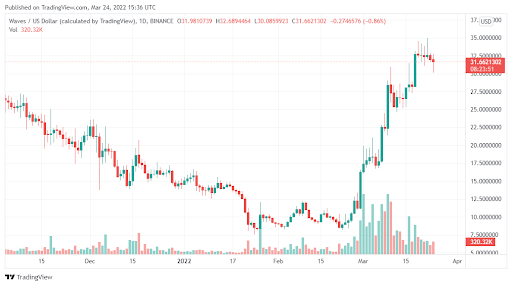
The coin has gained over 240% in the last 30 days or so.
Waves has also outperformed the entire crypto market by a huge margin.
The coin is now ranked among the top 50 biggest crypto assets.
Data Source: Tradingview
Waves (WAVES) – Where will it go next?
There have been several factors that have pushed Waves in recent weeks. More so however is the increased total value locked or TVL in some of the ecosystem projects. For example, The Neutrino Protocol, an innovative DeFi tool kit built on the Waves network has seen its TVL rise by nearly 350% in the last month alone.
There was also an announcement that Waves was planning to launch Waves 2.0, a much improved and efficient network. The announcement was made on February 11, and while the coin has had volatility since then, its overall trend has been upward.
Waves is looking at adding EVM compatibility with Waves 2.0, something that will bring cross-chain interoperability into the platform. The coin is expected to continue seeing this decent uptick in the near term. It could surge above the $3.3 billion market cap quite substantially.
Is it time to buy Waves (WAVES)
Waves (WAVES) has been doing very well to enhance the appeal of its ecosystem towards developers. It is also allowing a lot of innovative DeFi products to come to its protocol. The future is indeed bright, and it is likely we are going to see superb long-term value. As a result, it would make a lot of sense to buy the coin.
Please be aware that some of the links on this site will direct you to the websites of third parties, some of whom are marketing affiliates and/or business partners of this site and/or its owners, operators and affiliates. We may receive financial compensation from these third parties. Notwithstanding any such relationship, no responsibility is accepted for the conduct of any third party nor the content or functionality of their websites or applications. A hyperlink to or positive reference to or review of a broker or exchange should not be understood to be an endorsement of that broker or exchange’s products or services.
Risk Warning: Investing in digital currencies, stocks, shares and other securities, commodities, currencies and other derivative investment products (e.g. contracts for difference (“CFDs”) is speculative and carries a high level of risk. Each investment is unique and involves unique risks.
CFDs and other derivatives are complex instruments and come with a high risk of losing money rapidly due to leverage. You should consider whether you understand how an investment works and whether you can afford to take the high risk of losing your money.
Cryptocurrencies can fluctuate widely in prices and are, therefore, not appropriate for all investors. Trading cryptocurrencies is not supervised by any EU regulatory framework. Past performance does not guarantee future results. Any trading history presented is less than 5 years old unless otherwise stated and may not suffice as a basis for investment decisions. Your capital is at risk.
When trading in stocks your capital is at risk.
Past performance is not an indication of future results. Trading history presented is less than 5 years old unless otherwise stated and may not suffice as a basis for investment decisions. Prices may go down as well as up, prices can fluctuate widely, you may be exposed to currency exchange rate fluctuations and you may lose all of or more than the amount you invest. Investing is not suitable for everyone; ensure that you have fully understood the risks and legalities involved. If you are unsure, seek independent financial, legal, tax and/or accounting advice. This website does not provide investment, financial, legal, tax or accounting advice. Some links are affiliate links. For more information please read our full risk warning and disclaimer.
Play-to-earn (P2E) gaming was one of the hottest sectors in the cryptocurrency market in 2021 and based off the recent moves of Yuga Labs and Bored Ape Yacht Club, the gaming industry could continue to be a winner in 2022.
Axie Infinity was the first game to really capture widespread attention and highlight the possibilities of what P2E had to offer and is continuing to lead the way in 2022 as the protocol prepares for its next major launch.
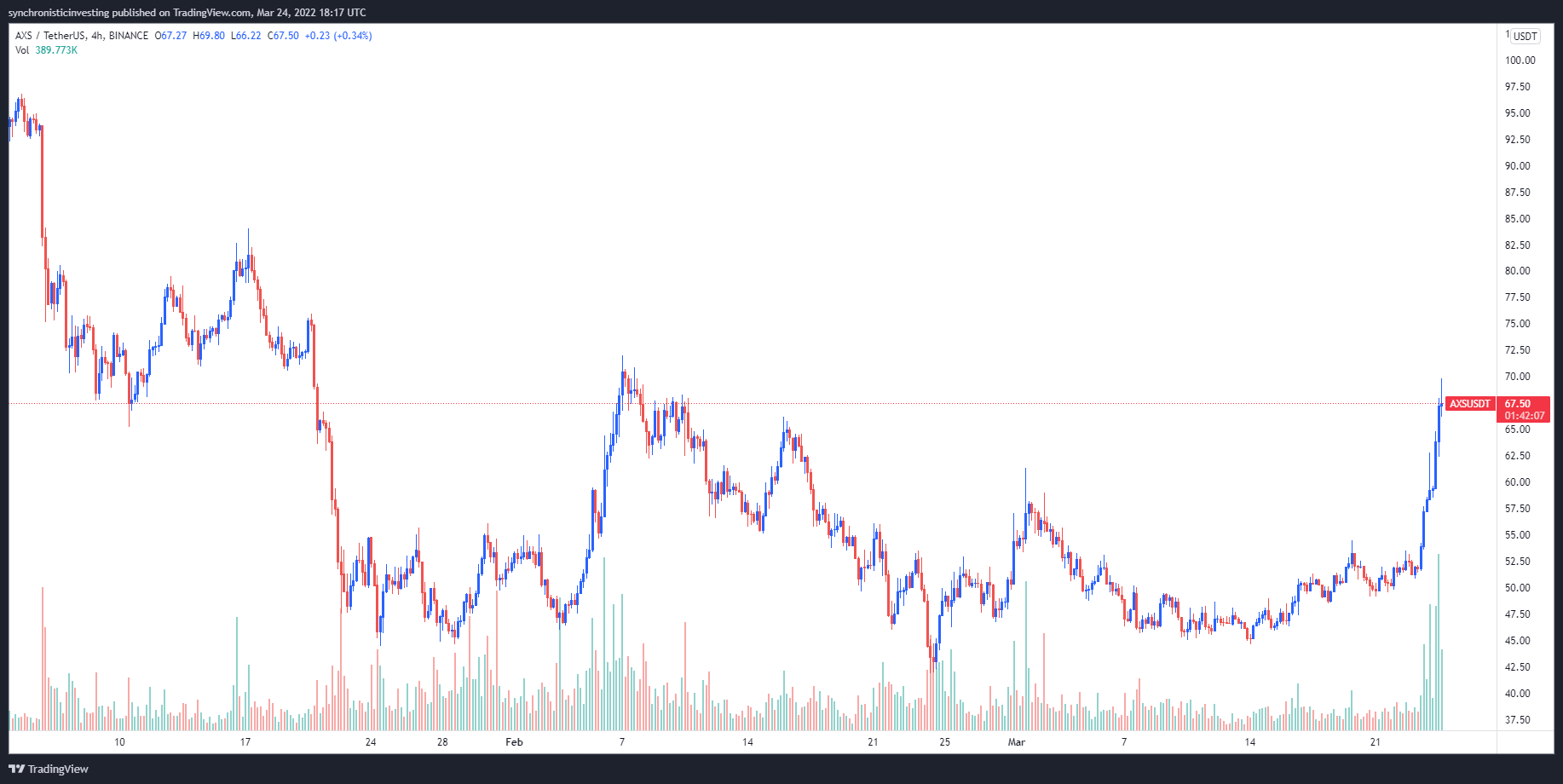
Data from Cointelegraph Markets Pro and TradingView shows that the price of AXS increased 56.5% over the past ten days as an increase in its 24-hour trading volume has lifted AXS to a daily high of $69.82 on March 24.
AXS/USDT 4-hour chart. Source: TradingView
VORTECS™ data from Cointelegraph Markets Pro began to detect a bullish outlook for AXS on March 14, prior to the recent price rise.
The VORTECS™ Score, exclusive to Cointelegraph, is an algorithmic comparison of historical and current market conditions derived from a combination of data points including market sentiment, trading volume, recent price movements and Twitter activity.
VORTECS™ Score (green) vs. AXS price. Source: Cointelegraph Markets Pro
As seen in the chart above, the VORTECS™ Score for AXS climbed into the green on March 14 and hit a high of 78 around 24 hours before the price began to increase 52.32% over the next nine days.
Three reasons for the climbing price of AXS are the upcoming launch of Axie Infinity: Origin, the steady increase of active users and AXS stakers, and the rising popularity of the Ronin sidechain, which enables Axie Infinity gameplay.
Axie Infinity: Origin
The most significant development underway helping to boost the forward outlook for AXS is the upcoming launch of Axie Infinity: Origin, which is expected to take place in the coming weeks.
To clarify, we’re still aiming to get Origin out by end of the month.
It’s cutting close but our engineers are working non-stop to polish and fix bugs.
Shipping a very complex and quality product is hard. Engineers out there may empathize with this. We’re pushing!
According to a recent report from Delphi Digital, Origin is a “completely reimagined version of the popular Axie Battles game that everyone is familiar with.”
Origin will include new game mechanics designed to improve the overall player experience, such as free starter Axies to help attract new players to the game, a reimagined storyline that adds depth to the player experience and the addition of active cards for eye and ear body parts.
The update will also introduce new in-game items like runes and charms, which will act as power-ups for Axies and require players to burn the platform’s native SLP token.
Active users and AXS stakers are on the rise
The rising price of AXS has also been given a boost by the steadily increasing Axie Infinity userbase, which is now at an all-time high of 207,209 total users, according to data from Dune Analytics.
Axie Infinity total user count. Source: Dune Analytics
While the pace of new users onboarding into the ecosystem has slowed along with activity in the wider cryptocurrency ecosystem, the increase is still significant and indicates ongoing adoption.
Non-gamers have also been incentivized to hold AXS with a current staking reward of 73% offered through the Axie Infinity platform.
AXS staking statistics. Source: Axie Infinity
As shown in the graphic above, nearly one-third of the circulating supply of AXS is currently staked on the protocol earning a total daily reward of 50,516 AXS.
A third factor bringing added momentum to Axie Infinity is the growth taking place on the Ronin network, an Ethereum (ETH) sidechain that was built for Axie Infinity by Sky Mavis that is becoming the default NFT scaling solution for crypto gaming.
Axie Infinity is currently the only game running on Ronin but that hasn’t stopped the network from consistently ranking in the top 3 in terms of total value locked compared to other Ethereum bridges, with nearly $3.4 billion in value currently locked on Ronin.
Total value locked on Ethereum bridges. Source: Dune Analytics
That will soon change, however, as Ronin will see the introduction of third-party developers, which includes “over 1,000 applications from teams wanting to build on Ronin,” according to Delphi Digital.
This has the potential to lead to an influx of new users to the Ronin ecosystem which could also benefit Axie Infinity as new users check out the top-performing project on the network.
The views and opinions expressed here are solely those of the author and do not necessarily reflect the views of Cointelegraph.com. Every investment and trading move involves risk, you should conduct your own research when making a decision.
Bitcoin (BTC) and the broader cryptocurrency market rallied on Thursday, as the total value of digital assets crossed $2 trillion for the first time in over three weeks amid signs of a clear shift in market sentiment — headlined by Goldman Sachs, no less.
BTC printed an intraday high of $44,253, having gained more than 3% during the session, according to data from Cointelegraph Markets Pro and TradingView. The largest cryptocurrency by market capitalization has now recovered over 33% from its January low.
The total crypto market cap has gained over 7% since Monday to reach nearly $2.1 trillion, according to Coingecko data. The market capitalization figure also reached $2 trillion on CoinMarketCap.
While not bullish, Bitcoin’s Fear & Greed Index has escaped “extreme fear” and is now in the “fear” stage with a reading of 40. The volatility and sentiment indicator is based on a scale of 0 to 100 with higher readings corresponding to a more bullish outlook for BTC.
Bitcoin’s Fear & Greed Index remains an important proxy for overall market conditions. Source: Alternative.me
The crypto market’s apparent shift in sentiment follows months of downward price action for Bitcoin and altcoins, which led some investors to speculate about the possibility of a full-fledged bear market. Amid geopolitical unrest, however, members of the legacy finance community have identified crypto as a potential opportunity.
As Cointelegraph reported, BlackRock CEO Larry Fink said the war in Ukraine could force nations to reevaluate their currency dependencies, potentially paving the way for digital assets. Specifically, the BlackRock CEO touted digital assets as a viable tool for international settlements and transactions.
Crypto has been on Fink’s radar since at least the fourth quarter of 2020.
Meanwhile, multinational investment bank Goldman Sachs appears to have put crypto on its radar and even redesigned its website’s homepage to reflect the growth of digital assets and the metaverse. Referring to these technologies as “megatrends,” Goldman populated a new “Insights” section of its website with previously released reports on gaming, the metaverse and Web3.
Goldman Sachs’ homepage on March 24, 2022.
Goldman Sachs recently completed its first over-the-counter crypto options trade with Galaxy Digital. The investment bank first launched its Bitcoin futures product for CME in June 2021.
Finally, Grayscale Investments recently announced the launch of a new smart contract fund that allows accredited investors to back Ethereum competitors. The new fund, which has already opened for daily subscriptions, provides exposure to Cardano (ADA), Solana (SOL), Avalanche (AVAX), Polkadot (DOT), Polygon (MATIC), Algorand (ALGO) and Stellar (XLM).
Ether (ETH) bulls have a few good reasons to celebrate the 20% gain between March 14 and March 24. The price increase surprised many and led to the first daily close above $3,000 in 34 days.
Even with this move, Marc’s $2.4 billion Ether options expiry is somewhat uncertain because bears can easily profit by pushing the price below $3,000.
In a letter to shareholders, Larry Fink, the CEO of BlackRock, the world’s largest asset manager, noted that the global socio-political crisis and growing inflation could make way for a global digital payment network.
Moreover, cryptocurrency investors turned bullish after Terra co-founder Do Kwon reconfirmed plans for the giant $10-billion BTC allocation. On March 24, the third tranche of Tether (USDT) left a wallet thought to hold funds earmarked to purchase Bitcoin.
On the macroeconomic side, there have been mixed feelings. For example, retail sales in Canada grew 3.2% over the last month, which is above the 2.4% market expectation. On the other hand, the United Kingdom’s Consumer Price Index came at 6.2% year-over-year while expectations stood at 5.9%.
Bulls expected a miracle, and it did not happen
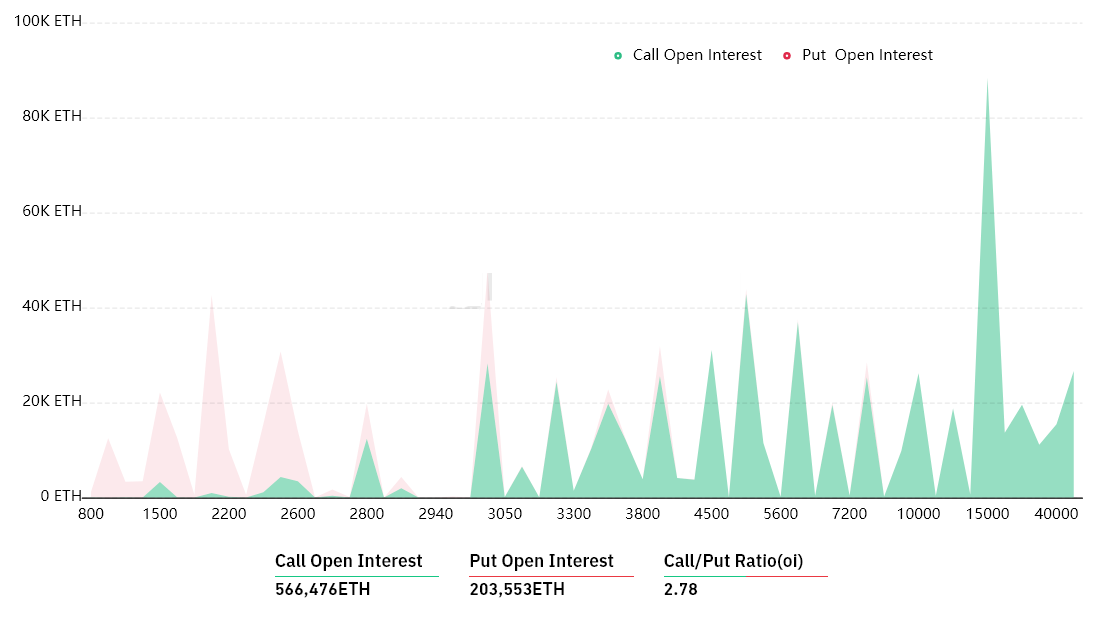
Ether’s recent strength might have come as a surprise for many, but some bulls were definitely over-optimistic. Even though the call (buy) option instruments dominate the March 25 options expiry, overconfident bulls placed bets at $5,000 and higher.
Ether options aggregate open interest for March. 25. Source: CoinGlass
A broader view using the call-to-put ratio shows a 178% advantage to Ether bulls as the $1.76 billion call (buy) instruments have a larger open interest versus the $630 million put (sell) options. However, the 2.78 call-to-put indicator is deceptive because most bullish bets will become worthless.
For example, if Ether’s price remains below $3,100 at 8:00 am UTC on March 25, only 10% of the call (buy) options will be available. That effect happens because there is no value in the right to buy Ether at $3,300 if it’s trading below that level.
Bears are better positioned despite having smaller numbers
Below are the three most likely scenarios based on the current price action. The number of options contracts available on March 25 for bulls (call) and bear (put) instruments varies depending on the expiry price. The imbalance favoring each side constitutes the theoretical profit:
Between $2,800 and $3,000: 27,500 calls vs. 37,500 puts. The net result is $25 million favoring the put (bear) instruments.
Between $3,000 and $3,200: 64,000 calls vs. 16,500 puts. The net result favors bulls by $140 million.
Between $3,200 and $3,300: 88,000 calls vs. 15,500 puts. The net result favors the call (bull) instruments by $240 million.
This crude estimate considers the call options used in bullish bets and the put options exclusively in neutral-to-bearish trades. Even so, this oversimplification disregards more complex investment strategies.
For instance, a trader could have sold a call option, effectively gaining a positive exposure to Ether above a specific price. But unfortunately, there’s no easy way to estimate this effect.
Sub-$3,000 Ether would benefit bears
Ether bears need a small dump below $3,000 to avoid a $140 million loss on M. On the other hand, the bulls’ best case scenario requires a 4% price increase from the current $3,100 to score a $240 million profit.
Ether bears seem in a worse position, considering Larry Fink’s positive remarks and the positive Bitcoin momentum triggered by Terra’s (Luna’ potential $3 billion BTC acquisition. The most likely outcome is that bulls will continue to display strength by pushing the price to $3,200 or higher as the March 25 options expiry approaches.
The views and opinions expressed here are solely those of the author and do not necessarily reflect the views of Cointelegraph. Every investment and trading move involves risk. You should conduct your own research when making a decision.
On March 9, United States President Joe Biden issued a quite comprehensive executive order that directs no less than two dozen cabinet members, departments and agencies in the government to study the benefits and detriments of blockchain technology for various aspects of the American economy. There has been a considerable amount already written about the implications of the executive order. I will add to this discourse and also offer some predictions, which few have done, on what the industry might expect to arise from the various governmental studies and reports over the next year.
Powers On… is a monthly opinion column from Marc Powers, who spent much of his 40-year legal career working with complex securities-related cases in the United States after a stint with the SEC. He is now an adjunct professor at Florida International University College of Law, where he teaches a course on “Blockchain & the Law.”
President Biden issued his executive order in a surprising act of executive power. No one quite expected it to occur the way it did, with most thinking that legislative action would be proposed sometime this year. I do not recall reading anywhere that an executive order, particularly without legislative action, would be proposed. Rather, our president instantly outtrumped — pardon the poorly crafted pun — former Vice President Al Gore, who under President Bill Clinton in the 1990s became a point man in the administration’s adoption and support of the internet. By the very act of issuing the executive order, President Biden will forever be recognized as the U.S. president who materially advanced the technology and its various use cases.
An overarching theme running through the executive order is the direction that various government departments and agencies coordinate, and that they do so in a relatively tight time frame by way of presenting reports. The president even ordered that each of the various governmental bodies investigate specific topics to be covered in the report. For example:
“Within 180 days of the date of this order, the Secretary of the Treasury, in consultation with the Secretary of State, the Attorney General, the Secretary of Commerce, the Secretary of Homeland Security, the Director of the Office of Management and Budget, the Director of National Intelligence, and the heads of other relevant agencies, shall submit to the President a report on the future of money and payment systems, including the conditions that drive broad adoption of digital assets; the extent to which technological innovation may influence these outcomes; and the implications for the United States financial system, the modernization of and changes to payment systems, economic growth, financial inclusion, and national security.”
Remarkably, we also see an official acknowledgment of concern over, and a direction that the report consider, the fact that China has been seeking to disrupt the U.S. dollar’s global dominance as the world’s reserve currency with its digital yuan projects over the past several years. The executive order requests that the report discuss ways “foreign CBDCs could displace existing currencies and alter the payment system in ways that could undermine United States financial centrality [emphasis added].” In other words, what should the U.S. be doing to protect the dollar’s reserve currency status?
The president also encourages the chairman of the Board of Governors of the Federal Reserve System, Jay Powell, to continue to research and report on CBDCs and develop “a strategic plan […] that evaluates the necessary steps and requirements for the potential implementation and launch of a United States CBDC [emphasis added].” Then, in consultation with the attorney general and the secretary of the Treasury, Powell is asked to within 180 days offer “an assessment of whether legislative changes would be necessary to issue a United States CBDC.” If this does not make clear that this administration wants action in implementing an American CBDC — and in short order — then nothing will. As my friend Troy Paredes, a former SEC commissioner, observed during Inveniam’s excellent “Data 3.0 For Web 3.0” conference in Miami this month, the executive order not only recognizes the risks of digital assets but also the benefits of blockchain technology.
The executive order directs certain cabinet members and agencies to study and report on relevant issues under their jurisdiction. The attorney general is to report on the role of law enforcement agencies in detecting, investigating and prosecuting criminal activity related to digital assets. The Federal Trade Commission is to consider the effects the growth of digital assets could have on competition policy, privacy interests and consumer protection measures. The Securities and Exchange Commission and Commodity Futures Trading Commission — in consultation with the Fed chair, comptroller of the currency and Federal Deposit Insurance Corporation — are encouraged to consider the extent to which investor and market protection measures within their respective jurisdictions may be used to address the risks of digital assets and “whether additional measures may be needed.” You can be sure current SEC Chair Gary Gensler will have plenty to say and recommend in this regard.
The Financial Stability Oversight Council — which is comprised of various agencies, including the SEC, CFTC, CFPB and federal banking agencies — is to produce a report within 210 days “outlining the specific financial stability risks and regulatory gaps posed by various types of digital assets and providing recommendations to address such risks.” Here, too, expect the SEC to be front and center in new proposals.
The final item in the executive order to mention is what the Biden administration sees as the core principles and policies that are to guide the government’s further actions. These include:
“Strong steps to reduce the risks that digital assets could pose to consumers, investors, and business protections; financial stability and financial system integrity; combating and preventing crime and illicit finance; national security; the ability to exercise human rights; financial inclusion and equity; and climate change and pollution.”
This hits me as sound. The executive order identifies a very thoughtful, systematic, comprehensive set of factors to inform policies that a government would or should be concerned about, and would or should like about, the use of blockchain technology, digital assets and currencies. I would not be surprised if a significant and comprehensive piece of legislation regarding blockchain, its regulation and a U.S. CBDC is proposed by the administration within the next 12 to 18 months. Even more comprehensive than SOX of 2002 ( mostly related to public companies) and Dodd-Frank legislation of 2010 (seeking to reign in excessive risk taking which led to the financial crisis) in ways it will affect the U.S. economy and our daily lives. I have less confidence that such a sweeping law will actually pass. It seems more likely that individual parts of our government will propose and adopt new rules and regulations addressing the findings and issues in the various reports they are directed to produce for the president.
Marc Powers is currently an adjunct professor at Florida International University College of Law, where he is teaching “Blockchain & the Law” and “Fintech Law.” He recently retired from practicing at an Am Law 100 law firm, where he built both its national securities litigation and regulatory enforcement practice team and its hedge fund industry practice. Marc started his legal career in the SEC’s Enforcement Division. During his 40 years in law, he was involved in representations including the Bernie Madoff Ponzi scheme, a recent presidential pardon and the Martha Stewart insider trading trial.
The opinions expressed are the author’s alone and do not necessarily reflect the views of Cointelegraph nor Florida International University College of Law or its affiliates. This article is for general information purposes and is not intended to be and should not be taken as legal or investment advice.
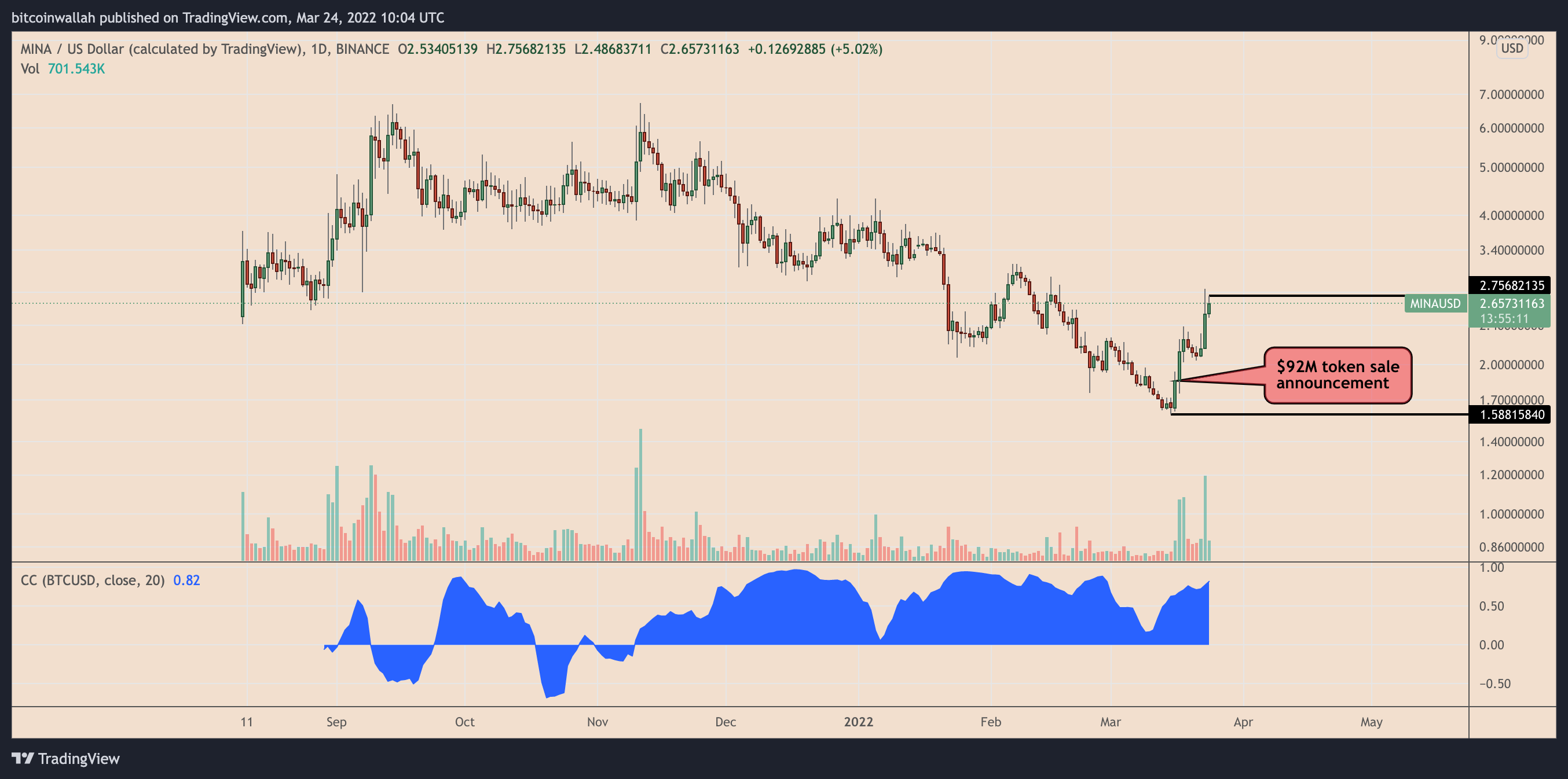
MINA, a utility token backed by a “lightweight” smart contracts platform of the same name, continued its upside move nine days after rebounding from $1.58, its lowest level to date.
The coin rallied by about 75% to reach $2.75 as of March 24 as traders weighed a high-profile funding rounds involving the sale of $92 million worth of MINA tokens to Three Arrows Capital, FTX Ventures, and other venture capitalists.
MINA/USD daily price chart featuring its correlation with Bitcoin. Source: TradingView
An overall recovery sentiment across the crypto market also assisted in pushing MINA’s price higher, since altcoins typically move in tandem with Bitcoin (BTC).
Additionally, Coinbase’s announcement on March 23 to add MINA support to its crypto exchange may have also boosted its upside prospects among traders and investors alike.
“Trading will begin on or after 9AM PT on Thursday, March 24, if liquidity conditions are met,” Coinbase clarified.
MINA bottoming out?
The latest buying spree in the MINA market came after a long period of brutal selloffs that saw its price per token falling from its record high of $6.71 on Nov. 11, 2021, to $1.58 on March 15, 2022 — a roughly 76.50% decline.
Nonetheless, MINA’s ongoing upside retracement has been showing signs of bottoming out, i.e., the end of its November-March bearish cycle, based on three widely-tracked technical setups: rising volumes, key moving averages, and a price-momentum indicator.
MINA/USD daily price chart. Source: TradingView
In detail, MINA’s rebound has had it break above its 20-day and 50-day exponential moving averages (the green and red waves in the chart above). Meanwhile, the move upside accompanied a rise in trading volumes, signifying traders and investors’ conviction in the rally.
Conversely, MINA risked a pullback move due to its relative strength index (RSI) nearing the overbought benchmark level of 70 and the price facing interim selloff sentiment near its 100-day simple moving average (100-day SMA; the purple wave in the chart above) at $2.72.
MINA price: key levels to watch
The 100-day SMA also coincided with the 0.236 Fib line (near $2.79) of the Fibonacci retracement structure — drawn from $6.71-swing high to $1.58-swing low, thus providing an additional layer of resistance against MINA’s upside attempts.
MINA/USD daily price chart. Source: TradingView
As a result, a successful pullback move, backed by an overbought RSI signal, could have MINA test its 20-day and 50-day EMAs as interim downside targets, with an extended selloff bringing back $1.58 in focus.
Conversely, a decisive move above the $2.36-2.72 resistance range could push MINA’s price toward $3 — a psychological upside target — initially, followed by an extended run-up to the 0.382 Fib line above $3.50.
The views and opinions expressed here are solely those of the author and do not necessarily reflect the views of Cointelegraph.com. Every investment and trading move involves risk, you should conduct your own research when making a decision.
ApeCoin (APE) continued its rebound move Thursday as the firm behind it raised hundreds of millions of dollars in a funding round led by Andreessen Horowitz.
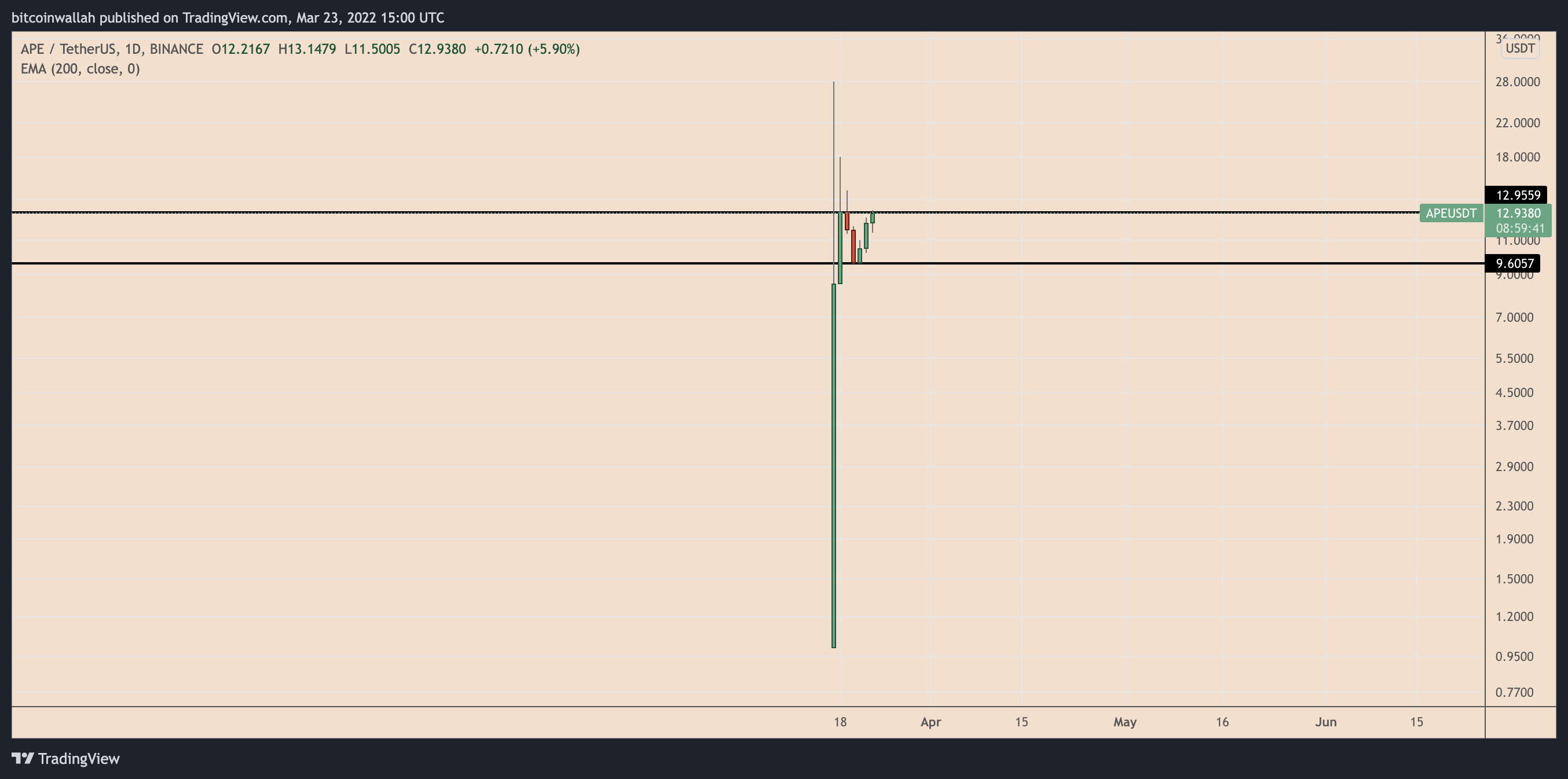
APE’s price surged 7.5% intraday to reach around $14.50 per piece. Notably, the token’s upside move came as a part of a retracement rally that started at the beginning of this week when it was changing hands for as low as $9.50.
That pushed APE’s week-to-date profits up by 50%, making it one of the best-performing digital assets since March 21.
APE/USD daily price chart. Source: TradingView
Big VC booster
To recap, ApeCoin digital currency came to existence on March 17, via an “airdrop” backed by Yuga Labs, the creator of the Bored Ape Yacht Club (BAYC), a collection of nonfungible tokens (NFT) popular among celebrities, sportsman, and venture capitalists alike for its so-called status symbol.
Yuga Labs dropped 150 million APE — out of the total 1 billion created — among the owners of the Bored Ape NFTs, with each getting 10,904 tokens, worth over $158,000 as of Thursday, for “free.”
Meanwhile, owners of rarest BAYC NFTs, the “Mutant Apes,” received 2,042 APE, which costs around $30,000 as of today’s price.
The firm projects APE as a governance and utility token to allow its holders to oversee and manage the so-called ApeCoin DAO, a decentralized autonomous organization. As a result, holding an APE gives users the right to vote on decisions proposed within the BAYC ecosystem.
“It will serve as a decentralized protocol layer for community-led initiatives that drive culture forward into the metaverse,” reads an excerpt from the ApeCoin’s official website.
The ApeCcoin community has issued 5 proposals, including the DAO structure; the voting process; the allocation of the ecological budget; the rules for staking and the allocation of staking pool. More than half of the budget goes to the game development. https://t.co/s1vq8v623g
Interestingly, Yuga Labs gave entities, including Andreessen Horowitz and Animoca Brands, that helped it launch APE about 14% of its total supply, worth about $2 billion at today’s prices. On Tuesday, the the firm raised $450 million from the same venture capitalists to value at $4 billion.
Crypto exchange FTX also contributed to the funding round, which, as Yuga claimed, would be used to expand its development team and to oversee their coming joint ventures, including a metaverse project called “Otherside.”
Yuga may also use the capital to make Bored and Mutant Apes into bigger brands with some of them debuting on luxury goods and a play-to-earn game that may involve APE tokens.
Nonetheless, switching to lower-timeframe charts shows APE trending upward inside a parallel ascending channel with traders buying when the price hits the lower trendline and selling when it hits the upper trendline.
As a result, APE’s ongoing rebound move could have it extend its upside momentum toward the channel’s upper trendline near $15, coinciding with another resistance level from March 18-19.
Meanwhile, APE has also been attempting to reclaim $14.25 as its interim support. Failing to do so could risk an early pullback move toward the channel’s lower trendline, also coinciding with its 20-hour exponential moving average (20-hour EMA; the green wave) near $13.50.
The views and opinions expressed here are solely those of the author and do not necessarily reflect the views of Cointelegraph.com. Every investment and trading move involves risk, you should conduct your own research when making a decision.
Co-founder of the Cardano blockchain Charles Hoskinson has cheekily admitted that his July 2020 forecast of the number of DApps coming to the blockchain has not yet come to fruition.
Referring to his famed July 2020 tweet, Hoskinson tweeted on Mar. 23, “Remember when I predicted thousands of assets and DApps on Cardano? Well I was wrong, there are now millions of native assets issued and DApps are now in the hundreds. #SlowAndSteady.”
Remember when I predicted thousands of assets and DApps on Cardano? Well I was wrong, there are now millions of native assets issued and DApps are now in the hundreds. #SlowAndSteadyhttps://t.co/mK4So6NHa1
However he may have misremembered his own tweet, as he had predicted back in July 2020 that by 2021, there would be “hundreds of assets and thousands of DApps” on Cardano (ADA).
While the number of assets appears to have exceeded his predictions by 2022 thanks to new nonfungible token (NFT) minting protocols, the number of decentralized apps running on the network isn’t so impressive.
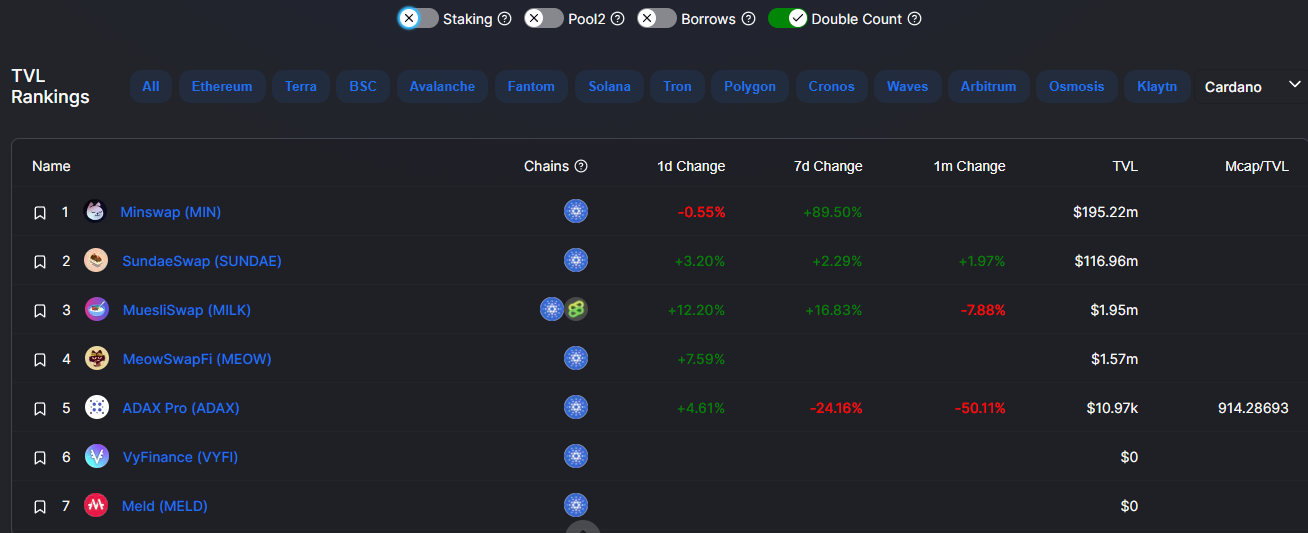
The decentralized finance analytics platform DeFiLlama tracks just seven DApps running on Cardano and a total of $315.72M in total value locked (TVL), excluding staked governance tokens. Two of those DApps have $0 TVL outside of governance tokens.
Hoskinson believes that developers are waiting for the deployment of the Vasil hardfork upgrade on Cardano scheduled for this June to launch their projects
Cardano DApps tracked by DeFiLlama.
According to the leading Cardano ecosystem tracker Cardano Cube, there are 579 DApps in various stages of development.
What most also don’t understand is that many Cardano DApps are waiting for the Vasil hardfork in June to launch to benefit from pipelining. So it seems we ain’t seen nothing yet on TVL https://t.co/mMHxwRrF96
While the data contradicts some of Hoskinson’s loftier predictions from 2020, it does confirm that Cardano’s ecosystem has been on a steady rise throughout 2022 so far. The Jan. 21 launch of the SundaeSwap decentralized exchange (DEX) helped spark a big increase in total value locked (TVL). Leading up to the launch, Cardano TVL shot up more than 24 times from $3 million to $87.7 in a single day from Jan. 20 to 21 according to DeFiLlama.
Cardano TVL has been on a steady climb throughout 2022 – DeFiLlama
Including the value of staked tokens, the ecosystem’s TVL now sits at an all-time high of $315.7 million with the Minswap DEX leading all other dApps with $195.2 million. That makes Cardano the 25th-largest blockchain network by TVL. If counting the value of staked governance tokens, Cardano’s TVL is about $421.5 million.
Despite the growth of Cardano this year, the network’s TVL still pales in comparison to that of its Layer-1 competitors in DeFi, such as Ethereum (ETH) and Solana (SOL). The two chains command a massive $137.3 billion and $7.2 billion respectively, according to DeFiLlama.
Oasis Network has an ongoing Hackathon that has drawn a lot of investor and developer interest into the project.
Oasis aims to become a leader in the private smart contracts space, the next growth phase in DeFi.
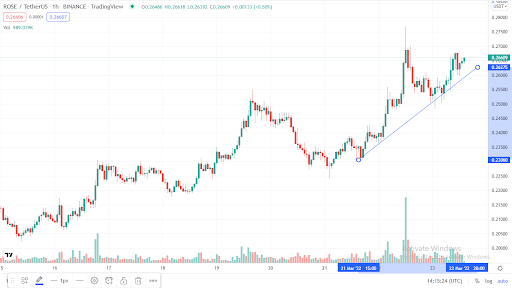
Oasis is making higher lows, indicating that bulls are firmly in control.
Oasis Network ROSE/USD is currently one of the top-performing cryptocurrencies in the past week. While it has eased up today due to a correction in the broader market, it is still one of those cryptos whose chart points to a potential continuation of the bull trend that had started earlier in the week.
Oasis Network’s current price action has a lot to do with the Oasis Bloom Hackathon that kicked off on March 10th. The Hackathon will run until May 2nd and comes with a reward of $200k. This has drawn a lot of interest in Oasis and is likely to keep driving interest in this project over the next couple of weeks.
Besides this short-term price action, Oasis has the fundamentals that could see it rally once the markets turn bullish again. That’s because it is operating in an aspect of the crypto market that has all the hallmarks of potential growth going into the future.
Oasis is looking to become a market leader in the private smart contracts markets. With DeFi disrupting traditional finance, it is only logical that privacy will be essential in the next wave of growth. It will give industry players the confidence to move even higher amounts of money, especially when it comes to lending and the issuance of under-collateralized loans.
Oasis making higher lows
Source: TradingView
Oasis has been on an uptrend since March 21st. It is currently making higher lows, indicating that bulls are firmly in control. With buying volumes on the rise in the broader market, Oasis could easily test $0.50
Summary
Oasis Network is on an uptrend and is currently making higher lows. Oasis has been outperforming the market driven by the ongoing Hackathon with a $200k reward.
 Data Source: Tradingview