A sharp upside retracement in the Avalanche (AVAX) market this week has raised its possibilities to rise by another 100% in Q2.
Avalanche chart painting a ‘bull flag’
The bullish outlook primarily appears in the wake of AVAX’s multi-month bull flag setup, which formed after a strong price move higher to over $150, an all-time high in the Avalanche market. In detail, the setup is a downward sloping channel, denoted by two parallel trendlines against the previous trend, with volumes declining to underscore a weakening downtrend.
In a perfect scenario, bull flags resolve with a breakout move above their upper trendlines, followed by an extended uptrend, with the profit target at length equal to the size of the underlying asset’s previous uptrend (also called flagpole).
That could have AVAX’s price to undergo a similar upside move in the coming weeks, beginning with a close above its interim resistance of 20-week exponential moving average (20-week EMA; the green wave in the chart above) and later with a breakout above the flag’s upper trendline.
As a result, AVAX may eye a run-up towards $157, up more than 100% from its current prices near $77.
AVAX price downside risks
The latest bout of buying in the Avalanche market has appeared largely due to its strong positive correlation with Bitcoin (BTC).
Notably, AVAX and BTC were moving in tandem almost perfectly at the beginning of 2022, with their correlation coefficient coming out to be between 0.90 and 0.99. However, as of March 17, the reading had corrected to around 0.79, still underscoring Avalanche’s continued preference of mirroring the benchmark cryptocurrency’s moves.
AVAX/USD and BTC/USD daily price chart featuring their correlation coefficient. Source: TradingView
On March 16, Fed’s chairman Jerome Powell said that the U.S. economy is strong enough to bear higher interest rates as he announced the central bank’s first rate hike since 2018.
Meanwhile, Joel Kruger, a strategist at crypto exchange LMAX Digital, noted that the central banker’s hawkish tone could pressure Bitcoin into falling further away from its all-time high of $69,000.
“Rates going higher will strangle equity markets. So if we see a mass exodus out of risk assets, it’ll weigh on everything,” he told Bloomberg, stressing that Bitcoin could fall to $20,000, thus contributing “to a decline in crypto assets.”
As a result, AVAX’s bullish outlook risks invalidation as long as it tails Bitcoin’s price accurately. That could mean a potential price pullback from its interim resistance level of around $80, coinciding with the 0.618 Fib line of the Fibonacci retracement graph drawn from $9-swing low to $152-swing high.
AVAX/USD daily price chart. Source: TradingView
If the correction occurs, AVAX’s next support line appears at the 0.786 Fib line around $64.
The views and opinions expressed here are solely those of the author and do not necessarily reflect the views of Cointelegraph.com. Every investment and trading move involves risk, you should conduct your own research when making a decision.
Ripple (XRP), the enterprise payment technology company, plans to give out one billion XRP in grants for developers. The newly announced grant is an extension of the company’s XRPL Grants program, which was launched in 2021.
The developer grant would be focused on encouraging open-source projects on the XRP ledger built for enterprise remittance assistance. Ripple has built a strong foothold in the Asia Pacific region through its XRPL based remittance technology called RippleNet
Ripplenet offers a real-time gross settlement system, currency exchange and remittance network with the help of the XRP ledger. The remittance platform has partnered with hundreds of banks to build a payment network of its own.
According to the current XRP price, the total value of the grant is about $794 million, out of which the firm has awarded a total of $6 million in funding to over 50 projects to date. The firm would offer financial, technical and business assistance to developers looking to build on XRPL.
Ripple’s new developer grant would be released over the course of the next decade. The firm would conduct a number of boot camps to encourage and onboard developers. The first two waves of the XRPL grant were focused on the nonfungible token and federated sidechains, while the third-wave aims to onboard open source projects on its ledger.
Ripple’s remittance technology has become quite popular in the past few years, owing to its advantages of lower costs and more instantaneous transactions than the traditional payment gateways. According to a recent report, Ripple partner The Clearing House is in talks with Wells Fargo to develop a SWIFT alternative.
Klaytn (KLAY) had a promising start in March 2021, reaching an impressive $11 billion market capitalization following its debut. However, investors have exaggerated their expectations as the token’s current total value stands at $3 billion, down roughly 70%.
KLAY/USD on Binance. Source: TradingView
Although not as well known as the leading smart contract blockchains, Klaytn remains a top-35 token by capitalization rank. Moreover, the network holds $1.2 billion worth of deposits locked on smart contracts. Capital locked on smart contracts is known in the industry as total value locked, or TVL.
Real use cases and strong backing
Klaytn is a flexible modular network architecture created by Kakao, a publicly-traded South Korean internet giant. The Asian tech group’s shares are valued at $36 billion, backed by diverse applications in traditional markets, including games, chat, taxi and rides, financial services, and a venture arm.
Businesses can customize and operate their own service-oriented blockchains built atop Klaytn architecture. These autonomously operated subnetworks are called Service Chains and are fully customizable.
The network is fully functional, offering decentralized applications (dApp) ranging from DEX exchanges, nonfungible token (NFT) marketplaces, social networks, collateralized loans, and games. For instance, KlaySwap, Klaytn’s leading dApp, holds $746 million in TVL and 19,840 active addresses over the past week.
According to Klaytn’s blog, the network is gearing up its infrastructure to provide services for the gaming and metaverse sectors. Initiatives include launching an open-source tools developer package that incorporates layer-2 solutions and adding direct support to Ethereum Virtual Machine (EVM) applications. Additional services include providing management and financial support for projects with high potential.
Klaytn’s roadmap includes higher scalability by leveraging layer-2 service chains, additional interoperability bridges with other blockchains, and integrating an Interplanetary File System (IPFS) gateway for decentralized storage.
Klaytn smart contracts deposits jumped 24%
Despite KLAY’s negative 15% performance over the last 30 days, the network’s TVL increased by 24% in the same period. As a comparison, Arbitrum scaling solution stalled at $1.7 billion, and Polygon decreased to $3.35 billion from $4.65 billion on Feb. 15.
Klaytn Total Value Locked, USD. Source: DefiLlama
In dollar terms, Klaytn’s current TVL of $1.2 billion is 13% below its $1.35 billion peak in January 2022. Yet, these figures represent less than 2% of the aggregate TVL (excluding Ethereum), according to DeFi Llama data.
In terms of recent developments, on Feb. 17, Klaytn joined the Blockchain Game Alliance, which encourages the development of standards and sharing of best practices in the decentralizing gaming sector. The initiative also aims to increase the public understanding and awareness of blockchain games.
To confirm whether Klaytn’s TVL growth is backed by increased adoption, one should analyze DApp usage metrics. Some DApps, such as games and collectibles, do not require large deposits, so the TVL metric is irrelevant in those cases.
As shown by DappRadar, on March 15 the number of Klaytn network addresses interacting with decentralized applications decreased by 5% versus the previous month.
Even though Klaytn’s TVL has increased by 24%, the network lacks a more substantial user base growth to support further KLAY token price momentum. Still, KLAYswap, the leading Dapp, presented a decent 39,090 active addresses over the past 30 days.
The above data suggests that Klaytn has found a niche within the decentralized application segment. If the project’s proposed features come to fruition, KLAY’s token price will likely hold $1.05 as medium-term support and present a decent upside.
The views and opinions expressed here are solely those of the author and do not necessarily reflect the views of Cointelegraph. Every investment and trading move involves risk. You should conduct your own research when making a decision.
Please be aware that some of the links on this site will direct you to the websites of third parties, some of whom are marketing affiliates and/or business partners of this site and/or its owners, operators and affiliates. We may receive financial compensation from these third parties. Notwithstanding any such relationship, no responsibility is accepted for the conduct of any third party nor the content or functionality of their websites or applications. A hyperlink to or positive reference to or review of a broker or exchange should not be understood to be an endorsement of that broker or exchange’s products or services.
Risk Warning: Investing in digital currencies, stocks, shares and other securities, commodities, currencies and other derivative investment products (e.g. contracts for difference (“CFDs”) is speculative and carries a high level of risk. Each investment is unique and involves unique risks.
CFDs and other derivatives are complex instruments and come with a high risk of losing money rapidly due to leverage. You should consider whether you understand how an investment works and whether you can afford to take the high risk of losing your money.
Cryptocurrencies can fluctuate widely in prices and are, therefore, not appropriate for all investors. Trading cryptocurrencies is not supervised by any EU regulatory framework. Past performance does not guarantee future results. Any trading history presented is less than 5 years old unless otherwise stated and may not suffice as a basis for investment decisions. Your capital is at risk.
When trading in stocks your capital is at risk.
Past performance is not an indication of future results. Trading history presented is less than 5 years old unless otherwise stated and may not suffice as a basis for investment decisions. Prices may go down as well as up, prices can fluctuate widely, you may be exposed to currency exchange rate fluctuations and you may lose all of or more than the amount you invest. Investing is not suitable for everyone; ensure that you have fully understood the risks and legalities involved. If you are unsure, seek independent financial, legal, tax and/or accounting advice. This website does not provide investment, financial, legal, tax or accounting advice. Some links are affiliate links. For more information please read our full risk warning and disclaimer.
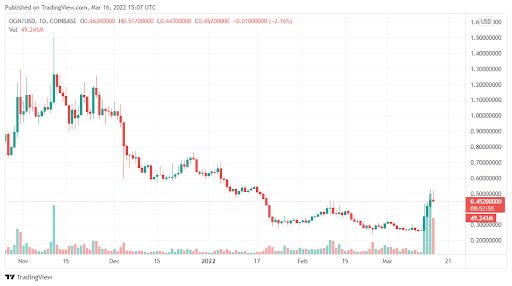
The Origin Protocol (OGN) has taken a plunge today of nearly 10%. This comes even as most coins post gains. But despite this, the long-term indicators for OGN remain positive. How long they stay, that way is another story. But here is what matters:
The OGN token remains slightly above its 25- and 50-day simple moving averages.
The coin is currently trading at $0.45, down by around 10% over the last 24 hours.
OGN is also down nearly 88% from its all-time highs last year.
Data Source: Tradingview
Can Origin Protocol (OGN) stay above water?
The fact that OGN is slightly higher than its 25 and 50-day simple moving averages is a good sign. It means that it’s yet to enter the bear market. But there are worries that this may not be the same any longer. The good news is that OGN appears to have completely bottomed.
It is 88% lower than its ATH and has trended downwards for the last week. In most cases, coins will reverse the trend once they bottom out. This reversal could come very soon for OGN. In fact, despite the 10% loss today, some analysts expect OGN to consolidate.
The coin could easily retest $0.8 in the near term, something that will lead to gains of at least 40%. However, the key support zone to watch at the moment will be $0.34. Any drop below that price will trigger a bearish fall.
Is Origin Protocol (OGN) a good investment?
The Origin Protocol is a DeFi project that brings NFT integration as well. It also has a yielding stablecoin as part of its ecosystem, something that makes it quite unique compared to other projects.
Although OGN has been on free fall since the end of 2021, it still has outstanding long-term potential. For this reason, you can consider it if you are looking to add more DeFi coins into your wallet.
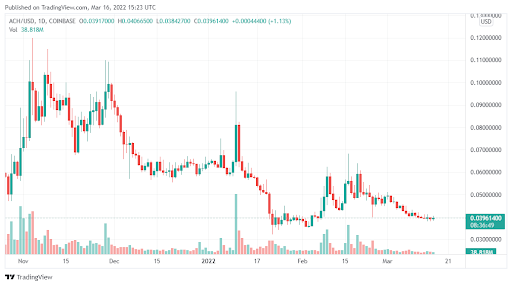
Alchemy Pay (ACH) appears to have entered an important consolidation phase. The coin has moved largely sideways after coming under pressure in the past two weeks. But despite this, ACH still remains in a bearish trend, and it will take something special to break this. Here are some facts:
ACH has been bouncing off a very wide range, indicating wild volatility.
The coin is over 77% lower than its 2021 all-time highs
It remains below the crucial 25-day SMA, suggesting more weakness.
Data Source: Tradingview
Alchemy Pay (ACH) – when will the downtrend break?
It’s very hard to say right now when or how ACH will break this downtrend. After all, there are just too many risk factors. The threat of inflation, global economic fallout due to rising energy prices, and the war in Europe are some of the factors weighing down sentiment.
We expect the coin to continue dropping before it bottoms at its $0.032 support. After that, bulls can try to find any demand. At the time of writing, ACH was selling at $0.039. There is therefore still a long way to go before we reach the bottom.
We do not expect ACH to reclaim its all-time highs anytime soon as well. The coin will still remain volatile and could be perfect for short-term plays. As of now, ACH has a market cap of around $160 million and trade volume remains very low.
Is Alchemy Pay (ACH) sustainable?
Crypto-based payments are going to become huge in the near future. There are a ton of companies out there that are investing heavily in these projects and as such, Alchemy Pay (ACH) will get a lot of competition.
But this should not worry any investor. ACH has already established itself within both the centralised and decentralised payment ecosystem. It surely has so much potential for the future.
ICP is now trading at over 98% off its all-time lows.
With its fundamentals, the odds are that it could bounce off current prices.
The broader market is turning bullish a factor that could boost the price.
Sometimes the best plays in terms of ROI aren’t necessarily the strongest fundamentally. In some cases, what matters is the price is right, then counting on the broader market to create the momentum.
One such play at the moment is Internet Computer (ICP). Internet Computer has been on a downtrend since it launched back in 2021. When it launched, ICP was trading at over $500. Currently, ICP is trading at $15, a pale shadow of its former self. This means it is down by over 95% from its all-time highs.
Logically, it can’t go much lower than this unless it goes to zero, which is highly unlikely. In essence, now that the market is looking up again, the chances are that it can only go up from here. Considering how much value it has lost since launch, it could also be one of those that give investors the highest ROI.
Besides, ICP is not exactly a worthless cryptocurrency. While it started with a lot of momentum as a project that aimed to decentralize the internet, ICP faced allegations that it was heavily centralized, a factor that hit its image hard. However, the project has worked hard to prove that it is decentralized, and as it moves towards meeting its long-term objectives, the price could start to rise again.
ICP Set for a breakout
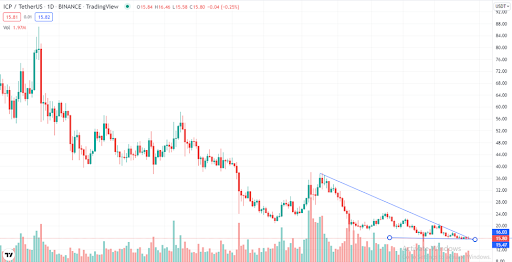
Source: TradingView
Internet Computer has been trading in a descending triangle for weeks now. However, selling volumes have dropped over the past week, signaling a potential breakout, especially now that the broader market is showing bullish signs again. If there is a breakout, ICP could easily test $50 in the short term.
Summary
Internet Computer was down by over 98% from its all-time highs in 2021. While there are no guarantees that it can retest its all-time highs, the odds are that it could bounce off current prices and be among the cryptos that could give a high ROI.
According to data compiled by Coin Metrics, the number of stablecoin wallet addresses with account balances over an equivalent $1 million USD has recently surpassed 12 million — up from 4 million one year ago. The stablecoins counted in the analysis include Tether ERC-20 (USDT), Tether TRC-20, Binance USD, DAI, GUSD, HUSD, PAX and USD Coin (USDC).
The vast majority of addresses holding more than $1 million came from Tether TRC-20 (approximately 8 million), followed by Tether ERC-20 (approximately 3.4 million), and USDC (approximately 1 million). Save for a sharp but brief decline last May, such addresses have increased regularly in the past 12 months.
The number still pales to the number of major cryptocurrency wallets holding more than $1 million. Data from Coin Metrics indicate that there are over 102 million wallet addresses meeting this criteria, denominated in either Bitcoin (BTC), Ethereum (ETH), or XRP Ledger (XRP). Most notably, the number of “millionaire” BTC wallet addresses has largely remained stagnant since May 2021. But the same cannot be said for ETH or XRP.
Limitations of the data include its basis on all wallet addresses — not unique ones, meaning that the number of individuals holding such wallet balances is likely significantly lower than north of 12 million. The use of stablecoins has advanced drastically in recent years. Having started out as a way for investors to cash out during volatile periods, they can now be used, among other items, for interactions with various types of decentralized finance protocols, such as that of Terra’s Anchor.
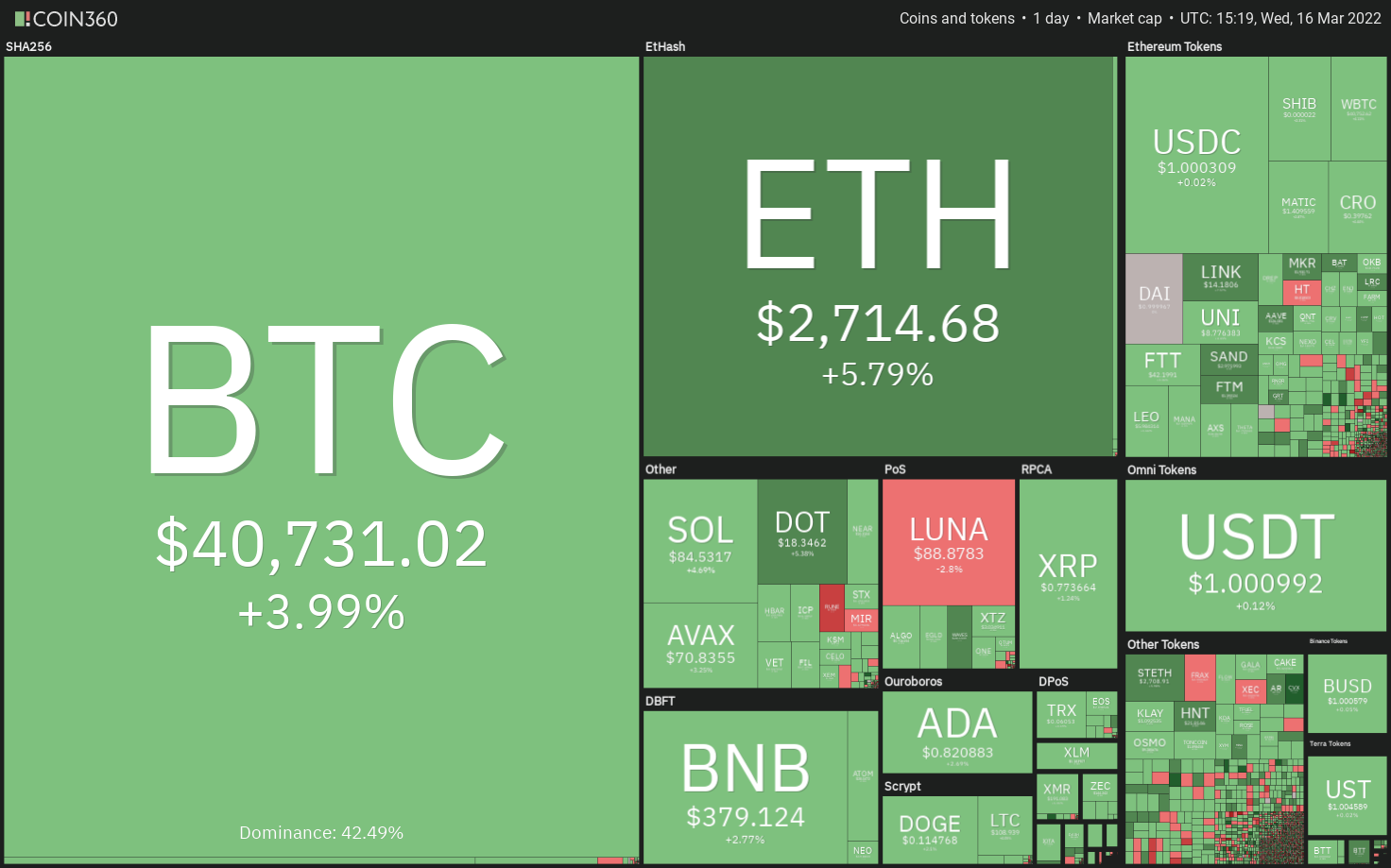
Bitcoin (BTC) is witnessing a see-saw battle near $40,000 with both the bulls and the bears trying to gain the upper hand. The volatility could remain high as the markets await the United States Federal Reserve’s policy decision due on March 16.
Analyst Willy Woo suggests that Bitcoin could witness a capitulation event based on a cost basis, a metric that indicates the transfer of Bitcoin from inexperienced to experienced traders. Such sharp declines usually suggest the formation of market bottoms.
However, Glassnode believes that a capitulation has been avoided because the sell-offs have been absorbed by a relatively strong market. Although 82% of the short-term holders’ coins are in loss, Glassnode considers this to be a late-stage bear market behavior where investors hold their coins until they turn profitable.
Could the Fed’s policy decision start a trending move in Bitcoin and altcoins? Let’s analyze the charts of the top-10 cryptocurrencies to find out.
BTC/USDT
Bitcoin turned down from the moving averages on March 15 but the long tail on the candlestick indicates strong demand at lower levels. The bulls continued their buying and have pushed the price above the 50-day simple moving average (SMA) ($40,151).
BTC/USDT daily chart. Source: TradingView
If bulls sustain the price above the 50-day SMA, the BTC/USDT pair could rally to the overhead zone between $45,400 and the resistance line of the ascending channel. The bears are expected to mount a strong defense in this zone.
If the price turns down from the overhead zone, the pair could extend its stay inside the channel for a few more days. The flat moving averages and the relative strength index (RSI) near the midpoint also suggest range-bound action is likely in the short term.
Contrary to this assumption, if the price turns down and plummets below the moving averages, it will suggest that bears continue to sell at higher levels. The bears will then try to sink the price below the support line of the channel and resume the downtrend.
ETH/USDT
Ether (ETH) bounced off the support line of the symmetrical triangle and the buyers are attempting to push the price above the 50-day SMA ($2,763).
ETH/USDT daily chart. Source: TradingView
If they succeed, the price could rise to the psychological level at $3,000 and then to the resistance line of the triangle. The bulls will have to push and sustain the price above the triangle to signal a possible change in trend.
The RSI has also formed a symmetrical triangle and a breakout from it could signal that buyers have the upper hand.
This bullish view will invalidate if the price turns down from the current level and breaks below the support line of the triangle. That could open the doors for a possible drop to $2,159.
BNB/USDT
The buyers are trying to push BNB above the moving averages but the bears are likely to have other plans. They will attempt to stall the recovery near the moving averages as they have done on the three previous occasions.
BNB/USDT daily chart. Source: TradingView
Both the moving averages are flattening out and the RSI has risen above 48, indicating that bulls are attempting a comeback. If buyers drive and sustain the price above the 50-day SMA ($388), the BNB/USDT pair could rise to $425 and thereafter to $445.
Contrary to this assumption, if the price turns down from the moving averages, it will suggest that the sentiment remains negative and traders are selling near resistance levels. The bears will then try to pull the price below the strong support at $350.
XRP/USDT
Ripple (XRP) turned down from the downtrend line on March 12 and dropped to the moving averages. Although the bulls have defended the moving averages, they have failed to achieve a strong rebound off it.
XRP/USDT daily chart. Source: TradingView
Both moving averages have flattened out and the RSI is near the midpoint, indicating a balance between supply and demand. The buyers will have to push and sustain the price above the downtrend line to gain the upper hand. The XRP/USDT pair could then rally to $0.91 and later to the psychological level at $1.
Conversely, if the price turns down and breaks below $0.69, the advantage will turn in favor of the bears. The pair could then slide to the strong support level at $0.62.
LUNA/USDT
Terra’s LUNA token broke above the overhead resistance at $94 on March 14 but the bulls could not sustain the higher levels. The bears pulled the price back below $94 on March 15.
LUNA/USDT daily chart. Source: TradingView
The bears will now try to pull and sustain the price below the 20-day exponential moving average (EMA) ($84). If they succeed, the LUNA/USDT pair could drop to $70. Such a move could suggest that the bullish momentum has weakened.
Contrary to this assumption, if the price rises from the current level or rebounds off the 20-day EMA, the buyers will again attempt to push the price toward $105. A break and close above this resistance could indicate the resumption of the uptrend. The pair could first rally to $115 and later to $125.
SOL/USDT
The bulls pushed Solana (SOL) back above the breakdown level at $81 on March 14, indicating that the recent breakdown on March 13 may have been a bear trap.
SOL/USDT daily chart. Source: TradingView
The buyers are attempting to push the price above the 20-day EMA ($86). If they manage to do that, the SOL/USDT pair could rally to the downtrend line. This is an important level to keep an eye on because a break and close above it will suggest a possible change in trend. The pair could then rally to the overhead resistance at $122.
This positive view will be invalidated in the short term if the price turns down from the 20-day EMA or the downtrend line and plummets below $77. Such a move could indicate the resumption of the downtrend and the pair may extend its decline to $66.
ADA/USDT
Cardano (ADA) is attempting to rise above the 20-day EMA ($0.85) but the bears are expected to mount a strong defense at the resistance.
ADA/USDT daily chart. Source: TradingView
If the price turns down from the current level, the ADA/USDT pair could drop to the strong support at $0.74. This is an important level for the bulls to defend because if it cracks, the pair could decline to the next support at $0.68.
Alternatively, if the price breaks and closes above the 20-day EMA, the pair could attempt a rally to the psychological level at $1. This level is likely to act as a strong resistance. If the price turns down from this resistance, the pair may remain range-bound between $1 and $0.74 for a few days.
Avalanche (AVAX) has been sustaining below the uptrend line since March 13 but the bears have not been able to capitalize on this weakness and sink the price below the immediate support at $64. This indicates a lack of sellers at lower levels.
AVAX/USDT daily chart. Source: TradingView
The bulls are attempting to push the price back above the uptrend line and the moving averages. If they succeed, the AVAX/USDT pair could rise to the downtrend line of the descending channel. This is an important level to watch out for because the bears have successfully defended the resistance on four previous occasions.
If the price once again turns down from the downtrend line, it will suggest that the bears are in no mood to relent. The sellers will then try and pull the price back below $64.
Conversely, if bulls drive the price above the channel, it will suggest that the downtrend could be over. The pair could then rally to the psychological level at $100.
DOT/USDT
Polkadot (DOT) has been trading close to the 20-day EMA ($17) for the past two days, indicating that the bulls are buying the dips.
DOT/USDT daily chart. Source: TradingView
The flattish moving averages and the RSI near the midpoint suggest that the bears may be losing their grip. The bulls are again expected to attempt a rally above the overhead resistance at $19.
If they can pull it off, the DOT/USDT pair could rise to $23 where the bears may pose a strong challenge. A break and close above this level would complete a double bottom pattern.
This positive view will invalidate if the price turns down and breaks below the strong support at $16. That could drag the price down to $14.
DOGE/USDT
Dogecoin (DOGE) turned down from the 20-day EMA ($0.12) on March 14, indicating that higher levels are witnessing strong selling by the bears.
DOGE/USDT daily chart. Source: TradingView
One minor positive factor is that the bulls have not allowed the price to break below the strong support at $0.10. This could keep the DOGE/USDT pair range-bound between $0.12 and $0.10 for a few more days.
A break and close above the 20-day EMA could be the first sign that the selling pressure may be reducing. The bulls will then try to push the pair above the 50-day SMA ($0.13) and clear the path for a possible rally to $0.17.
Alternatively, if the price breaks below $0.10, the selling could intensify and the pair may drop to $0.06.
The views and opinions expressed here are solely those of the author and do not necessarily reflect the views of Cointelegraph. Every investment and trading move involves risk. You should conduct your own research when making a decision.
NFTs are blamed for everything from tacky art to economic inequality and environmental destruction. But, the arguments by critics don‘t add up, writes Something Interesting‘s Knifefight.
“For every minute you are angry, you lose sixty seconds of happiness.”
— Ralph Waldo Emerson
Toward the end of January, one of my favorite content producers on the internet Dan Olson (aka Folding Ideas) published a video titled Line Goes Up — The Problem with NFTs outlining his complaints about nonfungible tokens, or NFTs. At the time of writing, Line Goes Up has accumulated over six million views — almost twice as many views as his next most successful video. That’s an impressive reach for a 2.5 hour documentary with very little marketing behind it.
In the film, Olson lays out the following argument:
Cryptocurrency is useless except to sell to a greater fool.
NFTs, DAOs and play-to-earn games are just ways to find more fools.
The fools who buy in become accomplices in marketing the scam.
NFTs are ugly, centralized, pointless, exploit artists and damage the environment.
To be honest, the movie bums me out. It is not because Olson doesn’t like NFTs — it is perfectly reasonable not to like NFTs. It bums me out because one of my favorite things about the Folding Ideas canon was how much sympathy he brought to previous subjects. Consider how hard Olson worked to humanize flat earthers or 50 Shades of Gray. In contrast, Olson describes NFTs as “incomprehensibly tasteless” and cryptocurrency enthusiasts as “terrible people” with “poor judgment” and “low social literacy.” He calls Ethereum founder Vitalik Buterin a “butthurt warlock.” He summarizes the entire space as “Amway but with ugly ass ape cartoons.”
To be clear, I agree with a lot of Olson’s criticisms of the space. It attracts gamblers, fraudsters and fools. Motivated reasoning and dishonest marketing are everywhere. I have written extensively about what I think are the fatal flaws of Ethereum, I am very skeptical of DAOs and I don’t think the current generation of P2E games is compelling.
Olson describes a lot of examples of shitty behavior and, for the most part, they are accurate descriptions — there are certainly plenty of similar examples that he could have used to make the same points. The history of crypto is littered with failed projects and overt scams.
The problem is not that Olson is wrong about the examples he identifies, the problem is that he is wrong about the conclusion he draws. Some people misunderstand cryptocurrency, but that doesn’t make cryptocurrency useless. Some people make bad art with NFTs, but that doesn’t make NFTs bad art. Explaining the value of NFTs by finding the worst possible examples of how they are used is like explaining the value of the internet by making a list of the worst possible websites.
Olson sampled the NFT projects he describes by accepting random spam discord invites — roughly like evaluating average website quality by clicking on every spam email link. It’s a foolish way to measure average quality and average quality is a foolish thing to measure in the first place. The quality of the “average” website doesn’t really mean anything and doesn’t matter anyway — what matters is the quality of the websites you choose to interact with. The same is true of NFTs.
There is no such thing as NFT art
A common complaint about NFTs is that they are ugly. In Line Goes Up, Olson describes them as “fugly,” “garish” and “incredibly cringeworthy.” But, to anyone who understands NFTs, it is immediately obvious that the criticism makes no sense. Not just because art is subjective and no one has the authority to dismiss a genre of art as unworthy, but because NFTs are not a genre of art at all. NFTs don’t look like anything. They can be associated with literally any visuals or with no visuals at all. NFTs aren’t a style of art, they are a tool that artists can use.
There are NFTs for portrait photography, generative art, songs, virtual real estate, poems, memes, mood stones, video game items, financial contracts and athletic accomplishments. There is even an NFT that represents a work of 1010×1010 transparent pixels arranged recursively. Anyone who tells you that NFTs are ugly is telling you more about the limits of their imagination than about the limits of NFTs. It is like someone who has only ever watched Marvel films confidently asserting that movies are inherently unrealistic.
Take a dog to a Knifefight.
Cryptocurrency is useful — that’s why people use it
Olson opens Line Goes Up with a description of the 2008 mortgage crisis and how Bitcoin emerged from it. His criticisms of Bitcoin are weak but are mostly not relevant to the argument he is making about NFTs — if you are curious to explore the case for Bitcoin in greater detail, I recommend Letter to a Bitcoin Skeptic. It is interesting, though, to examine the broad strokes of the argument he makes because it is symbolic of how he misunderstands NFTs. According to Olson, Bitcoin does not solve anything. As he puts it:
“Crypto does nothing to address 99% of the problems with the banking industry, because those are problems of human behavior. They are incentives, they are social structures, they are modalities. The problem is what people are doing to others — not that the building they are doing it in has the word bank on the outside.”
It is true that Bitcoin does not eliminate banks or the excesses of capitalism but, in fairness, I am not aware of any technology that does that. The idea that Bitcoin was meant to eliminate banks is a weirdly ahistorical strawman argument. Satoshi himself talked about how banks would use Bitcoin. The purpose of Bitcoin was never to fix every problem in the economy — it was to make it impossible to debase wealth or censor transactions. Reasonable people can disagree about whether those problems are worth solving, but Bitcoin does solve them.
Bitcoin may seem useless to Olson, but it is useful to Alexei Navalny and the political opposition to Putin. It is useful to citizens of countries with struggling local currencies like Nigeria, Venezuela and Turkey and to ordinary people trying to flee Ukraine and Russia. It is useful to feminist protestors in Africa who were debanked by their governments and to women in Afghanistan who are not allowed bank accounts at all. Olson calls Bitcoin “the hobbyhorse of a few hundred thousand gambling addicts,” perhaps because he does not know that Coinbase alone has millions of active users worldwide.
NFTs are not bad art. In fact, they‘re not art at all.
You don’t have to believe that Bitcoin is good to believe some people find it useful. But, anyone claiming that Bitcoin is useless is ignoring the many ways it is already being used. Line Goes Up keeps returning to variations on this flawed approach: Olson lays out a problem he says NFTs were meant to solve, shows how that problem isn’t solved and then concludes that NFTs are therefore useless — without examining why people are actually using them.
NFTs are not pointless, they are pointers
Olson argues that NFTs are pointless because they do not work as advertised. The images they reference can be lost or replaced. The same image can be minted into more than one token or into tokens on more than one chain. NFTs don’t prove that the token creator was the artist and they don’t stop anyone else from having access to the image even without the token. Olson (correctly) points out that NFTs are not useful for proving authenticity and then (incorrectly) concludes that they aren’t useful at all.
NFTs cannot prove the authenticity of art because authenticity is a subjective assessment by the audience, not a quality of the art itself. Different people can disagree about which version of a work of art is the most authentic or how much authenticity should matter. There is no technology that can prove authenticity because authenticity is not a technical property. That was never the point of NFTs.
What NFTs can prove is who made the token, who has held it and who owns it now. Olson explains that isn’t the same as authenticity — but that doesn’t make it worthless. Documenting provenance for fine art is an expensive and valuable service despite its limitations. NFTs can provide the same service with much stronger guarantees.
When viewed through that lens, it becomes clear as to why the critiques above are not interesting. Some NFTs have malleable images, some have permanent images and some have no images at all. Whether there are images and whether they can change is not a property of NFTs is the result of choices made by the artists. Concluding that NFTs are useless because the artist might surprise you with their choices is like concluding that paintings are useless because Banksy shredded one at an auction once.
There is nothing evil about Etsy
Of course, the argument that NFTs are pointless and bad art would be incomplete by itself because there is lots of pointless and bad art in the world — there is nothing wrong with that. Two-thirds of Etsy would qualify as pointless and bad but no one would make (or watch) a two-hour-long documentary about it. Arguing that NFTs are not good is not enough. Olson’s real argument is that NFTs are bad. He argues that NFTs are bad for three reasons:
NFTs are harmful to the environment
NFTs are dangerous to users
NFTs exploit artists
Let’s consider them one at a time.
The environmental impact of JPEGs
The environmental impact of cryptocurrencies, in general, is a large and complicated topic that we don’t have space to do justice to here. If you are interested, I’ve written in greater detail about the energy impact of Bitcoin mining and why we don’t need to be alarmed by it. But, for the sake of argument, let’s suppose that proof-of-work mining was bad for the environment. What would that mean for NFTs?
How much energy miners spend to validate the network is a function of how much money they make mining — the better miners are paid, the more willing they are to mine. Anything that increases miner revenue will increase the network’s energy footprint, and anything that decreases miner revenue will reduce that energy footprint. To reduce the environmental footprint of proof-of-work mining, make mining less profitable.
When users trade NFTs back and forth they pay transaction fees to miners, which somewhat increases the revenue for mining. But, those fees are in proportion to how often/urgently NFTs move, not to how valuable they are. For example, the most expensive NFT collection at the moment, Bored Ape Yacht Club, has generated around 200 transactions a day since its launch. For context, Ethereum processes around 1.2 million transactions per day.
On the other hand, NFTs are priced in ETH — so anyone buying an NFT is selling ETH. When a lot of NFTs go up in price that means a lot of people are selling ETH, and a lot of people selling ETH pushes the price down. Miners are paid in ETH, so anything that puts pressure on the price of ETH is putting pressure on their revenue. In other words, every time an NFT project goes up in price it is actually bad news for Ethereum miners. Want to discourage people from mining Ethereum? Buy some monkey JPEGs.
Of course, the real story is more complex. NFTs get a lot of mainstream attention, which attracts more users to Ethereum. Different NFT projects will have different prices and create different transaction volumes. Even the same project may look different over time as it evolves. Anyone who tells you a simple story about an economic system is oversimplifying. But, NFTs are only one part of a large and complicated ecosystem, and it is far from clear whether they make mining more profitable or less overall.
Pixelmon raised $70 million and this is the best one.
Don’t confuse tools with the hands that wield them
Over the course of Line Goes Up, Olson swings back and forth between contempt for the people who own NFTs and a paternalistic fear of being taken advantage of by scams and fraud. He can’t seem to decide whether he’d rather blame the technology or the user base. Personally, I think we should blame the scammers. Frauds and scams predate NFTs and would be here in a world where NFTs never existed.
Overpromising naive investors and pocketing their money is nothing new and didn’t particularly transform when scammers started adopting NFTs. Fyre Festival didn’t need NFTs and neither did WeWork. The (still) unlaunched MMORPG Star Citizen raised more than $400 million since its initial Kickstarter in 2012 before NFTs even existed. There are definitely scammers using NFTs to execute old playbooks in a new market, but NFTs aren’t really enabling anything new or different about the scams. NFTs are just a trend scammers are attaching themselves to.
Part of the fear here seems to stem from a technical misunderstanding where Olson claims that NFTs can contain hostile code that will “live in your wallet forever like a landmine” — that is fundamentally not the case at all. NFTs don’t contain code and they don’t exist anywhere. When someone sends you an NFT, what actually happens is that a record is sent to the blockchain that causes the smart contract for that NFT to give your address new permissions.
Nothing is “put” anywhere and the NFT itself is just a record written into the blockchain, not a payload of potentially dangerous code. The goal of scammers who send unsolicited NFTs is not to inject code, it is to convince victims to go to an attacker’s website and sign a malicious transaction. An NFT like this is like a spam email that lures victims to a phishing site — it’s not the attack itself. It’s just the bait.
Olson (correctly) observes that bad people are using NFTs and then presents that as evidence that NFTs must be bad — but, that is the wrong conclusion. Bad people use lots of tools that good people use, too. Drug dealers use dollars, terrorists have cell phones and Hitler wore pants. When bad people use a technology, all that tells you is that the technology must be useful.
Sure, Beeple‘s Everydays may not actually be worth $69 million, but what is?
Lots of artists have made money with NFTs
The last major argument that Olson makes against NFTs in Line Goes Up is the idea that NFTs are actually bad for artists. That’s a commonly held belief, but it is also an extraordinary one given that the third-highest paid living artist of all time (Beeple with $69 million) made his money almost exclusively from selling NFTs.
Olson’s argument is that the Beeple sale shouldn’t count because a buyer of Beeple, MetaKovan, is also the creator of a fractionalized Beeple token called B20. That’s a funny argument for a couple of reasons. First, regardless of how sincere you think the valuation was, Beeple received $69 million of actual money. This sale was undeniably good for the artist.
Second, if you look at the relative valuation of B20 and Beeple’s $69 million-worth Everdays NFT, there is absolutely no way that MetaKovan turned a profit by flipping B20 tokens. There was just never enough volume to make that profitable. So, it is reasonable to think MetaKovan might have been biased, but it was ultimately MetaKovan who paid for the bid.
Finally, another bidder was ready to pay that price: Justin Sun of the Tron network posted a video of him trying to outbid the winner but hitting a website error. So, even if you ignore MetaKovan entirely, there was still a buyer ready to pay $69 million to Beeple for the Everydays NFT. $69 million may be a surprising price, but it was real.
Olson uses the example of the Beeple/MetaKovan sale to build toward a broader claim that most sales in the NFT space are wash trades, where the seller buys from themselves to fake interest or price in their art. To someone unfamiliar with NFT markets, that might seem like a legitimate concern, but it is pretty naive to anyone who knows the space. A little more investigation into the mechanics of the proposed trades would have made that obvious.
OpenSea charges a 2.5% fee per transaction plus miner fees, so wash trading is quite expensive. NFTs are also subject to capital gains taxes, so anyone creating fake profit for themselves is also creating very real tax obligations. It’s also largely pointless — it is much easier and cheaper to fake Discord and Twitter activity for a new project that hasn’t launched yet than market volume for a project that has. There is a lot of shadiness in NFT markets, but there isn’t that much wash trading.
That means most of that money is really going to the project creators, which is why so many artists like Beeple have found NFTs to be a lucrative new opportunity. Olson asserts without evidence that most artists have lost money in NFTs, but it is hard to see how. Minting NFTs has always been cheap to do and, more recently, has become possible to do for free. Not everyone finds the NFT market is lucrative for them, but making NFTs that never end up selling is not expensive. If an artist is losing money in NFTs, it’s as a buyer — not as a seller.
Stolen NFTs don’t make sense
So, artists who sell their own work are benefiting from NFTs — but what about the artists who haven’t or don’t want to create NFTs? Art theft has been so rampant in NFT markets that DeviantArt had to launch a dedicated tool for detecting stolen art and issuing takedown notices. Doesn’t that mean that NFTs are being used to exploit artists?
Art theft is reprehensible but blaming NFTs for stolen art is like blaming RedBubble piracy on the existence of t-shirts. The problem is the theft of art, not the medium stolen art is sold on. NFTs don’t make art any easier to steal and they don’t make stolen art more valuable. In fact, NFTs are actually less useful to thieves: It is impossible to distinguish between a print sold by the artist and one sold by a pirate, but it is possible to know conclusively who created which NFT. Anyone who cares about whether they are buying the authentic version will buy the original and anyone who doesn’t can mint their own version for free. The art thief doesn’t have anything useful to sell.
Stolen NFTs make very little sense. They are like buying a certificate of authenticity from someone who has no authority to issue them, like John Cleese’s NFT of the Brooklyn Bridge except less funny:
Hello! It is time you meet my alter ego “Unnamed Artist” I’m delighted to offer you the opportunity of a lifetime. I’m selling my 1st NFT. Though bidding starts at 100.00, you can “BUY IT NOW” for 69,346,250.50! https://t.co/Vuyx4trvPEpic.twitter.com/aC4oSVfGHF
More sophisticated scammers don’t focus on selling stolen art so much as using stolen art to sell a broader scam, like pretending it is concept art from an upcoming video game. But, just like more primitive RedBubble pirates, the problem is the art theft and fraud — not the specific thing fraudsters trick their marks into overvaluing. NFTs aren’t critical to the scam at all, they are just a way of getting the attention of a group of wealthy potential targets.
No one needs to be angry about NFTs
To be clear, I am not arguing that everyone should understand or value nonfungible tokens. It is entirely reasonable to not care about them and not understand why other people do either. But, I don’t think anyone should be upset about NFTs and I think Line Goes Up is a particularly good example of how that misunderstanding happens.
Throughout the movie, Olson blames NFTs for everything from tacky art to economic inequality. The result isn’t a coherent argument against NFTs so much as a long list of things Olson dislikes about the world and personally associates with NFTs. Guilt by association has led him to the wrong conclusions. NFTs don’t cause scams, theft or ecological disaster. They are good for artists and often genuinely loved by collectors. They’re not bad art because they are not a type of art at all. They are a tool artists can use.
NFTs are not the final boss of late-stage capitalism. They’re just a file type. If you’ve never been angry about JPEGs, then you don’t need to be angry about JPEGs people can own.