“The Market Report” with Cointelegraph is live right now. On this week’s show, Cointelegraph’s resident experts discuss which tokens you should buy and hodl in 2022.
But first, market expert Marcel Pechman carefully examines the Bitcoin (BTC) and Ether (ETH) markets. Are the current market conditions bullish or bearish? What is the outlook for the next few months? Pechman is here to break it down.
Next up, the main event. Join Cointelegraph analysts Benton Yaun, Jordan Finneseth and Sam Bourgi as they debate which tokens you should buy and hodl right now. Will it be Bourgi’s picks? He has selected Pax Gold (PAXG), an Ethereum-based asset backed by the yellow metal; FTX Token (FTT), a native exchange token with similar potential to BNB; THORChain’s RUNE, which allows token swaps for several cryptocurrencies, from BTC to ETH; and LIDO, the native token of the Lido liquid staking solution for Ethereum 2.0. All are great picks, and it seems like Bourgi has given this a lot of thought.
Next, we find out which tokens Yuan has picked. He kicks things off with FTM, the primary token on the Fantom network, a highly scalable blockchain platform for decentralized finance, decentralized applications and enterprise applications. For his second pick, he’s gone with AVAX, the native coin of the decentralized, open-source proof-of-stake Avalanche blockchain, which has smart contract functionality. In the third spot, he’s picked ATOM, which is the cryptocurrency powering the Cosmos ecosystem of blockchains designed to scale and interoperate with each other. For the fourth spot, he’s chosen the ever-popular LUNA, the token of the Terra open-source stablecoin network, which is controlled by its stakeholders.
Lastly, we have Finneseth and his picks, two of which he shares with Yuan — AVAX and ATOM. Perhaps great minds think alike? Third on his list is SOL, the native token of the Solana blockchain, which claims to offer faster transaction times and lower costs than its main competitor, Ethereum. Finally, he has DOT, the native token of Polkadot, which enables cross-blockchain transfers of any data or asset, not just tokens. Each analyst has some solid picks, but which one will come out on top in our live poll? Stick around till the end of the show to cast your vote and find out.
After the showdown, we’ve got insights from Cointelegraph Markets Pro, a platform for crypto traders who want to stay one step ahead of the market. The analysts use Cointelegraph Markets Pro to identify two altcoins that stood out this week: Synthetix Network Token (SNX) and Request Network’s REQ token.
Do you have a question about a coin or topic not covered here? Don’t worry. Join the YouTube chat room, and write your questions there. The person with the most interesting comment or question will be given a free month of Cointelegraph Markets Pro, worth $100.
The Market Report streams live every Tuesday at 12:00 pm ET (4:00 pm UTC), so be sure to head on over to Cointelegraph’s YouTube page and smash those like and subscribe buttons for all our future videos and updates.
THORChain (RUNE) could continue its upward momentum in the coming weeks even as it treads inside a classic bearish reversal structure.
RUNE’s price has rebounded strongly by over 165% four weeks after testing its multi-month horizontal level support near $3.15.
What’s more, its upside retracement has opened up possibilities about an extended bull run toward $11.50, about 45% above the current price level near $7.89, as shown in the chart below.
The $11.50-level coincides with RUNE’s multi-month falling trendline resistance, forming a descending triangle, a bearish setup, in conjunction with the lower horizontal support.
That could have RUNE’s price correct again to $3.15 after reaching $11.50, followed by another breakout to the downside.
A long-term bullish setup, meanwhile
Adjusting RUNE’s lower horizontal trendline in the descending triangle setup hints at restructuring the pattern into a symmetrical triangle.
A Symmetrical triangle is a continuation pattern, meaning they typically send the price in the direction of its previous trend after a period of consolidation. In doing so, the triangle’s ideal profit target comes to be at length equal to the maximum distance between its upper and lower trendline.
That puts RUNE en route to between $30 and $80 in 2022, depending on its breakout point.
THORChain’s fundamentals skewed towards bulls
The mixed outlook in the THORChain market appears as the entire crypto market trades under geopolitical and macroeconomic risks. Notably, the market capitalization of all the cryptocurrencies combined has fallen by nearly 25% year-to-date (YTD).
RUNE has so far bucked the trend, rising nearly 9% YTD. Interestingly, the THORChain token has secured most of its gains in the past 30 days, gaining over 100% owing to the hype surrounding its back-to-back feature updates.
For starters, THORChain rolled out “synthetic assets” on March 10, a feature that enables users to trade tokens backed by 50% of their target assets and 50% of RUNE. In addition, the protocol allows traders to redeem the synthetic assets for the real ones at 1:1.
@THORChain just hit $20m daily volume in synths, hasn’t even been launched a week.$RUNE has a bright future
Meanwhile, THORChain core developer Chad Barraford also revealed that he expects the launch of Thorfinance (Thorfi) — a protocol integrating DeFi tools, such as lending and borrowing, into the THORChain ecosystem — by June 17.
The revelation also included a proposal to build a native stablecoin called THOR.D, employing Terra’s burn-and-mint tactic featuring its native token LUNA and stablecoin UST.
TLDR:
Huge alpha is being dropped in this Twitter space by @CBarraford about Thorfinance (Thorfi). Target release for Thorfi is on June 17th.
The optimistic updates focusing on RUNE’s adoption could provide additional tailwinds to its interim technical price target near $11.50.
The views and opinions expressed here are solely those of the author and do not necessarily reflect the views of Cointelegraph.com. Every investment and trading move involves risk, you should conduct your own research when making a decision.
The SocialFi movement has now started to gather steam as social media becomes more integrated into the blockchain. Many investors, including traditional social media firms, are starting to pour money into new Social blockchain projects. Here is why:
The rise of web 3.0 will drive the growth of SocialFi.
SocialFi can address some of the key problems of traditional social media.
Innovative projects in SocialFi are already hitting the market.
Well, while there aren’t many established social media blockchain projects as we speak, we did manage to find a few that should be worth your time. Here they are:
Ultra (UOS)
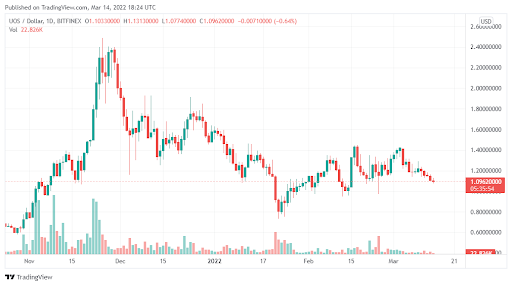
Ultra (UOS) is a social blockchain project that looks to revolutionize how content is shared across various platforms. The platform is hoping to give users the one-stop-shop to share video games, music, and other types of entertainment in a fully decentralized manner.
Data Source: Tradingview
Ultra is relatively new and is just getting started. With a market cap of around $340 million, there is a high chance that it will gain even further in the coming days.
Steemit (STEEM)
Steemit (STEEM) is not a new social project, but it’s still very exciting. The project has had a fair bit of issues including a recent hack but they are now looking to the future.
Steemit basically allows users to create decentralized blogs and other social media platforms within its ecosystem. You also get an easy way to monetize your content. STEEM has a market cap of $122 million right now.
MediaChain
MediaChain is an upcoming decentralized project that hopes to also provide a network of content creators from around the world. It hopes to also help people monetize data without having to go through third parties.
MediaChain is still under development. We are not sure when it’s coming out, but it is one project you can put on your watchlist.
After Bitcoin (BTC) faced its third consecutive rejection, investors became more confident in adding altcoin positions. For the leading cryptocurrency, the path to $50,000 appears more challenging than previously expected.
According to Euronews Next, on March 14, the European Union rejected a proposed rule that could have banned the energy-intensive proof-of-work (PoW) mining algorithm used by Bitcoin and other cryptocurrencies. Several EU parliamentarians have been pushing to ban PoW mining over energy concerns.
BTC/USD price at FTX. Source: TradingView
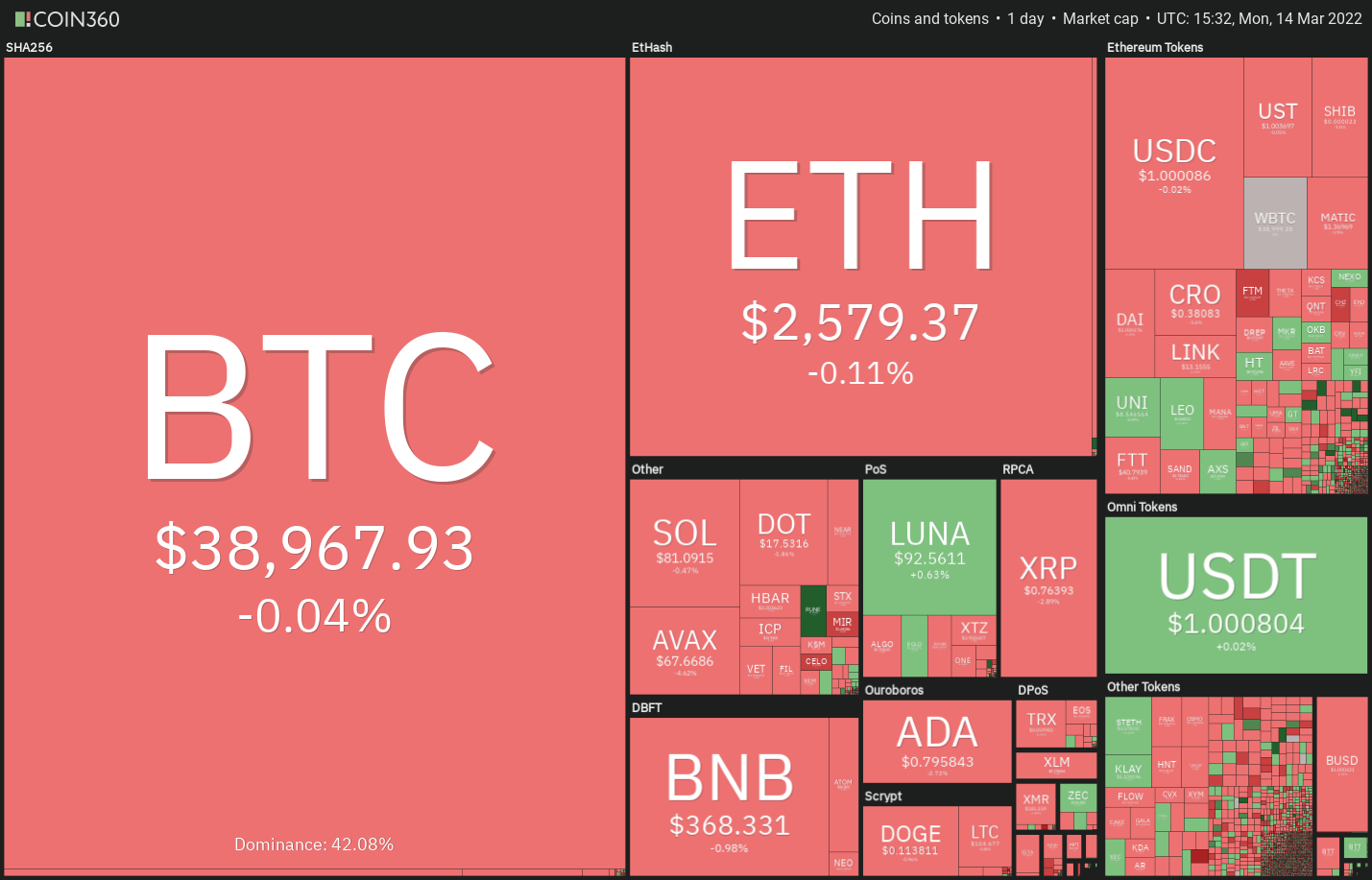
In terms of performance, the aggregate market capitalization of all cryptos was relatively flat over the past seven days, registering a modest 0.4% gain to $1.77 trillion. However, the apparent lack of performance in the overall market does not represent some mid-capitalization altcoins, which managed to gain 17% or more in one week.
Bitcoin presented a 2.5% gain over the previous seven days, while the vice-leader Ether (ETH) increased 3.6%. However, they were no match for the altcoin rally that happened. Below are the top gainers and losers among the 80 largest cryptocurrencies by market capitalization.
Weekly winners and losers among the top-80 coins. Source: Nomics
THORChain (RUNE) rallied after enabling synthetic tokens on March 10. Those derivatives are pegged to the value of other underlying collateralized assets. In THORChain’s version, the project has opted to back its synths with 50% of the underlying asset and 50% in RUNE.
Privacy tokens ZCash (ZEC) and Monero (XMR) rallied as United States President Joe Biden signed an executive order on March 9 focused on establishing a regulatory framework for crypto — mentioning its possible role in circumventing sanctions.
Lastly, Terra (LUNA) rallied after Terraform Labs donated $1.1 billion to Luna Foundation Guard’s (LFG) reserves on March 11. LFG was launched in January as part of a broader effort to grow the Terra ecosystem and improve the sustainability of the network’s stablecoins.
On the other hand, Fantom (FTM) led the worst performers after prominent Fantom Foundation team members Andre Cronje and Anton Nell announced their departure.
Meanwhile, Celo (CELO) suffered a hack on its third-party email service on March 10. A phishing communication was sent to all of its 25,741 users, but the attack was quickly investigated, and the Celo Foundation posted alerts across its social channels.
Tether premium indicates resilience from retail
The OKX Tether (USDT) premium is a good gauge of China-based retail trader crypto demand. It measures the difference between China-based USDT peer-to-peer trades and the official U.S. dollar currency.
Excessive buying demand tends to pressure the indicator above fair value, which is 100%. On the other hand, Tether’s market offer is flooded during bearish markets, causing a 4% or higher discount.
Tether (USDT) peer-to-peer vs. USD/CNY. Source: OKX
Currently, the Tether premium stands at 100.7%, which is neutral. Still, there has been a consistent improvement over the past two months. This data signals that retail demand is picking up, which is positive considering that the total cryptocurrency capitalization dropped 50% between Jan. 1 and March 14.
Funding rates show a lack of excitement
Perpetual contracts, also known as inverse swaps, have an embedded rate usually charged every eight hours. Perpetual futures are retail traders’ preferred derivatives because their price tends to track regular spot markets perfectly.
Exchanges use this fee to avoid exchange risk imbalances. A positive funding rate indicates that longs (buyers) demand more leverage. However, the opposite situation occurs when shorts (sellers) require additional leverage, causing the funding rate to turn negative.
Seven-day accumulated perpetual futures funding rate on March 14. Source: Coinglass
Notice how the accumulated seven-day funding rate is uneventful in most cases. Such data indicates a balanced leverage demand between longs (buyers) and sellers (shorts).
For example, Polkadot’s (DOT) negative 0.30% weekly rate equals 1.2% per month, which is not a burden for traders building futures’ positions. Typically, when there’s an imbalance caused by excessive pessimism, that rate can easily surpass 5% per month.
Some might say that the third failure to sustain Bitcoin prices above $42,000 was the nail in the coffin for the bulls, as the cryptocurrency failed to display strength during a period of global macroeconomic uncertainty and a massive commodities rally.
Still, there are no signs of bearishness from Asian retail traders, as measured by the CNY Tether premium, and there is no indication of pressure from leverage shorts (sellers) on futures markets.
The views and opinions expressed here are solely those of the author and do not necessarily reflect the views of Cointelegraph. Every investment and trading move involves risk. You should conduct your own research when making a decision.
Despite these pressures, however, several cryptocurrency projects have managed to post gains in excess of 20% on March 14, thanks to new partnerships and protocol updates.
Top 7 coins with the highest 24-hour price change. Source: Cointelegraph Markets Pro
Data from Cointelegraph Markets Pro and TradingView shows that the biggest gainers over the past 24-hours were Request Network (REQ), Hifi Finance (MFT) and Selfkey (KEY).
Metaverse payments with Request Network
Request Network (REQ) is an Ethereum-based decentralized payment system that allows users to create, share or fulfill a request for payment through secure channels without the need for an intermediary.
VORTECS™ data from Cointelegraph Markets Pro began to detect a bullish outlook for REQ on March 13, prior to the recent price rise.
The VORTECS™ Score, exclusive to Cointelegraph, is an algorithmic comparison of historical and current market conditions derived from a combination of data points including market sentiment, trading volume, recent price movements and Twitter activity.
VORTECS™ Score (green) vs. REQ price. Source: Cointelegraph Markets Pro
As seen in the chart above, the VORTECS™ Score for REQ began to pick up on March 13, around eight hours before the price increased 45% over the next day.
The increase in momentum for REQ comes following the addition of support for the Jarvis Network’s Euro stablecoin (jEUR) to go along with the project’s ongoing push to become the go-to payment provider for activities in the evolving Metaverse.
Hifi Finance adds community governance
Hifi Finance is a decentralized lending protocol that allows crypto holders to borrow against the value in their assets using bond-like instruments that represent an on-chain obligation that settles on a specified date in the future.
Data from Cointelegraph Markets Pro and TradingView shows that since hitting a low of $0.006 on March 6, the price of MFT climbed 5% to hit a daily high at $0.009 on March 14 as its 24-hour trading volume spiked 1,131% to $235 million.
MFT/USDT 4-hour chart. Source: TradingView
The sudden spike in price and trading volume for MFT follows an announcement that Hifi Finance will soon be integrating governance capabilities for MFT holders who will be able to create and vote on proposals regarding the future development of the protocol.
Selfkey (KEY) is a blockchain-based identity platform that is looking to advance the Know Your Customer (KYC) process and support the ethos of Self-Sovereign Identity through its KYC-Chain.
VORTECS™ data from Cointelegraph Markets Pro began to detect a bullish outlook for REQ on March 7, prior to the recent price rise.
VORTECS™ Score (green) vs. KEY price. Source: Cointelegraph Markets Pro
As seen in the chart above, the VORTECS™ Score for KEY elevated into the green on March 7 and hit a high of 85 around 72 hours before the price began to increase 35.6% over the next four days.
The turnaround in the price of KEY comes as the project works to integrate SelfKey and its KYC-Chain decentralized identity management system across the cryptocurrency ecosystem as a way to satisfy global KYC/Anti-Money Laundering regulations.
The overall cryptocurrency market cap now stands at $1.732 trillion and Bitcoin’s dominance rate is 42.7%.
The views and opinions expressed here are solely those of the author and do not necessarily reflect the views of Cointelegraph.com. Every investment and trading move involves risk, you should conduct your own research when making a decision.
Within 24 hours of its launch on digital collectibles marketplace Veve, crypto enthusiasts purchased all 54,995 pieces of the Disney Pixar Pals nonfungible tokens, or NFTs, collection. The drop consisted of iconic characters and moments created by Pixar Animation Studios, including Sheriff Woody, Mike Wazowski,Lightning McQueen, The House from Up andEdna Mode. Users purchased their NFTs from a blind box, meaning that they receive a random collectible as part of the series and would not know which collectible until after payment.
The list price for each Pixar NFT was 60 gems ($60). By multiplying the collection sold by their listed gem price, it is estimated that the NFT collection fetched the equivalent of $3.3 million. At the time of publication, items in the Pixar drop are selling for up to 350 gems on the secondary market. NFTs on VeVe are currently minted on GoChain. Its developers claim that the blockchain is fast, environmentally friendly and 100% compatible with Ethereum (ETH).
Gems are VeVe’s in-app tokens exchangeable for digital assets on a 1:1 basis with the U.S. dollar. However, the ability to convert gems back into fiat is still in the testing phase. This is because there currently exists a related incentive with holding OMI tokens, which are created by VeVe’s parent, ECOMI.
Whenever gems are used to purchase an NFT, 100% of the equivalent value of OMI is burnt from the token supply while the digital collectible is transferred to the user’s account. Correspondingly, OMI can be converted into gems but not vice versa due to speculation that it may tank the former’s price.
Bitcoin (BTC) has largely been directionless since the start of the year as the bulls have been buying on dips while bears are selling the rallies. This suggests that the price is consolidating in a large range with both the bulls and the bears waiting for the next trigger to establish their supremacy.
The short-term volatility may pick up after the United States Federal Reserve announces its policy decision on March 16 but unless the Fed springs a surprise, the likelihood of a new trending move could be low. Bitcoin could spend some more time in a bottoming formation before breaking out of it.
A positive sign in the range-bound action this year has been evidence of accumulation by both the small investors and select whales. This has coincided with a sustained drop in Bitcoin balances on exchanges. The combined Bitcoin balances on the 21 exchanges it covers have dropped to 2.32 million Bitcoin, the lowest since August 2018, according to CryptoQuant.
Could Bitcoin break above the immediate resistance level and pull the altcoins higher? Let’s analyze the charts of the top-10 cryptocurrencies to find out.
BTC/USDT
Bitcoin has bounced from the immediate support at $37,000, indicating that bulls are attempting to defend this level. The buyers will now try to push the price above the moving averages. If they succeed, it will suggest strong demand at lower levels.
BTC/USDT daily chart. Source: TradingView
The bulls will then try to extend the up-move by clearing the overhead hurdle at $42,594. If they manage to do that, it will be the first indication that the bears may be losing their grip. The BTC/USDT pair could then rise to the overhead zone between $45,400 and the resistance line of the ascending channel.
Conversely, if the price turns down from the moving averages, it will suggest that bears are unwilling to let go of their advantage. The sellers will then attempt to solidify their position by pulling the price below the support line of the channel. Such a move could signal the resumption of the downtrend.
ETH/USDT
The bulls are attempting to defend the support line of the symmetrical triangle. A strong bounce off the current level could push Ether (ETH) to the moving averages where the bears are again likely to mount a strong defense.
ETH/USDT daily chart. Source: TradingView
If the price turns down from the moving averages, it will suggest that the sentiment remains negative and traders are selling on relief rallies. That will increase the possibility of a break below the triangle. The ETH/USDT pair could then resume its downtrend and decline to $2,159.
Contrary to this assumption, if bulls propel the price above the moving averages, it will suggest that the selling pressure may be reducing. The pair could then rise to the psychological level at $3,000 and later challenge the resistance line of the triangle.
BNB/USDT
BNB is attempting to rebound off the support zone between $360 to $350. This suggests that buyers continue to accumulate on dips near the support zone.
BNB/USDT daily chart. Source: TradingView
The buyers will have to push and sustain the price above the moving averages to indicate that the bears may be losing their grip. If the price sustains above the 50-day simple moving average (SMA) ($389), the bulls will attempt to push the BNB/USDT pair to $425.
This positive view will invalidate if the price once again turns down from the moving averages and breaks below $350. Such a move will suggest that the sentiment remains negative and traders continue to sell on rallies. That could pull the price to the critical support at $320.
XRP/USDT
Ripple (XRP) price soared above the downtrend line on March 11 but the rally met with stiff resistance at $0.85. This suggests that the bears have not yet given up and they continue to sell on rallies.
XRP/USDT daily chart. Source: TradingView
The price has pulled back to the 20-day exponential moving average (EMA) ($0.75), which is likely to act as a strong support. If the price rebounds off the current level, the buyers will make one more attempt to push and sustain the XRP/USDT pair above $0.85. If they succeed, the pair could rally to $0.91 and then rise to the psychological resistance at $1.
This positive view will invalidate if the price breaks below the moving averages. Such a move will suggest that the break above the downtrend line may have been a bull trap. A break and close below $0.69 could open the doors for a possible drop to $0.62.
LUNA/USDT
Terra’s LUNA token slipped below $94 on March 11 but the bears could not pull the price to the 20-day EMA ($82). This is a positive sign as it shows that traders are buying on every minor dip.
LUNA/USDT daily chart. Source: TradingView
Although the rising 20-day EMA indicates advantage to buyers, the negative divergence on the relative strength index (RSI) suggests that the bullish momentum may be weakening.
The bulls are attempting to push the price back above $94. If that happens, the buyers will make one more attempt to clear the overhead hurdle at $105 and resume the uptrend. If they do that, the LUNA/USDT pair could rally to $115.
Conversely, if the price turns down from the overhead zone, the bears will try to sink the pair below the 20-day EMA.
SOL/USDT
Solana (SOL) broke and closed below the strong support at $81 on March 11 and followed it up with further selling on March 13. However, the bears have not been able to break the intraday low at $75 made on Feb. 24.
SOL/USDT daily chart. Source: TradingView
The positive divergence on the RSI indicates that the selling pressure may be reducing. The bulls are attempting to push the price back above the breakdown level at $81 on March 14. If they sustain the price above $81, it will suggest that the recent breakdown may have been a bear trap. The buyers will then strive to push the SOL/USDT pair above the 20-day EMA ($87).
This positive view will invalidate if the price turns down from the current level and breaks below $75. That will suggest the bears have flipped the $81 level into resistance. The pair could then drop to $66.
ADA/USDT
Cardano (ADA) is attempting a rebound off the strong support at $0.74 but the effort lacks conviction. A minor positive is that the RSI is showing the first signs of positive divergence, indicating that the selling pressure may be reducing.
ADA/USDT daily chart. Source: TradingView
The bulls will have to push and sustain the ADA/USDT pair above the 20-day EMA ($0.85) to signal that the bears may be losing their grip. That could open the doors for a possible retest of the breakdown level at $1. This level is likely to attract strong selling.
Contrary to this assumption, if the price turns down from the current level or the 20-day EMA, it will indicate that bears are pouncing on every minor rally. That will increase the possibility of a break below $0.74. If that happens, the downtrend could extend to $0.68.
Avalanche (AVAX) broke below the uptrend line on March 13, indicating that the bears have overpowered the bulls. The attempts by the buyers to push the price above the breakdown level on March 14 met with strong selling by the bears.
AVAX/USDT daily chart. Source: TradingView
If bears sink and sustain the price below $64, the AVAX/USDT pair could slide to the strong support at $51. The downsloping 20-day EMA ($74) and the RSI in the negative territory indicate advantage to sellers.
This bearish view will invalidate in the short term if the price turns up from the current level and breaks above the moving averages. The bulls will then try to overcome the barrier at the downtrend line of the descending channel.
This is an important level to keep an eye on because the bulls have faltered at the downtrend line on four previous occasions. If bulls push and sustain the price above the channel, the pair could rally to $100.
DOT/USDT
Polkadot (DOT) once again turned down from the 50-day SMA ($18) on March 13 but the bulls are not allowing the price to sustain below the 20-day EMA ($17).
DOT/USDT daily chart. Source: TradingView
The price has been stuck in a tight range between $16 and $19 for the past few days, indicating indecision among the bulls and the bears. Such tight-range trading is usually followed by a sharp trending move.
If buyers push and sustain the price above $19, the DOT/USDT pair could rally to the next overhead resistance at $23. A break and close above this level will signal that the downtrend may be over.
Alternatively, if the price turns down and breaks below $16, the pair could retest the critical support at $14.
DOGE/USDT
Dogecoin (DOGE) made a strong attempt to start a relief rally on March 14 but the efforts of the bulls met with stiff resistance at the 20-day EMA ($0.12).
DOGE/USDT daily chart. Source: TradingView
If the bulls fail to clear the overhead hurdle, the bears will fancy their chances and try to sink the pair below the psychological support at $0.10. If that happens, the selling could further pick up momentum and the DOGE/USDT pair may slide to $0.06.
Contrary to this assumption, if the price rises from the current level or rebounds off $0.10, it will suggest accumulation by the bulls. The buyers will have to push and sustain the price above the 50-day SMA ($0.13) to signal a possible change in trend.
The views and opinions expressed here are solely those of the author and do not necessarily reflect the views of Cointelegraph. Every investment and trading move involves risk. You should conduct your own research when making a decision.
“USD consumer inflation will continue near all-time highs, and asset inflation will run at double the rate of consumer inflation. Weaker currencies will collapse, and the flight of capital from cash, debt, & value stocks to scarce property like bitcoin will intensify,” Saylor tweeted in response to Musk’s inflation query late Sunday.
The leader in news and information on cryptocurrency, digital assets and the future of money, CoinDesk is a media outlet that strives for the highest journalistic standards and abides by a strict set of editorial policies. CoinDesk is an independent operating subsidiary of Digital Currency Group, which invests in cryptocurrencies and blockchain startups. As part of their compensation, certain CoinDesk employees, including editorial employees, may receive exposure to DCG equity in the form of stock appreciation rights, which vest over a multi-year period. CoinDesk journalists are not allowed to purchase stock outright in DCG.
The leader in news and information on cryptocurrency, digital assets and the future of money, CoinDesk is a media outlet that strives for the highest journalistic standards and abides by a strict set of editorial policies. CoinDesk is an independent operating subsidiary of Digital Currency Group, which invests in cryptocurrencies and blockchain startups. As part of their compensation, certain CoinDesk employees, including editorial employees, may receive exposure to DCG equity in the form of stock appreciation rights, which vest over a multi-year period. CoinDesk journalists are not allowed to purchase stock outright in DCG.