Category: NEWS

  • Bitcoin’s sub-$40K range trading and mixed data reflect traders’ uncertainty

    Bitcoin’s sub-$40K range trading and mixed data reflect traders’ uncertainty

    The phrase “hindsight is 20/20” is a perfect expression for financial markets because every price chart pattern and analysis is obvious after the movement has occurred.

    For example, traders playing the Feb. 28 pump that took Bitcoin (BTC) above $43,000 should have known that the price would face some resistance. Considering that the market had previously rejected at $44,500 on multiple instances, calling for a retest below $40,000 made perfect sense, right?

    Bitcoin/USD at Coinbase. Source: TradingView

    This is a common fallacy, known as “post hoc” in which one event is said to be the cause of a later event merely because it had occurred earlier. The truth is, one will always find analysts and pundits calling for continuation and rejection after a significant price move.

    Meanwhile, on March 2, Cointelegraph reported that Bitcoin “could force a $34K retest.” The analysis cited an “ailing momentum” because Russia had just announced its invasion of Ukraine.

    In the past seven days, the aggregate market capitalization performance of the cryptocurrency market showed an 11.5% retrace to $1.76 trillion and this move erased the gains from the previous week. Large cap assets like Bitcoin, Ether (ETH) and Terra (LUNA) were equally impacted, reflecting nearly 12% losses in the period.

    Weekly winners and losers among the top-80 coins. Source: Nomics

    Only two tokens were able to present positive performances over the past seven days. WAVES rallied for the second consecutive week as the network upgrade to become Ethereum Virtual Machine (EVM)-compatible advanced. The transition is scheduled to start in the spring and the new consensus mechanism will provide a “smoother transition to Waves 2.0.”

    THORChain (RUNE) jumped after completing its Terra (LUNA) ecosystem integration, enabling the blockchain to support all Cosmos-based projects. ThorChain users now have more trading and staking options available, including TerraUSD (UST) stablecoin.

    Funding rates flipped positive

    Perpetual contracts, also known as inverse swaps, have an embedded rate usually charged every eight hours. Perpetual futures are retail traders’ preferred derivatives because their price tends to track regular spot markets perfectly.

    Exchanges use this fee to avoid exchange risk imbalances. A positive funding rate indicates that longs (buyers) demand more leverage. However, the opposite situation occurs when shorts (sellers) require additional leverage, causing the funding rate to turn negative.

    Accumulated perpetual futures funding rate on March 7. Source: Coinglass

    Notice how the accumulated seven-day funding rate flipped positive in all of the top four coins. This data indicates slightly higher demand from longs (buyers) but is not yet significant. For example, Bitcoin’s positive 0.10% weekly rate equals 0.4% per month, which is not eventful for traders building futures’ positions.

    Typically, when there’s an imbalance caused by excessive optimism, the rate can easily surpass 4.6% per month.

    Options data is pricing in a potential price crash

    Currently, there is not any clear direction in the market, but the 25% delta options skew is a telling sign whenever market makers overcharge for upside or downside protection.

    If professional traders fear a Bitcoin price crash, the skew indicator will move above 10%. On the other hand, generalized excitement reflects a negative 10% skew.

    Bitcoin 30-day options 25% delta skew: Source: Laevitas.ch

    As displayed above, the skew indicator held 10% until March 4, but slightly reduced to 7% or 8% during the week. Despite this, the indicator shows that pro traders are pricing higher odds for a market crash.

    There are mixed feelings coming from retail traders’ futures data, which shows a shift moving away from a slightly negative sentiment versus options market makers pricing in a higher risk of a further crash.

    Some might say that the third failure to break the $44,500 resistance was the nail in the coffin because Bitcoin failed to display strength during a period of global macroeconomic uncertainty and strong commodities demand.

    On the other hand, the crypto sector’s current $1.76 trillion market capitalization can hardly be deemed unsuccessful, so there’s still hope for buyers.

    The views and opinions expressed here are solely those of the author and do not necessarily reflect the views of Cointelegraph. Every investment and trading move involves risk. You should conduct your own research when making a decision.

  • How HAL and Aldrin are helping to keep crypto assets secure during bear markets

    How HAL and Aldrin are helping to keep crypto assets secure during bear markets

    Crypto bear markets are known for their downturns and their liquidations for investors who are trading with leverage. On top of that, decentralized finance, or DeFi, projects can become targeted by hacks or suffer rug pulls, leading to enormous losses for investors of their tokens. Now new software seeks to alert investors in real-time about potential risks to their positions. 

    Users and executives from two such services, HAL and Aldrin, explain. HAL is a Web3 data infrastructure tool allowing companies or traders to track, monitor and trigger data. HAL recently launched simple API notifications on Avalanche (AVAX), which seeks to enable users on the blockchain to automate notifications of risky positions. Meanwhile, Aldrin is the first fully-audited decentralized exchange, or DEX, on Solana (SOL). 

    Marco De Rossi, the co-founder of HAL, explained that users can notify anyone on any channel of suspicious DeFi activities on an address with wallet monitoring. “We already have hundreds of Avalanche users playing with Pangolin (PNG), Sushiswap (SUSHI), Aave (AAVE) and also wallet monitoring and much more. In addition, TraderJoe is soon coming, as well as the top 10 Avalanche ecosystem apps in general,” says Rossi.

    Meanwhile, a HAL user, who wished to remain anonymous, told Cointelegraph:

    “I use AAVE, and HAL directly integrated with them, allowing me to be notified if my position there becomes at risk; without me refreshing their dashboard, I can then take action quickly.”

    The anonymous user added that: “I may also want to be the first to know when something new comes up, and for this, HAL allows me to follow every new smart contract deployed by a developer I follow, that way, I can start my research faster and stay up to date.”

    Regarding the price volatility of tokens, Hisham Khan, founder and CEO of Aldrin, explained that it could be very difficult to execute trades manually and get a reasonably decent price. “If you’re exposed to smaller or even mid-market cap tokens, the downside when Bitcoin or Ethereum breaks certain support levels is insane; you can lose 70% gain within 48 hours,said Khan.

    He raised the example of rebalancing a portfolio of 25 tokens taking up to 30 minutes if done manually, but allegedly only seconds if done via Aldrin’s rebalancing feature. “The automation features provided by Aldrin such as the Rebalancer and auto-rebalance when providing liquidity in pools saves me a lot of time,” commented an Aldrin user, who wished to remain anonymous. 

    Like all DEXs, Aldrin faces potential security risks. But according to Khan, Aldrin has been fully audited and would thus have greater strength to combat those risks. He added:

    “There is always the risk of impermanent loss risk that liquidity providers are exposed to. The projected returns […] could be false or scams if the underlying token is not under Aldrin pools […] but this is made clear as a disclaimer to the users.”

  • Which Terra-based coins have the most explosive potential? | Find out now on The Market Report live

    Which Terra-based coins have the most explosive potential? | Find out now on The Market Report live

    “The Market Report” with Cointelegraph is live right now. On this week’s show, Cointelegraph’s resident experts discuss which Terra-based coins you should be looking out for in 2022.

    But first, market expert Marcel Pechman carefully examines the Bitcoin (BTC) and Ether (ETH) markets. Are the current market conditions bullish or bearish? What is the outlook for the next few months? Pechman is here to break it down.

    Next up, the main event. Join Cointelegraph analysts Benton Yaun, Jordan Finneseth and Sam Bourgi as they debate which Terra-based coin has the most explosive potential. Will it be Bourgi’s pick of StarTerra, which capitalizes on blockchains’ biggest trends — play-to-earn, nonfungible tokens (NFTs) and staking — basically combining multiple multibillion-dollar industries?

    Bringing his pick to the table next is Yuan with Loop Finance, which aims to launch the world’s first decentralized finance NFT marketplace that will include NFTs linked directly to DeFi protocols such as Anchor Protocol? It will also launch a content creation platform where creators will be rewarded in LOOPR tokens for creating quality crypto content. There is a lot happening with the project, but will it be enough to win the votes of the audience?

    Lastly, we have Finneseth with his pick of Mirror Protocol, which is currently the sixth-ranked protocol by total value locked on Terra, with $594.63 million locked on the protocol. Assets on the protocol “mirror” versions of real-world assets by reflecting the exchange prices on-chain. These assets include Apple, Airbnb, Amazon, Microsoft, PayPal and Tesla stock along with major cryptocurrencies. It seems like a clear winner, but you’ll have to wait and see.

    After the showdown, we’ve got insights from Cointelegraph Markets Pro, a platform for crypto traders who want to stay one step ahead of the market. The analysts use Cointelegraph Markets Pro to identify two altcoins that stood out this week: Anchor Protocol’s ANC and Waves WAVES.

    Do you have a question about a coin or topic not covered here? Don’t worry. Join the YouTube chat room, and write your questions there. The person with the most interesting comment or question will be given a free month of Cointelegraph Markets Pro, worth $100.

    “The Market Report” streams live every Tuesday at 12:00 pm ET (5:00 pm UTC), so be sure to head on over to Cointelegraph’s YouTube page and smash those like and subscribe buttons for all our future videos and updates.

  • Mama Bitcoin: Fishing for female empowerment with crypto in West Africa

    Mama Bitcoin: Fishing for female empowerment with crypto in West Africa

    Mama Bitcoin is the pseudonym claimed by a young Senegalese Bitcoiner called Bineta. Her business, Bleu comme la mer, was the first retailer in Senegal (and possibly West Africa) to accept crypto as payment. She’s also the first generation of her family to read and write proficiently. 

    The name Mama Bitcoin takes inspiration from the initials of her name, while the “mama” not only reflects her motherly instincts but serves to inspire other women in West Africa to get into blockchain technology and Bitcoin (BTC). She told Cointelegraph:

    “There are very few women that are active in the blockchain space around the world and the situation is no different in Senegal. I wanted to shine a light on being a woman in the crypto industry.”

    Bineta first stumbled across Bitcoin in early 2017 thanks to a curious combination of good intentions and incongruous circumstances. Bineta had dreams of opening her village’s first bakery, a small fishing village called Mbour 90 minutes south of Senegal‘s capital, Dakar. But, in order to deliver warm pains au chocolat to the community each morning, Bineta needed money.

    Mbour village beach, Senegal

    It’s incredibly difficult to get a bank loan for a business idea in West Africa, and it’s even harder for women. Bineta had to search for alternative means. She tried a multi-level marketing scheme (MLM) before hearing from a friend in Cameroon that Bitcoin might fit the bill.

    After copious research, Bineta‘s curiosity sparked. She quickly realized that Bitcoin was far more important for her vision than a potentially risky MLM scheme. Fast-forward to mid-2017 and Mama Bitcoin had spent hours and hours devouring Bitcoin-related content in French and in English, translating where possible.

    She’d arrived at the conclusion that Bitcoin is more than just a “number go up” technology — it could build far more than a new village bakery:

    “The more I learned, the more I realized we need this. This kind of money will help overcome so many issues. Not only is Bitcoin a tool for freedom, but the technology underpinning Bitcoin such as blockchain and decentralization will change Africa‘s development.”

    The journey down the Bitcoin rabbit hole shifted Bineta‘s plans up a gear. The bakery (Bineta jokes it would have been called the Bitcoin Boulangerie) was dropped and a vision for Bitcoin in West Africa took its place.

    As the progress and the price of Bitcoin rose during the 2017 bull run, her understanding of the protocol evolved.

    “Bitcoin isn’t just a means of self-financing without using a bank, it’s a technological revolution and a way of unlocking growth and development in Senegal.”

    Questions such as “why is it so big yet why do so few Senegalese people talk about it, why is the media avoiding this critical topic, why doesn’t Senegal use this tool and why are there so few women talking about it?” kept swirling in her head.

    Bineta set to work, penning articles about Bitcoin on social media websites, reaching out to the Senegalese Bitcoin and crypto community and reevaluating her goals.

    Drawing from past experience in business and given the proximity of Senegal to the Atlantic ocean, Bineta allowed herself to dream bigger. She conceived then established an ambitious seaside operation called Bleu comme la mer.

    A fishing commerce platform, Bleu comme la mer connects fishermen directly with consumers, removing the middleman. It is the first business in Senegal to accept Bitcoin as payment. They also accept Ether (ETH) and Tezos (XTZ). In fact, Mama Bitcoin founded the Tezos community in West Africa.

    Sardines, shrimp, octopus and squid — anything that can be fished from the Atlantic — are available to buy with cryptocurrency on the platform. Bineta adds:

    “Payment with cryptocurrencies shows that, contrary to what many people think, Bitcoin is a peer-to-peer payment solution, not a speculative asset.”

    Bineta showing a potential buyer how to buy fish with crypto. Source: Mama Bitcoin 

    The blockchain vision extends merely beyond cryptocurrency payments. Bineta has focused on making Bleu comme la Mer into a decentralized e-commerce platform where fishermen log their catches and consumers can see exactly what was fished and from where.

    Not only does the decentralized platform aim to streamline the fishing industry, but it also strives to undermine overfishing, a harmful yet common activity in West Africa’s waters.

    Related: One man’s plan to orange pill a nation: Bitcoin Senegal

    Nonetheless, “Senegalese and West Africans are quite skeptical about Bitcoin.” Getting more women into crypto, a passion project of hers, remains a long-standing challenge.

    However, there is hope. At Dakar’s first in-person Bitcoin meetup in 2022, there were three women out of 20 participants. It’s a small but strong start, undoubtedly boosted by Mama Bitcoin‘s infectious energy and zest for cryptocurrency. 

    Celebrating Senegal‘s win in the football tournament The Africa Cup of Nations. Source: Mama Bitcoin

  • VanEck files for new ETF to track crypto and gold mining companies

    VanEck files for new ETF to track crypto and gold mining companies

    VanEck, an investment firm with almost $82 billion in assets under management, has submitted an application to the United States Securities and Exchange Commission (SEC) for the launch of a new exchange-traded fund that invests in gold mining and Bitcoin (BTC) mining companies.

    According to the SEC document filed on March 3, the fund will focus on securities in an index that reflects the performance of gold mining and digital assets mining firms. It would not invest in cryptocurrencies directly or through derivatives. However, there was no ticker or cost ratio mentioned in the document.

    The news of VanEck’s proposed fund comes as concerns over a fresh round of U.S. regulation linger in the air. The U.S. president, Joe Biden, is expected to sign an executive order later this week that will set forth the country’s cryptocurrency strategy.

    The order will instruct federal agencies, including the SEC, to submit reports on what measures they’ve taken regarding digital assets later this year. The administration has come under fire for not providing enough clarity on cryptocurrency regulation.

    In November, the SEC denied a VanEck ETF that would have bought BTC directly. Despite industry figures advocating for one for years, the regulator has not yet approved such a fund. With the groundwork for regulating the crypto space commencing, regulators may be delaying the approval of such ETFs until a more solid regulatory framework is put in place.

    Related: Customer demand prompts Charles Schwab file for Crypto Economy ETF

    Earlier this year, VanEck announced the creation of its first cryptocurrency fund. The fund is listed on the Deutsche Boerse Xetra and SIX Swiss exchanges as an exchange-traded note, or ETN, with exposure to BTC, ETH, DOT, SOL, TRX, AVAX and MATIC.

    In April last year, VanEck introduced its Digital Transformation ETF (DAPP), which invests in firms that provide cryptocurrency exchanges, miners, and other crypto-related stocks. The firm also launched its Bitcoin Strategy Fund (XBTF), which invests in cash-settled Bitcoin futures contracts.

  • BRISE token soars to new highs after the official launch of BitGert Chain

    BRISE token soars to new highs after the official launch of BitGert Chain

    The cryptocurrency ecosystem as a whole has taken a back seat to events in the larger world but this is not stopping developers from building.

    One project that has recently begun to gain traction thanks to its focus on creating a high throughput, low-cost blockchain network is Bitgert (BRISE), a crypto engineering organization that has set out to build a blockchain network capable of processing 100,000 transactions per second for little to no cost for the user.

    Data from Cointelegraph Markets Pro and CoinGecko shows that since hitting a low of $0.000000157 on Feb. 8, the price of BRISE has surged 1,124% to a daily high at $0.00000184 on March 7 as its 24-hour trading volume spiked by 1,050%.

    BRISE/USD 3-hour chart. Source: CoinGecko

    Three reasons for the burst in momentum for BRISE include the launch of the Bitgert Chain, the beta release of the Bitgert Exchange and a series of new partnerships and exchange listings.

    Bitgert Chain launches

    The most significant development to come out of Bitgert over the past month was the launch of the Bitgert Chain on Feb. 14.

    With the launch of the Bitgert Chain, the BRISE token is now available on its mainnet chain as well as on the BNB Beacon Chain as a BEP20 token that can be bridged between the two networks.

    According to Bitgert, the Bitgert Chain operates with a BRC20 standard and is capable of reaching a speed of 100,000 TPS with a gas fee that averages about $0.00000001 per transaction.

    The Bitgert chain is designed to support a variety of decentralized finance applications, nonfungible token projects and Web3 protocols.

    Bitgert Exchange

     On March 6, the beta version of the Bitgert Exchange launched and this could also be a bullish factor for the project.

    The Bitgert Exchange is the first exchange protocol to launch on the Bitgert Chain and it currently supports trading for Bitcoin (BTC), Ether (ETH), Litecoin (LTC), Dash (DASH) and Dogecoin (DOGE).

    According to documentation from the protocol’s website, Bitgert Exchange will be the first crypto exchange to offer users a zero-trading fee environment.

    Related: VC Roundup: Web3 infrastructure developers attract major investors

    Partnerships and exchange listings

    A third factor helping to boost BRISE’s price has been a series of protocol partnerships and exchange listings that have helped spread awareness and access to the token.

    Since the launch of the Bitgert Chain in mid-February, BRISE has been listed on Gate.io, Coin98 Exchange, BitMart, Belon.io, Hoo.com, BitForex and HotBit.

    In addition to the exchange listings, Bitgert also announced new partnerships with Sphynx Labs, Omniaverse, 4D Twin Maps and Innovativ Plastics, and launched the Bitgert Startup Studio program designed to help entrepreneurs and businesses raise funds to launch their ideas or enterprises as a BRC20 smart contract.

    The views and opinions expressed here are solely those of the author and do not necessarily reflect the views of Cointelegraph.com. Every investment and trading move involves risk, you should conduct your own research when making a decision.

  • Price analysis 3/7: BTC, ETH, BNB, XRP, LUNA, SOL, ADA, AVAX, DOT, DOGE

    Price analysis 3/7: BTC, ETH, BNB, XRP, LUNA, SOL, ADA, AVAX, DOT, DOGE

    The geopolitical tension between Russia and Ukraine has resulted in investors seeking safe-haven assets. Contrary to expectations by crypto investors, Bitcoin (BTC) has failed to rise along with gold and it remains closely correlated with the U.S. stock markets.

    Lloyd Blankfein, the former CEO of Goldman Sachs, said that the actions of governments freezing accounts, blocking payments and inflating the U.S. dollar should all be positive for crypto but the price action suggests a lack of large inflows.

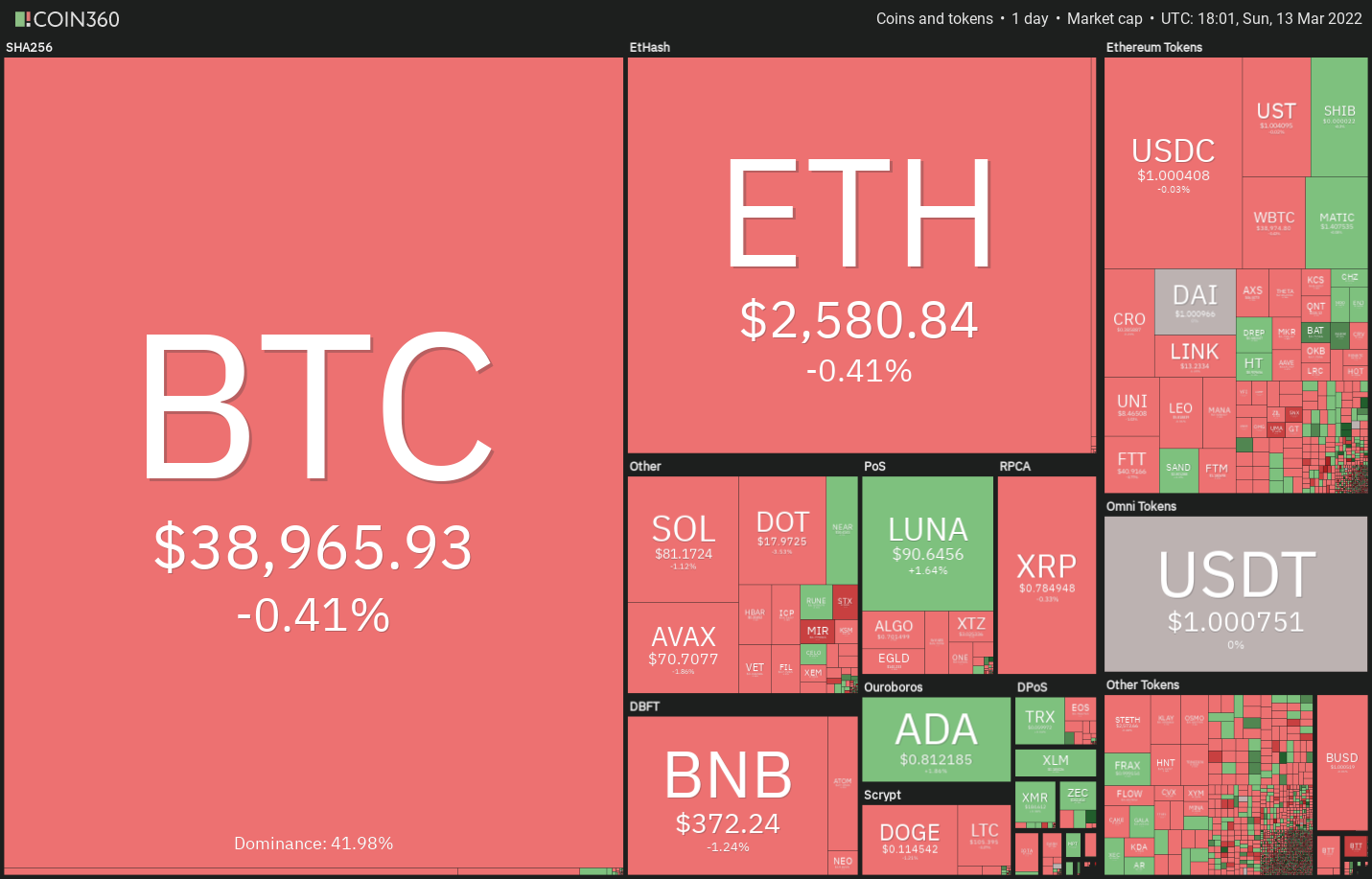
    Daily cryptocurrency market performance. Source: Coin360

    On-chain data suggests that investors may be accumulating Bitcoin for the long term. Data from Santiment shows that 21 out of the past 26 weeks have seen Bitcoin move off the exchanges.

    Could Bitcoin climb back above $40,000 and pull altcoins higher? Let’s analyze the charts of the top-10 cryptocurrencies to find out.

    BTC/USDT

    Bitcoin has been attempting to form a base for the past few weeks. The price has been stuck inside an ascending channel with bulls buying on dips to the support line and bears selling on rallies to the resistance line.

    BTC/USDT daily chart. Source: TradingView

    The crisscrossing moving averages and the relative strength index (RSI) near 45, indicate a minor advantage to bears. If the immediate support at $37,000 fails to hold, the BTC/USDT pair could decline to the support line of the channel.

    A strong rebound off this level will suggest that bulls are accumulating at lower levels. The bulls will then attempt to push the price above the moving averages. If they do that, the pair could rise to the resistance line of the channel.

    The traders should keep a close watch on a break above or below the channel as that could start a strong trending move.

    ETH/USDT

    Ether (ETH) broke and closed below the support line of the symmetrical triangle pattern on March 6, indicating that the continuation pattern has resolved in favor of the bears.

    ETH/USDT daily chart. Source: TradingView

    The bulls purchased the dip and are attempting to push the price back into the triangle. If they manage to do that, it will suggest that the current breakdown may have been a bear trap. A break and close above the moving averages could push the ETH/USDT pair to the psychological level at $3,000 and later to the resistance line of the symmetrical triangle.

    Conversely, if the price turns down and breaks below $2,491, the prospects of a decline to the support zone between $2,300 and $2,159 increase. This is an important zone for the bulls to defend because if it cracks, the selling could intensify and the downtrend may resume. The pair could then drop toward the next strong support at $1,700.

    BNB/USDT

    BNB broke below the 20-day exponential moving average (EMA) ($387) on March 4. The bulls tried to push the price back above the level on March 5 and 6 but failed.

    BNB/USDT daily chart. Source: TradingView

    If the price sustains below the 20-day EMA, the BNB/USDT pair could drop to the strong support at $350. This is an important level to watch out for because if this level cracks, the decline could extend to the strong support zone at $330 to $320.

    Conversely, if the price turns up and breaks above the moving averages, the bulls will attempt to push the pair to $425 and later to $445. This level could attract strong selling but if bulls overcome this resistance, the up-move could reach $500.

    XRP/USDT

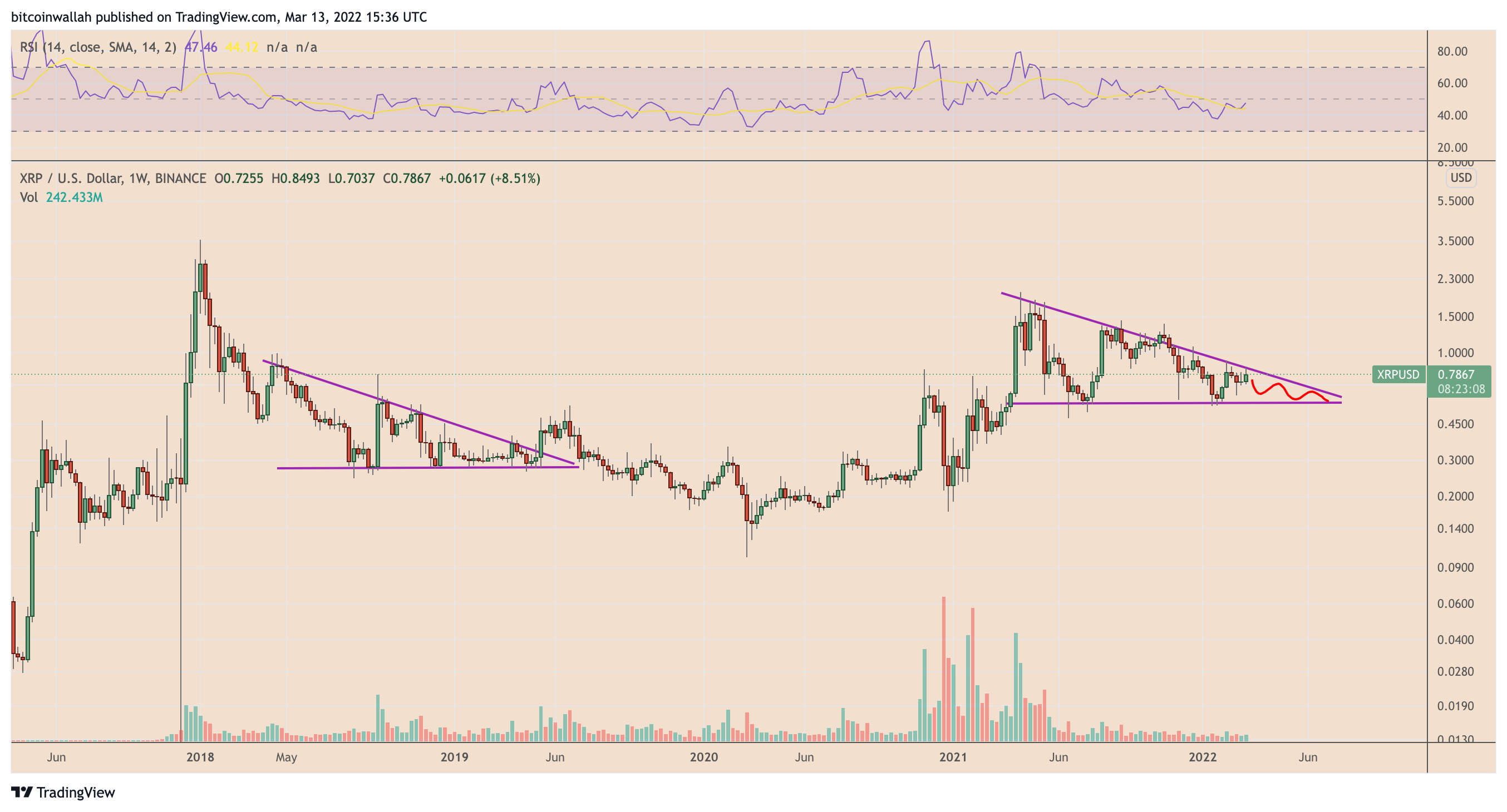
    Ripple (XRP) has again bounced off the 50-day simple moving average (SMA) ($0.72), indicating that bulls continue to defend the level with all their might. The buyers will now try to push and sustain the price above the downtrend line.

    XRP/USDT daily chart. Source: TradingView

    If they succeed, the momentum could pick up and the XRP/USDT pair could rise to $0.85 and then to $0.91. The bears are likely to mount a stiff resistance in the zone between $0.91 and $1. A break and close above $1 could bring the large range between $1.41 and $0.50 into play.

    This positive view will invalidate in the short term if the price turns down from the downtrend line and plummets below $0.62. That could open the doors for a possible drop to the strong support at $0.50.

    LUNA/USDT

    Terra’s LUNA token turned down from the overhead resistance at $94 and could now drop to the 20-day EMA ($74). During uptrends, the bulls buy the dips to the 20-day EMA; hence, this becomes an important level to watch out for.

    LUNA/USDT daily chart. Source: TradingView

    If the price rebounds off the 20-day EMA, the buyers will again try to drive and sustain the LUNA/USDT pair above $94. The gradually upsloping 20-day EMA and the RSI in the positive zone indicate advantage to buyers.

    A break and close above $94 could push the pair to the all-time high at $103. The bulls will have to clear this hurdle to signal the resumption of the uptrend.

    Alternatively, if the price breaks below the 20-day EMA, the pair could drop to the breakout level at $70. A break below this support could suggest that the advantage may be shifting in favor of the bears.

    SOL/USDT

    Solana (SOL) broke below the 20-day EMA on March 4 and dropped close to the strong support at $81 on March 7. This is an important level to keep an eye on.

    SOL/USDT daily chart. Source: TradingView

    If the price breaks and sustains below $81, the SOL/USDT pair could complete a descending triangle pattern. Such a move could suggest the resumption of the downtrend. The pair could then drop to $66 and then extend its slide to the pattern target at $40.

    The downsloping moving averages and the RSI in the negative territory indicate advantage to bears. Contrary to this assumption, if the price rises and breaks above the downtrend line, it will suggest that bears may be losing their grip. The pair could then rally to $122.

    ADA/USDT

    Cardano (ADA) bounced off the immediate support at $0.82 on March 5 but the bulls could not push the price toward the 20-day EMA ($0.92).

    ADA/USDT daily chart. Source: TradingView

    The downsloping moving averages and the RSI in the negative territory indicate that bears have the upper hand. If the price breaks and sustains below $0.82, the ADA/USDT pair could drop to the strong support at $0.74. If this support also cracks, the decline could extend to the next support at $0.68.

    Alternatively, if the price rises from the current level, the bulls will again try to propel the pair above the 20-day EMA. If they manage to do that, the pair could retest the breakdown level at $1. A break and close above this level could be the first sign that the bulls are on a comeback.

    Related: 3 reasons why Bitcoin can rally back to $60K despite erasing last week’s gains

    AVAX/USDT

    Avalanche (AVAX) slipped below the moving averages on March 4 and the bears thwarted attempts by the bulls to push the price back above the 20-day EMA ($78) on March 5.

    AVAX/USDT daily chart. Source: TradingView

    The selling resumed on March 6 and the price reached close to the uptrend line. The bulls bought this dip and are again trying to push the price above the moving averages. If they succeed, the AVAX/USDT pair could reach the downtrend line of the descending channel. The bulls will have to clear this barrier to signal a possible change in trend.

    On the contrary, if the price turns down from the current level and breaks below the uptrend line, the selling could accelerate and the pair could slide toward the strong support at $51.

    DOT/USDT

    Polkadot (DOT) bounced off the strong support at $16 on March 5 but the bulls could not push the price above the 20-day EMA ($17). This suggests that bears are selling on rallies to this level.

    DOT/USDT daily chart. Source: TradingView

    The selling resumed on March 6 and the DOT/USDT pair dropped to the strong support at $16 where buyers stepped in. This suggests that the pair is stuck between the 20-day EMA and $16.

    If bears pull the price below $16, the pair could drop to the intraday low made on Feb. 24. A break and close below this support could open the doors for a further decline to $10.

    Alternatively, if the price rises off the current level or rebounds off the $16 to $14 zone, the bulls will try to push the pair above the 50-day SMA ($17). If they succeed, it will suggest that the bears may be losing their grip. The pair could then rally to $23.

    DOGE/USDT

    The bulls are attempting to defend the strong support at $0.12 but the failure to achieve a strong rebound off it indicates a lack of demand at lower levels. This heightens the risk of a break below the support. If that happens, Dogecoin (DOGE) could drop to $0.10.

    DOGE/USDT daily chart. Source: TradingView

    Both moving averages are sloping down and the RSI is in the negative territory, indicating that the path of least resistance is to the downside. However, the buyers are likely to defend the zone between $0.12 and $0.10 with vigor.

    If the price rebounds off this zone, the bulls will again try to clear the hurdle at the moving averages. A break and close above the 50-day SMA ($0.14) will be the first sign that the downtrend could be coming to an end.

    The views and opinions expressed here are solely those of the author and do not necessarily reflect the views of Cointelegraph. Every investment and trading move involves risk. You should conduct your own research when making a decision.

    Market data is provided by HitBTC exchange.

  • Top 5 cryptocurrencies to watch this week: BTC, XRP, NEAR, XMR, WAVES

    Top 5 cryptocurrencies to watch this week: BTC, XRP, NEAR, XMR, WAVES

    Bitcoin (BTC) plunged below $40,000 on March 4 and has been trading below the level throughout the weekend.

    Although the crypto price action has been volatile in the past few days, Glassnode data shows that institutional investors have been gradually accumulating Bitcoin through the Grayscale Bitcoin Trust (GBTC) shares since December 2021.

    Another positive sign has been that fund managers have not panicked and dumped their holdings in GBTC. This suggests that managers possibly are bullish in the long term, hence they are riding out the short term pain.

    Crypto market data daily view. Source: Coin360

    Bloomberg Intelligence said in their crypto market outlook report on March 4 that Bitcoin may remain under pressure if the U.S. stock markets keep falling, but eventually, they expect crypto to come out ahead. On the other hand, if the stock market recovers, then Bitcoin could “rise at a greater velocity” if past patterns repeat.

    Although crypto markets are facing strong headwinds, select altcoins are showing signs of life. Let’s study the charts of the top-5 cryptocurrencies that could benefit from a rebound in Bitcoin.

    BTC/USDT

    Bitcoin broke below the moving averages on March 4, suggesting that bears are attempting to gain the upper hand. The bulls tried to trap the aggressive bears by pushing the price back above the moving averages on March 5 and March 6 but they failed.

    BTC/USDT daily chart. Source: TradingView

    If the price sustains below the moving averages, the bears will try to pull the BTC/USDT pair to the support line of the ascending channel. The bulls are likely to defend this level aggressively. A strong rebound off this support will suggest that the pair could extend its stay inside the channel for a few more days.

    This short-term bearish view will invalidate if the price turns up from the current level and breaks above the 20-day exponential moving average ($40,474). That will indicate strong buying at lower levels. The bulls will then attempt to push the price toward the resistance line of the channel. The next trending move is likely to begin after the pair breaks above or below the channel.

    BTC/USDT 4-hour chart. Source: TradingView

    The 20-EMA on the 4-hour chart has turned down and the relative strength index (RSI) is in the negative zone, indicating that bears have the upper hand. If the price breaks below $38,000, the pair could drop to $37,000 and then to $35,500.

    Contrary to this assumption, if the price turns up from the current level and rises above the 20-EMA, it will suggest strong buying at lower levels. The bullish momentum could pick up after the pair breaks and closes above the 50-simple moving average. That could open the doors for a possible rally to $45,000.

    XRP/USDT

    Ripple (XRP) has been attempting to rise above the downtrend line for the past few days but the bears have held their ground. A minor positive is that the bulls have not given up and are trying to defend the 50-day SMA ($0.72).

    XRP/USDT daily chart. Source: TradingView

    The flattish moving averages and the RSI near the midpoint do not give a clear advantage either to the bulls or the bears. If bulls push and sustain the price above the downtrend line, the momentum is likely to pick up and the XRP/USDT pair could rally to $0.91.

    A break and close above this level could clear the path for a possible retest of the psychological resistance at $1. Conversely, if the price slips and sustains below $0.69, it will suggest that bears are back in control. The pair could then drop to $0.62.

    XRP/USDT 4-hour chart. Source: TradingView

    The 4-hour chart shows that the pair is currently range-bound between $0.80 and $0.70. If buyers push the price above the downtrend line, the pair could challenge the overhead resistance at $0.80. A break and close above this level could signal that bulls have the upper hand. The pair could first climb to $0.85 and then to $0.91.

    Contrary to this assumption, if the price turns down from the moving averages, it will suggest that bears are selling on rallies. The pair could then drop to $0.70. If this level cracks, the selling could accelerate and the pair could drop to $0.62.

    NEAR/USDT

    NEAR Protocol (NEAR) is sandwiched between the moving averages for the past few days. This shows that bears are selling on rallies to the 50-day SMA ($11) while bulls are buying on dips to the 20-day EMA ($10).

    NEAR/USDT daily chart. Source: TradingView

    The RSI is near the midpoint and the 20-day EMA has flattened out, indicating a status of equilibrium between the bulls and the bears. If the price rebounds off the current level and breaks above $12, it will suggest that bulls are on a comeback. The NEAR/USDT pair could then rally to $14 where it may again encounter strong resistance from the bears.

    Contrary to this assumption, if the price breaks and sustains below the 20-day EMA, it will suggest that the bears have the upper hand. The pair could then drop to the strong support at $8.

    NEAR/USDT 4-hour chart. Source: TradingView

    The pair picked up bullish momentum after breaking above the downtrend line but the relief rally is facing strong resistance at $12. The bears pulled the price below the 20-EMA but the bulls have managed to defend the 50-SMA.

    If buyers push and sustain the price above the 20-EMA, the bulls will again try to clear the overhead hurdle at $12. Alternatively, if the price breaks below the 50-SMA, the selling could intensify and the pair could slide to $9.50.

    Related: Bitcoin heading to 36K, analysis says amid warning global stocks ‘look expensive’

    XMR/USDT

    Monero (XMR) has been correcting inside a descending channel for the past several weeks. The bulls are buying the dips to $134 and attempting to form a basing pattern.

    XMR/USDT daily chart. Source: TradingView

    This has resulted in a consolidation between $134 and $188 for the past few days. The 20-day EMA ($164) has flattened out and the RSI is close to the midpoint, indicating a balance between supply and demand.

    This equilibrium will shift in favor of the buyers if they push and sustain the price above $188. That will complete a double bottom pattern, which has a target objective at $242. However, the rally is unlikely to be easy as the bears are expected to mount a strong defense at the resistance line of the channel.

    Contrary to this assumption, if the price turns down and slips below $155, the bears will attempt to pull the XMR/USDT pair to $134.

    XMR/USDT 4-hour chart. Source: TradingView

    The 4-hour chart shows that the bulls pushed the price above the downtrend line, but could not sustain the higher levels. This indicates that the bears are aggressively defending this level. The moving averages are flattening out and the RSI is just below the midpoint, indicating a balance between supply and demand.

    If the price turns down and slips below $155, the short-term trend could turn in favor of the bears. Conversely, a close above the downtrend line could improve the prospects of a possible rise to the overhead resistance at $188.

    WAVES/USDT

    Waves (WAVES) formed a double bottom pattern at $8 and rallied sharply to $21. The moving averages have completed a bullish crossover and the RSI is in the overbought zone, indicating that bulls have the upper hand.

    WAVES/USDT daily chart. Source: TradingView

    The bears are posing a stiff challenge near $20 but a positive point is that bulls have not given up much ground. If the price turns up from the current level, it will suggest that bulls are buying on dips. That will increase the possibility of a retest at $21.

    If bulls push and sustain the price above $21, the WAVES/USDT pair could pick up momentum and rally toward $24 and then $27. This positive view will invalidate in the short term if bears pull and sustain the pair below $16.

    WAVES/USDT 4-hour chart. Source: TradingView

    The 4-hour chart shows that the correction from $21 pulled the RSI from deeply overbought levels to just below the midpoint. The bulls purchased the dip to the 38.2% Fibonacci retracement level at $16 and have pushed the price back above the 20-EMA.

    If the price sustains above the 20-EMA, the bulls will attempt to drive the pair above the overhead resistance at $21.

    Contrary to this assumption, if the price turns down from the current level and breaks below the moving averages, it will suggest that the short-term traders may be rushing to the exit. That could pull the pair to $14 and then $13.

    The views and opinions expressed here are solely those of the author and do not necessarily reflect the views of Cointelegraph. Every investment and trading move involves risk, you should conduct your own research when making a decision.


  • 6 Questions for Reeve Collins of BLOCKv

    6 Questions for Reeve Collins of BLOCKv

    We ask the buidlers in the blockchain and cryptocurrency sector for their thoughts on the industry… and throw in a few random zingers to keep them on their toes!


    This week, our 6 Questions go to Reeve Collins, co-founder of BLOCKv — a platform for creating, minting and distributing next-generation programmable NFTs.

    I have always found myself at the forefront of new trends and technology developments. I started in 1997 at the first-ever online advertising agency when the internet was in its infancy. As the “dot-com boom” matured, I created one of the first ad networks in 2000 before shifting into the online branded entertainment space in 2007. By 2013, I was diving headfirst into the world of Bitcoin, and this exploration led me to invent the first-ever stablecoin, Tether, in 2014 and the first-ever NFT platform, BLOCKv, in an effort to bring crypto utility to the mainstream. Now, I’m dedicating my time and energy to BLOCKv’s ecosystem of companies and developing programmable NFTs and cutting-edge metaverses for leading global brands.


    1 — Looking at the top 100 projects in crypto by market cap, which ones stand out to you, and for what reason?

    Of course, Bitcoin. While I’m not quite a Bitcoin maximalist, it’s the invention and concept that started this whole movement. I believe Bitcoin has the potential to revolutionize our financial system and free the world from the monopoly that governments have over the control of money.

    After that, I have to say Tether. As my first venture in the space, I’m still blown away at how it has become the foundation and model of the entire ecosystem. Besides those, I’m following the L1s, DeFi and NFT protocols closely since each project introduces new and novel approaches to solve the numerous challenges blockchains face in order to achieve the decentralized future we are all striving for.

    2 — What are the top five Crypto Twitter feeds you can’t do without, and why?

    Documenting Bitcoin (@DocumentingBTC), Andreas Antonopoulos (@aantonop), Dan Held (@danheld), Erik Voorhees (@ErikVoorhees) and Elon Musk (@elonmusk).

    Anyone even slightly interested in the crypto industry should follow these accounts. The folks on this list are experts in the industry’s history, latest news and developments and are some of the greatest dreamers and doers this industry has to offer. No matter your level of crypto knowledge, these accounts can show you the limitless possibilities that the crypto economy has to offer.

    3 — Have you ever bought a nonfungible token? What was it? And if not, what do you think will be your first?

    Have I ever bought one? We invented them! While that may sound a bit outlandish, we really were the first company ever to build out a platform that enables you to create a highly programmable digital object and write it to a blockchain. We started BLOCKv back in 2015, and we have spent the better part of the last decade refining, adjusting and perfecting the technology. Since our ICO in 2017, the platform has created more NFTs for large brands than anyone out there.

    4 — Which alternate movie universe would you most like to live in, and why?

    About Time. In the movie, the protagonist gains the power to go up to 24 hours back in time and redo those moments. My goal in life has always been to create as many “perfect” moments as I can — to truly live life to its fullest. The ability to “edit, redo and relive” certain moments would make that dream come true.

    5 — What’s the silliest conspiracy theory out there… and which one makes you pause for a moment?

    These days, there are more than a few to choose from, unfortunately. I’d have to say the one that really leaves me speechless is this flat Earth theory. It’s just a complete abandonment of objective fact. I mean, if Aristotle could land on the conclusion that the Earth is round in 350 BC, I think we’ve had plenty of time to check the math on this one. 

    There are some theories that always make me pause and consider them a little more deeply. Whether or not I fully buy in is a different story, but some of the conspiracy theories around the global financial system and who/what/how it is controlled make you want to dig a little deeper. It’s concepts like these that make cryptocurrencies so fascinating to me and, in my opinion, essential to the growth and development of the world’s financial future.

    6 — What’s the future of social media?

    I hope for a brighter future for social media. Nobody truly understood its power and influence from the onset, so we’ve been left with the current toxicity that can foster hatred and anger, all bundled into a carefully curated echo chamber for your viewing enjoyment and ad dollars.

    My hope is that we make a cultural correction here and social media takes a turn for the better. Social media still has all the capabilities to bring the world together, foster self-expression and lead to empowerment over disillusionment. It has the potential to be the Great Community Builder, and I hope we get to see it reach that potential.

    Aside from its cultural impact, I see a future where it can have a very positive financial impact on the individuals who participate in it. Today, a small percentage of “influencers” can make a living from their involvement on different social media platforms. This monetary system is built on views, clicks and web traffic — other people’s data. Soon, there will be tools and structures in place that will enable a significant percentage of users to earn meaningful amounts from their participation. Most importantly, though, I think this development will parallel the developments in crypto that will lead to most of this new revenue coming from various forms of community currencies and NFTs, as opposed to the traditional advertising model.

    A wish for the blockchain community: 

    To stay the course and to always remember this quote by Victor Hugo: “There is one thing stronger than all the armies in the world, and that is an idea whose time has come.”

  • Non-crypto natives launch social tokens to engage with community and fans

    Non-crypto natives launch social tokens to engage with community and fans

    The COVID-19 pandemic, along with other recent events, have revealed the need for a fully digital economy, giving rise to Metaverse ecosystems, Web3 platforms and the adoption of digital currencies. 

    For example, the Ukrainian government recently reached out to the crypto community on Twitter asking for donations in Bitcoin (BTC), Ether (ETH) and Tether (USDT). Nonfungible tokens, or NFTs, have also gained mainstream adoption as artists and creators across the globe have discovered new forms of monetization with these models. While innovative, these use cases also demonstrate the notion that blockchain-based concepts that emerged early on often take years to resonate with mainstream society.

    Social tokens in 2022

    This also appears to be the case with social tokens o tokens that are issued by individuals and communities to create engagement. While social tokens were predicted to be the next big trend within the crypto sector in 2020, they seem to be taking off this year due to increased interest from non-crypto natives.

    Jan Baeriswyl, token design specialist at Outlier Ventures — a venture capital firm supporting the development of new technologies — told Cointelegraph that social tokens are fungible, ERC-20 tokens that can be used for instances other than financial purposes. “For example, social tokens can be used to gain access to specific communities, like on Discord. By being less financially focused, social tokens are more accessible to the mainstream, which is why we are seeing increased interest,” Baeriswyl explained. He added that social tokens can take different forms for various purposes, noting that these digital tokens can be used by creators to engage with fans, or by communities to increase awareness for certain causes.

    In addition, social tokens are also being leveraged to help creators and communities gain access to Web3 platforms that offer decentralized models and incentives for community participation. Andrew Berkowitz, chief executive officer at Socialstack — a social token issuance platform built on the Ethereum, Polygon and Celo — told Cointelegraph that Socialstack caters to non-crypto native communities to help issue social tokens that allow for the development of a Web3 ecosystem. “At Socialstack, we realize that 99% of the world are not crypto-natives. We believe that individuals need a platform where they can simply use an email login to take advantage of Web3 capabilities,” he said.

    To put this in perspective, Berkowitz explained that Socialstack recently helped Project Zero — a non-profit organization focused on protecting the ocean from climate change — launch a social token to create an “ecosystem of value that benefits both the planet and participants.” Michele Clarke, founder and CEO of Project Zero, told Cointelegraph that their social token, PZero, enables community members to earn rewards by taking specific actions.

    An ocean shot by Project Zero ambassador and photographer Ben Thouard. Source: Project Zero

    For instance, Clarke remarked that Project Zero’s pre-existing user base consists of about 1 million people. Users can now be rewarded with PZero by helping raise awareness for certain issues. “This can be further amplified by an ambassador with a massive following, a brand partner or collectible artist or news piece that causes a spike into the millions or even hundreds of millions, and we have had a few activations reach over a billion,” she said. Clarke also explained that a primary focus Project Zero aims to achieve with its social token is to convert members’ brief attention spans (often seen during a major crisis) into long-term participation with the organization.

    Jake Beaumont-Nesbitt, founder and chief community experience officer at Project Zero, further told Cointelegraph that Project Zero was created eight years ago and was decentralized by design, as the project is made up of a science-based community located across the globe. Given this, Beaumont-Nesbitt explained that Project Zero naturally aligned with the Web3 ethos, as the organization has always existed without centralized platforms or third-party intermediaries. By adopting a Web3 model through the incorporation of social tokens, Beaumont-Nesbitt pointed out that Project Zero is now able to better engage with its community. He said:

    “Web3 engagement allows an organization to scale up massively by creating value going back to the contributors. Giving back to certain causes today isn’t just about dropping money in a jar and hoping it helps. Web3 enables transparency, allowing people to understand where their money is going, while also participating in a greater way.”

    In terms of incentives, Clarke noted that Project Zero community members will be able to use their social tokens to redeem a variety of digital and real world offerings. “For example, members could buy an NFT on our platform and then be rewarded even more with social tokens to redeem for different incentives,” she said.

    While Project Zero represents what Baeriswyl would refer to as a “community” social tokens, other projects are geared toward individuals — especially as the “creator economy” continues to gain traction. For example, Calaxy is a token-based app for creators founded by NBA star Spencer Dinwiddie and ex-financier Solo Ceesay. While Calaxy is still in its beta version, Ceesay told Cointelegraph that the mobile app will essentially allow creators to build their own social fan-tokens within a Web3 ecosystem: “Calaxy app allows influencers to build social tokens with an easy interface, while also having a marketplace in the application to engage with fans.”

    Ceesay added that Calaxy is powered by Hedera Hashgraph’s distributed ledger technology, which allows the application to act in a decentralized manner to let users engage in different ways using social tokens. Like Project Zero, Ceesay shared that Calaxy is focused on non-crypto natives. “We cater to YouTubers, gamers, social media influencers, sports players and more. Our creator list is expansive,” he remarked.

    NFTs within Calaxy App. Source: Calaxy

    Given this, Ceesay explained that Calaxy offers an Instagram or Twitter like user experience, where individuals have a discover page that also allows them to follow different influencers. Users can then visit an influencer’s homepage to buy their social tokens, where they will also be presented with a list of experiences offered, such as one-on-one video calls or access to exclusive events. While creator social tokens may sound similar to NFTs, Ceesay noted that nonfungible tokens are more about utility and artistic expression, whereas social tokens offer greater flexibility:

    “We envision a world where a sports player, for instance, has a social token that portrays their image. They can then hold that token for eventual decentralized finance capabilities. This is an entirely new economy where creators can do whatever they want with their tokens.”

    Regulatory concerns around “social money”

    Yet while social tokens may be gaining traction, it’s also important to point out the regulatory concerns. The biggest issue to consider here would be a social token in the form of a security.

    To ensure that social tokens are not viewed as securities, Ceesay explained that tokens created on Calaxy are stable coins that are collateralized one-to-one with USDC. “These are stable coins due to the regulatory gray area, but this also helps with onboarding,” he said. For instance, Ceesay pointed out that a Calaxy user could be an eight-year-old boy who is a fan of a specific sports player. “We don’t want these users to have a volatile asset,” explained Ceesay.

    Berkowitz further remarked that Socialstack is an entirely closed ecosystem to ensure regulatory compliance. Berkowitz added that while there are still no clear regulations around social tokens, certain steps can be taken to ensure compliance:

    “The best way to mitigate the risk of a security is to do things through an NFT and then have a Know Your Customer layer that identifies each person as an accredited investor. This is the best way to mitigate risk, but as of now we are making sure communities on our platform are not getting into risky situations.”

    To Berkowitz’s point, Clarke commented that Project Zero is “not a get rich quick scheme,” but rather a social movement. “We are building a community. Web3 is creating great opportunities for exchanging value, not only through currency and smart contract projects, but also social tokens,” she explained. Clarke added that Project Zero’s PZero social tokens have no monetary value:

    “That was deliberate. As such, it was tricky figuring out the initial values for earning and redeeming PZero social tokens. Our tokenomics need to be simple, but we also need to develop them without reference to a single fiat currency and with a view to creating scale.”

    Will social tokens underpin DAOs moving forward?

    Although social tokens are being adopted more widely, use cases for these digital assets are still being developed. As such, the future of social tokens remains unclear. “There are different ways in which people can use these assets. The most exciting part is that we don’t know the best use cases yet,” said Ceesay.

    Given this, some in the industry believe that social tokens will play a key role in decentralized autonomous organizations (DAOs), that typically leverage a token that can be spent to earn rewards. Stani Kulechov, founder and chief operating officer at Aave (AAVE) — an open-source DeFi protocol — told Cointelegraph that although social tokens are still extremely nascent, in the future the crypto sector may see creator social tokens underpinned by DAOs.

    In addition, Baeriswyl expects to see combinations of NFTs and social tokens emerge. While this is just a hypothesis, he explained that the GameFi and play-to-earn spaces are already leveraging a combination of NFTs and forms of fungible tokens:

    “With play-to-earn, you usually have NFT items and then a currency to exchange value. Therefore it may make sense to reward users with social tokens that are really NFTs.”

    Predictions aside, it’s a safe bet to say that social tokens are here to stay since, for example, they are making it easier for creators and communities to launch these social tokens. “Social tokens may not have gained traction before due to complexities and not enough easy-to-use onboarding ramps. There are now apps and platforms that help with this,” said Ceesay.

    Berkowitz further remarked that Socialstack is working with a number of different communities, which has resulted in 20 different use cases across podcasting, artists, festivals, conferences and more. “Our target audience is non-crypto native communities interested in bringing their community into Web3 through a social token. This will further advance as Web3 develops.”