Category: NEWS

  • How do you DAO? Can DAOs scale and other burning questions

    How do you DAO? Can DAOs scale and other burning questions

    DAO: Decentralized. Autonomous. Organization.

    “The whole phrase is a misnomer. They’re not decentralized, not autonomous and they are not organizations,” Monsterplay blockchain consultancy founder David Freuden tells Magazine.

    Freuden co-authored a 51-page report on DAOs in May 2020 in an attempt to help realize their potential. “We need DAOs,” he explains. “The idea of ‘shareholder first’ is only a 1980s/1990s concept. Companies became about profits, not products.”

    He foresaw big things for DAOs and much has changed nearly two years later. By the end of 2021, DAOs had more than 1.6 million participants, up from just 13,000 at the start of the previous year. In 2021, the US state of Wyoming legislated for legal recognition of DAOs and the Marshall Islands. In 2022, Australia is considering doing the same.

    Yeah, but what is a DAO?

    In short, a DAO is a governance model popularized in the decentralized finance sector where members buy (or are rewarded with) governance tokens to vote on how the DAO operates and spends its money. “DAOs were born from DeFi as an investment vehicle. So, you can’t separate a DAO from tokenomics,” says Freuden.

    DAOs are usually built around a mission which can be a promise or a social cause but usually still involves a desire for profits. “If you can’t answer the why the DAO won’t be sustainable,” he says. And, “if you don’t have tokenomics, it’s a co-op, not a DAO.” 

    DAOs come in a range of types that now include operating system DAOs, protocol DAOs, investment DAOs, grant DAOs, service DAOs, social DAOs, collector DAOs and media DAOs. 

    The idea that people could be galvanized around a good cause was very attractive to Freuden. The crypto world comprises “speculators or builders,” so “crypto needs a DAO for the builders.”

    But, one problem is that mismatched expectations among speculators and builders — or both — cause endless but, sometimes creative, friction.

    How do you DAO
    How do you DAO?

    Productivity coordination organisms

    For DAOs, the idea is usually to launch the DAO with an original product, such as a cryptocurrency, an IT protocol or a VC-like investment fund like FlamingoDAO. DAOs allow for tokenized and incentivized distributed open-source contributions without borders. Product or mission is key. Sometimes, this happens in reverse and DAOs emerge once a product is launched, leaving the company to eventually transition to a DAO, like Uniswap eventually did.

    A well-coordinated DAO can get things done. So, it’s a vehicle for a distributed incentivized workforce. Essentially, DAOs are something like productivity coordination organisms.

    DAOs incentivize merit-based contributions. Those who “work for the DAO make permissionless contributions and enjoy fragmented employment benefiting from task descriptions, not job descriptions,” argues Freuden. So, DAOs are, above all else, a new way of organizing cooperation.

    DAO? Distributed not decentralized

    In decentralized autonomous organizations, each word can be interpreted differently. DAOs can emphasize one aspect or at the expense of another. Decentralization is a trade-off for autonomy and vice-versa.

    Matan Field, CEO at DAOstack, has long argued that a DAO is a distributed governance system. Power is distributed collectively. Yet, the decentralized aspects of a DAO can be understood by two different factors. This sheds light on the conflicting definitions of a DAO.

    A DAO can be decentralized because it runs on a decentralized infrastructure. For example, it could be created on a public permissionless blockchain so that another party cannot take over. 

    A DAO is distributed because it’s not organized hierarchically around executives or shareholders. There is no concentration of power around its leadership.

    Option two is clearly distributed rather than decentralized.

    Yet, not all of these endeavors are “automated.”

    Autonomous: Think quorum, not robot

    Think of a quorum rather than a robot. DAOs can be autonomous in the sense that the most profound characteristics of a smart contract are self-enforcing and self-executory capabilities. Thus, every transaction on a blockchain is technically a simplified version of a smart contract.

    Dao landscape
    The DAO landscape is growing more complicated.

    For example, keep in mind how smart contracts work on the Ethereum network. They are less like legal contracts and more like lines of self-executing computer code described as “persistent scripts” by Vitalik Buterin.

    A DAO, however, is autonomous in the sense that its rules are self-enforced once agreed upon by its members. So, a DAO is not fully automated but “automated upon approval by the governance committee.” This can differentiate them from traditional organizations whose rules form guidelines that someone must interpret and apply.

    Why a DAO? They move fast

    A DAO can adapt quickly to local conditions as a quick way to spin up a governance mechanism. It’s a knowledge coordination tool to make decisions collectively and fast. 

    Like UkraineDAO, spun up rapidly by Ukrainian expat Alona Shevchenko, Nadya Tolokonnikova, founder of Russian feminist punk band Pussy Riot, artist Trippy Labs and digital artist collective PleasrDAO, in response to Putin’s invasion of Ukraine. The DAO quickly sought to support Ukrainian charities by selling NFTs of the Ukrainian flag. This is the perfect use case for a DAO: a single mission, moving fast and raising funds for a country accepting crypto where trust in banks is low. 

    This could be a watershed moment for DAOs.

    For Freuden, like many, ConstitutionDAO was another clever use case for DAOs. ConstitutionDAO was an ultimately unsuccessful but “beautiful experiment in a single-purpose DAO” to buy a copy of the U.S. Constitution for public viewing from a Sotheby’s auction. ConstitutionDAO raised $47 million dollars from 19,000 people in just one week in November 2021, but was outbid by a hedge fund manager

    Contributions were returned or lost if transactional gas fees were too high. Yet, as a “beautiful experiment,” a Special Vehicle DAO like the ConstitutionDAO proved exceptionally fast at organizing and crowdsourcing funds for a specific purpose.

    Soon, we may all be lauding the success of UkraineDAO‘s geopolitical ambitions in support of the DAO concept. 

    For Adam Miller, founder of DAOplatform.io and MIDAO Directory Services, some of the best use cases for DAOs today are where a DAO structure is part of the raison d’être.

    That is, a “flat community is key to the venture.” A good example is crowdsourced product development. Miller tells Magazine that DAOs are most likely to succeed when members are excited about a DAO as an alternative to starting a company. He agrees that “distributed is better for the acronym” because DAOs “still need some kind of hierarchy.”

    For Miller, DAOs are also a “new way of organizing people and, importantly, resources.” He started DAOplatform.io, a DAO tooling advisery that is currently transitioning to a DAO due to the “woeful tech options for running a DAO,” which he says mainly comprises of just “multisig admin keys and a voting system.” So, today, he is trying to advise on the best tech stacks for DAOs. 

    There are three key elements, according to Miller.

    “Firstly, tokenization for which there are many methods and tools. Secondly, governance mechanisms, on chain or off chain, and connected to the DAO’s treasury. And, finally, community.” 

    How a typical DAO works…

    DAOs can become more than just a glorified Discord group — but only if there’s a clear mission. That mission is inevitably part financial speculation part utopian dream. The spectrum can vary greatly.

    The Dash DAO was created because the founder left the cryptocurrency project in 2017. It’s the story of a prophet who never anointed a successor. So, building a tokenized evangelical missionary community that was distributed around the world — through a DAO — made sense.

    Dash’s founder Evan Duffield was a “libertarian/anarchist” visionary who forked Bitcoin in January 2014 to make it instant and essentially free, or with negligible gas fees. He disappeared for a while, and so DASH organically transitioned to a DAO.

    Today, 200,000 U.S. retail locations including Walmart and Barnes and Noble accept Dash so that purchasers can use crypto in retail settings. This payment system operates on gift card rails like any other gifted voucher. 

    DAO tools
    There are increasing numbers of DAO tools available. (Source: Coinyuppie)

    Dash is the “first successful DAO,” according to DASH Corp Co (the legal entity for the DAO) Dash head of crypto, DAO and blockchain marketing, Arden Goldstein. By contrast, The DAO, the first actual DAO, was founded in 2016 and disbanded after a hack, an Ethereum hard fork and many controversies. But, what are the metrics for success?

    “In crypto, the measures for success are different,” says Goldstein. But, a “healthy DAO is where people participate or are incentivized to work toward common goals.” A “successful DAO is when people are incentivized to complete a task.” And, crucially, when tasks get completed.

    “Voting, yes or no, 1 or 0, is not the newest concept. The challenge is getting people to continue to participate and keep building a community.” A DAO incentivizes volunteers: Nothing is holding people there to build. The DAO “philosophy isn’t anything new. You need to have skin in the game to participate.”

    DAO members must stake 1000 Dash to become a MasterNode. Those members are incentivized to do marketing (and other tasks) for DASH rewards. It’s basically an outsourced team for its onboarding of new users around the world.

    Part of the fun of joining a DAO is encountering the countless crazy or “very active” people on Discord. No one gets fired (usually). But, in-line with open-source coding communities, you can be offered a full-time job if your work is noticed.

    DAO community members all over the world are incentivized to build the brand. And, Dash is a very useful product for developing countries, where inflation is high and governments are undemocratic. According to wallet downloads, the highest concentrations of Dash DAO members are Russia, Brazil, Venezuela, India, China, France, Italy and the Philippines. 

    Grassroots activism means that this DAO makes sense. A DAO relies on local knowledge. For example, Dash.org is blocked in Venezuela, so DAO members help people use a VPN. DAO members are investors, energized evangelicals and also local expert product distributors.

    There is a Dash platform for submitting proposals and grant applications which are voted on every month. But, the DAO can decide at any time not to fund you. For example, it once employed a PR firm and the community said not enough press was getting published, so the DAO pulled the funding. This raises a great question: How are real-world contractual obligations met by a DAO?

    Does the DASH DAO work?

    “Sometimes, I see the DAO de-fund projects I saw a lot of value in,” Goldstein explains. “As a full-time employee, I still have to put in a funding proposal.” But, with monthly votes, it is still “much faster than other companies I’ve worked on.” 

    The Dash DAO community sees itself as a headless beast. There is a CEO of the corporate entity overseeing the project DASH Core Group, Ryan Taylor. But, he himself is subject to the decisions of the DAO. He oversees the tech development, investment arm and incubator. Yet, the DAO community “will lose it if any press ever says Dash CEO Ryan Taylor.”

    The problem is that “we don’t know who holds the most tokens […] because you don’t know who your customers are or who your investors are.” However, “the loudest voices usually don’t have the most MasterNodes and are not the most invested, so they yell and scream the loudest to offset that power imbalance.”

    On the other hand, Goldstein says she worked hard as the only female in the DAO. “I was proud of the DAO when I turned the logo pink for a day and received a great outpouring of support from the men in the DAO.” This has yet to entice a major influx of female DAO members.

    Like the Kibbutz, communism or even the space race, utopian dreams face a great many hurdles.

    Governance problems remain

    How can DAOs deal with bad behavior by major token holders?

    In early February, a heated debate in crypto Twitter touched on inclusion, diversity and cancel culture over a number of incidents related to decentralized projects. Again, this spotlight on founding teams raised the question of how a DAO addresses any alleged inappropriate behavior.

    In a corporation, misconduct can result in termination. In a DAO, founders usually hold a large number of tokens and the keys to the blockchain (multisignature) or otherwise.

    The conversation was sparked by derogatory comments made by Brantly Millegan, the director of operations of Ethereum Name Service (ENS), about the LGBTQ community and other controversial topics. The screenshotted comments were made in 2016 and were brought to the attention of the board of the not-for-profit behind ENS in early 2022.

    His contract was terminated with the legal entity linked to ENS. But, what about his large holding of DAO’s governance tokens?

    Build your own DAO
    DAOs have enormous potential but plenty of limitations too.

    Members of the DAO put forward a motion to its members, or those that hold tokens to vote on key decisions, to remove Millegan. Yet, he is a “delegate” that holds 370,000 votes that were “delegated” to him. He is the largest delegate in the DAO itself and remains so today.

    So, what would have happened if he refused to accept the DAO’s decision? 

    The answer is not that simple, according to Freuden.

    “Do the members of a DAO have a right to throw someone out that built the project?”

    Yet, if the original mission is no longer viable, they “should be dissolved.” “When a DAO fails, do they give the money back and dissolve themselves? They should. Give back the money with interest like a prenuptial for a marriage that fails.” 

    One relevant analogy is that VCs might seek to remove a problematic CEO before an IPO.

    While treasury is one governance mechanism deployed by DAOs, they are usually (at least for an initial period) controlled by the people that built the original project. Or, in the case of Uniswap, venture capital firm a16z controls so much of the voting power that it delegated various parcels to student-run blockchain organizations in order to gain a semblance of distribution. 

    This leads to the question of whether DAOs can truly work at scale. And, how to evolve these voting paradigms beyond token holdings?

    There are some solutions for the whale token holder problem. Multiple tokens, for example, a utility token on top of a governance token and quadratic voting for whales have become one such mechanism. There are also other protections such as multisignatures keys to a blockchain and time locks on decisions that leave time for any automated decision to eventuate. Each DAO will need to get the structure right depending on the assets at stake.

    In truth, voter participation is often itself a bigger issue.

    Can DAO governance work at scale?

    Participation is also very low in many DAOs. This is likely due to not understanding the tech, apathy or members‘ busy lives. The “bigger the DAO, the smaller the number of voters that vote,” that’s “apathy but also culture,” says Freuden.

    Freuden’s report cites Dunbar’s Law, a British anthropologist, who argued that people can only maintain a total of about 150 relationships, noting that:

    “The larger the DAO gets, the less influence the individual exercises, as their perception of their voting power becomes diminished or inconsequential once the individual becomes a smaller part of a large group. This can be seen via Dunbar’s Rule and the Ringelmann Effect, which states that members of a group become lazier, disenfranchised and more detached as the size of their group increases.”

    Freuden says that “we need to understand how humans relate” to operate a DAO. For this reason, he believes DAOs may work best as an investment fund vehicle, rooted in Cryptoland and function better if small in scale. SyndicateDAO, for example, enabled the creation of 450 new investment group DAOs in just three weeks.

    For example, FlamingoDAO, a celebrated NFT curation investment DAO, had a maximum of 100 investors due to U.S. Securities and Exchange Commission‘s regulations. The so-called “LAO” is a member-directed venture capital fund and a registered LLC in the United States. They have limited membership to only 100 members in compliance with U.S. Securities law with a 120ETH minimum staking contribution.

    Still, how were investment decisions made by FlamingoDAO? Did all 70-odd members have a say regularly? Art and NFTs are highly speculative.

    Thus, there is a belief that investment DAOs work well in the small petri-dish environment. This is due to pooled capital (a max of 7% contributions per member) and crowd-sourced knowledge in a crypto-native club.

    While scalability may be an issue, every DAO will operate differently depending on the aim, the stage of tech development and the personalities within. Tech people are accustomed to meet ups and hackathons for collaborating around a cause or exploratory idea. But, someone or something still organizes the hack.

    Mass voting via holographic consensus

    However, there are lots of clever people working on creative solutions to every problem.

    DAOplatform.io’s Miller cites DXdao, as an example of a successful DAO. DXdao is “a collective that builds and governs decentralized products and services” and runs the DAO completely on-chain. You “earn governance rights by contributing to the community and must keep contributing to keep voting.”

    DXdao, a fork of DAOstack, also deploys a system of economic curation of proposals known as holographic consensus, a voting algorithm invented by DAOstack founder Matan Field. The system allows a random or semi-random subset to make decisions for the group as a whole. 

    DXdao’s Luke Keenan explains to Magazine that “a small predictions market economy emerges around the likely outcome of a proposal as tokens are staked on it, which increases the potential influence of the issue by acting as a gatekeeper for voters. Additionally, proposals that have been given a financial incentive (boosted) have fewer prerequisites to be considered successful, resulting in increased system efficiency.” DXdao “makes decisions by removing voting power as an economic incentive.”

    Field, noting that “scalable DAOs are indeed my focus,” explains that the main point is that holographic consensus “does not require a quorum to render a vote valid.”

    “Rather, it provides a different parallel process to do so. This other parallel process is a ‘prediction game’ played (for profit) by the ‘predictors’ who can be anyone and not particularly voters — they can even be A.I. bots — who make predictions about whether a certain vote will be eventually approved or not by the voters. If, for a long enough period of time, enough stake is being placed over the prediction that the vote will be approved, then the voting process is considered valid, even when the voting quorum is low.”

    “In other words, a quorum is not a resilient strategy for DAO governance at scale,” says Field.

    “So, you don’t need large votes on every issue. If only 5% votes, that’s fine. But, if the proposal moves a significant amount of value or makes a significant change, you require a longer, say a 30 day, voting period and a higher quorum,” says Miller.

    Clearly, the DAO space is maturing. There’s less of a focus on voter turnout and more of a focus on tools like Orca and processes that mean power is delegated to smaller sub-DAOs, committees and working groups.

    Miller also argues that “studies in psychology show that if you reward people too much for participating in a volunteer activity, then you disincentivize them. So, depending on what your DAO does and what type of contributions you are looking for, you may want to offer symbolic rewards such as POAPs or contributor levels, rather than focusing on giving out tokens for every activity.” 

    “Free lunches offer less intrinsic rewards. Random rewards can provide more incentive.”

    Link between culture and incentivization

    One thing that DAOs can do (and Web3 generally), is to reward early-stage users a product with effective ownership. They encourage early participation and bootstrapping before there are network effects, at least in theory.

    For Goldstein, DAOs are “a double-edged sword.” They ferment “evangelical communities in the developing world and may not be fully-scalable, period.” 

    “There always has to be a leader somehow,” she says. “If people don’t want to volunteer for any given task, they won’t.” 

    Sometimes, DAO members have a feeling of ownership or entitlement. “They are not the boss, but they feel that they should be able to see my calendar or that I should provide a daily report on my workday,” complains Goldstein. “I own three MasterNodes and I demand to know X, Y and Z,” they may say.

    As with most decentralized projects, having strong community leaders to influence the culture is paramount. 

    Freuden notes that the “the DAO’s community builder is the influencer of cryptoland.” They “disseminate the DAO’s culture, the cause and rally the troops and also need to speak in English, not tech.”

    They need to keep member spirits high.

    So, the community builder’s role is crucial. Building a community around a coin that promises riches might be easy, but keeping the DAO members motivated as tech development stalls is essential.

    This is a human task. But, there is a lot of focus on tools that measure contributions and then allocate tokens such as SourceCred or coordinate. Many DAOs also have large growth funds/community funds/grant programs that seek to incentivize development and get things done.

    The Future?

    Maybe all DAOs need is a critical mass of onboarding, committed volunteers to emerge and a legendary community builder to herd the flock.

    DAOs are unique for their ability to bring together a passionate (sometimes obsessive community) in a day. But, for organizations built around a shared goal, managing expectations for all stakeholders is key.

    The key element of a DAO is community and cause, not scalable governance mechanisms. “Gaming communities work at scale, that’s how DAOs will work, but we will have sub-DAOs everywhere like sub-committees,” opines Freuden.

    And, as Field notes, new crypto-native voting mechanisms such as holographic consensuses “can handle, in principle, a higher and higher rate of proposals by turning this tension between scale and resiliency into an economical cost.” Scalability is possible but not ensured. 

    The fragmented workplace also remains the key innovation of the DAO. So, for Freuden, “voting is a subset of engagement. The purpose of DAO should allow permissionless engagement and permissionless contributions. DAOs mean people can work remotely.”

    In 20 years, DAOs may be the AI-powered self-organizing concept that has long been imagined. For now, that seems a long way off. But, we are witnessing the maturing of a new breed of productivity coordination organisms.


  • Bitcoin sees $43K dip amid expectations of ‘another run’ for BTC price

    Bitcoin sees $43K dip amid expectations of ‘another run’ for BTC price

    Bitcoin (BTC) corrected from highs above $45,000 on March 3 as traders’ optimism over continued upside remained in the driving seat.

    BTC/USD 1-hour candle chart (Bitstamp). Source: TradingView

    “Liquidity taken” at $43,000

    Data from Cointelegraph Markets Pro and TradingView showed BTC/USD briefly dipping below $43,000 on March 3.

    The reset was expected, punctuating a multi-day uptrend, which had seen the pair add $10,000 in a single week.

    “Short term correction happened on Bitcoin after taking the liquidity again,” Cointelegraph contributor Michaël van de Poppe summarized in a Twitter update.

    “Looks to me like we’re going to see another run to the highs, as the correction is not as swift as we normally would be.”

    Eyes were on the yearly opening price at just above $46,000, alongside order book resistance at $48,000.

    Meanwhile, accumulation continued, with smaller investors coming into focus as keen buyers at current levels.

    “The small fish are stacking sats like there is no tomorrow,” analytics resource Ecoinometrics commented alongside a chart showing buying habits this week.

    Bitcoin investor accumulation chart. Source: Ecoinometrics/ Twitter

    Altcoins retain higher volatility 

    Despite the overall bullish performance this week, none of the top ten cryptocurrencies by market cap were all in the red on daily timeframes at the time of writing.

    Related: $45,000 Bitcoin looks cheap when compared with gold’s market cap

    While BTC/USD was down around 1.8%, major altcoins fared worse, led by Solana (SOL) and Cardano (ADA), both more than 5% lower.

    Ether (ETH), the largest altcoin by market cap, shed 3.5% to return under the $3,000 mark, something which had yet to establish itself as meaningful support.

    “The markets are relatively calm. People have [a] low interest in crypto right now. Engagement is low on social media on all accounts,” Van de Poppe continued

    “Ethereum gas fees are on an ultra-low level. Those are the times that you actually should start paying attention, as it gives opportunities.”

    ETH/USD 1-hour candle chart (Bitstamp). Source: TradingView

  • Japanese business giant Nomura to explore crypto and NFTs with new unit

    Japanese business giant Nomura to explore crypto and NFTs with new unit

    In a move that may suggest growing institutional interest in cryptocurrencies and nonfungible tokens (NFTs), Nomura Holdings has announced it is establishing a new digital assets team to look into possible opportunities in the asset class.

    The company, which deals in retail, wholesale and investment businesses, has said that it was restructuring its Future Innovation Company into a brand new Digital Company, which will begin operations in April. The main objective of the new company will be to increase clients’ use of digital assets and provide related services. Nomura Group president and CEO Kentaro Okuda said:

    “The new Digital Company will lead deeper collaboration among internal and external stakeholders, accelerate our uptake of digital technologies, and enhance our client services.”

    The corporate giant, which has about 120 trillion yen ($1 trillion) in assets under management, stated that it aims to increase digital adoption across all of its operations. The new division will reportedly explore opportunities in cryptocurrencies and NFTs, among other digital assets.

                                                                           Source: stevepb, Pixabay

    NFTs are becoming increasingly popular in Japan, despite having some of the most stringent crypto rules. The Japanese financial services conglomerate Nomura Holdings is the latest major player in the country to look at NFTs. Last week, major Japanese e-commerce firm Rakuten announced the launch of its own NFT trading platform, dubbed Rakuten NFT.

    Related: Japan-based messaging app will offer trial run of native token starting in March

    Last month, Japan’s largest financial conglomerate, Mitsubishi UFJ Financial Group (MUFG), announced it would terminate its three-year-old blockchain payment project to focus on stablecoins.

  • Price analysis 3/2: BTC, ETH, BNB, XRP, LUNA, SOL, ADA, AVAX, DOT, DOGE

    Price analysis 3/2: BTC, ETH, BNB, XRP, LUNA, SOL, ADA, AVAX, DOT, DOGE

    The speculation regarding the U.S. Federal Reserve’s tightening cycle and recent geopolitical developments may have resulted in panic selling by short-term traders. Analysis from Glassnode suggested that traders who had purchased Bitcoin (BTC) near the November 2021 high liquidated their positions in the past two and half months. This supply was absorbed by high conviction investors, which resulted in a redistribution from weak hands to strong hands.

    The crypto market, due to its resilience, continues to attract erstwhile naysayers to its fold. The latest popular figure to have a change of heart is Ken Griffin, founder of American multinational hedge fund and financial services company Citadel. In an interview with Bloomberg, Griffin said that Citadel will “engage in making markets in cryptocurrencies” over the next few months.

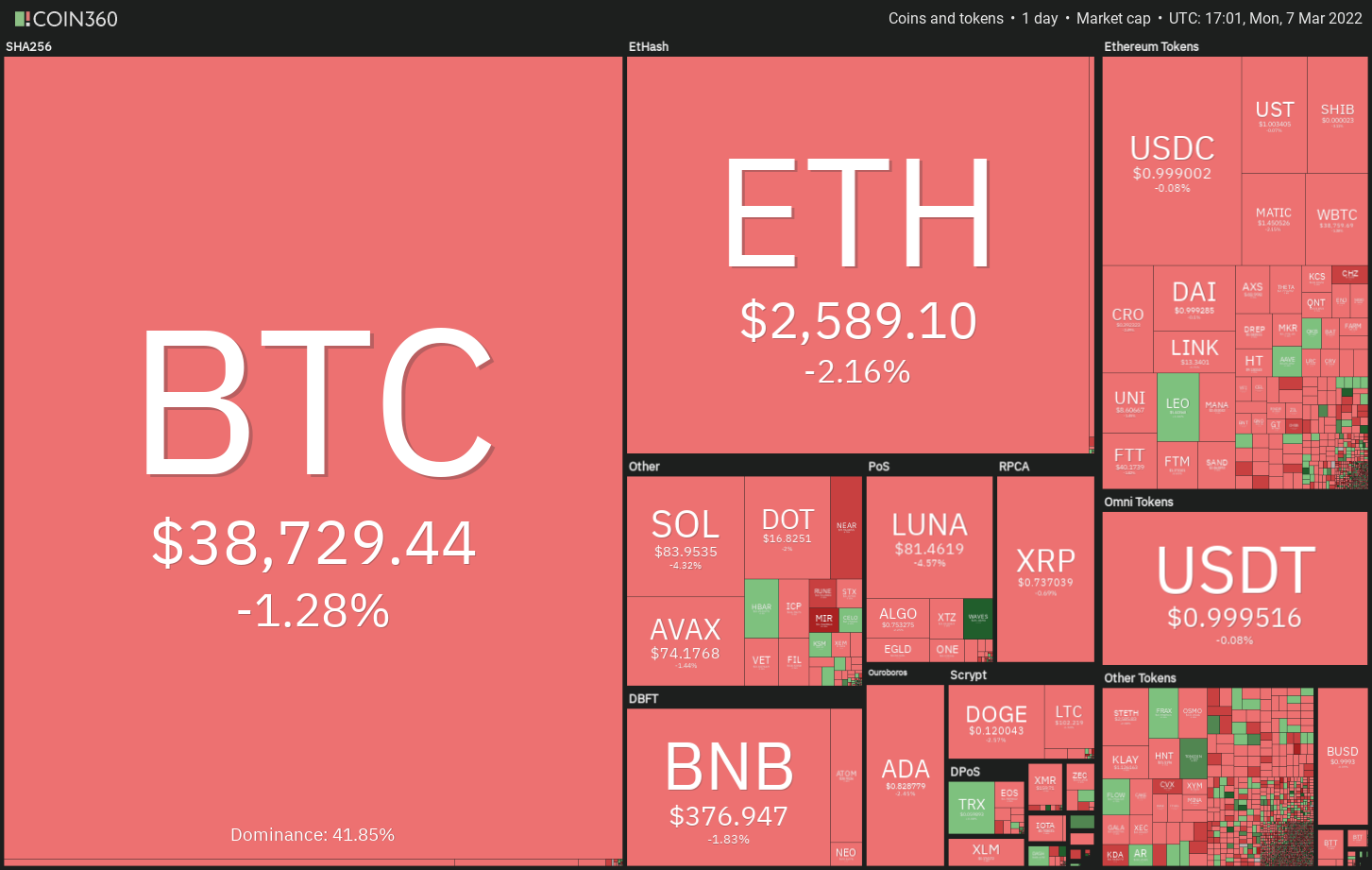
    Daily cryptocurrency market performance. Source: Coin360

    Voyager Digital co-founder and CEO Stephen Ehrlich told Cointelegraph that the firm’s recent quarter was its “best ever, so I certainly feel it’s a great time to be in crypto.” Along with businesses, Ehrlich believes that crypto investors are likely to be rewarded in the long term.

    Will the demand remain intact at higher levels and could the recovery extend further in the next few days? Let’s analyze the charts of the top-10 cryptocurrencies to find out.

    BTC/USDT

    Bitcoin’s recovery has reached the overhead resistance zone between $45,821 and the resistance line of the ascending channel. The bears are expected to defend the zone with vigor.

    BTC/USDT daily chart. Source: TradingView

    The 20-day exponential moving average ($40,797) (EMA) has started to turn up and the relative strength index (RSI) is in the positive territory, indicating an advantage to buyers. If the bulls arrest the next dip at the 20-day EMA, it will increase the possibility of a break above the channel. If that happens, the BTC/USDT pair could rally to $52,088.

    Contrary to this assumption, if the price turns down and breaks below the moving averages, it will suggest that the pair could remain stuck inside the channel for a few more days. The pair may then drop toward the support line of the channel.

    ETH/USDT

    Ether (ETH) broke and closed above the 50-day simple moving average (SMA) ($2,860) on Feb. 28, indicating that bulls are attempting a comeback. The moving averages are close to completing a bullish crossover and the RSI is in the positive territory, indicating that the path of least resistance is to the upside.

    ETH/USDT daily chart. Source: TradingView

    If the price rebounds off the 20-day EMA ($2,824), it will suggest that the bulls are buying on every minor dip. The ETH/USDT pair could then rise to the resistance line of the symmetrical triangle pattern. The bears are likely to defend this level aggressively but if bulls surpass this barrier, the pair could start a new uptrend.

    Alternatively, if the price slips below the 20-day EMA, the pair could drop to the support line of the triangle. A break and close below the triangle could suggest the resumption of the downtrend. The price action inside the triangle is likely to remain volatile.

    BNB/USDT

    BNB broke above the 50-day SMA ($406) on March 1 but the long wick on the candlestick indicates selling at higher levels. The bulls again pushed the price above the 50-day SMA on March 2 but are struggling to sustain the higher levels.

    BNB/USDT daily chart. Source: TradingView

    This indicates that the bears are trying to defend the 50-day SMA. If the price turns down from the current level but does not break below the 20-day EMA ($391), it will suggest that bulls are buying on dips.

    That will improve the prospects of a break and close above the 50-day SMA. If that happens, the BNB/USDT pair could rally to the overhead resistance at $445. This positive view will invalidate in the short term if the price breaks and sustains below the 20-day EMA.

    XRP/USDT

    Ripple (XRP) rose to the downtrend line on Feb. 28 where the bears are mounting a strong defense. The price has turned down from the downtrend line and could now drop to the 50-day SMA ($0.72).

    XRP/USDT daily chart. Source: TradingView

    The flattish moving averages and the RSI near the midpoint suggest a balance between supply and demand. This balance will shift in favor of the buyers if the XRP/USDT pair rises and sustains above the downtrend line. The pair could then rally to $0.85 and later to $0.91.

    Conversely, if the price slips below the 50-day SMA, it will suggest that higher levels continue to witness strong selling. The pair could then drop to $0.68 and if this level also cracks, the next stop may be the Feb. 24 intraday low at $0.62.

    LUNA/USDT

    The bulls have been trying to sustain Terra’s LUNA token above the overhead resistance at $94 for the past two days but the bears have not allowed that to happen.

    LUNA/USDT daily chart. Source: TradingView

    The moving averages have completed a bullish crossover, indicating advantage to buyers. However, the RSI in the overbought territory suggests that the rally may be extended in the short term. The failure to push and sustain the price above $94 could attract profit-booking from short-term traders.

    That could pull the price toward $80. If the price rebounds off this level, it will suggest that sentiment remains positive and traders are buying on dips. The bulls will then again attempt to clear the overhead hurdle at $94. If they succeed, the LUNA/USDT pair could retest the all-time high at $103.

    Alternatively, a break and close below $80 could suggest a deeper correction to the 20-day EMA ($68).

    SOL/USDT

    Solana (SOL) broke above the 20-day EMA ($95) on Feb. 28 and successfully held the retest on March 1. The bulls are striving to push the price above the 50-day SMA ($106). If they succeed, the rally could extend to $122.

    SOL/USDT daily chart. Source: TradingView

    The 20-day EMA has flattened out and the RSI has risen into the positive zone, indicating that bulls are on a comeback. If bulls push and sustain the price above $122, the SOL/USDT pair will complete a double bottom pattern. The pair could then rally to $163.

    This bullish view will invalidate in the short term if the price turns down and breaks below the 20-day EMA. Such a move will suggest that demand dries up at higher levels. That could keep the pair range-bound between $81 and $122 for a few days.

    ADA/USDT

    Cardano (ADA) has reached the breakdown level at $1. This is an important level for the bears to defend because a break and close above it will suggest that the markets have rejected the lower levels.

    ADA/USDT daily chart. Source: TradingView

    The flattish moving averages and the RSI just below the midpoint suggest that the bears may be losing their grip. If bulls push and sustain the price above $1, the ADA/USDT pair could rally to the resistance line of the channel.

    A break and close above the channel will suggest a possible change in trend. The pair could then rise to the overhead resistance at $1.60. This bullish view will invalidate if the price turns down sharply from the current level. In that case, the pair may retest the support at $0.82.

    Related: Solana price eyes $150 as SOL’s 25% jump this week puts ‘double-bottom’ in play

    AVAX/USDT

    Avalanche (AVAX) broke above the moving averages on Feb. 28 and reached the downtrend line of the descending channel on March 1. The bears are attempting to defend this level as they have done on three previous occasions.

    AVAX/USDT daily chart. Source: TradingView

    If the price dips from the current level but does not break below the moving averages, it will suggest that the sentiment may have changed from sell on rallies to buy on dips.

    The bulls will then make one more attempt to push and sustain the price above the channel. If they succeed, it will signal a possible change in trend. The AVAX/USDT pair could then rally to $100.

    On the contrary, if the price breaks and slips below the moving averages, it will suggest that bears continue to sell aggressively. The pair could then drop to $64.

    DOT/USDT

    Polkadot (DOT) broke and closed above the 20-day EMA ($18) on Feb. 28 but the bulls have not been able to clear the overhead hurdle at the 50-day SMA ($20). This indicates that bears continue to sell at higher levels.

    DOT/USDT daily chart. Source: TradingView

    The 20-day EMA has flattened out and the RSI is just above the midpoint, indicating a possible range-bound action in the near term. If buyers push the price above the 50-day SMA, the DOT/USDT pair could rally to $23.

    Contrary to this assumption, if the price turns down from the current level and breaks below the 20-day EMA, the pair could retest the strong support zone at $16 to $14. The bears will have to pull the price below this zone to resume the downtrend.

    DOGE/USDT

    Dogecoin (DOGE) sharply rebounded off the $0.12 support on Feb. 28, indicating that the bulls are aggressively defending the level.

    DOGE/USDT daily chart. Source: TradingView

    The relief rally is facing resistance at the 20-day EMA ($0.13), suggesting that the bears have not yet given up and they continue to sell on rallies.

    If the price turns down from the moving averages, the DOGE/USDT pair could drop to $0.12. This is an important level for the bulls to defend because a break below it could pull the pair to the psychological support at $0.10.

    Conversely, if the price breaks above the moving averages, the pair could rally to the overhead resistance at $0.17. The bullish momentum could pick up above this level.

    The views and opinions expressed here are solely those of the author and do not necessarily reflect the views of Cointelegraph. Every investment and trading move involves risk. You should conduct your own research when making a decision.

    Market data is provided by HitBTC exchange.

  • Bitcoin casts off dip, climbs past $45K as Fed signals rate hike coming in March

    Bitcoin casts off dip, climbs past $45K as Fed signals rate hike coming in March

    Bitcoin (BTC) hit daily lows, then bounced strongly on March 2 as fresh comments by the United States Federal Reserve added to macro volatility.

    BTC/USD 1-hour candle chart (Bitstamp). Source: TradingView

    Powell: March rate hike expected “appropriate”

    Data from Cointelegraph Markets Pro and TradingView showed BTC/USD dipping to $43,350 on Bitstamp before the Wall Street open on March 3.

    A recovery ensued as trading began, however, with the pair already back above $45,000 at the time of writing.

    The volatility followed the release of a new statement from Fed Chair Jerome Powell, who for the first time gave concrete notice of a key rate hike coming this month.

    “Our monetary policy has been adapting to the evolving economic environment, and it will continue to do so,” he commented.

    “We have phased out our net asset purchases. With inflation well above 2% and a strong labor market, we expect it will be appropriate to raise the target range for the federal funds rate at our meeting later this month.”

    Long priced in by the markets, questions nonetheless remained as to the extent of the hike, and how many could follow in 2022. The Russia-Ukraine conflict, Powell added, threatened “highly uncertain” consequences for the U.S. economy.

    Bitcoin nonetheless shook off any nervousness over the news, climbing to near local highs just under $45,000.

    For trader and analyst Rekt Capital, there was cause for optimism, as in terms of order books, BTC/USD was now in something of a “gap” which could trigger a run towards $48,000 — the next area of sell-side resistance.

    Of interest, too, was whether the 50-day exponential moving average (EMA) could be flipped to support.

    “A scenario could be that we’re going upwards again on Bitcoin to trap the shorts, take the liquidity and go back down towards $42 thousand,” Cointelegraph contributor Michaël van de Poppe continued in a separate forecast on the day.

    “Next to that, we also have a massive resistance at the $46,000 region which I doubt we’ll break in one go.”

    LUNA gains signal return to $100 all-time highs

    Elsewhere, altcoins were stable, with Ether (ETH) looking to retake the $3,000 mark once again.

    Related: Bitcoin analysts eye crucial levels to hold after BTC price almost hits $45K, Ethereum $3K

    Terra (LUNA) was the standout in the top ten cryptocurrencies by market cap, continuing a winning streak set to see it reach $100 after its initial rejection at the start of the year.

    “The total value locked in the entire crypto ecosystem is actually doing really well,” Van de Poppe added.

    “It only lost approx. 10%–15% in $USD value in the past months, while the entire market has been dropping down heavily. The next wave of the bull phase will probably be led by DeFi.”

    LUNA/USD 1-day candle chart (Binance). Source: TradingView

  • Solana price eyes $150 as SOL’s 25% jump this week puts ‘double-bottom’ in play

    Solana price eyes $150 as SOL’s 25% jump this week puts ‘double-bottom’ in play

    The price of Solana (SOL) may rise by over 45% in the coming weeks as the cryptocurrency intends to complete a double-bottom chart pattern against the United States dollar.

    A $150 SOL ahead?

    Double-bottoms typically appear at the end of a downtrend when the price falls to a low, rebounds, and returns to the level near the previous low. With bears unable to push the price to a newer low, the selling sentiment becomes exhausted, leading to a sharp upside retracement and a breakout move afterward.

    SOL has been somewhat painting a similar pattern since Jan. 24, especially after extending its rebound move by rising 25% week-to-date to reach above $100.

    Additionally, a visible bullish divergence between SOL’s price and relative strength index trends indicates a high probability of a double-bottom breakout. 

    SOL/USD daily price chart featuring double-bottom and bullish divergence setups. Source: TradingView

    Nonetheless, a bullish confirmation might come if SOL’s price breaks above the double-bottom neckline near $120 with a rise in trading volume. As it happens, SOL’s upside target could be at length equal to the maximum distance between the double-bottom pattern’s lowest point and its neckline.

    That would put SOL en route to at least $150, with a possibility of continuing the bullish move toward $170, marked in red in the chart above.

    Bull-trap risks

    As double-bottom envisioned SOL at $150 or above, popular market analyst Capo warned about a potential bull trap in the Solana market, noting that altcoins, on the whole, would resume their downtrends.

    The pseudonymous analyst presented $120, the double-bottom neckline, as a solid resistance level that would most likely limit SOL’s ongoing upside retracement. He also applied the popular Elliott Wave Theory to hint about the beginning of Solana’s next bearish wave cycle, as tagged with “c” in the chart below.

    SOL/USD daily price chart. Source: Capo/TradingView

    “It’s impossible to me to be bullish here, after the break of all the bullish MS + correctives moves to the upside,” Capo said on March 1, adding:

    “You can enjoy the LTF pumps while they last, but don’t get too comfy.”

    The bearish outlook lined up with a CoinShares report published last week showed most altcoin-based investment vehicles witnessing negative investor sentiment, including BNB, Polkadot (DOT), Cardano (ADA), XRP and Litecoin (LTC).

    Flow by asset in the week ending Feb. 25. Source: Bloomberg/CoinShares

    Related: Crypto investment funds attract $36M in capital despite market turmoil

    Solana also suffered as the week ending Feb. 25 saw SOL investment products losing $2.6 million in capital outflows.

    In contrast, all the digital asset investment products combined attracted $36 million in the same period, with multi-asset portfolios injecting the highest capital — of $14 million, followed by Bitcoin’s (BTC) 17.3 million.

    The views and opinions expressed here are solely those of the author and do not necessarily reflect the views of Cointelegraph.com. Every investment and trading move involves risk, you should conduct your own research when making a decision.

  • Rune’s upcoming mainnet launch and Terra (LUNA) integration set off a 74% rally

    Rune’s upcoming mainnet launch and Terra (LUNA) integration set off a 74% rally

    2021 was a roller coaster of a year for THORChain (RUNE), which saw its price top out at $20.31 only to come crashing down below $4 as a series of hacks and declining interest in decentralized finance had the token limping into 2022.

    Data suggests that investors could be taking a closer look at Rune and a few potentially bullish factors could include the protocol’s recent integration with the Terra and Cosmos ecosystem, an upcoming mainnet launch and the attractive yields offered to liquidity providers.

    RUNE/USDT 4-hour chart. Source: TradingView

    Data from Cointelegraph Markets Pro and TradingView shows that after hitting a low of $3.00 on Feb. 24, the price of RUNE has rallied 74.2% to a daily high at $5.23 on March 1 amid a 388% surge in its 24-hour trading volume.

    Rune integrates with Terra

    One development that has excited the RUNE community is the integration of Terra (LUNA) into the THORChain protocol. This integration also enables the platform to support all Cosmos-based projects.

    Terra integration brings LUNA token, along with the TerraUSD (UST) stablecoin to the THORChain ecosystem and gives users more trading and staking options.

    THORChain now supports six wallet types and eight blockchains on its THORSwap cross-chain decentralized exchange. THORChain is also in the process of adding support for Haven and Monero.

    Wallets and blockchains supported by THORSwap. Source: Twitter

    As part of the rollout for Terra and the Cosmos SDK, THORChain will be updated via a hard fork, which will be fully tested in the testnet and followed by further testing in Stagenet after the Terra launch and on ChaosNet before the mainnet launch.

    Bulls anticipate the next mainnet launch

    A second reason for the increased attention to RUNE could be the upcoming mainnet launch on THORChain. This event has been highly anticipated since late 2021 when the launch was originally planned but delayed due to a variety of factors.

    The specific date for the mainnet launch has yet to be disclosed, but there is no shortage of interest from community members who have remained loyal throughout the struggles and hacks over the past year.

    The requirements for mainnet launch are meeting all testnet goals, which includes the rehearsal of adding and removing chains, removing Bitcoin (BTC) and Litecoin (LTC) from the testnet, and several test runs with forking the chain.

    Related: THORSwap hammers home the point: Aligned incentives are a crypto superpower

    High staking yields attract new deposits

    A third factor helping to attract users and liquidity to THORChain is the high yields offered to liquidity providers on the protocol.

    APRs offered on THORSwap. Source: THORSwap

    Some of the highest yields offered include 55% for Binance USD (BUSD) and 30% for the DAI stablecoin. LTC deposits earn 26% and Dogecoin (DOGE) is set at 24%.

    VORTECS™ data from Cointelegraph Markets Pro began to detect a bullish outlook for RUNE prior to the recent price rise.

    The VORTECS™ Score, exclusive to Cointelegraph, is an algorithmic comparison of historical and current market conditions derived from a combination of data points including market sentiment, trading volume, recent price movements and Twitter activity.

    VORTECS™ Score (green) vs. RUNE price. Source: Cointelegraph Markets Pro

    As seen in the chart above, the VORTECS™ Score for RUNE spiked to a high of 78 on Feb. 25, around 57 hours before the price began to increase 55% over the next two days.

    The views and opinions expressed here are solely those of the author and do not necessarily reflect the views of Cointelegraph.com. Every investment and trading move involves risk, you should conduct your own research when making a decision.

  • 3 reasons why Waves price gained 100%+ in the last week

    3 reasons why Waves price gained 100%+ in the last week

    Development never stops in the blockchain sector and projects that continuously evolve are the ones that stay at the forefront and survive over the long-term. 

    One project attempting to stay on top of the innovation wave is Waves, a multi-purpose blockchain protocol designed to support a variety of use cases, including decentralized applications and smart contracts.

    Data from Cointelegraph Markets Pro and TradingView shows that the price of WAVES has rallied 120% since forming a double bottom at $8.28 on Feb. 22.

    WAVES/USDT 4-hour chart. Source: TradingView

    Three reasons for the price growth for WAVES are the recent announcement that the protocol will migrate to Waves 2.0, a partnership with Allbridge that will connect Waves with other popular blockchain networks and the upcoming launch of a $150 million fund aimed at fostering Waves’ growth in the United States. 

    Migration to Waves 2.0

    The biggest development sparking momentum for WAVES has been the announcement that the protocol has begun the process of migrating to Waves 2.0.

    Part of this transition includes the implementation of a new version of Waves consensus that will be based on practical proof-of-stake sharding (PPOSS), an upgrade that will help make the network faster, more secure and Ethereum Virtual Machine (EVM) compatible.

    Development of the EVM-compatible network is scheduled to start this coming spring and will be connected to the existing network as a way to provide a “smoother transition to Waves 2.0 without depreciating the old network’s value or efficacy.”

    Waves 2.0 will also include a new generic governance model, gravity bridges to all EVM-compatible networks and the creation of a blockchain agnostic Level 0 Inter-Metaverse protocol capable of providing a toolbox for creating connected metaverses that are unified by a shared economy and identity.

    Partnership with Allbridge

    Another development that has helped boost the price of WAVES is a partnership with Allbridge, a protocol focused on facilitating the transfer of assets between all blockchain networks.

    This partnership was established as part of the larger goal of Waves 2.0 and establishes universal bridge integration.

    The stated goal of the collaboration is “to create a unique bridge between Waves and supported EVM as well as non-EVM chains, such as NEAR Protocol, Solana and Terra.”

    According to developers at Waves, the goal is to have Allbridge fully integrated by the end of May.

    Related: Allbridge to become the first token bridge for the Stacks token

    Waves Labs and a $150 million ecosystem fund

    A third reason for the price growth in WAVES has been the addition of new partners to the ecosystem and the establishment of Waves Labs, which is a U.S.-based company.

    Waves also revealed that it will be launching a stand-alone decentralized finance (DeFi) fund at some point in Q1 2022 that will focus on investing in selected Waves-based DeFi products.

    The views and opinions expressed here are solely those of the author and do not necessarily reflect the views of Cointelegraph.com. Every investment and trading move involves risk, you should conduct your own research when making a decision.

  • Which DAOs have the most potential in 2022? | Watch The Market Report live

    Which DAOs have the most potential in 2022? | Watch The Market Report live

    “The Market Report” with Cointelegraph is live right now. On this week’s show, Cointelegraph’s resident experts discuss which decentralized autonomous organizations (DAOs) have the most potential in 2022.

    But first, market expert Marcel Pechman carefully examines the Bitcoin (BTC) and Ether (ETH) markets. Are the current market conditions bullish or bearish? What is the outlook for the next few months? Pechman is here to break it down.

    Next up, the main event. Join Cointelegraph analysts Benton Yaun, Jordan Finneseth and Sam Bourgi as they debate which DAO has the most potential. Will it be Bourgi’s pick of MonkeDAO, with its large community, Solana-based ecosystem and more than $10 million staked, earning around 7% to support the DAO development?

    Not to be outdone, Yuan comes in with the tasty pick of PizzaDAO, which is one of the most revolutionary DAOs to hit the market. It is a global community of creators and pizza lovers who believe that pizza should be free. The DAO is selling rare digital pizza art in the form of nonfungible tokens (NFTs) to raise money to throw a global pizza party! Who wouldn’t want to get into that idea?

    Lastly, we have Finneseth with his pick of Merit Circle, which taps into the hottest sectors in blockchain, gaming and the Metaverse. It helps provide a way for gamers to earn money playing the games they love. It also offers scholarships to players by lending them items from the treasury to be used for gameplay as well as delivering educational content with one-on-one coaching sessions to help scholars improve their performance. Currently, it supports 20 different popular games including Axie Infinity. Gaming is an immensely popular sector, but will it be enough to help push Finneseth to the top of our live poll? Once each of our experts has made their case, you, the audience, get to decide the winner by voting in our live poll, so be sure to stick around till after everyone’s presentations to cast your vote.

    After the showdown, we’ve got insights from Cointelegraph Markets Pro, a platform for crypto traders who want to stay one step ahead of the market. The analysts use Cointelegraph Markets Pro to identify two altcoins that stood out this week: The Sandbox’s SAND and Terra’s LUNA.

    Do you have a question about a coin or topic not covered here? Don’t worry. Join the YouTube chat room, and write your questions there. The person with the most interesting comment or question will be given a free month of Cointelegraph Markets Pro, worth $100.

    “The Market Report” streams live every Tuesday at 12:00 pm ET (5:00 pm UTC), so be sure to head on over to Cointelegraph’s YouTube page and smash those like and subscribe buttons for all our future videos and updates.

  • Payment services provider Shift4 acquires The Giving Block for $54 million

    Payment services provider Shift4 acquires The Giving Block for $54 million

    According to an investor presentation published Tuesday, U.S.-based payment solutions provider Shift4 announced its acquisition of The Giving Block in cash and stock for $54 million, plus a potential earnout of up to $246 million. The Giving Block is an online platform that allows over 1,300 nonprofit organizations and charities to accept crypto donations. 

    As told by its annual report, the organization processed $69.64 million in crypto donations, an increase of 1,558% from 2020. Out of this amount, approximately $12.3 million came from donations by nonfungible token, or NFT, projects. Ether (ETH) became the most-popular crypto donated for the first time, accounting for nearly half of the total volume. Last month, The Giving Block provided Cointelegraph with a sample list of six charities on the receiving end of crypto donations and how philanthropy has positively impacted such organizations. 

    Regarding the acquisition, the team at The Giving Block wrote

    “Shift4’s status as a leading payments company with over $200 billion in annual payments volume, plus our shared commitment to taking crypto mainstream and leading on nonprofit sector payments innovation, has given us the opportunity to have the impact on the world we began dreaming up.”

    Meanwhile, Shift4 commented in a statement:

    “Shift4 will invest further in The Giving Block’s successful strategy while also pursuing a $45+ billion embedded cross-sell opportunity by bundling crypto donation capabilities with traditional card acceptance. This represents just a small portion of the $470+ billion nonprofit addressable markets that Shift4 will uniquely be able to pursue as a result of this acquisition.”

    The Giving Block also launched its Ukraine Emergency Response Fund last week in response to the ongoing Russian invasion. Proceeds, which can be donated via Bitcoin (BTC), ETH and other altcoins, will go to at least 10 humanitarian relief organizations and international nonprofits.