Category: NEWS

  • Bitcoin restaking: programmable slashing and enhanced security

    Bitcoin restaking: programmable slashing and enhanced security

    Bitcoin restaking: programmable slashing and enhanced security

    • Programmable slashing deters malicious acts in shared security blockchain models.
    • SatLayer enables custom slashing rules for diverse decentralized applications.
    • Bitcoin restaking enhances security while offering flexible incentive structures.

    At the heart of many modern-day crypto protocols lies a powerful yet nuanced concept called ‘slashing.’ In its most basic terms, it can be viewed as an economic line of defense helping establish a delicate balance of incentives to encourage proper behavior while deterring malicious activities.

    To be more elaborate, slashing conditions offer up financial guardrails within blockchain networks, imposing monetary penalties on participants who violate protocol rules. As a result, they create a system where operators must have skin in the game (i.e. put their capital) before being entrusted with network validation responsibilities.

    This is particularly vital in shared security models, where the same set of validators secures multiple chains or applications, as misbehavior in one area can trigger penalties across the entire ecosystem.

    For instance, a validator considering double-signing (producing conflicting blocks at the same height) must weigh the potential short-term gain against the guaranteed loss of staked assets – a calculation that typically makes malicious behavior economically irrational.

    The economics of trust

    Without quality slashing conditions, restaking protocols would lack the necessary financial deterrents to prevent malicious behavior, potentially leading to catastrophic security failures and loss of user funds. However, the implementation of slashing conditions requires careful consideration of numerous factors, including the severity of different offenses, the appropriate penalty levels, and the mechanisms through which violations are detected and proven.

    Too lenient, and the rules may fail to deter malicious behavior; too harsh, and they might discourage participation altogether. This delicate balance is essential for creating a system that maximizes security while remaining attractive to potential validators and stakers.

    One project that achieves this equilibrium well is SatLayer, a shared security platform leveraging Bitcoin as primary security collateral while offering unprecedented flexibility in slashing condition implementation.

    By deploying as a set of smart contracts atop the popular BTC staking platform Babylon, SatLayer enables Bitcoin restakers to secure any type of decentralized application as a Bitcoin Validated Service (BVS) — all while maintaining full Turing-complete programmability with minimal trust assumptions.

    Differentiators galore

    What truly distinguishes SatLayer from the rest of the fray is its ability to allow each BVS to implement its own specific slashing conditions tailored to its security requirements.

    Unlike one-size-fits-all approaches that apply identical penalties across different contexts, SatLayer recognizes that various applications may have distinct security needs and threat models. A bridge service connecting multiple blockchains, for instance, might require different slashing conditions than a decentralized exchange or an oracle service, each facing unique attack vectors and security considerations.

    This customizability extends not just to the conditions that trigger slashing but also to the consequences of those violations. BVS developers utilizing SatLayer have considerable flexibility in defining what happens to slashed assets – they can be redirected as protocol revenue, permanently burned by sending them to a null address, or distributed according to other parameters defined by the service.

    Basically, different services can experiment with different incentive structures to find the optimal balance between security assurance and participant attraction.

    Lastly, it bears mentioning that SatLayer’s approach to slashing creates a three-sided marketplace where Bitcoin restakers, BVS developers, and node operators interact within a self-regulating economic ecosystem. For instance, restakers can enhance the crypto-economic security of the ecosystem by staking their Bitcoin assets and delegating them to trusted operators, earning rewards in return.

    BVS developers, on the other hand, can address the cold-start problem – where new services initially lack sufficient security – by launching with the backing of Bitcoin’s massive economic weight.

    Lastly, node operators can provide the computational resources necessary to run these services, taking a portion of rewards as their fee while facing the prospect of slashing if they violate established rules — all within a permissionless system where market forces can determine which services gain the most support and which operators earn delegation trust.

    A rapidly evolving security horizon

    With each passing year, the importance of sophisticated slashing mechanisms (within shared security protocols) seems to be becoming increasingly apparent, especially since traditional approaches to blockchain security often rely on simplistic models with limited flexibility, unable to adapt to the diverse requirements of modern decentralized applications.

    In this regard, SatLayer represents a significant advancement, leveraging Bitcoin’s massive security potential to a diverse range of services through flexible, programmable slashing conditions.

    Source link

  • Bitcoin Pepe emerges as a possible go to altcoin as crypto market bleeds

    Bitcoin Pepe emerges as a possible go to altcoin as crypto market bleeds

    Bitcoin Pepe emerges as a possible go to altcoin as crypto market bleeds

    • The crypto market has crashed, losing $1.01 billion in liquidations.
    • Bitcoin (BTC) has plunged below $84k while altcoins like ETH and SOL have slumped 15-20%
    • Bitcoin Pepe’s presale offers a compelling alternative with the price set to rise from $0.0255 to $0.0268 in next presale stage.

    The crypto market is reeling from a brutal wave of liquidations. Over $1 billion in leveraged positions have vanished in the last 24 hours, according to Coinglass data.

    The liquidations have hit traders hard across major exchanges. Bitcoin alone accounted for $396.16 million in wiped-out positions. Ethereum saw $209.58 million evaporate, and Solana’s liquidations reached $70.55 million. Even meme coins weren’t spared—Dogecoin saw over $20 million in liquidations.

    The crypto market erased gains made earlier this week

    Bitcoin (BTC) has plummeted below $84,000 gain, shedding nearly 10% of its value in a single day. The tumble has reversed its rally past $95,000 earlier this week. It has hit an intraday low of $82,467.24 before stabilizing slightly above $83k.

    Ethereum (ETH) followed suit, diving 15% to $2,089, while altcoins like Solana (SOL) and XRP cratered by 20% and 18%, respectively. Cardano (ADA) also plunged 25% to $0.7998 as a majority of the other altcoins bore the blunt of the bloodbath.

    Meme coins were not spared either. Shiba Inu (SHIB) and Pepe Coin (PEPE) have dropped 13% and 18%, respectively, while Sonic (S) and Trump-backed tokens have shed 23% to 25,% respectively. It seems the high-risk corner of the market faced unrelenting exits as fear gripped traders.

    Notably, the crypto market carnage mirrors a broader market slump, with the global crypto market cap tumbling 10% to $2.76 trillion.

    What is causing the crypto market to drop?

    Investors blame CME futures gaps and thinning liquidity for the sudden crypto market drop. Analysts point to liquidity gaps and leveraged bets gone wrong as the culprits.

    Trump’s talk of a strategic crypto reserve couldn’t shield the market from broader economic tremors; the selloff has erased gains sparked by optimism over President Donald Trump’s pro-crypto moves.

    Besides the liquidity gaps, economic factors are also to blame for the crypto crash. Trump’s new 25% tariffs on imports from Canada and Mexico have sparked trade tensions.

    Canada and Mexico supply a third of US goods, and the tariffs threaten growth and stoke inflation fears.

    Following the introduction of the tariffs, American stocks also tanked alongside crypto, with the Dow Jones falling 650 points. The VIX index also jumped to 22, signaling rising market panic.

    Historically, cryptocurrencies falter when fear dominates, pushing investors to the sidelines.

    Bitcoin Pepe emerges as a haven for crypto investors

    Amid this chaos, Bitcoin Pepe stands out as a bold contender. Pitched as the “World’s Only Bitcoin Meme ICO,” blending Bitcoin’s durability with meme coin flair, the project aims to build a Meme Layer-2 for Bitcoin, promising instant transactions and ultra-low fees. Its PEP-20 standard lets users launch memecoins on Bitcoin’s blockchain.

    Unlike the currently bleeding altcoins and memecoins, Bitcoin Pepe is currently in its presale stages, which are structured to ensure the price rises with each presale stage progression.

    The presale is gaining traction despite the market rout. Currently in stage 5 of 30, the presale has raised $3,690,133. The current price sits at $0.0255 and is set to rise to $0.0268 in the next stage.

    The project’s smart contract has already been audited by SolidProof, offering a glimmer of credibility in a sea of uncertainty.

    Interested investors can connect wallets and buy in, betting on its vision of “Solana on Bitcoin” as a lifeline. The project’s whitepaper and roadmap pitch a future where meme coins thrive on the “only chain that will live forever.”

    Source link

  • Unity Wallet COO: three factors are affecting crypto market prices

    Unity Wallet COO: three factors are affecting crypto market prices

    • The Bybit hack has increased fears over centralized exchange security vulnerabilities
    • US President Donald Trump’s trade tariffs are increasing market uncertainty
    • Trump’s crypto promises may have started as being great, but they could end up proving catastrophic

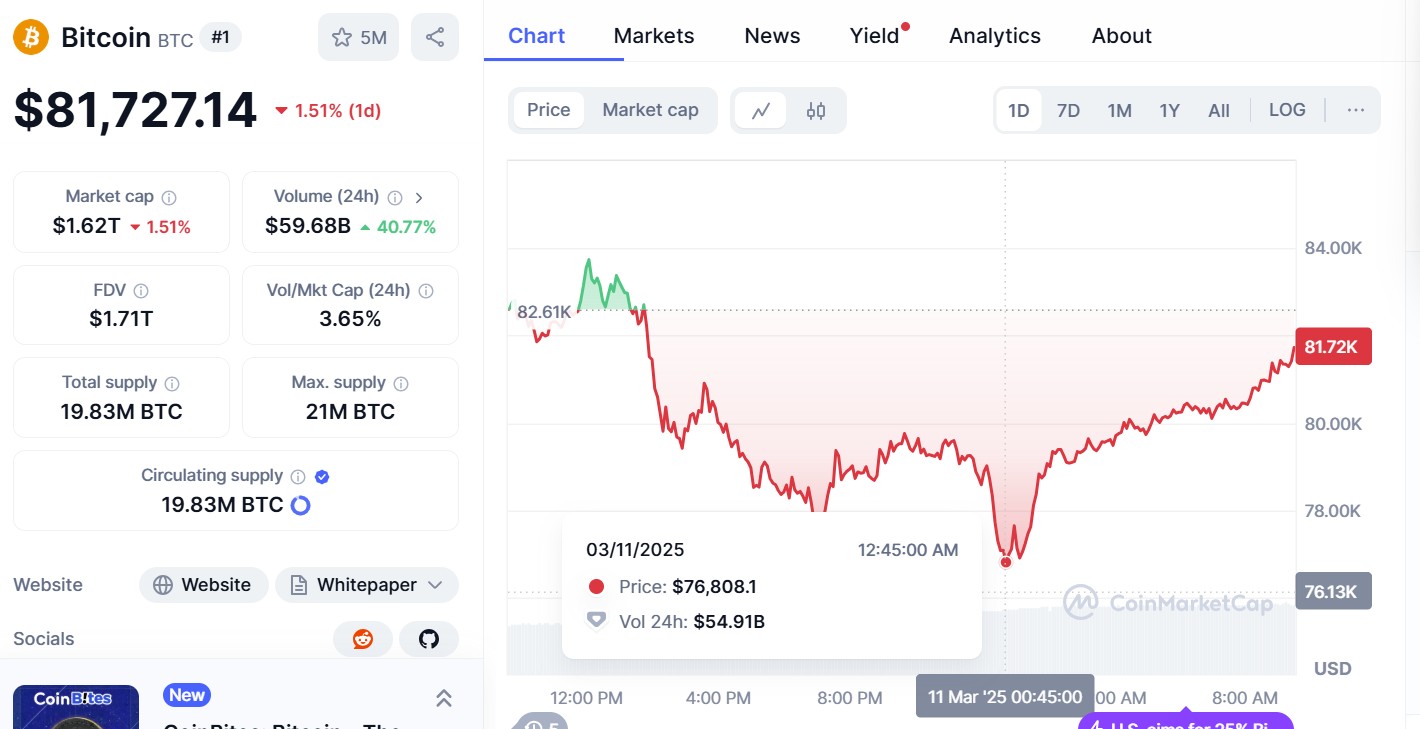
    Three things are contributing to the drop in crypto prices, which has seen Bitcoin fall 7.50% over 24 hours to $78,000, according to Unity Wallet’s COO.

    BTC price at $78,000. Source: CoinMarketCap

    It’s a significant drop from Bitcoin’s all-time high, which reached $109,000 in January ahead of US President Donald Trump’s inauguration.

    According to James Toledano, it feels like optimism around the crypto market post-election created a bubble and that the “reality post-inauguration is now setting in – and hard,” he said to CoinJournal.

    In Toledano’s view, the Bybit hack at the crypto exchange last Friday—which resulted in the theft of nearly $1.5 billion worth of Ethereum—is one of the contributing factors affecting crypto prices.

    Undermining investor confidence, it has led to panic withdrawals and a market-wide selloff across the board. While Bybit’s CEO, Ben Zhou, quickly responded to the hack, the situation has increased “fears about centralized exchange security vulnerabilities—which only solidifies the case for self-custodial services,” Toledano continued.

    Dom Harz, co-founder of BOB (“Build on Bitcoin”), a hybrid Layer-2, said to CoinJournal the theft at Bybit is a “stark reminder of the industry’s fundamental issues,” adding:

    “We’ve been hypnotized by price spikes, memecoin frenzies, and media spectacles, forgetting that crypto was meant to be a new financial system—one built on decentralized protocols that make finance accessible to everyone. Bybit just gave us a $1.5 billion reminder that we are nowhere near that reality.”

    Trump’s tariffs

    The continued market selloff follows Trump’s trade tariff announcement earlier this week.

    During his election campaign, the US president made promises regarding crypto, stating that America will be the “crypto capital of the planet.”

    Since entering the White House, he has appointed pro-crypto individuals to reshape government agencies, namely Paul Akins as the incoming chair of the US Securities and Exchange Commission (SEC).

    Mark Uyeda is currently acting chair of the SEC.

    Trump also signed an executive order to establish a crypto working group to provide regulatory clarity. It’s also expected that the working group will look into the potential of a national crypto stockpile.

    Yet, despite these steps, Trump’s trade wars—which could soon hit the EU, the world’s largest trading bloc, with a 25% tariff—is increasing market uncertainty.

    According to Toledano, Trump’s tariffs are “harming the global economy” and that many in the crypto space feel let down by the US president.

    “The promise was great and the reality is potentially proving to be catastrophic,” he added. “It does make me wonder if Trump understands that financial verticals are interlinked and increasingly converging.”

    Biggest economic risk

    The third contributing factor affecting market prices—according to Toledano—are questions around the overall governance of the US.

    An article by Chatham House suggests that the biggest economic risk from Trump’s presidency is a loss of confidence in US governance. It reads that while Trump’s policies may seem mild in the short term, steps that undermine the US and its international allies could have lasting effects.

    “I rarely get spooked from the peaks and troughs that crypto presents but when I combine what’s happening with traditional equities volatility, I think there is cause for concern right now,” said Toledano.

    Source link

  • iDEGEN hits public shelves with momentum as crypto prices crash

    iDEGEN hits public shelves with momentum as crypto prices crash

    Bitcoin dump

    AI meme crypto market has grown to a market cap of $2.4 billion, and iDEGEN is set to take its rightful position on the table. After three months in the presale stage, it has hit the public shelves with the same viral momentum. 

    Its early adopters are set to continue reaping big from the project as the uncensored AI agent revolutionizes the crypto space. In addition to the 300,000% gains already locked in, its value may surge by at least 10X in coming months. This is despite the selling pressure current felt across the crypto majors.

    Ripple price chart pattern hints at further selling pressure in the short term

    After trading steadily above the support zone of $2.5000 in the past one week, Ripple price has plunged by about 16% since Monday. Similar to other crypto majors, the altcoin is under pressure as extreme fear grips the broader market. 

    A look at its daily chart points to the formation of a bearish death cross pattern as the short-term 25-day EMA crosses the 50-day EMA to the downside. In the near term, the range between $2.0000 and $2.3357 is worth watching. For a firm trend reversal, the bulls will need to gather enough momentum to rebreak the resistance at $2.5500.

    XRP Price
    XRP Price

    iDEGEN debuts on Raydium with the same viral momentum

    iDEGEN has hit the public shelves as promised; ending the three-month-long presale. It has debuted on Raydium, a Solana-based DEX and is set to also list on BitMart on 4th March.

    What started on a blank slate ready to learn from the crypto degens on X has grown into an ultra-popular AI crypto with the potential to compete with other AI meme coins like AI16Z, Hamster Kombat, and Fartcoin. 

    In three months, it has managed to raise $25 million. This has been made possible by its aggressive community, apt timing, and booming AI crypto market. If the presale is anything to go by, its viral momentum is set to yield growth of atleast 10X in the coming months. At its last stage price of $0.038, its early adopters are already enjoying returns of upto 300,000%. 

    Bitcoin spot ETF records streak of outflows as tariff jitters persist

    Bitcoin price

    Concerns over the impact that Trump’s trade policies will have on the US economy have triggered a shift in the market sentiment. Compared to last week’s neutral level of 49, the crypto fear & greed index is now at an extreme fear level of 10. 

    With the resultant plunge in Bitcoin price, Bitcoin spot ETFs have seen persistent outflows as its institutional demand falls. According to SoSoValue, Bitcoin spot ETFs recorded daily total outflows of $754.53 million on Wednesday. Notably, the trend has been on for 7 sessions in a row. 

    On its daily chart, the bearish death cross pattern points to continued selling pressure in the short term. At its current level, the bulls will be keen on defending the support at $81,600. A subsequent correction may have it rebound past $85,000 to find resistance at $90,000. 


    Source link

  • Bitcoin Pepe turns into a compelling alternative amid a bleak Bitcoin sentiment

    Bitcoin Pepe turns into a compelling alternative amid a bleak Bitcoin sentiment

    Bitcoin Pepe turns into a compelling alternative amid a bleak Bitcoin sentiment

    • Bitcoin sentiment hits lowest since 2022 as Fear & Greed Index drops to 10.
    • Bitcoin funds lose $3B in 7 days, with BlackRock ETF seeing a record $420M single-day exit.
    • Bitcoin Pepe offering Layer-2 meme coins on Bitcoin offers an alternative with its ongoing presale.

    Bitcoin’s recent tumble has sent shockwaves through the crypto market, with the Crypto Fear & Greed Index plunging to its lowest level in over two years, signaling extreme fear among investors.

    Macroeconomic uncertainties, fueled by threats of trade tariffs from US President Donald Trump, have only added to the unease.

    However, amid this bleak backdrop, a new project dubbed Bitcoin Pepe is emerging as a potential alternative for crypto enthusiasts.

    Bitcoin’s bleak outlook

    The Crypto Fear & Greed Index recently hit a score of 10, its lowest since June 2022. That period saw major crypto collapses like Three Arrows Capital and Terraform Labs, sparking widespread panic. Today, the sentiment echoes that fear, even without similar crashes.

    Bitcoin’s price has dropped nearly 16% in the past 30 days, hovering around $86,304. Analysts pin this on macroeconomic pressures, including Trump’s reaffirmed 25% tariffs on Canada and Mexico, with threats aimed at the European Union stoking fears of a trade war.

    Bitcoin investment products, particularly US spot Bitcoin ETFs, are bleeding cash. Over seven days, $3 billion flowed out, including a record $420 million single-day exit from BlackRock’s iShares Bitcoin Trust. Funds like Ark 21Shares and Grayscale saw heavy withdrawals too.

    However, some analysts remain hopeful. Ben Simpson of Collective Shift says buying during extreme fear often pays off historically.

    But Arthur Hayes warns of a drop to $70,000. Ki Young Ju notes 30% corrections are normal in bull cycles, citing a 53% dip in 2021 that Bitcoin overcame.

    Bitcoin Pepe offers a meme-focused alternative

    Amid the volatile crypto market, Bitcoin Pepe is stepping up as a fresh option in the stormy market with its ongoing presale. With the “World’s Only Bitcoin Meme ICO,” the project aims to bring Solana-like perks of speed and low fees to Bitcoin’s sturdy network. It’s a Layer-2 solution built for meme coins.

    The PEP-20 standard is its backbone. It lets anyone launch meme coins on Bitcoin, tapping into the blockchain’s unmatched resilience. Bitcoin’s staying power makes this a big deal.

    Bitcoin Pepe’s presale is rolling along in Stage 5 of 30, having raised $3,632,454 at press time, with the BPEP token priced at $0.0255 and set to rise to $0.0268 in the next stage. This tiered pricing shows a deliberate rollout plan aimed to incentivize early investors.

    As Bitcoin Pepe rides the meme coin wave, blending it with Bitcoin’s strength with instant transactions and tiny fees to draw users tired of Bitcoin’s usual costs, its presale offers a compelling haven for those who want to hedge against the current market turmoil.

    Looking ahead, the project’s roadmap hints at future growth with talk of partnerships and integrations.


    Source link

  • UTXO, SNZ, and Jump Crypto among major institutions adopting sBTC

    UTXO, SNZ, and Jump Crypto among major institutions adopting sBTC

    UTXO, SNZ, and Jump Crypto among major institutions adopting sBTC

    • Stacks’ sBTC gains traction with UTXO, SNZ, Jump Crypto as early adopters.
    • With this adoption, the demand for sBTC has tripled capacity in under 24 hours.
    • The sBTC unlocks Bitcoin DeFi, with withdrawals set to start in March 2025.

    A new wave of institutional adoption is sweeping through the Bitcoin ecosystem as Stacks, a prominent Bitcoin Layer 2 solution, celebrates the rapid uptake of its decentralized, Bitcoin-backed asset, sBTC.

    Leading the charge among early sBTC adopters are industry heavyweights UTXO Management, SNZ, and Jump Crypto, signalling strong confidence in sBTC’s potential to unlock decentralized finance (DeFi) utility for Bitcoin holders worldwide.

    UTXO Management, a key player with its venture arm backing top Bitcoin companies and its liquid fund 210k Capital deploying resources across public and private markets, has embraced sBTC as part of its Bitcoin strategy.

    Jump Crypto, a division of the renowned Jump Trading Group, brings its expertise as a quantitative trading firm and infrastructure builder to the table. Saurabh Sharma of Jump Trading notes, “sBTC fosters a more dynamic and interconnected financial landscape.”

    SNZ, a crypto-native investment firm with a footprint in Hong Kong, Singapore, and the US, continues its legacy of supporting Bitcoin innovation. It was an early backer of Stacks and other public blockchains in Asia.

    Other notable participants include CMS Holdings, an active investor in Bitcoin scaling ventures; RootstockLabs, a pioneer behind the Rootstock sidechain; Sypher Capital, with its focus on generating native Bitcoin yield; and Asymmetric Research, a security partner to major protocols like Solana and Wormhole.

    Together, these institutions underscore sBTC’s broad appeal across the crypto ecosystem, from trading and investment to technical development and security.

    The rising enthusiasm for sBTC

    Launched on the Stacks mainnet in December 2024, sBTC has quickly positioned itself as a game-changer in the tokenized Bitcoin landscape, enabling programmable smart contracts and transactions secured by Bitcoin’s robust infrastructure.

    The enthusiasm for sBTC was evident from the start, with its initial capacity cap filled by a roster of influential depositors, prompting a second cap raise that tripled availability on February 25th.

    Remarkably, this expanded capacity was fully subscribed in under 24 hours, reflecting surging demand from institutions, wealth managers, builders, and retail investors alike.

    Among the standout sBTC use cases driving this momentum is Zest, a fast-growing application that has already captured nearly 40% of the sBTC within the protocol, showcasing the asset’s immediate usability and appeal.

    For Bitcoin enthusiasts, sBTC represents a bridge between the cryptocurrency’s unparalleled security and the dynamic possibilities of DeFi.

    Unlike traditional staking or locking of Bitcoin on its base layer, sBTC activates capital by enabling a wide range of financial applications, from yield generation to lending and decentralized exchanges.

    Alex Miller, CEO of Hiro, a developer tooling company within the Stacks ecosystem, emphasized the sBTC’s transformative potential stating that the growing adoption of sBTC provides essential liquidity for developers building and scaling applications.

    Notably, the rise of sBTC comes amid a broader surge in Bitcoin Layers, which have seen their total value locked (TVL) soar by over 460% in the past year, climbing from approximately $500 million in 2024 to $2.8 billion by February 2025, according to CoinGecko data.

    This growth reflects a growing recognition among Bitcoin (BTC) holders that Layer 2 solutions like Stacks can enhance functionality without compromising the core principles of security and decentralization.

    With tokenized Bitcoin assets now accounting for 1.67% of BTC’s circulating supply, the highest level since October 2022, sBTC is poised to play a central role in this evolving narrative.

    Looking ahead, Stacks is preparing to roll out withdrawal functionality for sBTC in March 2025, a milestone that will further solidify its utility. As the leading Bitcoin Layer 2 by developer traction and market cap, Stacks is driving a movement to transform Bitcoin’s $1 trillion in passive capital into a fully programmable, productive asset.

    With support from top staking providers, custodians, and ecosystems like Solana and Aptos, sBTC is not just connecting Bitcoin to DeFi—it’s paving the way for a future where all roads in crypto lead back to Bitcoin.

    Source link

  • Bitcoin drops below $84k as markets react to tariffs

    Bitcoin drops below $84k as markets react to tariffs

    BTC on stack of cryptocurrencies with falling crashing graph in background

    • Bitcoin price fell to lows of $82,131, dipping to levels seen in November 2024.
    • The BTC sell-off happens after Trump’s latest tariffs announcement, including a 25% tarriffs on the EU.
    • Equities also dumped, with the S&P 500 seeing $500 billion wiped off.

    The price of Bitcoin dropped more than 6% in 24 hours to break below $84,000 on Wednesday.

    Notably, Bitcoin price has touched its lowest levels since November 2024, when it rose amid election momentum. According to crypto and stocks trader IncomeSharks, the market is bearish.

    BTC sold-off as the crypto market reacted to trade war sentiment, with this coming on the heels of the latest tariffs announcement by President Donald Trump.

    Having announced that the 25% tariffs on Canada and Mexico and 10% on China will go into effect in April, Trump said he would slap 25% tariffs on the European Union. The news saw the S&P 500 fall, with over $500 billion in market cap wiped off.

    Bitcoin dips amid ETFs outflows

    As equities reacted to the potential trade war, Bitcoin crashed below $84,000. Per data from CoinMarketCap, the price of BTC hit lows of $82,131.

    BTC price also dumped amid massive selling pressure from ETFs. Major issuers Fidelity, Ark and Grayscale all sold. BlackRock, which sent millions of dollars worth of BTC and ETH to an exchange on Tuesday, also offloaded $150 million of the flagship coin.

    While bulls had rebounded to above $84k at the time of writing, sentiment remains weak and a retest of $80k is possible. Crypto analyst Rekt Capital shared the chart below.

    According to analysts, the markets are pricing in a possible “rebound in inflation” with investors factoring in likely spikes in the prices of goods.

    “What’s interesting is the SHARP divergence between Gold and Bitcoin since the trade war began. While Gold is up +10%, Bitcoin is down -10%, even though Bitcoin is historically viewed as a “hedge” against uncertainty,” the Kobeissi Letter said.


    Source link

  • Binance CEO: we’re seeing a “tactical retreat” with crypto “not a reversal”

    Binance CEO: we’re seeing a “tactical retreat” with crypto “not a reversal”

    • Richard Teng indicated that the crypto market tends to bounce back after major geopolitical events
    • Teng’s remarks come as Bitcoin dropped below $90,000 earlier this week following the news of US President Donald Trump’s trade tariffs on Canada and Mexico

    What we’re seeing with crypto market prices is a “tactual retreat, not a reversal,” according to Binance’s CEO.

    In a series of posts on X, Richard Teng said crypto markets typically bounce back after major events.

    “History has shown that crypto markets react to macroeconomic shifts much like traditional assets, but they also bounce back with remarkable resilience,” he said, adding “what we are witnessing now is another short-term tactical retreat, far from a structural decline.”

    Bitcoin drops to $87,000 for the first time since November

    Teng’s post comes as Bitcoin dropped below $90,000 earlier this week following the news that US President Donald Trump had confirmed trade tariffs on Canada and Mexico.

    Speaking to CoinJournal, James Toledano, COO at Unity Wallet, said many believed that Bitcoin’s price would continue rising once Trump entered the White House, adding:

    “But the reality is that the price has gone south, likely due to tariff trade wars, fragile peace talks in Eastern Europe, and fears around DeepSeek’s impact on the US tech sector. But this could also just be a momentary lapse of pricing reason.”

    Continuing on X, Teng said: “Price movements often overshadow what’s happening beneath the surface, but the core drivers of crypto’s growth remain firmly intact.”

    Crypto ETF filings on the rise

    According to Teng, the rising number of crypto exchange-traded funds (ETFs) is a good sign for the market.

    He added that market cycles come and go, but the fundamental indicators of crypto’s strength are getting stronger.

    Earlier this month, the Chicago Board Options Exchange (Cboe) filed four separate filings on behalf of issuers to launch spot XRP ETFs.

    Last week, the US Securities and Exchange Commission (SEC) acknowledged 19b-4 filings from Grayscale to list spot Dogecoin and XRP ETFs. More recently, Grayscale filed for a Polkadot ETF, making it the latest crypto ETF application submitted in the past few months.

    In October, Bitwise filed an S-1 form with the SEC for an XRP ETF. Similarly, Canary Capital filed for an XRP ETF last year, reflecting its broader strategy of bringing multiple crypto ETFs to the market.


    Source link

  • Bitcoin drops below $90k as Trump confirms trade tariffs

    Bitcoin drops below $90k as Trump confirms trade tariffs

    Dogecoin and other major altcoins dip

    • This is the lowest Bitcoin has dropped since November 2024
    • Trump’s trade tariffs are likely impacting crypto market prices as investors look elsewhere to trade
    • Two crypto hacks days apart have worsened investor sentiment

    Bitcoin’s price has dropped below the $90,000 mark, signalling the lowest decline for the number one crypto asset since November 2024.

    Bitcoin’s price at $87,000. Source: CoinMarketCap

    On February 25 at 10:25 UTC, Bitcoin was trading at around $87,190, according to data from CoinMarketCap. At the time of publishing, it has risen slightly but remains under $90,000, a key figure to stay in bullish territory.

    According to Arthur Hayes, BitMEX’s co-founder, Bitcoin could drop to $70,000 if large hedge funds sell their positions in Bitcoin exchange-traded funds (ETFs).

    Impact of Trump’s tariffs

    The drop in value comes amid uncertainty about inflation, US President Donald Trump’s policies, and geopolitical events.

    Yesterday, Trump confirmed 25% trade tariffs on Canada and Mexico, causing the market to react as investors look to other avenues to put their money.

    According to James Toledano, COO at Unity Wallet, many believed that Bitcoin’s price would continue rising once Trump entered the White House, adding to CoinJournal:

    “But the reality is that the price has gone south, likely due to tariff trade wars, fragile peace talks in Eastern Europe, and fears around DeepSeek’s impact on the US tech sector. But this could also just be a momentary lapse of pricing reason.”

    Security breach at Bybit

    Last week, Hong Kong-based crypto exchange Bybit was the target of a major hack, resulting in the loss of nearly $1.5 billion worth of Ethereum from a single wallet.

    Despite Ben Zhou, Bybit’s founder and CEO, saying it had “fully closed the ETH gap,” raising funds to cover the losses and boost investor confidence, the fact remains that investors are shaken.

    Not only that, but neobank Infini suffered a $50 million hack yesterday. According to reports, insider access enabled the hacker to manipulate the platform’s smart contract it had developed after retaining administrative privileges unbeknownst to Infini.

    Following the theft, the hacker converted the stolen USDC into Dai and then purchased 17,696 Ethereum, valued at around $49 million at the time.

    “Additionally, global macroeconomic uncertainty and a downturn in traditional markets have weighed on Bitcoin, as risk assets remain highly sensitive to external pressures,” said Toledano.

    “Note, the S&P 500 which is the bellwether for the equities market is down over 4% over the last month and over 2% this past week alone. While 2 and 4 percentage points mean little in the cryptosphere, these figures are notable in TradFi from a loss perspective.”

    Source link

  • Weekly price analysis: prices range on uncertain economic outlook

    Weekly price analysis: prices range on uncertain economic outlook

    • Crypto prices traded within a range last week as crypto takes is relegated to the back burner in the wake of economic uncertainties
    • Exchange-traded fund (ETF) inflows were negative as Bitcoin ETFs logged net outflows of $62.9 million while Ethereum ETFs logged $8.9 million in outflows

    Bitcoin

    Bitcoin’s price action continued trading rangebound, with weekly highs and lows of $99,509 and $93,331, as uncertainty looms around inflation, US President Donald Trump’s policies, and geopolitical events.

    Zooming out, we see that price action has ranged at the daily support level for the last three weeks as current market conditions lack sufficient catalyst to push prices to new highs.

    BTC/USD chart by TradingView

    Open interest mimics price action as the week began with a reduction in the volume of open contracts which picked up on Wednesday, February 19, congruent with price action.

    CME BTC Futures Open Interest (USD) chart by Coinglass

    Outlook

    Bitcoin must remain above the daily support of $90,673 to remain in bullish territory. A close below this level on the daily time frame could trigger a fall to the $84,000 level.

    Meanwhile, market sentiment has cooled significantly over the last month and is in neutral territory.

    Bitcoin trades at $87,900 as of publishing.

    Ethereum

    Ethereum’s price action ranged last week logging a weekly high and low of $2,848 and $2,604 despite last week’s news of the Bybit hack.

    ETH/USD chart by TradingView

    Zooming out, we see a bleaker picture as ETH has been trending lower since December 09 after failing to break above its March 2024 high.

    ETH/USD chart by TradingView

    Open interest data shows a steady rise in contract volume throughout the week though price traded rangebound.

    Binance ETH Futures Open Interest (USD) chart by Coinglass

    Outlook

    We reckon the next major support zone for ETH is the $2,500 level which has proven to be a strong liquidity level in the past.

    ETH/USD chart by TradingView

    ETH trades at $2,384 as of publishing.

    Solana

    Like Ethereum, Solana’s price has been declining since it failed to swing higher and form new candles above the last all-time high on the daily time frame.

    SOL/USD chart by TradingView

    Unlike Ethereum, last week’s price action was bearish as the price fell from a weekly open around $194 to a close around $171.

    SOL/USD chart by TradingView

    Open interest charts show topsy-turvy movement in open contract volumes as the price falls.

    Binance SOL Futures Open Interest (USD) chart by Coinglass

    Outlook

    The next major support zone for Solana is at the $129 level. However, we may see smaller rallies as price trends lower overall.

    SOL/USD chart by TradingView

    Source link