This time, however, rising inflation is thrown into the mix. Commodities, a traditional inflation hedge, tend to rally during the start of an inflationary cycle. Therefore, the correlation between bitcoin and commodities collapsed in recent months to more normal levels (zero correlation).
The leader in news and information on cryptocurrency, digital assets and the future of money, CoinDesk is a media outlet that strives for the highest journalistic standards and abides by a strict set of editorial policies. CoinDesk is an independent operating subsidiary of Digital Currency Group, which invests in cryptocurrencies and blockchain startups. As part of their compensation, certain CoinDesk employees, including editorial employees, may receive exposure to DCG equity in the form of stock appreciation rights, which vest over a multi-year period. CoinDesk journalists are not allowed to purchase stock outright in DCG.
Sin embargo, una estrategia de seis a 24 meses requiere que los inversores consideren factores como actualizaciones planificadas de redes, partnerships, hojas de ruta y desarrollos de proyectos que podrían materializarse y, como resultado, impulsar positivamente los precios. “Estas estrategias se basan en análisis a corto y medio plazo en los que la adopción, la integración y la escalabilidad del negocio tienen un papel importante en el análisis de la inversión para los inversores”, dijo Aguilar.
The majority of the reports required by the order relate to enforcement. The broadest of these is likely Treasury’s report with policy recommendations “to protect United States consumers, investors and businesses, and support expanding access to safe and affordable financial services.” The most impactful may be a joint U.S. Securities and Exchange Commission (SEC) and Commodity Futures Trading Commission (CFTC) report on how their existing jurisdictions may address the risks of digital assets, and whether additional authority is needed. Other reports deal with illicit activity, financial stability, climate, privacy and consumer protection as well as competition.
The leader in news and information on cryptocurrency, digital assets and the future of money, CoinDesk is a media outlet that strives for the highest journalistic standards and abides by a strict set of editorial policies. CoinDesk is an independent operating subsidiary of Digital Currency Group, which invests in cryptocurrencies and blockchain startups. As part of their compensation, certain CoinDesk employees, including editorial employees, may receive exposure to DCG equity in the form of stock appreciation rights, which vest over a multi-year period. CoinDesk journalists are not allowed to purchase stock outright in DCG.
Vachon-Desjardins allegedly operated as an “affiliate” of the NetWalker ransomware gang, which sells “Ransomware-as-a-Service” (RaaS) to affiliates like Vachon-Desjardins, who carry out the attack themselves, sharing a percentage of the booty with the developers.
“As market-moving news over the last two weeks has demonstrated, large amounts of time between margining periods causes risk to build up in the system, resulting in market swings at next open and lack of clarity over participants’ ability to cover their capital requirements,” Harrison wrote.
The leader in news and information on cryptocurrency, digital assets and the future of money, CoinDesk is a media outlet that strives for the highest journalistic standards and abides by a strict set of editorial policies. CoinDesk is an independent operating subsidiary of Digital Currency Group, which invests in cryptocurrencies and blockchain startups. As part of their compensation, certain CoinDesk employees, including editorial employees, may receive exposure to DCG equity in the form of stock appreciation rights, which vest over a multi-year period. CoinDesk journalists are not allowed to purchase stock outright in DCG.
Projects like BAYC have acted like potent contrast dyes injected into the corpus of art NFTs, helping to delineate the borderline between JPEG-as-underlying-asset poker chips and digital fine art. And now that the line has been drawn so clearly, it remains for the NFT community’s serious artists and the platforms providing their marketplace infrastructure to create a safe and inviting space for art lovers to show, buy, sell and trade their highly innovative digital work.
Waves (WAVES) continued its price rally further into this week, even as its top crypto rivals wobbled between losses and gains elsewhere in the market.
A 230% Waves boom
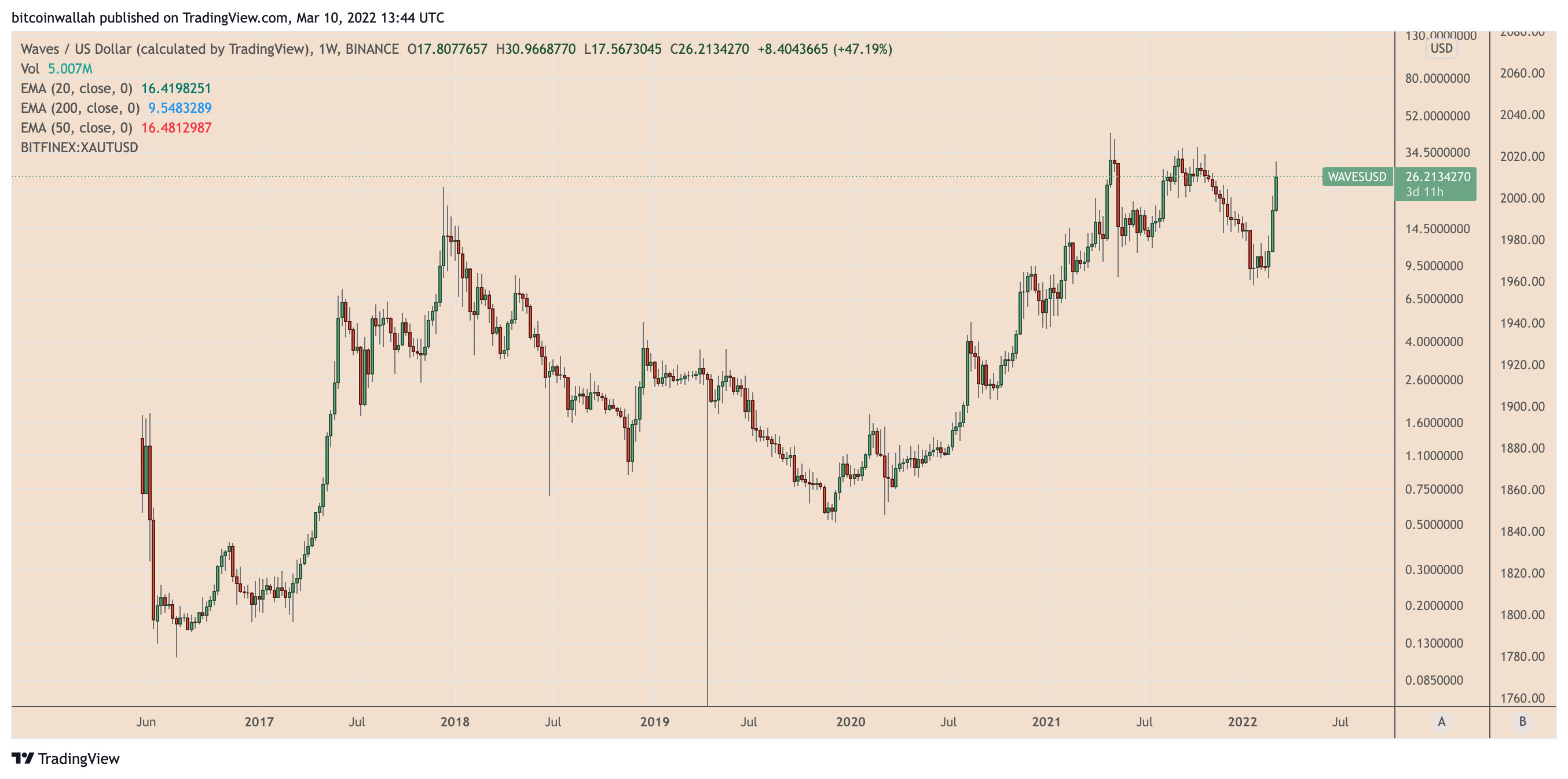
The WAVES/USD trading pair surged by nearly 75% this week to reach around $31, its best level since Oct. 28, 2021. Its rally came as a part of an upside retracement move that saw it rising by a little over 230% in three weeks.
WAVES/USD weekly price chart. Source: TradingView
In contrast, Waves’ top rival in the smart contracts sector, Ethereum, underperformed, with its native token Ether (ETH) dropping by almost 2% in the last three weeks. Similarly, Bitcoin (BTC), the leading cryptocurrency by market capitalization, underperformed in the same period, rising by a little over 1%.
Neutrino buys the Waves dip
As Cointelegraph covered earlier, Waves’ price rally might have surfaced in the wake of back-to-back optimistic updates, including the launch of a $150 million fund to support Waves-based decentralized application projects and the partnership with Allbridge to facilitate interoperability between Waves and other blockchains.
In addition, the period of Waves’ uptrend also coincided with an increase in its inflow to Neutrino’s smart contract. Notably, the supply of Waves tokens into the algorithmic stablecoin protocol increased from 43.38 million on Feb. 15 to as high as 51.80 million on March 8.
The total number of Waves tokens in Neutrino smart contract as of March 10, 2022. Source: Defi Llama
As of March 10, Neutrino held about 47.31 million Waves tokens in its smart contract, with the total value locked coming out to be worth $1.35 billion, almost 60% of the total value locked inside the Waves ecosystem.
Notably, Neutrino enables the creation of multiple decentralized stablecoins that maintain their U.S. dollar-peg by collateralizing Waves stored in Neutrino’s official smart contracts. The first such stablecoin is Neutrino USD (NUSD).
Over the past 30 days, Neutrino issued more than $135 million worth of NUSD, backed by reserves that surged from around $530 million to — as mentioned above — $1.35 billion. Meanwhile, an increasing amount of Waves tokens supplied into Neutrino’s smart contracts underscored that it was one of the most active Waves buyers since Feb. 10.
NUSD market capitalization in the past 30 days. Source: CoinMarketCap
As Waves’ price boomed, Neutrino appeared to have kept the tokens in its “reserves fund” to provide backing to NUSD in the event of the next price drop, thus limiting its downside bias.
‘Triple top’ setup
Technically, Waves may be sketching out a triple top against the U.S. dollar as its price comes closer to testing its all-time high near $42 for the third time since May 2021.
In detail, triple tops form when the price form three peaks with pullback moves towards a so-called “swing low” in between. First, they show that markets cannot penetrate the peak areas, i.e., they cannot find new buyers near/at the top level. Later, the price falls back to the swing low.
As a result, if Waves fail to close above its first and second top, its likelihood to drop towards the swing-low area between $11 and $13 — the range that has been supporting the three peaks — will be high.
The views and opinions expressed here are solely those of the author and do not necessarily reflect the views of Cointelegraph.com. Every investment and trading move involves risk, you should conduct your own research when making a decision.