Tag: Bitcoin

  • Michael Saylor is bullish on Bitcoin but sceptic on all other crypto

    Michael Saylor is bullish on Bitcoin but sceptic on all other crypto

    michael saylor bitcoin most secure asset
    • Michael Saylor reiterates his bullish view on Bitcoin.
    • MicroStrategy Inc currently has about 140,000 BTC.
    • Bitcoin has lost nearly 10% from its high in April.

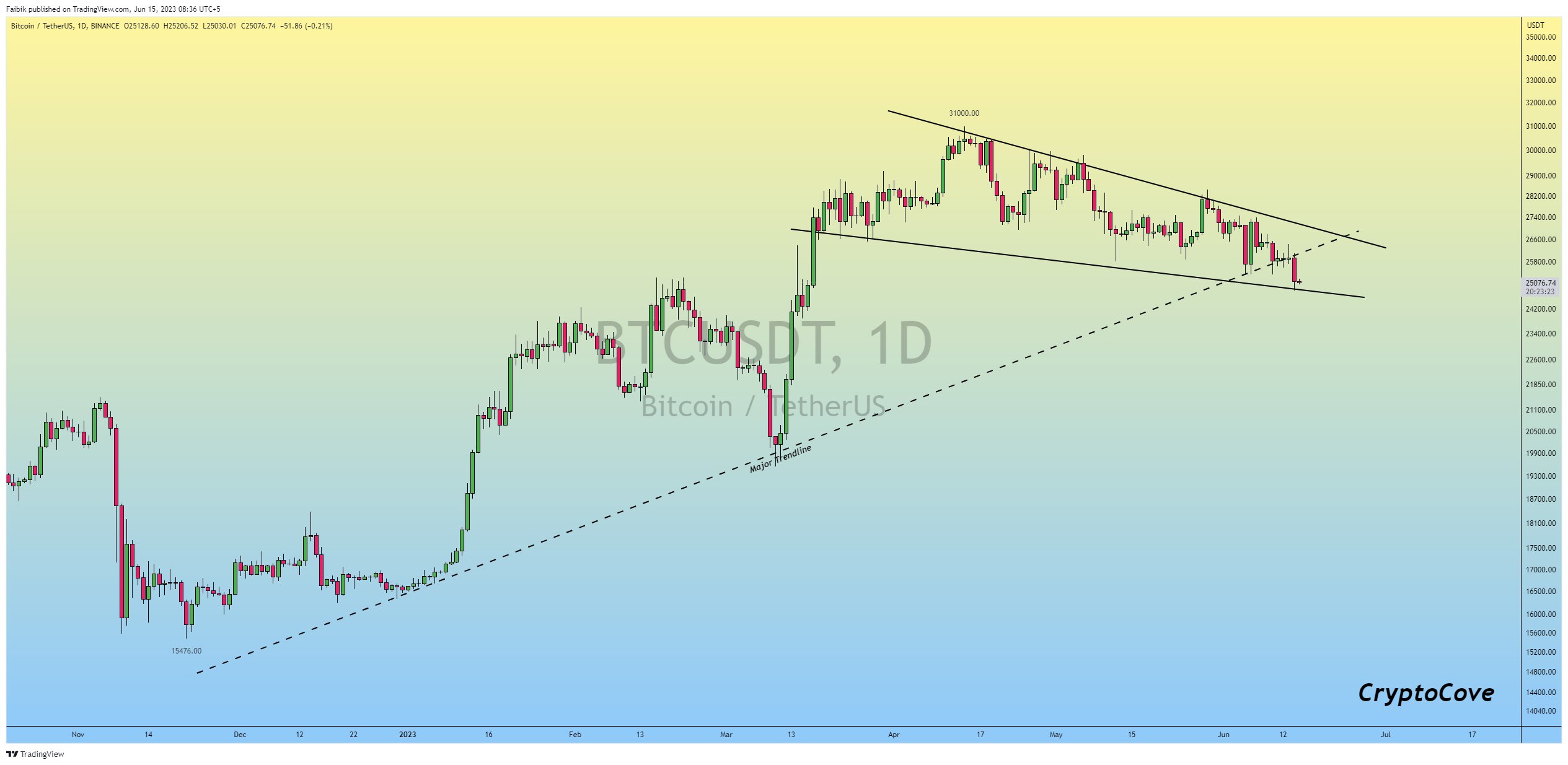
    Bitcoin has lost nearly 10% in recent weeks but the pullback is only an opportunity to build a position as far as Michael Saylor – Chairman of MicroStrategy Inc is concerned.

    Saylor is sceptic on other cryptocurrencies

    Interestingly, his bullish view is particular to bitcoin only while he remains “sceptic” on other cryptocurrencies in the midst of regulatory uncertainty. Speaking with CNBC today, Saylor said:

    I think bitcoin has found the bottom, the leverage is out of it, we are on a bull run. BTC is the one commodity the SEC won’t regulate. I think the way is clear for bitcoin to rally from here.

    Earlier this month, the U.S. Federal Reserve signalled a “pause” which could be a tailwind for BTC moving forward as easing monetary policy is known to see investors make riskier bets.

    MicroStrategy Inc currently has about 140,000 bitcoin bought for a total cost of roughly $4.17 billion.

    Why else is he keeping bullish on bitcoin?

    Saylor is convinced that the recent bank failures and the regulatory uncertainty surrounding cryptocurrencies will work in favour of the bitcoin considering its reputation as the safe haven.

    Bitcoin is the most secure network, the most secure asset. You’ll see a consistent flow of capital flowing from the rest of the crypto ecosystem to bitcoin.

    Other reasons cited for the bullish view on BTC include the “Lightning Network” – a protocol layered over bitcoin that he’s convinced has the potential to be a disruptive payment network.

    Also on Friday, Anthony Pompliano also said that bitcoin was like the world’s biggest insurance company.

    Source link

  • Bitcoin may be world’s largest insurance company

    Bitcoin may be world’s largest insurance company

    • Pompliano argues that Bitcoin’s unique properties make it an attractive insurance asset for a variety of reasons.
    • He says Bitcoin provides insurance against a variety of risks, including, currency debasement and sovereign default.
    • Bitcoin critics however point to things like the volatile nature of crypto assets and meagre adoption as reasons why it might not be the global insurance company.

    Anthony Pompliano, a venture capitalist and popular Bitcoin advocate, argues that BTC could be considered the largest insurance company in the world.

    The investor says the idea was proposed to him at a breakfast meeting with two investors, whose point suggested that the world’s largest insurance company may not “look like” the typical insurance company.

    Why Bitcoin could be the insurance

    Pompliano’s argument, published in the latest edition of The Pomp Letter, is based on the idea that Bitcoin provides insurance against a variety of risks, including, currency debasement, sovereign default, undisciplined monetary and fiscal policy, and economic censorship. 

    He explained:

    Just as there are different insurance policies that serve different purposes, Bitcoin is different things to different people. And just as most policyholders don’t want to ever have to use their insurance, most bitcoiners realise that bitcoin’s success will likely come on the heels of major issues in the legacy financial world.”

    On what exactly makes Bitcoin an insurance, the entrepreneur listed a number of reasons.

    He says Bitcoin is a one-time purchase, and it comes with certain advantages. Unlike traditional insurance policies, BTC doesn’t require ongoing premiums. If you buy early, Bitcoin comes as a cheap premium and much more expensive when done later.

    The second reason is that cryptocurrency is a decentralised asset that is not subject to the control of any one entity, which makes it more reliable than traditional insurance companies. It also has an inverse relation to catastrophe in traditional finance, the latest example being when BTC price rose amid the US banking crisis.

    Also, Bitcoin is a global asset that can be accessed by anyone, anywhere in the world, which makes it more accessible than traditional insurance products. As an insurance, its programmatic nature means holders don’t need to submit claims and wait for someone to judge whether to honour it or not.

    Bitcoin critics may disagree, but…

    Although Bitcoin continues to see major adoption across the globe, the argument such as the one highlighted by Pompliano has not escaped crypto critics.  

    For some, BTC remains too volatile to be considered a reliable insurance asset. Another argument is that the digital asset hasn’t achieved the adoption levels that would make it a practical insurance choice for most people.

    Pomp says the idea is still a viable one, especially with the possibility that Bitcoin can be an insurance against events like inflation and economic collapse. Most of these events have largely been “uninsurable.”

    No insurance company is going to write you a legitimate policy against high inflation. They won’t write you a policy against government seizure of your assets. The insurance companies historically have not covered hyperinflation or economic collapse,” the investor argued.

    He also thinks one doesn’t need to hold huge amounts of BTC to tap into the benefits. Putting about 1-3% of investment allocation into bitcoin can be an effective hedge against negative impact of economic risks.


    Source link

  • Bitcoin shrimps holdings jump to 1.31 million BTC

    Bitcoin shrimps holdings jump to 1.31 million BTC

    • Bitcoin wallets with less than 1 BTC now hold an all-time high of 1.31 million coins.
    • Shrimps have been adding an average of 26,000 BTC every month, data shows.
    • The growth of the shrimp cohort is a positive development for the Bitcoin network.

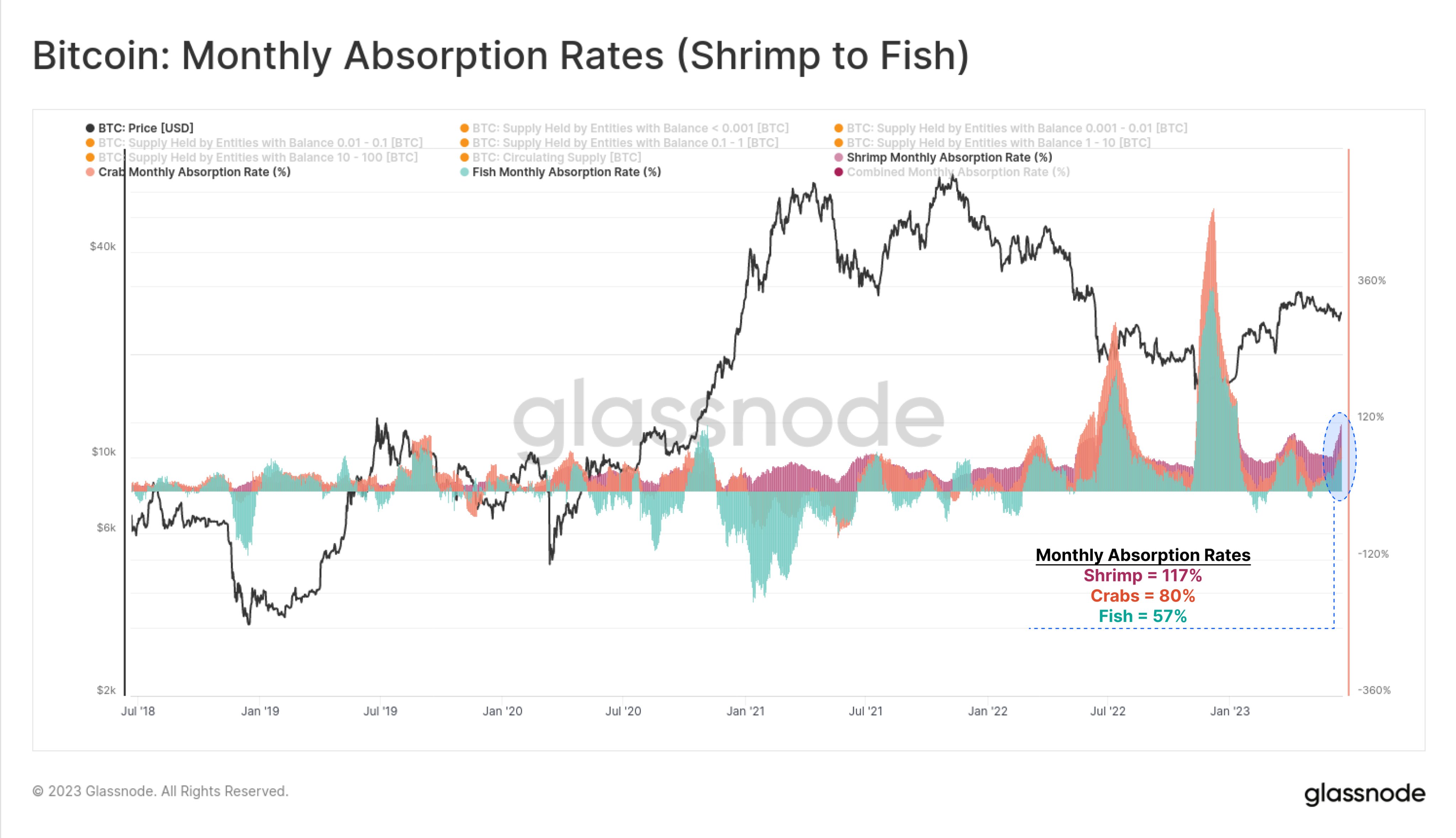
    The amount of Bitcoin held by “shrimps” – those wallet entities that currently hold less than 1 BTC) has reached a new all-time high.

    According to data from Glassnode, shrimps have increased their total holdings to 1.31 million BTC. The cohort has witnessed the gradual increase in holdings over the past several months.

    Shrimps grow holdings by +26,000 BTC every month

    Per data Glassnode shared via Twitter, the shrimp cohort has experienced a significant expansion of their holdings in 2023. This followed a similar trend last year, with the buying among this group coming despite the greater volatility that hit the market.

    Specifically, shrimps have added 26,000 or more Bitcoin every month. Since July 2020, only 202 (3.9%) trading days have recorded a larger monthly growth.

    The suggestion from this is that retail investors have been aggressive in accumulating BTC, with the dips seen during the bear market providing investors with an opportunity to buy Bitcoin at low prices.

    The chart below shows the growth in the amount of BTC held by wallet addresses with less than 1 bitcoin. As you can see, the amount held by these entities has increased significantly in June/July 2022 and again in November/December and January 2023.

    Increase in small holders is a positive for the long-term health of Bitcoin’s network as the metric suggests retail investors are confident in the cryptocurrency’s growth and long term potential.


    Source link

  • No, Bitcoin has never seen a bear market before: Be careful

    No, Bitcoin has never seen a bear market before: Be careful

    Key Takeaways

    • Bitcoin has been through many bear markets before, always surging back to higher highs
    • Dan Ashmore, our Head of Research, cautions against naive extrapolation of past returns, however
    • Until this past year, stock markets had done nothing but rise during Bitcoin’s existence
    • Bitcoin was launched in 2009 as the stock markets bottomed, and the bull run afterward was one of the longest in history
    • This needs to be considered, cautions Ashmore, whilst sample size of Bitcoin trading with any sort of liquidity is also small

    Bitcoin is volatile. Also true: water is wet and the sky is blue. 

    A quick glance at a Bitcoin chart will tell you all you need to know about the meteoric rises and bone crushing pullbacks that the asset has produced over the years. In truth, it should be plotted on a scale, too. 

    When looking at Bitcoin markets, therefore, it is tempting to jump to the conclusion that “we have been here before”. Bull markets and bear markets, easy come and easy go. Or, as Jeff Bridges put it so poetically in the Big Lebowski, “strikes and gutters, ups and downs”. 

    While Bitcoin has drawn down many times before and, at least previously, always bounced back, I believe it is naive to extrapolate past resurgences into the present. Because no, we have not been here before. 

    To be clear, I am not saying Bitcoin will not rise to new heights again. It easily could (I hold Bitcoin as part of my portfolio, albeit via a monitored allocation and obeying the boring all adages of diversification and risk management, but hey – that is for another time). My point, however, is that we have zero point of reference for the current situation. Despite a surge of 75% in the last six months, Bitcoin is 60% off its high in Q4 of 2021, with many investors underwater if they opened positions in the past three years as Bitcoin truly established itself on the mainstream stage.  

    Let me explain why things are different this time around, and why assuming with blind confidence that Bitcoin will surge upward imminently may be misguided. First, the below are the biggest peak-to-trough drawdowns in Bitcoin history (the recent/current one is highlighted in yellow): 

    Clearly, Bitcoin has been here before. Right? 

    Well, no it hasn’t. Look at the dates of the above: all these drawdowns are from 2012 onwards. This is because Bitcoin was only launched in 2009. Indeed, it didn’t really have any sort of liquidity or infrastructure (such as exchanges or a marketplace) until 2012 (and even then, liquidity was extremely thin). 

    And consider what has happened in the wider economy since Bitcoin was launched in 2009. On March 9th 2009, two months after Bitcoin launched, the Nasdaq hit a low of 1268. The S&P 500 did the same, hitting a nadir of 676. 

    Since then, markets have enjoyed one of the most remarkable, longest and explosive bull runs in recent history, as basement-level interest rates propelled asset prices to dizzying all-time highs. By late 2021 at their peaks, the Nasdaq hit a level of 16,057, the S&P 500 4,793. Since those aforementioned lows in March 2009, that represents returns of 12.7X and 7.1X respectively. A historic period of gains.

    Presenting the returns of both the Nasdaq and S&P 500 since Bitcoin was launched in January 2009 (note – this goes back a couple of months before the trough of the stock market in March of that year and hence the returns are not as empathic as above) shows the run in markets visually throughout Bitcoin’s life:

    Or perhaps the next chart is better, showing quite how boisterous the stock market throughout Bitcoin’s life during the period up to and including 2021. 

    Therefore, every single dip in Bitcoin’s history took place whilst the wider financial markets were humming along swimmingly. This all changed in 2022, of course, when inflation spiralled and the world’s central banks began hiking rates at the fastest rate in recent memory. 

    Suddenly, for the first time in Bitcoin’s existence, it was ticking along block-by-block while financial markets elsewhere were falling. And they were falling quickly, the S&P 500 shedding nearly 20% in 2022, the Nasdaq losing over a third of its value. Not only were these losses the worst of any period in Bitcoin’s life, they were, aside from minor falls in 2011 and 2018, the only losses it had ever seen. 

    Therefore, this time is different. Blind faith in Bitcoin bouncing back aggressively because of the simple conclusion that it has done so before is a dangerous assumption to make. Again, Bitcoin could easily do exactly this, but it would be foolish to assume it is a guarantee because it has happened in the past. 

    The reality is that, until this past year, the world had no idea how Bitcoin would trade outside of the zero-interest rate vacuum that we have been operating in for the past decade. There is no trade history for Bitcoin going back to previous recessions, no chart one can pull up to assess how it weathered inflation in the 1970s, no reference point to anything but a stock market printing green candle after green candle. 

    Not only did all those previous resurgences come amid a period of cheap money and expanding central bank balance sheets, but Bitcoin markets were also incredibly illiquid. It took barely a drop of capital to move prices, as Bitcoin exploded from a fraction of a cent to thousands of dollars per coin. Bitcoin’s existence has been brief itself, at 14 years, but its status as a financial asset of any sort of liquidity is even briefer again. 

    So, for one last time: this is not a piece making any forecasts about the future of Bitcoin. I don’t want to wade into such murky waters (not here, anyway!). Rather, it is a piece cautioning that we have such a small sample size to work with when it comes to Bitcoin, and it is important to be cognisant of that when assessing how it trades. 

    Bitcoin has never experienced a bear market in the wider economy before. Until now. Overlooking that critical fact is a dangerous game to play.

    Source link

  • Retail investors will prefer Bitcoin over the dollar if US defaults: survey

    Retail investors will prefer Bitcoin over the dollar if US defaults: survey

    • Retail investors would prefer Bitcoin over the dollar in case of a default, a new survey says.
    • A US default could be here as early as June 1, experts have warned.
    • Standard Chartered analyst Geoff Kendrick previously predicted a 70% jump for Bitcoin price in case of a US default.

    A new survey has found that retail investors would prefer to buy Bitcoin (BTC) over the dollar in the event of a US default.

    According to the report, while gold and Treasury’s ranked higher on the list of trusted safe haven assets in case of a US default, BTC was seen as the third best asset, ahead of the US dollar.

    Retail investors would buy BTC over the dollar

    The results were from a survey conducted by Bloomberg’s Markets Live Pulse. The researchers had asked investors to indicate what they would buy were the US government to spiral to a debt ceiling.

    Gold was the top pick as 51.7% of professional investors and 45.7% of retail investors going for the precious metal. A significant percentage chose Treasurys, with 14% and 15.1% of professionals and retail investors respectively showing faith with the asset class.

    Meanwhile, Bitcoin ranked third among the responses as 7.8% of professional investors and 11.3% of retail investors picked it over the dollar. Per the survey, about 7.8% of professional investors and 10.2% of retail investors said they would still buy the dollar.

    Bitcoin price predictions in case of US default

    The US faces a default that could hit as early as 1 June 2023 should lawmakers fail to strike a deal to lift the $31.4 trillion debt limit. Stock investors were on Monday upbeat on a possible deal. However, stocks were mainly weak as reports of no consensus on the cards yet emerged.

    Bitcoin on the other hand remained poised above $27,400 as analysts projected a potential decline to support levels seen last week or lower. However, with the BTC price having rode the banking crisis to break above $31,000, it is possible a default could provide fresh fuel for more gains.

    As CoinJournal recently highlighted, this Bitcoin price prediction had been put forth by Standard Chartered analyst Geoff Kendrick. In his prediction, the head of FX research at Standard Chartered said the BTC price could explode by 70% in the event of a default.

    While he suggested an initial drop on the day, or two or week, of the default would likely clip bulls by $5k or so, the analyst believes the price of the digital gold could see a new $20,000 leg.

    Source link

  • Bitcoin price prediction and implications for Metacade

    Bitcoin price prediction and implications for Metacade

    • Metacade price rose to an all-time high after its presale and listing on major cryptocurrency exchanges.
    • Today’s Bitcoin price prediction highlights the implications for Metacade price as BTC is heavily shorted.
    • The week is key to investor sentiment with markets awaiting US inflation data.

    Bitcoin (BTC) traded around $27,575 on Wednesday morning even as equities and other risk assets traded lower ahead of key US inflation data. While US Futures and European stocks edged lower, Bitcoin lumbered within a range that sees it down nearly 4% this past week.

    On-chain data shows BTC is being heavily shorted as investor caution adds to the negative sentiment that has prevailed since the dip from highs of $30,000. What does the outlook for Bitcoin price mean for Metacade (MCADE)?

    Bitcoin price prediction: crowd sentiment is negative but what’s the outlook?

    The price of Bitcoin rose to $30,000 last Friday, with bulls looking to retest recent year-to-date highs. However, with sentiment flipping negative amid broader market anxiety and new FUD saw the benchmark cryptocurrency’s value dump to a weekly low under $28,000.

    At current prices, Bitcoin is under fresh pressure with on-chain data showing bets on further declines have surged on crypto exchange and derivatives trading platform BitMEX

    For the BTC price outlook, analytics firm Santiment points to Bitcoin’s funding rate, which is at its most negative ratio in nearly two months. While prices are likely to fall to support in the $25,000 region should a meltdown follow the CPI data and investor reaction to potential Fed rate hike path, the current crowd perspective has historically given way to new upside momentum.

    Santiment says of BTC price prediction:

    Bitcoin’s funding rate on BitMEX is seeing its most negative ratio since the heavy bets against prices in mid-March, just before prices soared. Generally, price rise probabilities increase when the crowd overwhelmingly assumes prices will be dropping.”

    This short term outlook for Bitcoin price will likely align with the anticipated new bull cycle ahead of the next halving. Altcoins are likely to see some action before then, and projects with greater ecosystem pull like Metacade could be stand out performers.

    Metacade’s big GameFi ecosystem bet

    Metacade is a play-to-earn (P2E) project looking to offer the gaming ecosystem an all-in-one GameFi and Web3 hub. As highlighted in the project’s whitepaper, the goal is to offer an arcade-style gaming platform where gamers, developers, and crypto enthusiasts connect, play and earn.

    One aspect of Metacade’s unique approach to the gaming ecosystem is its rewards system. Unlike other traditional P2E platforms, MCADE offers complete utility as it allows for multiple earn revenues for token holders and investors via a strategy that will bring new game titles.

    The team is also focused on incorporating leading industry gaming studios and developers, opening up the platform to growth into the ultimate GameFi environment.

    The platform is set to go live soon and has a native token that will power transactions and interactions for users. The token, MCADE, concluded its presale successfully in April before going live on major exchanges Uniswap, BitMart and MEXC Global.

    Is MCADE worth investing in in 2023?

    Metacade’s MCADE token sold out swiftly during its presale, with investors scooping the allocated supply portion amid greater interest in what the project offers. Investors also saw the token’s value explode after the crypto market showed confidence in Metacade’s potential with listings on the highlighted exchange platforms.

    Accomplishing roadmap milestones such as introducing Metagrants to support ecosystem development, and improving governance via a DAO, could help catapult Metacade into position as one of the biggest crypto gaming platforms.

    The upcoming launch of the mainnet coupled with the diverse opportunities MCADE offers could be the catalysts that elevate Metacade’s price in 2023 and beyond.

    Metacade price prediction

    Market experts are long-term bullish on Metacade price, particularly on being a potential game-changer in the GameFi sector.

    Metacade has a fixed supply of 2 billion MCADE tokens, with 1.4 billion tokens (70% of supply) available to investors during the presale. Demand for the token and removal from circulation via a burning mechanism should see buy pressure push the price higher long term as more people enter the Metacade ecosystem.

    If we look at Metacade price today, we see its trading largely in tandem with the major altcoins. The forecast for MCADE price in the short term looks at the broader implications of Bitcoin ripping higher again to uplift the entire sector.

    MCADE price hit an all-time high of $0.045 on 3 May 2023. The token’s current price is $0.024, down nearly 9% in the past 24 hours. MCADE/USD is also in negative territory on the weekly timeframe, although it trades above its Uniswap listing price level of $0.022 per token in April.

    If the altcoin market dumps further, primary support for MCADE would be at around the mentioned buffer of $0.022. There’s a possibility of $0.020 and the all-time low of $0.014 could come into play incase of a deeper rot.

    Should bulls regain control, a retest of the peak and targets of $0.1 in 2023 will likely be achievable. Meanwhile, the medium term price target could be $1 in 2024.


    Source link

  • Nearly a million addresses hold more than 1 bitcoin, half the US median salary

    Nearly a million addresses hold more than 1 bitcoin, half the US median salary

    Key Takeaways

    • The distribution of Bitcoin can be analysed through the transparent nature of the blockchain
    • Nearly 1 million addresses now hold more than 1 Bitcoin, equivalent to $27,500, or half the US median annual salary
    • As Bitcoin collapsed in price last year, falling 77% from peak to trough, the 1 Bitcoin hurdle became far easier to achieve

    The funny thing about the blockchain is that, while it is impossible to know the identities of individuals or institutions behind a Bitcoin address, the distribution of the asset is readily available on the Internet for all to see. 

    This means that we can study the distribution of coins across the network. For example, the largest holder of Bitcoin is the anonymous creator, Satoshi Nakamoto, at approximately 1 million coins, or over 5% of the entire supply. 

    In digging deeper, however, we can assess how many people own certain thresholds of Bitcoin. Notably, one target is about to be hit: there will soon be 1 million addresses holding 1 Bitcoin or greater. 

    The current number, as of 8th May 2023, is at 997,919 addresses containing 1 Bitcoin or greater, equivalent to $27,500. With the median US salary at $56,400 per year, 1 Bitcoin thus equates to roughly half of that – and a lot more in most other countries. 

    To be clear, one Bitcoin address is not equal to one person, so this doesn’t necessarily mean 1 million people own 1 Bitcoin. Certain individuals are in control of multiple Bitcoin addresses, while some addresses may belong to institutions or groups of people. But it is the best approximation we have, as like we said above, it is impossible to know the identity behind these addresses. We just have an alphanumeric code on the blockchain, which is the beauty of it. 

    The one million addresses represent just over 2% of the total number of non-zero addresses on the Bitcoin network. 

    “For a long time, one Bitcoin was just a small amount of money. It was only ten years ago that it first crossed the $100 mark. Then in 2017, it passed $10,000 for the first time. It is remarkable to be sitting here now with nearly one million addresses containing at least one Bitcoin, despite how expensive it has become”, said Max Coupland, director of CoinJournal. 

    How does the distribution change as Bitcoin’s price moves?

    Obviously, Bitcoin’s price is incredibly volatile. Back in November 2021, the price of Bitcoin was nearly $69,000, well clear of the median wage in the US. Since then, the asset’s price has collapsed. Despite rising 66% thus far this year, it remains 60% off its peak. 

    Therefore, this has made owning certain amounts of Bitcoin a lot more achievable. In plotting the pattern of Bitcoin addresses holding more than 1 Bitcoin against the price of Bitcoin, there is a clear shift upward in trajectory from the spring of 2022, when the price of Bitcoin began to crater downwards.  This followed a period of levelling off during COVID as the price of Bitcoin went parabolic, surging from $7,000 at the start of 2020 to nearly 10X that by late 2021.

    When comparing the growth in addresses holding 1 Bitcoin to total (non-zero) addresses on the network in the next chart, one can see that non-zero addresses have grown at a much more steady pace, with the pickup in early 2022 of addresses holding 1 Bitcoin or more not matched. This makes intuitive sense, as the world is on a dollar standard, and less dollars required to buy 1 Bitcoin means more people can hit that hurdle. 

    Despite the hurdle of owning more than 1 Bitcoin becoming easier to achieve, it is still a lot of money. If Bitcoin ever retakes the levels it did during its pandemic boom, the trajectory of people reaching this elusive “whole coiner” status will again slow, as it simply will not be possible. Of course, Bitcoin’s price can always go the opposite way, in which case it won’t be quite such a difficult – or desirable – target. 

    If you use our data, then we would appreciate a link back to https://coinjournal.net. Crediting our work with a link helps us to keep providing you with data analysis research.

    Source link

  • Here’s why the Bitcoin SV (BSV) price just went vertical

    Here’s why the Bitcoin SV (BSV) price just went vertical

    Bitcoin SV price surged to the highest level since March 1 as investors moved to the coin, which is an alternative to BTC. BSV jumped to a high of $42.10, which was about 48% above the lowest level this year. The coin’s market cap has jumped to more than $748 million.

    Is this a pump-and-dump scheme?

    There was no news that pushed Bitcoin SV higher on Tuesday. A likely reason why the BSV is rising is because some investors believe that it is a better alternative to Bitcoin. As we wrote in this article on Monday, Bitcoin’s fees jumped on Monday because of elevated congestion in the network. 

    As a result, Binancethe biggest crypto exchange in the world, suspended Bitcoin withdrawals several times on Monday. Bitcoin SV, which has less volume than the main Bitcoin, is therefore seen as a better alternative. For one, its transactions take less than 2 seconds to complete while the average transaction fee is about $0.0001. Also, the network can handle over 50,000 transactions per second (tps).

    However, it is worth noting that the BSV price rally could be a pump-and-dump scheme. This is a situation where insiders or large holders buys an asset, promote it, and then exits at a profit, leaving buyers holding the bag. This situation is common among low-volume coins like Bitcoin SV.

    Bitcoin SV price prediction

    The daily chart shows that the BSV price has been in a strong bearish trend. It has crashed by over 90% from the highest point on record. The coin has also moved below all moving averages. It moved slightly above the crucial resistance point at $34, the lowest point on November 22 last year.

    Therefore, I believe that this Bitcoin SV rally does not have legs. As such, there is a likelihood that it will resume the downward trend to where it was before it jumped. This could see it retreat to the next key support at $30.


    Source link

  • Trillion dollar coin could be good news for Bitcoin, Cardano, Solana

    Trillion dollar coin could be good news for Bitcoin, Cardano, Solana

    • The US government could be forced to print a $1 trillion coin soon.

    • Democrats and Republicans are yet to reach an agreement on a debt ceiling.

    • Analysts expect that the two sides will ultimately reach an agreement.

    The US government is at a crossroads as divisions in Congress put the country at an elevated risk of a default. In a recent statement, Janet Yellen, the Treasury Secretary warned that the American government could default in June if Democrats and Republicans fail to reach a deal. This is one of the top reasons why gold price has now soared to an all-time high.

    The trillion-dollar coin

    It is still unclear whether the US will default on its obligations if Congress fails to raise the debt ceiling. I believe that the situation will not get to that point because of its impact to the American economy. 

    Analysts believe that a default will lead to higher unemployment and possibly the collapse of the economy as we know it. 

    Therefore, the two sides will likely reach an agreement in the coming days. Signs of potential compromises will happen when Biden will meet Kevin McCarthy on Monday.

    There are several options if the two sides fail to raise the debt limit. A likely solution will be to print a trillion dollar coin. The concept of that coin was mooted in 2011 when the US faced another debt ceiling issue. 

    It would allow the Mint to come up with one platinum coin valued at $1 trillion. These funds would then be distributed to the Federal Reserve, which would then deposit it to the National Treasury. By doing that, the Treasury would then elimiate part of the national debt and postpone the need for raising the debt ceiling. A professor at Willamette University said:

    “At this point, if any of the other solutions, the so-called more serious solutions would work, then they would’ve been used by now. But they keep not actually being strong enough. The coin’s the only one that’s strong enough.”

    Bullish for Bitcoin, Solana, Cardano

    Such a move would be positive for Bitcoin, which is seen as a digital version of gold. Unlike fiat currencies, Bitcoin cannot be printed because its supply of 21 million coins cannot be adjusted. If Bitcoin rises, we could now see altcoins like Solana, Cardano, and Tron rise because of the close correlation that exists.

    The reality is that the American government is at risk of major changes going forward. For one, the total public debt has been in a strong upward trend in the past few years. It has jumped from just $320 million in 1970 to over $31.4 trillion today. 

    And the situation will continue worsening because of the large budget deficits. By 2030, analysts expect that debt will rise to over $44 billion. The CBO believes that the budget deficit will hit 5.9% of GDP by 2040.

    How to buy Bitcoin

    eToro

    eToro offers a wide range of cryptos, such as Bitcoin, XRP and others, alongside crypto/fiat and crypto/crypto pairs. eToro users can connect with, learn from, and copy or get copied by other users.


    Buy BTC with eToro today

    Public

    Public is an investing platform that allows you to invest stocks, ETFs, crypto, and alternative assets like fine art and collectibles—all in one place.


    Buy BTC with Public today

    Source link

  • Should you buy Block stock on a boost to bitcoin revenue in Q1?

    Should you buy Block stock on a boost to bitcoin revenue in Q1?

    buy block stock bitcoin revenue q1
    • Block didn’t see an impairment loss on its bitcoin holdings in Q1.
    • Analysts at KeyBanc continue to see upside in its shares to $85.
    • Block stock is currently down about 5.0% versus the start of 2023.

    Block Inc says it did not see an impairment loss related to its bitcoin hoard in the first financial quarter. Shares are trading up in extended hours.

    Bitcoin price recovery helped

    The surge in BTC this year pushed the fintech company’s bitcoin revenue in Q1 to $2.16 billion – up 18% sequentially and a whopping 25% versus the same quarter last year.

    Gross profit from bitcoin holdings also increased 43% versus the previous quarter, as per its letter to shareholders. Block generated $770 million of total gross profit in its recently concluded quarter – up 16% on a year-over-year basis.

    The fair value of its position in bitcoin was $229 million as of March 31st versus the original purchase price of $220 million.

    Year-to-date, Block stock is down about 5.0% at writing.

    Should you buy Block stock now?

    Block ended the quarter with 20 million monthly active users on “Cash Card” – up 34%. Earlier this week, K33 analyst Vetle Lunde noted the similarity in how bitcoin is performing this year and how it recovered after the bear market of 2018-2019.

    If it continued on the same trajectory, he added, bitcoin could be worth as much as $45,000 in the coming weeks which could be a significant benefit to Block Inc both in terms of its financial performance as well as the share price.

    Those interested in buying Block stock today should also know that analysts at KeyBanc continue to see upside in it to $85 – up roughly 40% from here.

    Other notable bulls of the financial technology company include Cathie Wood – the Founder and Chief Executive of Ark Invest.

    Source link