Tag: Bitcoin

  • Bitcoin price rose despite $25 million in product outflows

    Bitcoin price rose despite $25 million in product outflows

    • Bitcoin products saw $25 million in outflows last week, according to asset manager CoinShares.
    • There was $3.7 million in short Bitcoin as investor sentiment flipped negative on recent regulatory concerns.
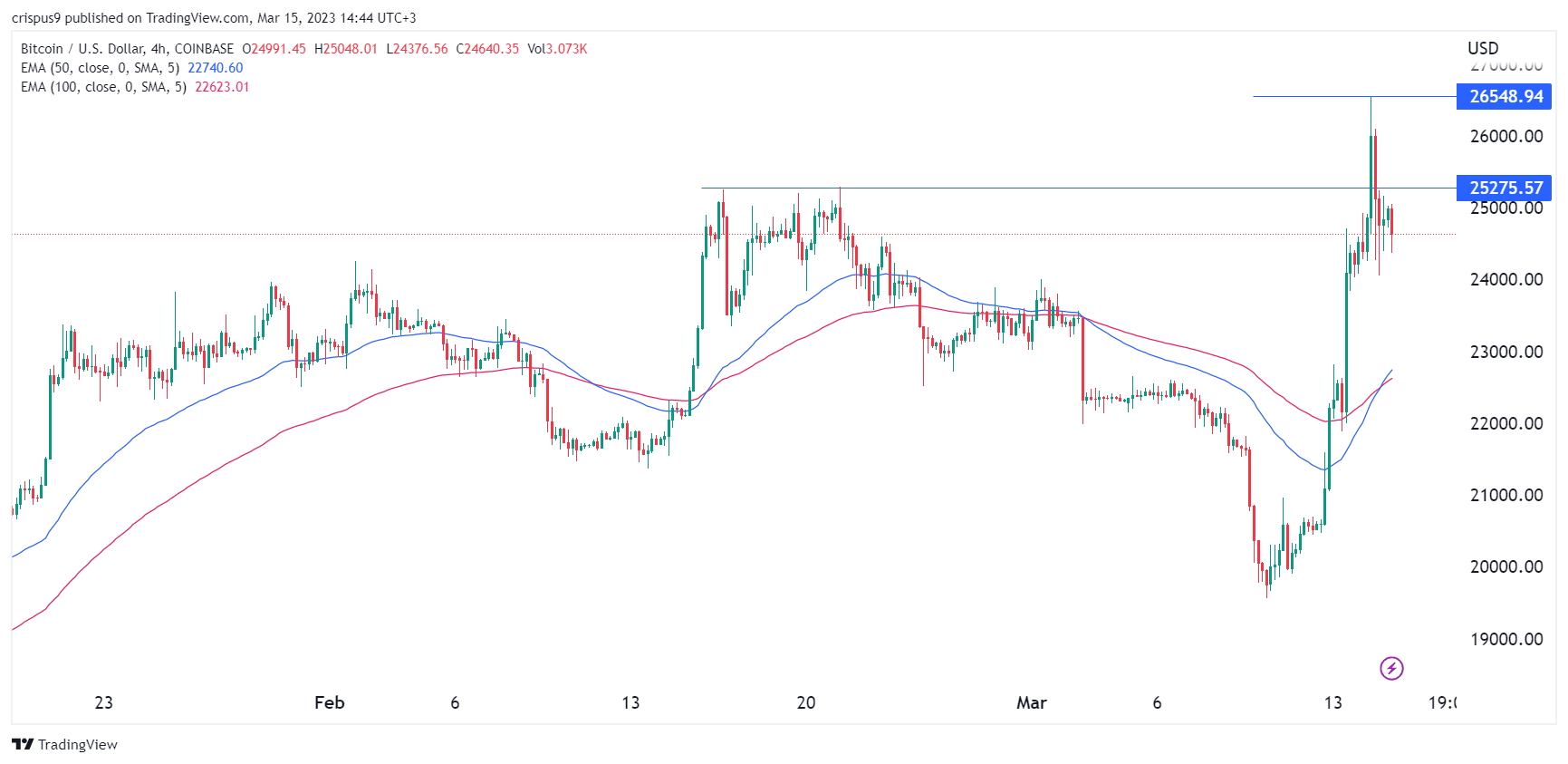
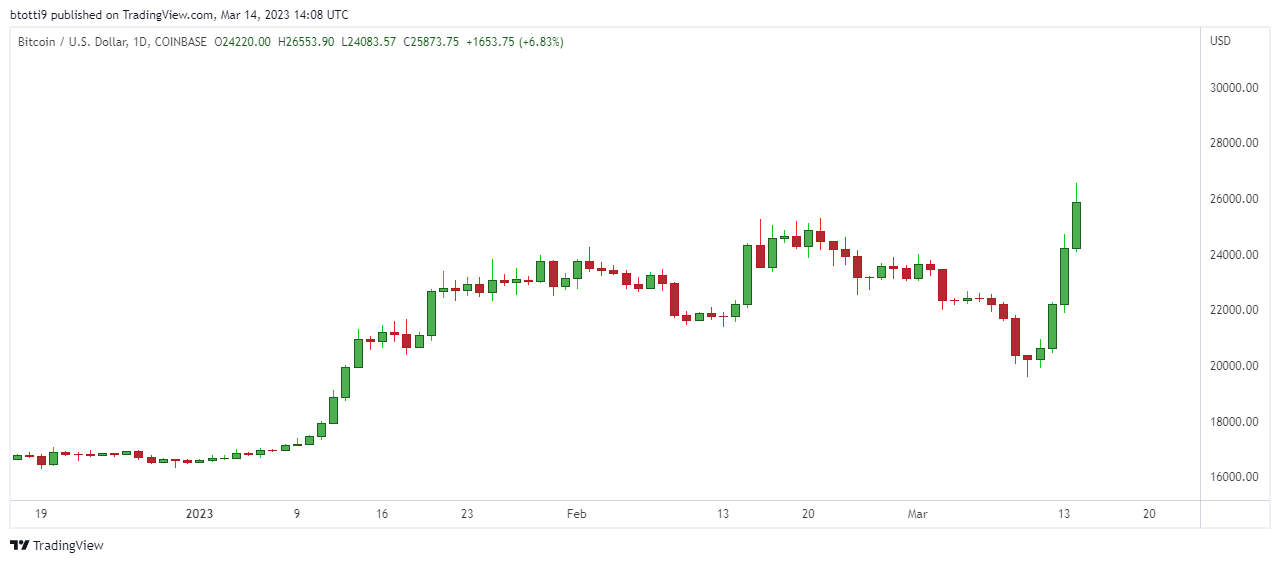
    • But crypto prices still recorded huge moves, with BTC hitting a six-month high above $25,000.

    Bitcoin price hit its highest price level in six months last week, with the flagship cryptocurrency testing bears’ resolve above the $25,300 zone.

    However, digital asset management firm CoinShares says despite reaching a new year-to-date high, the flagship cryptocurrency still bore the brunt of the negative sentiment that pierced the market as US regulators upped their crackdown on multiple industry sectors.

    Digital assets see $32 million in outflows

    As CoinShares Head of Research James Butterfill points out in a weekly funds flow report released on Monday, Bitcoin recorded the largest share of outflows seen in the digital assets investment products last week.

    Per the researcher, total crypto funds outflows totaled $32 million this past week, the largest single week outflows since December last year. But almost $25 million of the outflows were in Bitcoin products, with negative sentiment seeing short Bitcoin investment products account for $3.7 million in inflows.

    Infact, as US Securities and Exchange Commission (SEC) increased its crackdown on stablecoins and staking services among other sectors of the crypto industry, crypto outflows hit $62 million. The market did record significant outflows as Bitcoin led the market in holding prices above key levels.

    According to Butterfill, the mid-week flip in sentiment (with Bitcoin price soaring more than 10%) helped digital assets products register $30 million in inflows. This in turn helped push the total assets under management in exchange-traded products (ETPs) to its highest level since last August. Butterfill noted:

    The negative sentiment amongst ETP investors was not expressed in the broader market with Bitcoin prices rising by 10% over the week, this price appreciation pushed total assets under management (AuM) to US$30bn, their highest level since August 2022. We believe this is due to ETP investors being less optimistic on recent regulatory pressures in the US relative to the broader market.”

    Crypto assets saw mixed flows

    While Bitcoin recorded over 78% of the outflows, Ethereum products saw $7.2 million in outflows last week. Other top altcoins with large withdrawals included Cosmos ($1.6 million), Polygon ($0.8 million), and Avalanche ($0.5 million).

    Yet, investment products for Aave, Binance, Fantom, XRP, and Decentraland saw inflows of between $0.36 million and $0.26 million, CoinShares highlighted in its report.

    Elsewhere, while crypto assets experienced a second consecutive week of outflows, blockchain equities had a more positive outlook from investors, with $9.6 million in inflows last week. Blockchain equities have now had six consecutive weeks of inflows.


    Source link

  • Bitcoin is up in Argentinian Pesos over the last year, but natives should still avoid it

    Bitcoin is up in Argentinian Pesos over the last year, but natives should still avoid it

    Key Takeaways

    • Inflation in Argentina is now near 100%, as savings in the peso are getting crushed
    • Bitcoin, despite collapsing in the last year, is up in peso terms
    • Weak currencies are often cited as benefits of Bitcoin, but in the case of Argentina, it would be worse, writes our Analyst Dan Ashmore 
    • Stablecoins present a better case, he argues, with US dollar up 87% against the peso since 2022

    It’s a well-trodden argument, the one that states Bitcoin is purpose-built for the developing world. A more accessible financial system; a medium through which citizens can circumvent failing currencies. 

    In theory, it makes sense, and it’s something that I have written about extensively in the past. As risky and experimental as Bitcoin is, one could state a case that this enigmatic digital currency could  – one day in the future – offer such financially oppressed peoples a way to protect their wealth. 

    But that day is not now. In fact, Bitcoin is entirely useless for such a purpose. That is despite the below chart showing that Bitcoin has appreciated in value over the last year against the Argentinian peso. 

    This has seen some Bitcoin advocates – and to be clear, I am a Bitcoin investor – declare that this is a poignant display of Bitcoin’s power. But it is important to be wary of what we are benchmarking to here. The Argentinian peso is quite literally one of the world’s worst-performing currencies in recent years – plotting its value against the US dollar shows how far it has fallen.

    Bitcoin is no better than the peso

    This analysis of the Argentinan peso really has nothing to do with Bitcoin. It simply highlights how torrid a store of wealth the peso has been, and how devastating its devaluation has been for its citizens. 

    But imagine holding one’s wealth in Bitcoin? What if you were looking to send your child to college in January of this year. Tuition is, let’s say $10,000. Imagine if you had stored $10,000 in Bitcoin back in November 2021 (when it was trading at $68,000).  If tuition was due on January 1st of this year, your $10,000 would have fallen to $2,400. Need I say more?

    Instead of benchmarking Bitcoin to one of the worst stores-of-value around, it should be compared to, well, an actual store of value. If Bitcoin is to replace money, it’s not really a win if it’s better than one of the worst forms of money around. It’s the ultimate straw man argument. 

    We should be charting Bitcoin compared to an established currency. In the below graph, I have plotted the weekly percentage moves of the euro to Bitcoin (comparing both to US dollar). It’s like comparing night and day.

    Stablecoins suit Argentina better than Bitcoin

    The Argentinan example does present as a more intriguing example when considering a different type of crypto – stablecoins. Theoretically, this opens up dollar access to those who would otherwise be shut out (via capital controls, banking barriers or other). And at the same time, the asset being purchased – the dollar – is a store of wealth worthy of firing college savings into. 

    Could the day come when this may change? Sure, who knows what happens in fifty years. But I’m talking right here, right now. And Argentininans going from the peso to Bitcoin would be like jumping out of one fire and into the next. For the everyday Argentine citizen fearing for their own wealth, is there any argument at all that advocates for Bitcoin over stablecoins?

    So, arguing for stablecoins is one thing. And yeah, I can see it – citizens of high-inflation regimes are getting crushed as their currencies devalue into oblivion. 

    But Bitcoin? How can you look at these currencies and then decide Bitcoin is the solution? I’m as intrigued by Bitcoin as anyone, and I do believe that the store-of-value narrative is the one that the magical orange coin should pursue in the long-term. And hey, maybe we re-look at this peso vs USD vs Bitcoin debate in 25 years time and there is a different conclusion. 

    But right now, in the year 2023? Bitcoin is not Argentina’s answer. Far from it.

    Source link

  • Bitcoin rally could be a mirage, writes our Analyst – a Deep Dive

    Bitcoin rally could be a mirage, writes our Analyst – a Deep Dive

    Key  Takeaways

    • Bitcoin is up nearly 50% thus far this year, but there have been no positive catalysts from within the industry
    • Rally is nothing but macro-driven, writes our Analyst, with Nasdaq up 16% and Bitcoin continuing to trade like a levered bet on the index 
    • There are many headwinds still present, the latest being the potential regulatory clampdown, such as the BUSD shutdown this week
    • Bitcoin – and crypto – remain vulnerable to these factors, and despite the recent rally is still 65% off highs with many questions still unanswered


    What do the below things have in common?

    • Crypto lender Genesis files for bankruptcy
    • Parent company DCG announces it is to sell off crypto assets at a discount
    • Layoffs surge, including Coinbase, crypto.com, blockchain.com
    • SEC sues the issuer of Binance’s stablecoin, BUSD, with the coin to gradually wind down
    • Regulatory clampdown fears rise off back of BUSD case, most predominantly for world’s second largest stablecoin, USDC


    They are all negative news events, that’s what. And yet, despite these headwinds, the crypto market is on an absolute tear thus far this year. Bitcoin is now staring down the barrel at $25,000 for the first time since August 2022.

    Were all the bearish catalysts priced in? Maybe. One could certainly argue that prices incorporated the DCG and Genesis issues in the immediate aftermath of the FTX collapse in November. The BUSD story was certainly a surprise, however. Then again, should that really impact markets? Maybe not. 

    The big crypto-specific story is the looming threat of regulation and the fears surrounding projects like USDC, the stablecoin that carries a $41 billion market cap. The concern around securities laws was first triggered last week when crypto exchange Kraken was issued with a $30 million fine in relation to staking products it offered.  

    To frame it a different way, has cryptoland seen viable reasons to jump up to this extent? Bitcoin is now up 48% on the year. Where has the good news been?

    Crypto is rising for one reason only 

    The answer may not be the romantic one, but it’s macro. Inflation readings have softened, with the market moving towards an expectation of a Fed pivot off tight monetary policy sooner than was previously anticipated. 

    The market, whether you agree or not, is now positioning itself as if inflation has been slayed – or, at least it is in the process of being slayed, with the peak in the past and numbers falling. In terms of prices, this means that optimism creeps in because the market expects a pivot off tight monetary policy sooner than was previously anticipated. 

    For crypto, that is the most important thing bar none. The asset class is positioned as far out on the risk spectrum as can be, and despite claims from advocates to the contrary, it very much trades like an extreme-risk asset.

    It is no coincidence that Bitcoin plummeted precisely when the Federal Reserve transitioned to a hawkish interest rate policy back in April of last year. And with inflation then softening towards the end of the last year, it has bounced back up. 

    There are not many charts more indicative than the below one, a simple comparison of rates and the Bitcoin price. Again, not an overly romantic view, but it paints a pretty clear picture.   

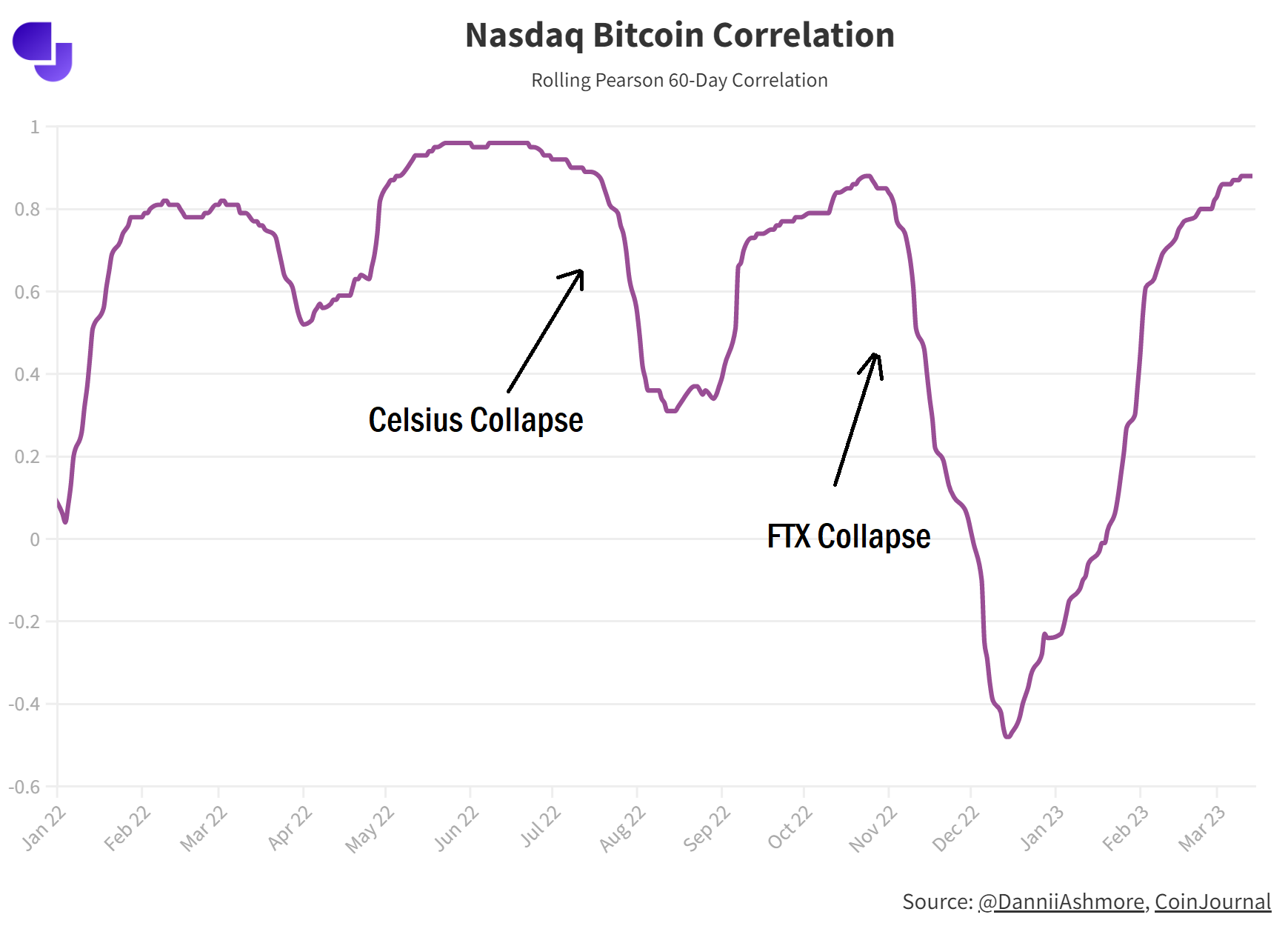
    Another way to chart this, albeit not an overly fashionable graph again, is by plotting Bitcoin against the tech-heavy Nasdaq index. It’s the modern-day Ross and Rachel from Friends story – the duo just can’t seem to separate for longer than a few days. 

    I was tempted to decry what I think is an overreaction in the crypto market. But in truth, this is simply a continuation of what we have been seeing over the last few years. In good times, Bitcoin rises a magnitude higher than the Nasdaq, and in bad times, it does the same in the opposite direction.

    Bitcoin is simply trading like a levered bet on the Nasdaq, which itself has been glued to inflation numbers and Federal Reserve minutes. 

    I think what we have seen thus far this year is the strongest argument yet that Bitcoin is simply trading like a levered bet on the long end of the risk spectrum. There has been nothing but bearish catalysts from within sector, and yet it’s rocketing upward. 

    The Nasdaq, on the other hand, is also printing boisterous gains – up a cool 16% at time of writing, meaning Bitcoin has pretty much tripled its gains. From the BTC all-time high in November 2021, the Nasdaq shed about 37% to its low. Bitcoin lost 77%. 

    And so, while the Bitcoin price rise may seem jarring in nominal terms – it’s up nearly 50% this year! – it’s not that much over what we would have expected, had you known the Nasdaq would jump 16%. 

    Not to mention, Bitcoin is still down 64% from its all-time high, and the space remains barren compared to the fruitful abundance of the bull market. 

    None of this analysis is particularly revolutionary. We know for a long time now that Bitcoin is an extreme risk-on asset and its price movements are leveraged bets on the macro situation – with some crypto-specific scandals (looking at you, Do Kwon and Sam Bankman-Fried) thrown in. Do Kwon and Sam Bankman-Fried) thrown in. 

    But when staring at the jaw-dropping percentage gains for Bitcoin, it’s important to keep this perspective. The space remains very vulnerable to some seriously bearish The space remains very vulnerable to some serious issues surrounding bankruptcies (and ongoing contagion out of FTX) and a potential hit to its reputation on the mainstream stage, not to mention the collapsed volumes and interest – which have not shown much bounceback even amid the recent rally. 

    Bitcoin is 65% off its high, even after this run. It’s great that the economy appears a little more optimistic than a few months back, and that is obviously a good thing for Bitcoin. But be careful here people, there remain a lot of predators lurking in the long grass. 

    Source link

  • Bitcoin, stocks swing as markets react to CPI data

    Bitcoin, stocks swing as markets react to CPI data

    • Bitcoin price was trading sideways after hitting highs of $22,300, with major US indexes also down.
    • The markets’ reaction comes after hotter-than-expected inflation data for the first month of 2023.
    • US CPI rose 0.5% over the month and 6.5% year-over-year.

    Bitcoin was holding just above $22,000 at around 11:00 am ET, with the flagship cryptocurrency having swung from highs of $22,300 as the broader crypto market mirrored Wall Street following Tuesday’s US inflation data.

    Across crypto, Ethereum first ticked closer to $1,570 across major exchanges, rising as much as 5% before the upside cooled to see ETH trade near $1,540 at the time of writing. A similar picture held for Binance Coin, with BNB nearing $300 with about 3.5% in gains before shedding some of the gains.

    The action across US stocks also had the major indexes in the green premarket, before broader reaction to consumer price data released on Tuesday saw the major indexes trade lower.

    The S&P 500 rose nearly 0.7% but had flipped negative after the latest Consumer Price Index (CPI) data from the US Bureau of Labor Statistics showed inflation picked up over the past one month after consecutive months of declines. The S&P 500 was down 0.6% at the time of this report.

    The outlook was similar for the Dow Jones Industrial Average and the Nasdaq Composite, which were down about 0.8% and 0.6% respectively.

    Markets react to January CPI data

    On Tuesday morning, the US government’s data on inflation showed consumer prices rose 0.5% in January and 6.4% over the past twelve months, higher than the forecast 6.2%. 

    Even for the Core CPI, which leaves out the more volatile food and energy components, the readings were 0.4% in January and 5.6% year-over-year.

    The data thus showed inflation had picked up in the first month of 2023, coming in hotter than economists expected, with Wall Street reacting lower on the news as investors weigh what this means for the Fed’s interest rates path. Market observers say this could point to a higher for longer path that the Fed has previously pointed out.

    Tim Seymour, the CIO of Seymour Asset Management certainly thinks this could be on the cards now.


    Source link

  • Bitcoin isn’t getting less volatile, and that’s a massive problem

    Bitcoin isn’t getting less volatile, and that’s a massive problem

    Bitcoin was 26X more volatile on a weekly basis than the euro in 2022, up from 19X in 2021 and 16X in 2020

    Key Takeaways    

    • There is a perception that Bitcoin’s volatility is coming down, however the data fails to back this up
    • Bitcoin’s volatility fell until 2015, but it has not improved since then
    • In comparing the asset’s returns to the Nasdaq and individual stocks, it blows them out of the water
    • Bitcoin’s average volatility vs USD on a weekly basis was 26X greater than the euro last year, up from 19X in 2021 and 16X in 2020

    Bitcoin and volatility are like the two leads in a rom-com. They may have some time apart intermittently, but you know that they will get back together before long. 

    But are things improving? I have written plenty about what I believe is the single biggest challenge to Bitcoin ever “achieving” anything of note – volatility. We at CoinJournal.net dove in to assess whether the situation is getting better. 

    Realised volatility

    The first step is charting the realised volatility. We annualised the annualised mark over a rolling 30-Day window, which in layperson’s terms means we assessed the magnitude of the movement by looking at a rolling 30-Day window. 

    The chart shows two things right off the bat. The first is that Bitcoin was all over the place until 2015, which is not surprising. At that point, it was still a niche Internet currency few had heard of, and its liquidity was minimal. While this article is striving to assess whether Bitcoin’s volatility is coming down, it is hard to put any weight into pre-2015. 

    The short answer is that it certainly has come down since before this time, but you don’t need much analysis to deduce that. The interesting part is whether it has continued to come down. Let’s zoom in on the time period since 2015. 

    Certainly a less perceptible trend, but it does look like the tail end – that being the latter half of 2021, 2022 and the start of 2023 – may suggest Bitcoin is calming down a little. 

    Upon further inspection, it doesn’t really hold, however. The period is devoid of any big isolated spikes which we have seen in the past – see March 2020 above, for example – which makes it seem like it has been serene. But aside from not offering an explosion of brief movement, the last couple of years have still offered near-constant volatility, and not dissimilar to what we have seen for much of the previous years. 

    “I was expecting a little more improvement with regard to Bitcoin’s volatility,” said Max Coupland, Director of CoinJournal. “There is a common perception in the space that Bitcoin’s volatility is coming down. But the CoinJournal research team had a hard time backing this up with numbers.

    In truth, while the period since 2015 has undoubtedly seen Bitcoin become mainstream and its price move sharply upwards as a result, its trademark volatility remains as fierce as ever. Bitcoin, in the short-term at least, remains more of a gamble”. 

    Bitcoin is still too volatile to be a store of value

    Bitcoin is still yo-yoyoing like there is no tomorrow. 

    Perhaps the below chart is a more intuitive display of this. The simple reality is that, if the asset is ever to act as a store of value, it is vital that these days where it moves 5%, 6%, 7% (or more) become a thing of the past. 

    It hasn’t happened to date. 

    The point is a simple one, but it bears repeating. An asset can’t lay claim to being a store-of-value (and certainly not a currency) while it is oscillating so wildly. People point towards developing world currencies as unsafe to store one’s wealth (and they are correct – looking at you Lebanon, Argentina and Venezuela), but Bitcoin is still a currency that can crater 20% overnight. Is that much better?

    Volatility less severe over long time periods

    Like anything, the volatility of Bitcoin does settle down a little when assessing it on a larger time frame. 

    The next chart plots the average daily returns over the prior 30 days. Again there is a noticeable downtrend to 2015, but not much improvement afterwards. 

    Zooming in on the prior graph, looking at the period since January 2020 (i.e. the pandemic bull market and the post-pandemic collapse) shows that while these moves are not overly large – they don’t spike over 3% – these are still daily averages, meaning the gain and loss is averaged out. And even then, 3% on a daily basis is far beyond what it needs to be. 

    Bitcoin’s volatility can’t compare to mainstream assets

    When comparing Bitcoin to anything but other cryptocurrencies, the contrast is stark. If Bitcoin is a mainstream asset, it carries volatility unlike anything else. That, above all, is the killer point. 

    An apt comparison is the Nasdaq, which is the more tech-heavy index and hence prone to more volatility. Over the last couple of years, this has rung especially true, as the world has transitioned to rising interest rates and the stock market plays a game of cat-and-mouse with the Federal Reserve. 

    Tech is particularly sensitive to interest rates because profit is not a favoured word in Silicon Valley. Instead of profits, companies are commonly valued off the promise of future cash flows, with unicorns seeing fat valuations off the back of these future cashflows being discounted at 0% rates. That is no longer the case, and hence we have seen share prices collapse and layoffs flood across the sector. 

    Nonetheless, comparing the Nasdaq’s volatility to Bitcoin is like comparing a great white shark to a goldfish. It’s just not a fair fight. 

    Of course, the Nasdaq is an index comprised of 100 stocks, and so when I say it’s not a fair fight to compare its volatility to Bitcoin’s, that is literally the case. 

    But even if we plot the volatility of some individual stocks of the Nasdaq against Bitcoin, the divergence is clear. 

    In summary, Bitcoin has a hell of a long way to go. In my eyes, this has always been its biggest challenge: to overcome this volatility. If it doesn’t, then what is really the point of this asset? You can’t have a store-of-value if it is prone to massive plunges in price. 

    I will finish with one more comparison – of where Bitcoin needs to get to, to illustrate how far it still has to go. To be a store of value, Bitcoin’s volatility needs to be (at least) on par with major currencies. 

    The below chart compares its volatility since 2015 to the euro, the newest of the “premier” currencies, launched around two decades ago.

    The final chart below shows this another way, in weekly terms. In fact, on a weekly basis, Bitcoin was 26 times more volatile than euro in 2022. It was 19X greater in 2021 and 16X greater in 2020 – yet further evidence that the volatility is not dissipating.

    It’s clear Bitcoin has a long way to go. That is accepted by most. But the thought that the volatility is coming down is a misconception, at least to date. 

    As for the future, well who knows?

    Research Methodology

    We drew price volatility measures from Glassnode, with our Analyst, Dan Ashmore, building the charts and comparing to other assets. Price data for stocks was scraped from Yahoo Finance. 

    If you use our data, then we would appreciate a link back to https://coinjournal.net. Crediting our work with a link helps us to keep providing you with data analysis research.

    Source link

  • Long-term Bitcoin holders at all-time high, but price not cooperating

    Long-term Bitcoin holders at all-time high, but price not cooperating

    Key Takeaways

    • Two-thirds of the Bitcoin supply has not moved in over a year
    • Metrics for percent of supply unmoved in 2+, 3+ and 5+ years also at all-time highs
    • The average hold period for Bitcoin on-chain is 3.8 years
    • Despite thesis that dwindling supply will boost price, this has not proved the case thus far

    The capped supply of Bitcoin has always offered an intriguing layer to analysis of the enigmatic asset. 

    Simply put, there are not many assets worldwide that offer an inelastic supply. Truthers argue that this cap will inevitably squeeze the price upwards through the simple economic theory of supply and demand. That is, assuming the demand continues to grow, of course. 

    Here, we look at this supply, and how many of the total supply of 21 million bitcoins (of which 19.3 million are currently in circulation) have not moved in quite some time.

    Percentage of Bitcoin supply unmoved in over a year at all-time high

    If one takes the 1+ year mark as a benchmark for long-term holders, that means a growing amount of Bitcoin supply is held by what constitutes long-term investors. 

    Two-thirds of the Bitcoin supply has not moved in over a year, an all-time high. That means no purchases or sales. 

    In expanding the timeframe out, we can look at what portion of this 67% has been held for even greater amounts of time. On the below chart, I have plotted the portion of supply that has been stagnant for 1+ years, 2+ years, 3+ years and 5+ years. 

    The results are interesting. Nearly half the supply – 49.3% – has not moved in over 2 years. Pushing out to 3+ years, the number is 39%. And 28.1% of the supply has not moved in 5+ years. The marks are all all-time highs.

    So, diamond hands? Well, sort of. The numbers are certainly large, but there are other variables at play. Most notably lost coins, for which it is impossible to know how many there are. Satoshi Nakamoto is estimated to own over one million coins, which is circa. 5% of the supply alone. 

    Long-term holders growing despite market carnage

    Nonetheless, to see such stout numbers following the year that crypto has had is notable. The average hold time of Bitcoin on-chain right now is 3.8 years.

    This comes less than a year after the collapse of LUNA (May-22) which sparked a meltdown crisis that ultimately bankrupted hedge fund Three Arrows Capital and sent a wave of contagion across the industry. 

    Things shook further when this contagion claimed crypto lender Celsius in June. The fallen crypto lender disclosed two months before, at the Bitcoin 2022 conference, that it held 150,000 Bitcoin, which would constitute 0.8% of the supply. 

    Unfortunately for investors, court filings by Kirkland & Ellis indicate that the firm has lost roughly 62,000 Bitcoin, and right now it is unclear how many they really held, nor how many the bankrupt firm now holds. 

    Then there was the staggering collapse of FTX in November.

    But despite this,  long-term holders do continue to grow, at least if on-chain metrics are to be trusted. 

    Dwindling supply not supporting price

    But as for the thesis that a dwindling supply will push price up, it has not worked to date. Bitcoin has collapsed while these metrics have all jumped to all-time highs. 

    What happens in the long-term remains to be seen. The advocates aren’t wrong when they reference simple supply and demand. This will undoubtedly help the price, and if long-term holders continue to hold, the liquidity drying up further can only squeeze the price upward. 

    On the other hand, every sale needs a bid order, and these have not been coming in quickly enough over the last two years. As I have written about repeatedly, Bitcoin continues to follow the macro cycle, trading like an extreme-risk asset making a mockery of those who claim it is any sort of inflation hedge. Look no further than its reaction to recent inflation readings and Federal Reserve meetings on interest rate policy for evidence of this. 

    Supply drying up is a good thing. But until Bitcoin sheds its high-risk image, it will continue to trade like a levered bet on the Nasdaq. Every asset needs a bid, people, and in times of uncertainty, the market has shown that Bitcoin is the last thing that investors want to hold. 

    Time will tell if this all changes. 


    Source link

  • Bitcoin on-chain metrics are now bullish: Bitfinex

    Bitcoin on-chain metrics are now bullish: Bitfinex

    • Bitfinex market report points to bullish metrics for BTC
    • Supply in Profit, Bitcoin Realised HODL (RHODL) Multiple and Reserve Risk ratio are all flashing green.
    • Bitcoin has traded to above $23k again after slipping on Monday following broader market reaction to economic news.

    Bitcoin is trading around $23,360 at the time of writing, about 2.4% up in the past 24 hours as cryptocurrencies flash green on Tuesday amid an improving market sentiment.

    For the world’s leading cryptocurrency by market cap, it appears on-chain metrics are ticking further north to suggest a strengthening bullish case.

    Supply in Profit up 20%, points to buy signal

    According to analysts at Bitfinex, one of Bitcoin’s on-chain metrics suggesting fresh upside momentum is likely the Supply in Profit indicator. Data shows bulls look to have successfully absorbed selling pressure as short-term and some long-term HODLers turn profitable.

    An observation of the metric on the 90-day time frame highlights a 20% jump for the “supply in profit” chart in January 2023, the analysts wrote in the report released on Monday.

    This implies that larger and longer-term investors currently hold profitable on-paper spot positions. This is healthy for the latter half of a bear market as a sustained 30-day uptrend after an extensive downtrend on this indicator has historically provided a good buy signal for the following two years,” the Bitfinex team noted.

    As far as markets are concerned, the above scenario doesn’t mean that the crypto market is set for an “up-only” move. However, the outlook does suggest bulls have an upper hand in the spot markets, a scenario that’s historically reflective of “late bear and early bull markets.”

    The Bitcoin Realised HODL (RHODL) Multiple, historically also bullish, has also been in an uptrend. According to data, the RHODL Multiple has remained positive over a 90-day window, to also suggest profitability for HODLers.

    Key metrics suggest a 10x jump for BTC price

    Apart from the 90-day EMA, other technical indicators flipping green include the net adjusted Spent Output Profit Ratio. Per on-chain data, the indicator is currently above one, which suggests that net sales across the Bitcoin market are profitable.

    Also, the Realised Profit to Losses (RPLR) ratio is above zero, which also confirms the profitable selling observed in past few weeks. The metric is currently moving towards 0.2, a reading comparable to the RPLR measure when Bitcoin price fell to lows of $3,600 in 2019. After the RPLR hit 0.2, BTC price flipped green and rallied 19x, hitting its all-time high in November 2021.

    Bitcoin Realized Profit Loss Ratio chart by Glassnode

    With the metric approaching this ratio when Bitcoin fell to lows of $16,000, the possibility of another 10x rally could see BTC target highs of $160,000 over the next two-three years.

    Bitcoin’s reserve risk ratio suggests HODLer conviction is high

    Looking at a longer time frame, Bitcoin’s on-chain metrics are also pointing to a bullish outlook. One odf these technical indicators is the Reserve Risk ratio.

    According to on-chain analytics platform Glassnode, Bitcoin’s reserve risk ratio has fallen to its all-time low. This puts the metric lower than when markets bottomed in 2019 or 2020, Bitfinex analysts pointed out.

    As the ratio is a cyclical oscillator that highlights price vs. HODLer conviction, with incentive to sell factored against opportunity cost, a very low ratio translates to a higher conviction among investors.

    A positive outlook for Bitcoin is also seen in the Market Value Realised Value (MVRV) ratio, which has recovered and has often coincided with historically bullish returns.


    Source link

  • Bitcoin sees $23.3K amid market reaction to US jobs report

    Bitcoin sees $23.3K amid market reaction to US jobs report

    • Bitcoin price fell slightly to retest support near $23,250 on Friday.
    • The top cryptocurrency’s price action mirrored early trades on Wall Street as the market reacted to US economic data.
    • The US added 517,000 jobs, against an estimated 188,000 and unemployment fell to 53-year low of 3.4%.

    Bitcoin responded to Friday’s US jobs report by swinging nearly 2% lower to trade around $23,250 early morning. As CoinJournal reported, Bitcoin fell against the US dollar after it briefly touched highs of $24,086. 

    Across crypto, Ethereum had slipped towards $1,600 with about 1.4% in losses.

    Bitcoin and stocks react to US jobs data

    As noted, early action across cryptocurrency prices mirrored the opening on Wall Street, where the three major US indices swung lower after the January jobs report showed a higher-than-expected rise in nonfarm payroll.

    Data released by the US Bureau of Labor Statistics showed the labour market added 517,000 jobs in the first month of 2023. The statistic indicated an unexpected growth, exceeding the 188,000 estimated by economists.

    The US economy added far more jobs in January than the 223,000 managed in December, with the unemployment rate falling to its lowest level in over half a century. Per the data, unemployment is now down to 3.4%, the lowest level for the US since 1969. Economists expected the unemployment rate at 3.5%

    The market’s reaction to the economic data, together with sentiment around disappointing earnings results from across Big Tech, fueled an early sell-off on Wall Street. It’s also likely down to nervousness over what this means for the Fed’s inflation outlook.

    The S&P 500 fell nearly 1%, while the Dow Jones Industrial Average declined by 100 points before regaining some footing. The Nasdaq Composite, impacted by a decline across tech stocks, shed more than 1.3% in early trading.

    The major indices are trying to recoup the early losses, as is Bitcoin that is trading near $23,500 as of 10.25 am ET. If bulls regain the upside momentum, BTC is likely to retest its intraday highs just above $24,000.


    Source link

  • MicroStrategy BTC paper loss hits $1.3B but no plans to stop trading bitcoin

    MicroStrategy BTC paper loss hits $1.3B but no plans to stop trading bitcoin

    • MicroStrategy registered $34 million in its first-ever bitcoin sale.
    • The company registered a paper loss of over 1 billion in 2022.
    • MicroStrategy made its first bitcoin purchase in August 2020.

    Despite making a paper loss of about $1.3 billion in 2022, MicroStrategy’s chief financial officer, Andrew Kang, said that the company will continue trading bitcoin. During a presentation for the Q4 2022 financial results webnier, Kang said:

    “We may consider pursuing additional transactions that may take advantage of the volatility in Bitcoin prices, or other market dislocations that are consistent with our long-term Bitcoin strategy.”

    The company’s stand on digital currencies comes at a time the crypto market is witnessing considerable recovery from last year’s plunge although it is not clear if digital currencies will ever reclaim their previous highs.

    Microstrategy bitcoin investment

    Microstrategy made its first bitcoin purchase in August 2020 acquiring 21,454 BTC in what it described as a “capital allocation strategy.” The company has been accumulating bitcoins since then and by December 24 2022 it had as much as 132,500 BTC worth $4.027 billion according to Microstrategy bitcoin statistics on the Buy Bitcoin Worldwide website.

    In the presentation on February 2023, Kang confirmed that Microstrategy holds 132,500 bitcoin that are worth about $1.84 billion as of Dec. 31, 2022.

    In the last quarter, MicroStrategy made a loss of $34 million after making its first-ever Bitcoin sale. The company made the decision to sell some of its bitcoins to recoup some tax losses.

    Microstrategy co-founder Michael Saylor said Bitcoin is one of the most important benchmarks that it uses to measure its stock performance against. He said that the company’s stock has risen by 117% since August 2020 compared to the bitcoin price which has risen by 98% in the same period.

    In an interview with a popular news outlet, Saylor said:

    “The only real safe haven for an institutional investor is Bitcoin. Bitcoin is the only universally acknowledged digital commodity, and so if you’re an investor, Bitcoin is your safe haven in this regard.”

    Source link

  • Tesla saw a net loss of $140 million on its Bitcoin in 2022

    Tesla saw a net loss of $140 million on its Bitcoin in 2022

    • Tesla recorded gains of $64 million and impairment loss of $204 million.
    • The company has revealed it sold 75% of its Bitcoin holdings, and held BTC worth about $184 million as of 31 December 2022.
    • The electric vehicle maker bought Bitcoin worth $1.5 billion in 2021.

    Tesla has revealed that the company sold most of the Bitcoin it purchased in 2021, and suffered a significant loss on the digital assets it currently holds during the 2022 crypto crash.

    In its Form 10-K filing with the US Securities and Exchange Commission (SEC) on Tuesday, 31 January, Tesla disclosed that it gained $64 million from its digital assets holdings when converting them into fiat currency. 

    However, according to the filing, the electric car maker’s Bitcoin bet also included a $204 million impairment loss for the year ending 31 December 2022. 

    All the gains recorded during the year were offset by the net impairment loss, which resulted from Tesla’s move to restructure its operations around the asset. This means the company reported a net loss of $140 million on its crypto trading in 2022. 

    During the years ended December 31, 2022 and 2021, we recorded $204 million and $101 million of impairment losses on such digital assets, respectively. During the years ended December 31, 2022 and 2021, we realized gains of $64 million and $128 million, respectively, in connection with converting our holdings of digital assets into fiat currency,” the company reported.

    Tesla has sold 75% of its Bitcoin

    Elon Musk’s company revealed that it received or purchased an “immaterial amount” of crypto last year. The tech giant plashed $1.5 billion when buying Bitcoin in 2021. 

    As of 31 December, 2022, Tesla had sold roughly 75% of its Bitcoin. Per the filing, that left the company with around $184 million worth of digital assets as of the end of last year, down from $1.26 billion at the end of 2021.

    While the fair market value BTC held as at 31 December 2021 was close to $2 billion (after Bitcoin price soared to highs of $69,000), the company’s total crypto holdings at the end of 2022 had a fair market value of approximately $191 million.

    Notably though, that value could be much high given the price of Bitcoin has soared nearly 40% year-to-date. The company’s stock (think the Bitcoin vs. Tesla stock comparison) has also soared over the past 30 days, with TSLA up nearly 56% YTD on Tuesday morning.

    Source link