Tag: crypto

  • Michigan proposes investments in crypto as Bitcoin Pepe’s presale nears $2m

    Michigan proposes investments in crypto as Bitcoin Pepe’s presale nears $2m

    Michigan

    • Michigan has joined the wave of other states in the US looking to invest in cryptocurrencies
    • Bitcoin Pepe’s presale approaches $2m two days after launch

    Michigan proposes crypto investments

    Michigan’s state representatives, Bryan Posthumus and Ron Robinson have proposed House Bill 4087 to allow the state to invest in Bitcoin and other cryptocurrencies. 

    If the bill is approved, the state treasurer can allocate up to 10% of Michigan’s general and economic stabilization funds to cryptocurrencies. Michigan joins a wave of other states in the US proposing to invest in cryptocurrencies.

    What is Bitcoin Pepe?

    With Michigan and other US states looking to invest in cryptocurrencies, Bitcoin will likely top the list as it’s the number one crypto by market cap. Bitcoin Pepe is leveraging Bitcoin’s position in the market to introduce memecoins to its ecosystem. 

    It’s a layer-2 network building on the Bitcoin blockchain. Bitcoin Pepe is a meme-specialized layer-2 solution built on top of Bitcoin, bringing Solana-style scalability to the Bitcoin network.

    According to the whitepaper, Bitcoin Pepe is designed to become ground zero for all memecoin trading and move all this economic activity to the BTC ecosystem. This project will unlock decentralized finance (DeFi) and meme trading on top of BTC.

    The team describes Bitcoin Pepe as the perfect fusion between BTC’s security and the unstoppable force of memecoins.

    The team added that Bitcoin Pepe is the first-ever meme initial coin offering (ICO) on the Bitcoin blockchain. With this, BTC Maxis will be able to trade memes, and combining high levels of trust (BTC) with high levels of performance (SOL) will lead to high levels of retail mass adoption.

    How can Bitcoin Pepe advance the Bitcoin ecosystem?

    Bitcoin is the oldest blockchain in the ecosystem, but offers less utility than smart contract blockchains like Ethereum and Solana. However, Bitcoin Pepe plans to open up the blockchain further by allowing the launch of memecoins and other narratives on the network. 

    By ushering in memes on Bitcoin, Bitcoin Pepe will turn the blockchain into the home base for the crazy high-octane meme experience. The team believes the BTC bridge will unlock $2 trillion in dormant BTC capital and make it available for memecoin trading.

    Bitcoin Pepe will launch as a layer-2 network, providing the necessary infrastructure for all memes to migrate to BTC and ensuring security and liquidity for investors and users. 

    Bitcoin Pepe presale raises $2m in two days

    Bitcoin Pepe’s presale launched two days ago and is already close to a new milestone. According to their official whitepaper, the Bitcoin Pepe presale has raised $1,937,568 in just two days.

    This isn’t surprising, as its native token, $BPEP, will power the Bitcoin Pepe layer-2 network and several other activities within the ecosystem. The presale allows investors to buy the tokens before they are listed on exchanges. 

    Investors can purchase the $BPEP tokens using various cryptocurrencies, including ETH, USDT, USDC, BNB, and SOL. 

    The presale could be an opportunity to purchase $BPEP at a discount. Solana’s SOL currently trades at $196 per coin. However, it was sold for $0.22 during its presale in 2020, indicating how early investors benefit from partaking in presales.

    Bitcoin Pepe aims to be a leading L2 network on Bitcoin, offering users security and liquidity. In addition to that, it’s leveraging the recent growth of memecoins to launch as one while working to introduce more memecoins to the Bitcoin ecosystem.

    Source link

  • Crypto recorded $1.3B in investment product inflows this past week

    Crypto recorded $1.3B in investment product inflows this past week

    Bitcoin (BTC) price breaks above $62K as crypto market awakens after Fed rate cut
    • Crypto investment products registered $1.3 billion in inflows last week
    • Ethereum outpaced Bitcoin with $793 million compared to $407 million

    Digital asset investment products notched $1.3 billion in inflows in the past week.

    It’s the fifth consecutive week of positive net flows for crypto exchange-traded products despite recent price declines. According to latest weekly flows report from digital asset manager CoinShares, the scenario outlines strong interest in buying amid market weakness.

    Ethereum outpaces Bitcoin in weekly net inflows

    Per a Coinshares report on February 10, the net inflows is almost double from the $747.4 million recorded the week before. The increase comes despite US President Donald Trump’s tariff impositions that saw prices dip amid investor reaction.

    Bitcoin and Ethereum dominated the inflows. However, the latter outpaced the former this week, registering $793 million inflows compared to Bitcoin’s $407 million.

    Overall, Bitcoin ETPs represent 7.1% of total market capitalization, making digital asset investment products the largest holder compared to other investments.

    “Digital asset investment products saw inflows for the 5th consecutive week totalling US$1.3bn. Bitcoin’s BTC saw inflows of US$407m, with ETPs globally now representing 7.1% of the current market capitalisation. It was Ethereum who stole the show this week, with the price falling recently close to US$2,100 leading to significant buying-on-weakness, with inflows of US$793m,” CoinShares posted on X.

    Investors see decline as a buying opportunity particularly after the rise in investment interest followed Ethereum’s price dip.

    In the meantime, XRP and Solana secured third and fourth positions respectively with $21 million and $11million. Meanwhile, $1 billion in overall net inflows by the US was the highest regionally, followed by Germany, Switzerland, and Canada with $61 million, $54 million, and $37 million, respectively.

    Bitcoin’s price has struggled with downside pressure below $100k in recent weeks. ETH has also experienced a tough month or so, with prices helmed below $3,000 and hitting lows of $2,100 at one time.

    Source link

  • Weekly price analysis: crypto prices reel from risk off sentiments

    Weekly price analysis: crypto prices reel from risk off sentiments

    • The crypto market trended lower last week as US tariffs rocked the market, causing investors to flee to safe-haven assets like Gold
    • Crypto prices, which recovered slightly on Monday and Tuesday, continued trending downward as uncertainty looms
    • Meanwhile, spot ETF inflows remained positive despite some days of outflows

    Bitcoin

    Bitcoin’s price trended lower over the last week following US President Donald Trump’s announcement of tariffs on Canada, Mexico, and China. Investors fled to safe-haven assets like gold while risky assets, like crypto, trended lower.

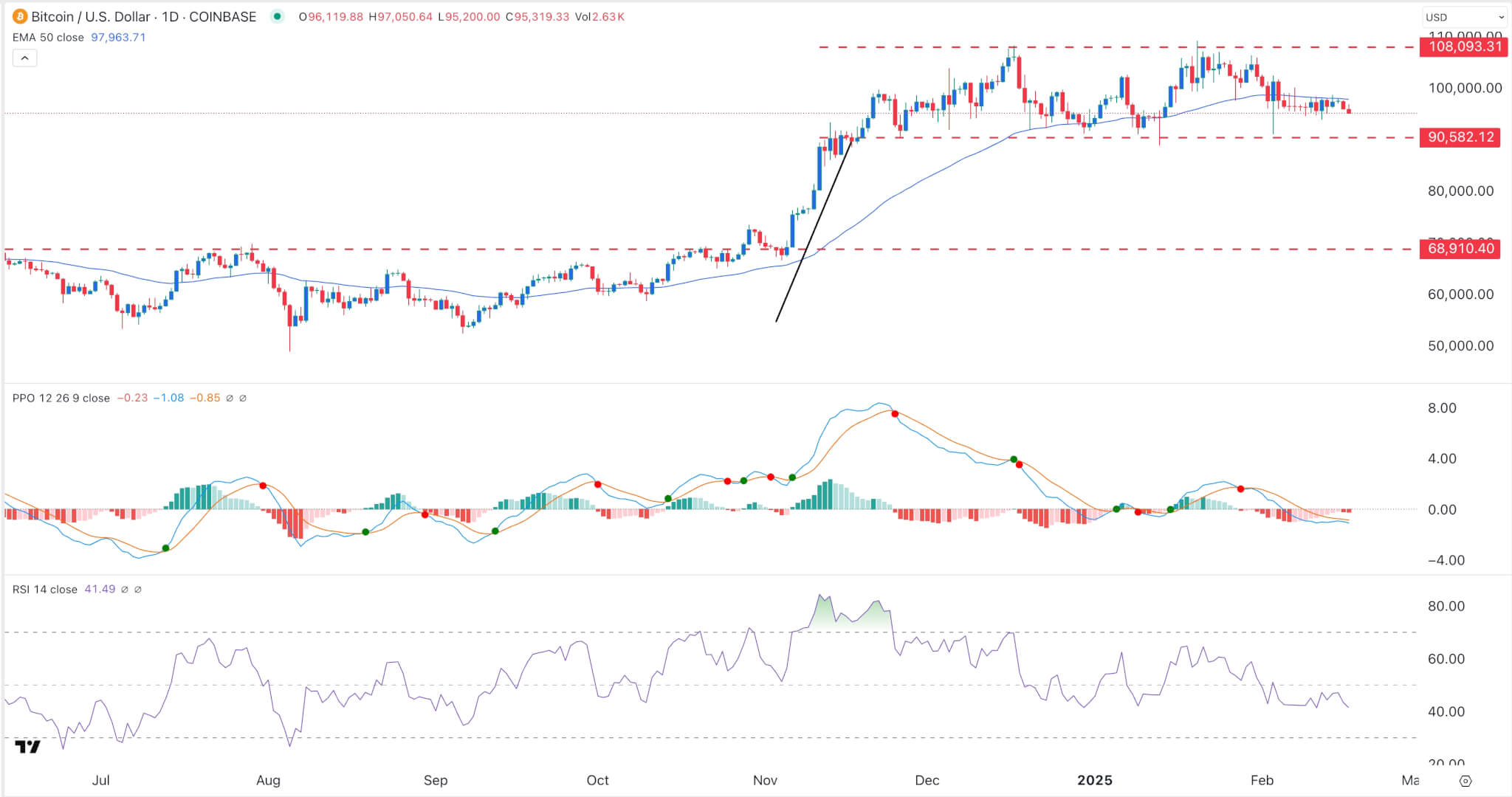
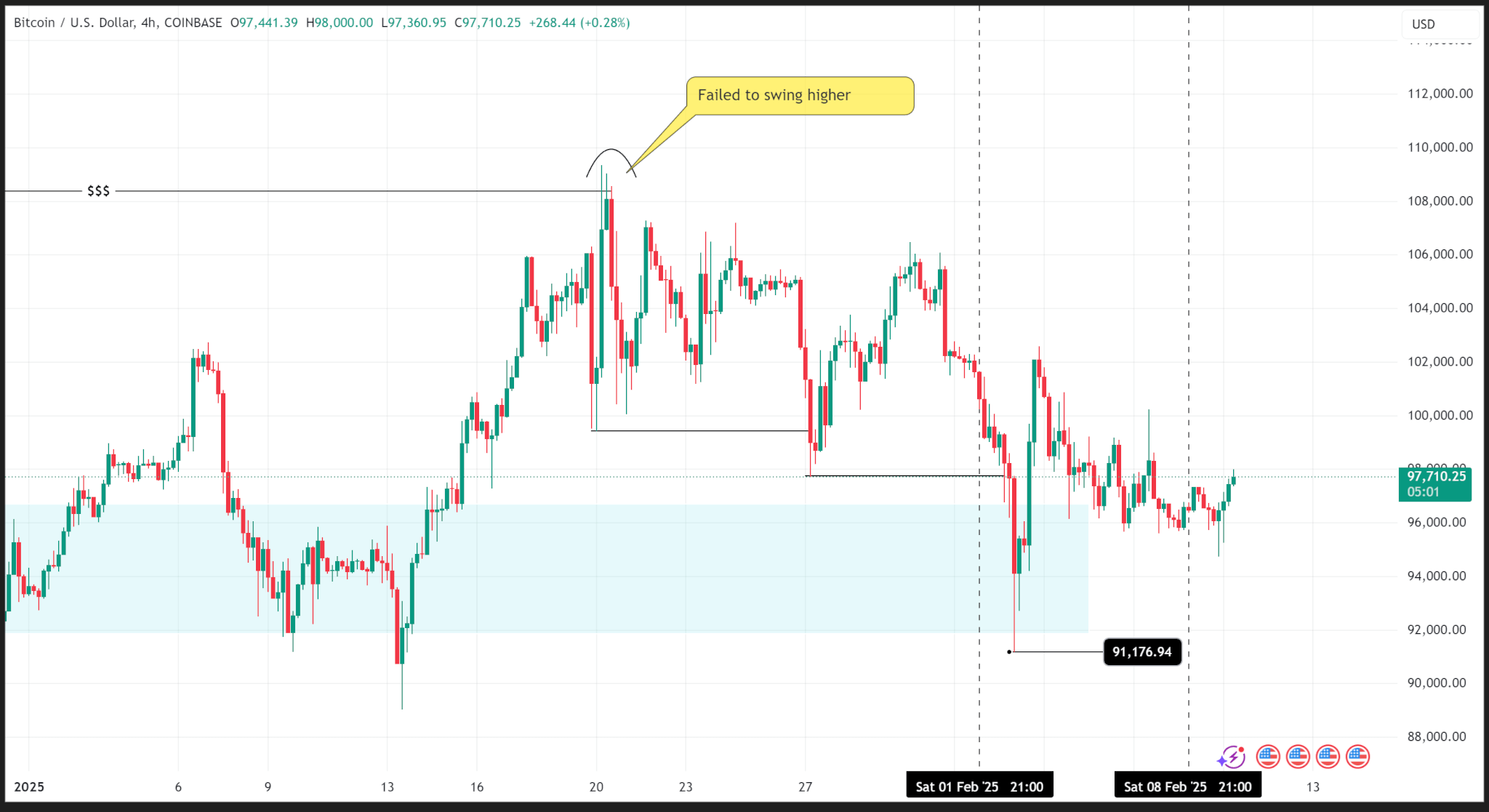
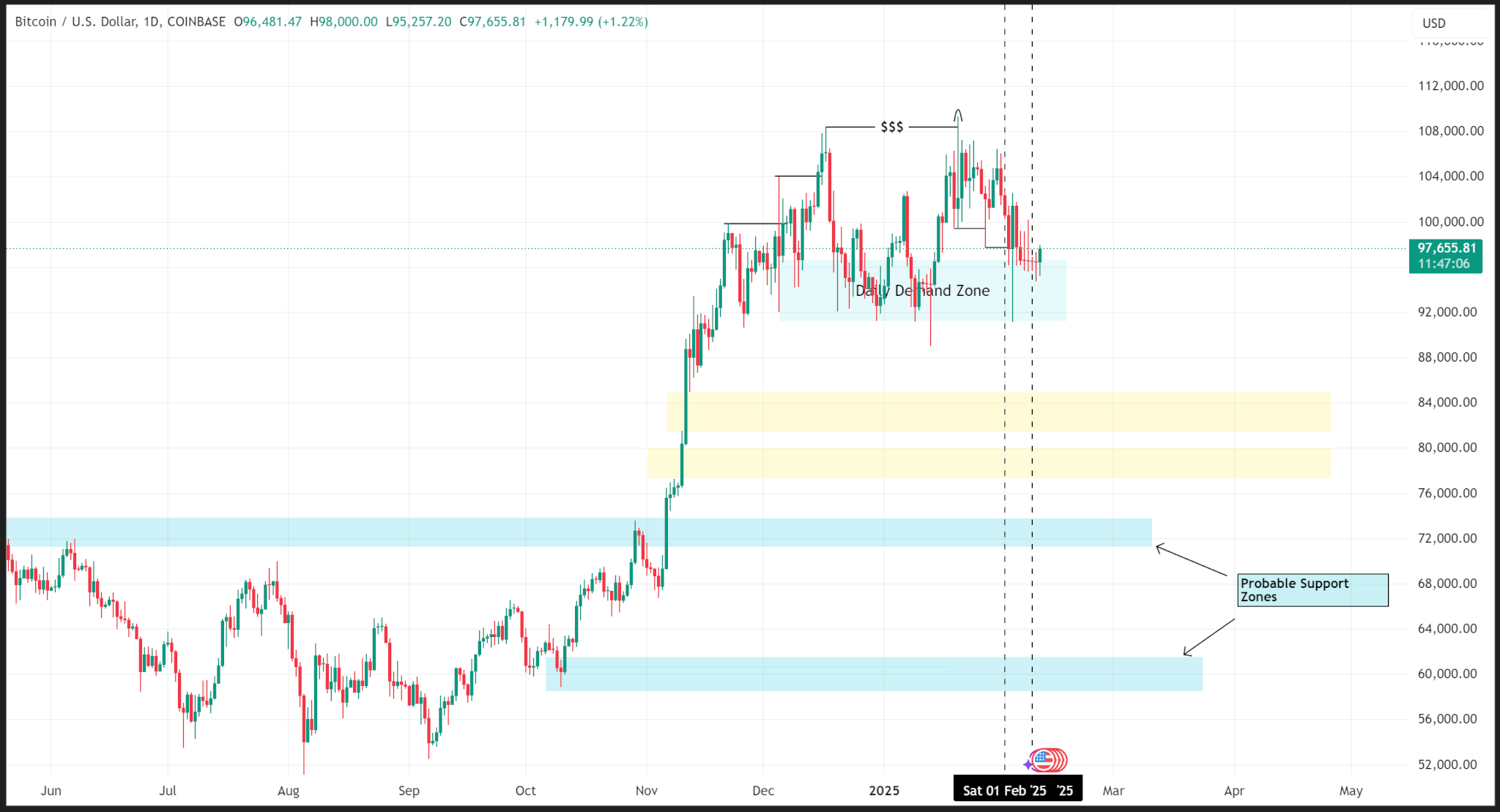
    However, the tariffs are a catalyst for faster price declines as price action shows that Bitcoin was already on a decline in its substructure after failing to swing higher than the $108,000 level three weeks ago.

    BTC/USD chart by TradingView

    BTC made two consecutive lower lows on the substructure over the last two weeks and traded into the daily demand zone early last week, logging a weekly low of $91,176.94.

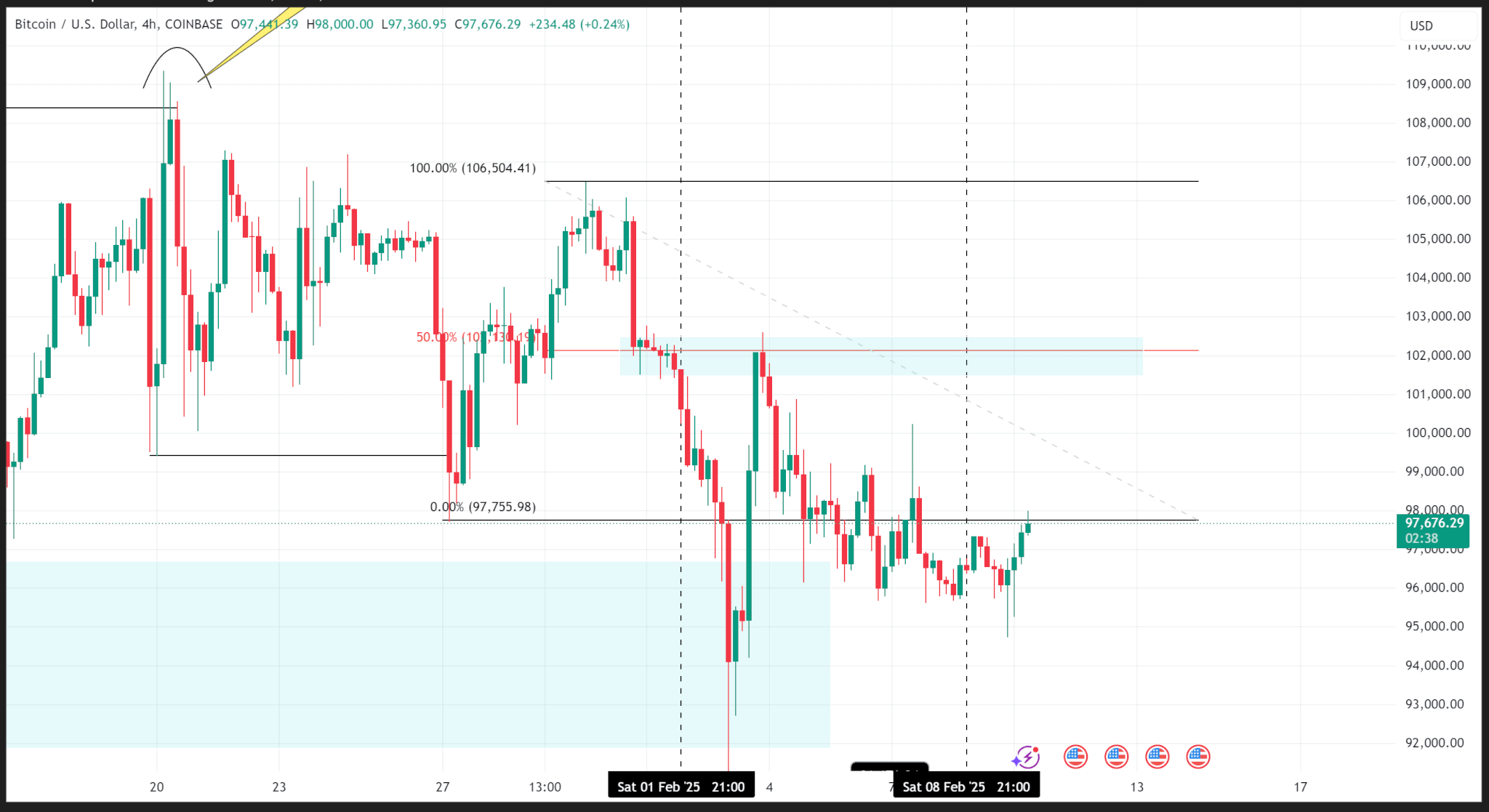
    After buying from the demand zone, the price rose to an internal supply zone at $102,000, validated by the 50% Fibonacci level, and sold off that zone to end the week at $96,475.03.

    BTC/USD chart by TradingView

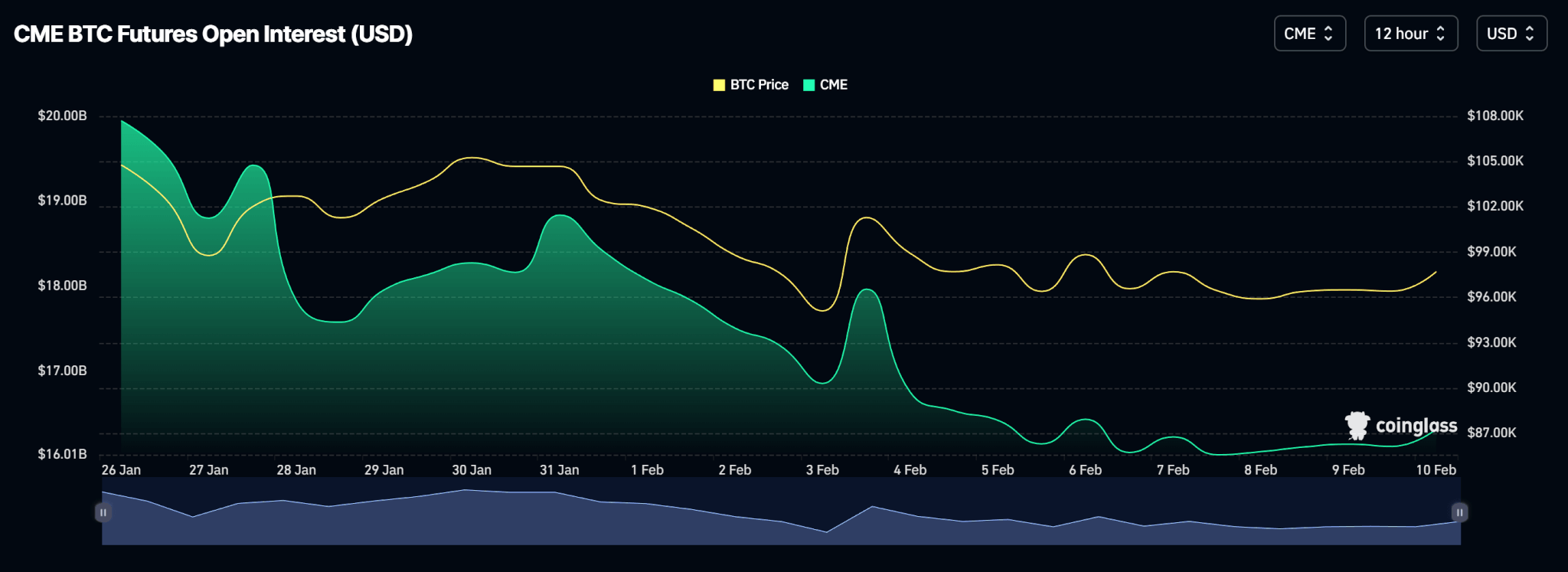
    On the CME, where Bitcoin Futures are traded the most, open interest fell last week as traders closed contracts due to uncertainty caused by Trump’s tariffs.

    Meanwhile, spot BTC ETFs logged a positive week as net flows printed $208.30 million despite two days of major outflows.

    Price Outlook

    Provided the price remains above the demand zone on the daily timeframe, then Bitcoin’s overall structure should remain bullish despite price declines on the substructure.

    However, a daily close below the demand zone, i.e., below the $90,000 level, may trigger a sell-off to support levels around $84,000 or lower.


    BTC trades at $97,624.73 as of publishing.

    Ethereum

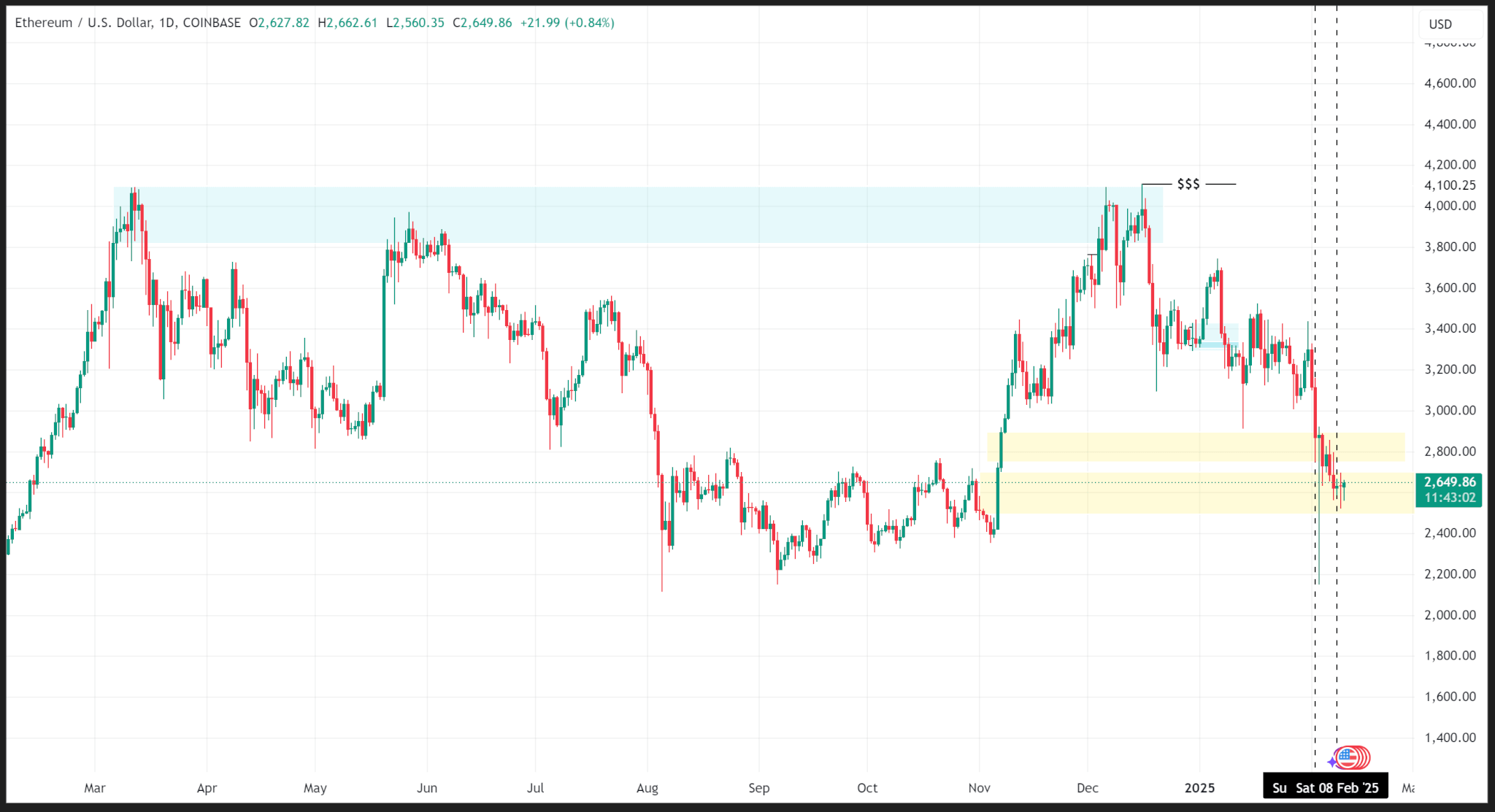
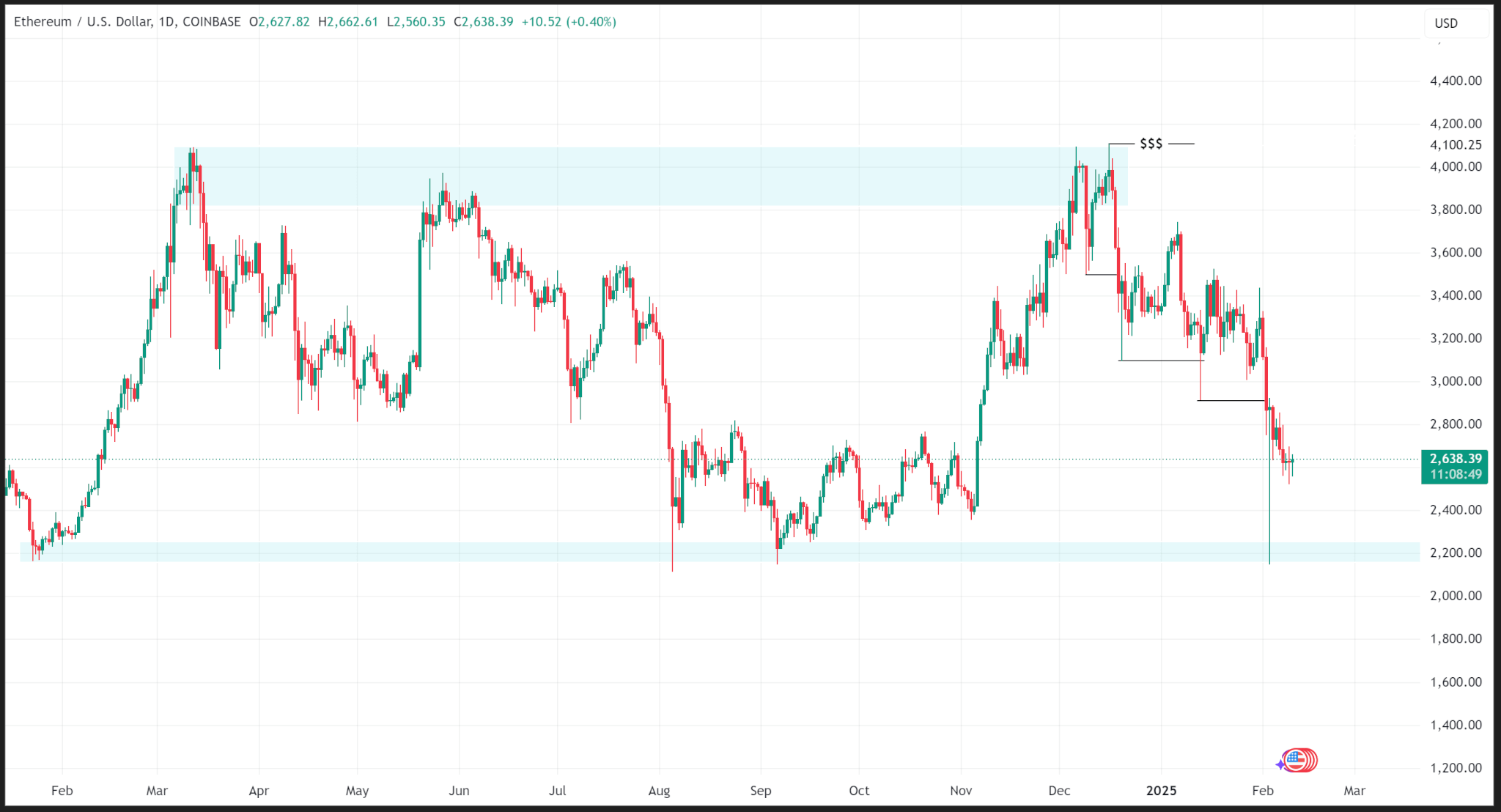
    After failing to break above March 2024 highs, Ethereum’s price has been on a downtrend on its substructure since mid-December 2024.

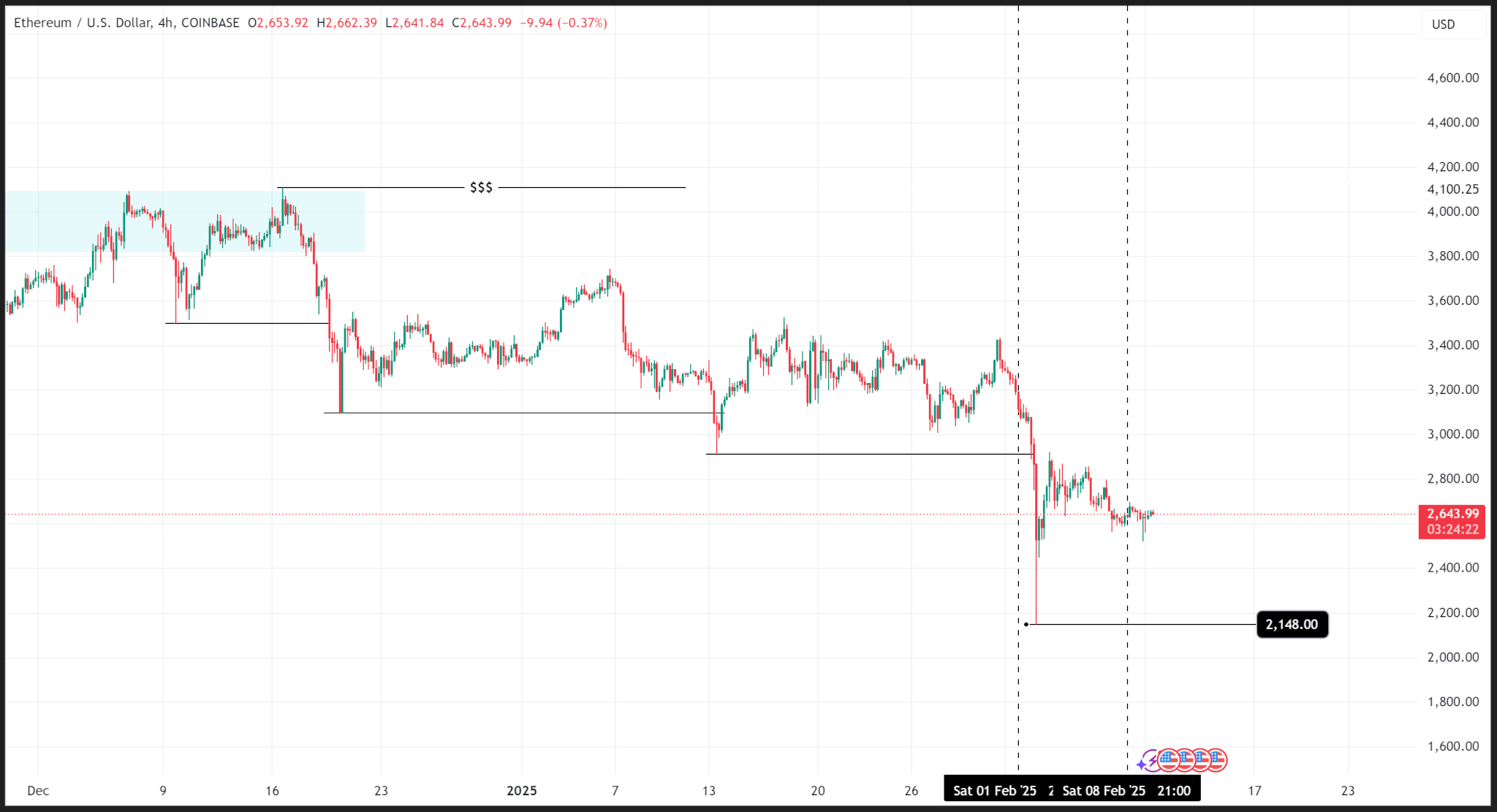
    On the 4-hour time frame, the price logged consecutive lower lows with the most recent low of $2,148.00 reached early last week. Price has improved since then, closing last week at $2,632.16.

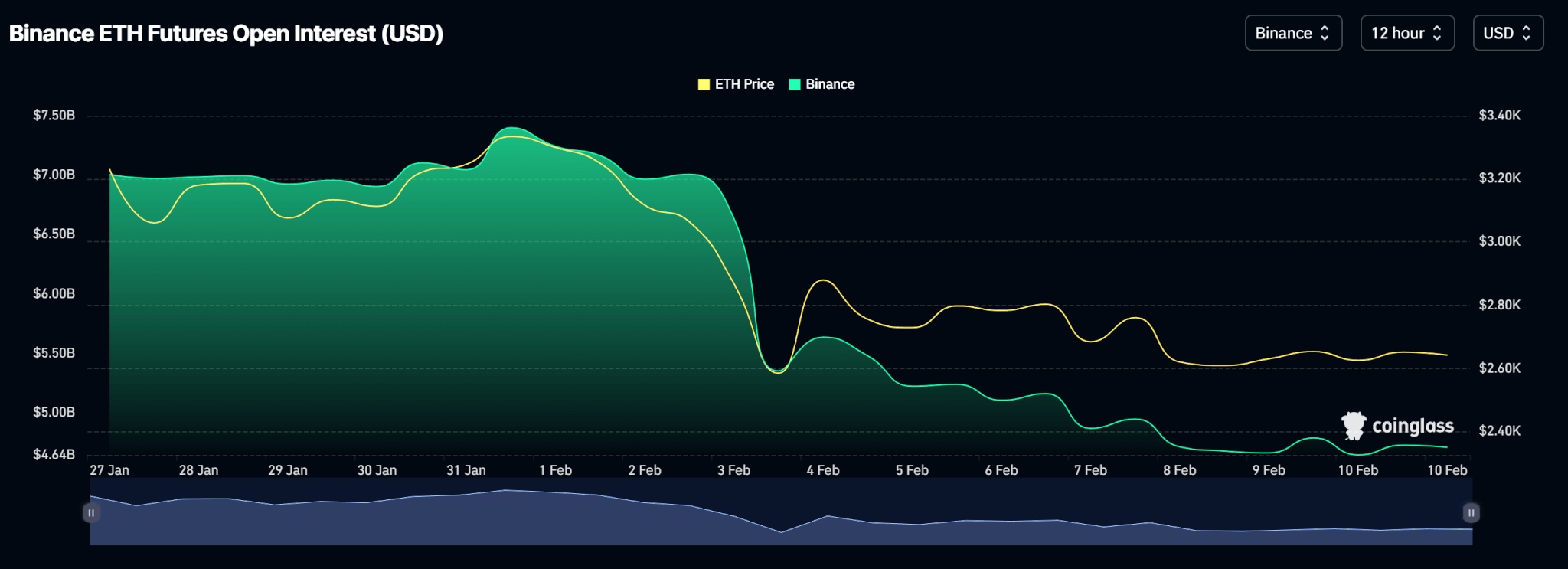
    Open interest on Binance, where Ethereum Futures are traded the most, shows a decline in the number of open contracts, which could be another catalyst for price declines.

    Meanwhile, spot ETH ETFs logged positive inflows on all days last week, aside from Friday when it logged no inflows (or outflows), totalling $420.20Mn for the week.

    Price Outlook

    The next probable zone for ETH’s price to fall is a major support zone around $2,200. With Trump planning to impose a 25% tariff on steel and Aluminum as well as a fresh round of retaliatory tariffs against trade partners, more uncertainty could push ETH’s price there soon.

    ETH trades at $2,640.05 as of publishing.

    Source link

  • What happened in crypto this week

    What happened in crypto this week

    We’ve had another busy week in the crypto market: Bitcoin hits $109,000, Trump and Melania launch memecoins, Elon Musk’s DOGE agency sued, Circle acquires Hashnote, Trump pardons Silk Road creator Ross Ulbricht, Taiwan is considering allowing banks to issue stablecoins, banks will embrace crypto with clearer regulations, and Trump signs executive order for crypto working group.

    Bitcoin hits $109,000

    Bitcoin hit a new all-time high of over $109,000 ahead of Donald Trump’s inauguration on Monday.

    On January 20, Bitcoin reached a new high as market sentiment remains optimistic about Trump’s plans for the crypto industry. The latest high surpasses its previous record of over $108,000, which it achieved in December.

    Trump also mentioned Bitcoin in a Sunday speech, highlighting its record performance since the US election.

    “Since the election, the stock market has surged and small business optimism has soared a record 41 points to a 39-year high,” Trump said. “Bitcoin has shattered one record high after another.”

    Over the past 90 days, Bitcoin is up nearly 60% and has a market cap value of $2.09 trillion.

    Trump and Melania launch memecoins

    Ahead of Trump’s inauguration on Monday, January 20, he announced the launch of his $TRUMP memecoin on his Truth Social platform.

    Within 24 hours of launching, the meme token rose 580% in value, topping $75, with a market cap of nearly $6 billion.

    Following Trump, Melania Trump launched her memecoin, $MELANIA, last Sunday, which saw the token reaching a high of over $13.

    At the time of publishing, $TRUMP and $MELANIA are trading at more than $33 and $2.60, according to data from CoinMarketCap.

    Elon Musk’s DOGE agency sued

    Elon Musk’s Department of Government Efficiency (DOGE) agency reportedly had three lawsuits filed against it within minutes of Trump’s inauguration on Monday.

    In a 30-page lawsuit from the National Security Counselors, a public interest law firm, it questions the legality of the agency Trump said he’d create to “dismantle government bureaucracy.”

    According to the complaint, DOGE violates the Federal Advisory Committee Act (FACA), which requires advisory committees to follow certain rules, including allowing public involvement.

    National Security Counselors state that DOGE meets the requirements to be considered a “federal advisory committee.” Yet, while similar agencies follow a “fairly balanced” representation, keep meeting records, and allow public involvement, as required by law, DOGE doesn’t.

    The two other lawsuits were filed by a group that includes the American Federation of Government Employees and the State Democracy Defenders Fund. In another case, the plaintiffs are the Citizens for Responsibility and Ethics in Washington and the American Federation of Teachers.

    Despite this, the US government launched the DOGE agency website the following day.

    Circle acquires Hashnote

    Stablecoin issuer Circle acquired Hashnote for an undisclosed amount earlier this week. As part of the acquisition, Circle is planning to integrate USYC as collateral on crypto exchanges.

    In a post on X, Circle said that the move, alongside a strategic partnership with DRW, a global trading firm, “is set to redefine the landscape of digital asset capital markets.”

    By integrating USDC, Circle’s stablecoin, and USYC, the platform is enabling interconvertibility between both assets, allowing USYC to be used as preferred collateral on exchanges and brokers.

    Trump pardons Silk Road creator Ross Ulbricht

    Donald Trump signed an order, giving Ross Ulbricht, the founder of darknet marketplace Silk Road, a full pardon this week.

    In a post on his Truth Social platform, Trump wrote:

    “I just called the mother of Ross William Ulbricht to let her know that in honor of her and the Libertarian Movement, which supported me so strongly, it was my pleasure to have just signed a full and unconditional pardon of her son, Ross.”

    The pardon comes after Ulbricht spent 12 years in prison following his arrest in 2013. Ulbricht created Silk Road in 2011; however, he was given two life sentences plus 40 years in 2015. Upon pardoning Ulbricht, Trump called Ulbricht’s sentence “ridiculous.”

    Taiwan is considering allowing banks to issue stablecoins

    Taiwan’s financial regulator is to propose legislation enabling local banks to issue stablecoins pegged to the New Taiwan Dollar (NTD).

    The draft law from the Financial Supervisory Commission (FSC) is expected to be introduced in June 2025. It aims to bridge the divide between fiat and digital currencies, enhancing investor access to the burgeoning crypto market.

    The proposal for banks to issue stablecoins is seen as a pivotal step in this regulatory evolution, providing a more secure and regulated environment for cryptocurrency transactions.

    The FSC emphasizes that all stablecoins issued within Taiwan will be under the joint management of the central bank, ensuring their stability and legitimacy.

    Zhuang Xiuyuan, director of a Taiwanese bank, has voiced concerns over existing stablecoins like Tether and USDC, criticizing their backing by non-government recognized assets.

    To address these issues, any new stablecoin in Taiwan will require explicit approval from the FSC, ensuring they meet specific qualifications regarding issuer credibility and reserve allocations.

    Banks will embrace crypto with clearer regulations

    Bank of America’s CEO has said that US banks will embrace crypto payments if clearer rules are in place from regulators.

    Speaking at the World Economic Forum, Brian Moynihan said that if rules come in and crypto payments are made “real,” then “the banking system will come in hard on the transactional side of it.”

    So far, US banks have been cautious about offering retail crypto services, instead focusing on providing institutional products such as US spot Bitcoin exchange-traded funds (ETFs).

    Trump signs executive order for crypto working group

    Less than a week into entering the White House, Trump has signed an executive order for a crypto working group designed to provide regulatory clarity.

    When signing the order, Trump appeared with his AI and crypto czar David Sacks who spoke about the order to the president. Sacks, who will be leading the working group if it’s implemented, said: “we’re going to be forming an internal working group to make America the world capital under your leadership.”

    In addition to providing regulatory clarity, the working group seeks to protect the US dollar through the development of lawful dollar-backed stablecoins worldwide. The working group also wants to prohibit “the establishment, issuance, circulation, and use of a [central bank digital currency] within the jurisdiction of the United States.”


    Source link

  • How the Fed’s latest decision could affect crypto markets in 2025

    How the Fed’s latest decision could affect crypto markets in 2025

    Bitcoin may have kicked off 2025 with a rebound back to $100,000, but since the release of the U.S. Federal Reserve’s December 2024 Federal Open Market Committee meeting on Jan. 8, the BTC/USD exchange rate dropped to as low as $91,220.84.

    Bitcoin has stabilized at around $95,000 since then, but concerns run high whether further news about the future direction of interest rates and monetary policy will result in an additional negative impact to the performance of Bitcoin and other cryptocurrencies.

    As cryptocurrencies have entered the financial mainstream, they have become increasingly sensitive to policy changes from the Federal Reserve. With this in mind, let’s take a closer look at the latest news from the Fed, and see what it could mean for the performance of both Bitcoins and altcoins in the months ahead.

    Why Cryptos Fell on The Latest Fed News

    As revealed in the aforementioned Fed meeting minutes, the central bank once again cut interest rates by 0.25%, or 25 basis points. This was in line with expectations. However, while the latest rate cuts arrived as expected, other takeaways from the meeting minutes caught investors off-guard.

    Namely, the Fed’s signaling of its plans to reduce the number of 25-basis point rate cuts in 2025. Before the meeting minutes hit the street, the market was still expecting four such cuts throughout the year. The latest remarks from Fed officials regarding quantitative tightening also suggested that the “Fed pivot” this year will not be as rapid of a shift from hawkish to dovish as previously anticipated.

    Taking this into account, it’s not completely surprising that Bitcoin has once again encountered negative volatility. Nor is it surprising that more volatile altcoins, like Ethereum, Solana, and Dogecoin, have all experienced double-digit declines over the past week. As “risk-on” assets, cryptocurrencies, especially altcoins, perform better during times of accommodative fiscal policy.

    Yet while the Fed may be not turning as dovish as previously expected, and is in fact continuing to engage in monetary tightening, the impact of these policy decisions on cryptocurrency prices in 2025 may not be as dire as it seems at first glance.

    What This Means for Bitcoin and Altcoin Prices in 2025

    Although the cryptocurrency market reacted negatively to the Fed’s current policy gameplan, said plans could still result in further upside for Bitcoin and other cryptocurrencies. For one, the planned implementation of fewer 25 basis-point rates still means a further loosening of monetary policy, helping to justify additional upside for this “risk-on” asset class.

    Second, with regards to Bitcoin, other positive factors are at play that could drive further upside for the largest cryptocurrency by market capitalization. These include increased institutional and retail investor allocation, as well as the specter of a more favorable crypto regulatory environment from the incoming Trump administration.

    Binance CEO Richard Teng commented on what we can expect in the crypto industry in 2025, “We expect to see development across all aspects. Crypto regulation saw great growth across the world in 2024 and we expect to see more in 2025. Given the recent U.S. presidential election and expected crypto regulation from its new government, we expect to see other countries follow the lead from the U.S. and enact more legislation across the world.”

    Teng continues, “In terms of institutional interest, financial giants like BlackRock and Fidelity entered the crypto business in 2024, and we expect to see more new players next year. More companies are learning about crypto and integrating crypto features like tokenization into their business. This is a trend that has grown for years and we expect to see more development in.”

    Admittedly, the recently-announced changes to the Fed’s rate cut plans could still negatively impact the performance of altcoins in the short-term. Altcoins are much more sensitive to changes in fiscal policy. Nevertheless, if a bull market continues in Bitcoin, chances are it will spill over into the altcoin space as well. Investors profiting from a continued run up in the price of Bitcoin could cycle their gains into Ethereum, XRP, Solana, and other major and emerging altcoins.

    The Bottom Line

    Over a longer timeframe, the Fed’s decision to more cautiously lower interest rates and loosen fiscal policy may do little to threaten the long-term bull case for cryptocurrencies. Due to a variety of trends, including the proliferation of exchange-traded cryptocurrency investment products, institutional and retail capital inflows into cryptocurrencies are poised to continue.

    Of course, nothing’s for certain. For instance, following the latest jobs report, there is growing doubt whether the Fed will further walk back its 2025 rate cut plans. Even if the Fed sticks to its current plan, this asset class is likely to stay highly volatile. Caution and patience remain key.

    Nevertheless, taking into account not just the Fed news,but the other positive trends at play as well, the opportunity for long-term price appreciation with Bitcoin and other cryptocurrencies is still on the table.

    Source link

  • Bank of America CEO says banks will embrace crypto with clearer regulations

    Bank of America CEO says banks will embrace crypto with clearer regulations

    • The banking sector could embrace crypto payments if clearer rules are in place
    • Crypto would be another form of payment like Visa and Mastercard, said Brian Moynihan
    • A new crypto task force aims to provide a “clear regulatory framework for crypto assets”

    Bank of America’s CEO said the US banking industry will embrace crypto payments if clearer rules are in place from regulators.

    In an interview with CNBC at the World Economic Forum in Davos, Switzerland, Brian Moynihan said that all banks send money digitally nowadays. He added that if rules come in and crypto payments are made “real,” then “the banking system will come in hard on the transactional side of it.”

    “If you go down the street here and you go in and buy lunch, right, if you can pay with Visa, Mastercard, a debit card, Apple Pay, etc., this would just be another form of payment,” the BoA CEO said.

    To date, US banks have been cautious about offering retail crypto services, instead focusing on providing institutional products such as spot Bitcoin exchange-traded funds (ETFs).

    Changes under a Trump administration?

    Moynihan’s comments come as President Donald Trump started another term in the White House earlier this week.

    During his election campaign, Trump indicated a pro-crypto stance and has since appointed several pro-crypto candidates to various government positions.

    Introducing a new crypto task force “dedicated to developing a comprehensive and clear regulatory framework for crypto assets” could give banks the push they need to enter the space.

    Speaking to CoinJournal, Tom Kiddle, co-founder of Palisade, a French-regulated digital asset custodian backed by Ripple, said: “So far, the country has done little to advance a clear crypto regulatory framework. However, Trump’s nomination of pro-crypto Paul Atkins could mark the dawn of a new era for the sector.”

    When asked about crypto such as Bitcoin as an investment option during the interview, Moynihan refrained from answering, stating that topic was “really a separate question.”

    Source link

  • Crypto industry hopes rise as Donald Trump enters the White House

    Crypto industry hopes rise as Donald Trump enters the White House

    Donald Trump's transition team considering XRP, Solana, and USDC strategic reserves
    • A new era is set for the industry with the appointment of crypto-friendly candidates such as Paul Atkins
    • It remains to be seen whether the US will match similar regulatory frameworks like Europe’s MiCA
    • The rise of Bitcoin will be shaped by institutional adoption, increased regulatory clarity, and broader macroeconomic and geopolitical trends

    US President-elect Donald Trump is taking office today with his incoming administration making significant promises for the crypto industry.

    After years of battling with the US Securities and Exchange Commission (SEC) under outgoing US President Joe Biden’s administration, the crypto market is beginning to feel hopeful.

    Even before entering the White House, a shift has already taken place with the appointment of crypto-friendly candidates including Paul Atkins as the next SEC Chair and crypto czar David Sacks. Trump is also, reportedly, going to sign an executive order making crypto a priority under his leadership.

    “So far, the country has done little to advance a clear crypto regulatory framework,” said Tom Kiddle, co-founder of Palisade, a French-regulated digital asset custodian backed by Ripple, to CoinJournal. “However, Trump’s nomination of pro-crypto Paul Atkins could mark the dawn of a new era for the sector.”

    A similar MiCA framework?

    While a potentially favorable crypto environment is possible with the likes of Paul Atkins, it remains to be seen whether the new administration will match international frameworks such as Europe’s Markets in Crypto Assets (MiCA) regulations.

    According to Kiddle the “US is at a crossroads,” adding that “if the SEC adopts a constructive stance, the country could finally reclaim is position as a global leader in blockchain innovation rather than watching talent and capital drain to emerging economies.”

    Several companies, including Bitwise, Coinbase, and Ferrari are already expanding their services into Europe. With a lack of clear crypto regulations, the crypto industry isn’t reaching its full potential in the US.

    Under a Trump administration that could soon change.

    “It’s unclear how closely the administration intends to match international frameworks such as the EU’s MiCA with its regulatory plans,” said Temujin Louie, CEO of Wanchain to CoinJournal. “By closely monitoring the administration’s policies and adapting accordingly, the blockchain industry can remain focused on developing innovative solutions that promote the mainstream adoption of blockchain technology.”

    Market sentiment

    Since winning the US election in November, Trump has helped pushed market prices to new highs. In December, Bitcoin reached an all-time high of over $108,000. However, while some think Trump isn’t the only reason Bitcoin’s is rising, it’s certainly helping.

    Speaking about this to CoinJournal, James Toledano, COO of Unity Wallet, said that “Bitcoin’s price ahead of inauguration day hinges on a mix of market sentiment and speculative optimism,” adding that “the real drivers of Bitcoin’s price include adoption, regulation, and macroeconomic factors.”

    Earlier last week, it was reported that bleak economic expectations were driving the bearish sentiment within the crypto market. At the time, Bitcoin had dropped below $90,000 as Trump’s tariff plans, the US Federal Reserve’s cautious approach to interest rate cuts, and a strong dollar dampened crypto enthusiasm.

    According to Toledano, following Trump’s inauguration, the rise of Bitcoin will be shaped by institutional adoption, increased regulatory clarity, and broader macroeconomic and geopolitical trends.

    At the same time, “as pro-Bitcoin as Trump is, some other major geopolitical or macroeconomic event could knock 40%-50% off the value overnight and we’ve seen this before,” said Toledano.

    Despite this, many are hopeful that positive changes are ahead.

    Source link

  • Trump to make crypto a priority with executive order

    Trump to make crypto a priority with executive order

    Ein Foto von US-Präsident Donald Trump
    • President-elect Donald Trump could sign the executive order on January 20 when he’s sworn in
    • The order may also create a crypto advisory council
    • People familiar with the matter said the order isn’t final and could change before it’s made public

    US President-elect Donald Trump is reportedly planning to sign an executive order designed to prioritize crypto as his inauguration day approaches.

    Citing people familiar with the matter, the order enables industry insiders to work with agency regulators. It could also create a crypto advisory council, reports Bloomberg.

    An earlier report from The Washington Post suggests Trump is expected to sign executive orders – on the first day of his presidency – focusing on crypto de-banking and the repeal of crypto accounting policies requiring banks holding digital assets to count them as liabilities.

    Trump, who will be inaugurated on January 20, has enjoyed strong support from the crypto industry. During his campaign trail, he promised to make the US the “crypto capital” of the world, and was the recipient of a $2 million Bitcoin donation from Cameron and Tyler Winklevoss and a $1 million Ethereum donation from Jesse Powell, co-founder of Kraken.

    Since winning the US election in November, the crypto market has rallied with Bitcoin hitting a new all-time high of over $108,000.

    Trump has also selected several pro-crypto candidates within his incoming administration, including crypto czar David Sacks, Bo Hines as executive director of the Presidential Council of Advisers for Digital Assets, and Paul Atkins as the next US Securities and Exchange Commission (SEC) chair.

    Earlier this week, Republican commissioners at the SEC indicated they were set to revise the agency’s crypto policies as Trump prepares to enter the White House next week.

    Pushing American tech

    Despite facing regulatory hurdles, the crypto market has also seen positive growth under President Joe Biden’s administration.

    At the beginning of 2024, for instance, the SEC approved the first US spot exchange-traded funds (ETFs), which have since expanded the market. BlackRock’s IBIT Bitcoin ETF currently accounts for more than 559,000 Bitcoin, valued at $56.2 billion, according to iShares data.

    However, with the new incoming administration, Trump is keen to push American technology companies to the front.

    Speaking on this, Kara Calvert, vice-president for US policy at Coinbase Global, said: “What I think Donald Trump is going to do is signal that the United States is back and we are ready to lead in this industry. What it’s signalling to other countries is to be careful, or you won’t keep up.”

    At the time of publishing, Bitcoin is back within the $100,000 territory, trading at around $102,000.

    Source link

  • La Rosa Holdings to allow real estate agents to receive commissions in crypto

    La Rosa Holdings to allow real estate agents to receive commissions in crypto

    La Rosa Holdings to allow real estate agents to receive commissions in crypto
    • La Rosa agents can now receive commissions in cryptocurrency with a 2% fee.
    • The initiative aims to streamline transactions and meet the demand for crypto payments.
    • La Rosa reported a 155% revenue growth, hitting $51.7M in the first nine months of 2024.

    La Rosa Holdings Corp. (NASDAQ: LRHC), a leading technology-integrated real estate company, has announced a groundbreaking initiative to enable its network of over 3,000 real estate agents in the United States to receive commissions in cryptocurrency. This positions La Rosa as a pioneer in integrating blockchain technology into the real estate sector.

    Real estate agents will have the option to receive payouts in digital assets, including Bitcoin (BTC), under a 2% fee structure. The plan addresses the growing demand for alternative payment options and reflects the company’s commitment to innovation.

    By leveraging blockchain technology, La Rosa aims to streamline transactions, enhance security, and reduce associated fees.

    In a press release announcing the initiative, Alex Santos, the Chief Technology Officer of La Rosa said, “Our intention to introduce cryptocurrency payments represents a natural evolution in our commitment to innovation and broker empowerment. Blockchain technology has the potential to simplify real estate transactions while offering agents and clients unmatched flexibility.”

    Joe La Rosa, the company’s CEO, emphasized that cryptocurrency payments could lead to faster, more secure transactions while offering agents the potential to benefit from digital asset appreciation.

    “This initiative not only positions La Rosa at the forefront of technological innovation in real estate but also creates new opportunities for our agents,” said La Rosa. “We are proud to empower our network with cutting-edge solutions while meeting the growing demand for alternative payment methods.”

    La Rosa Holdings, which operates 25 corporate offices across the US and Puerto Rico, has seen remarkable growth, with a 188% year-over-year revenue increase in the first nine months of 2024, reaching $51.7 million. The company’s flexible business model offers agents a choice between a 100% commission plan and a revenue-sharing model.

    By integrating cryptocurrency payment options, La Rosa Holdings continues to lead the charge in redefining real estate transactions, ensuring its agents remain competitive in a rapidly evolving marketplace.

    Source link

  • What happened in crypto this week

    What happened in crypto this week

    Bitcoin all-time high

    It’s been another busy week in the crypto market: Bitcoin tops $107,000, FTX is to begin customer repayments in early 2025, CyberKongz receives “concerning rhetoric” in Wells notice from the SEC, US lawmakers cancel vote to renominate SEC Commissioner Caroline Crenshaw, and Injective and Sonic partner to build first cross-chain AI agent hub.

    Bitcoin tops $107,000 for the first time

    Earlier this week, Bitcoin reached new heights, topping above $107,000. At the same time, the defunct crypto exchange Mt. Gox moved around 1,620 Bitcoin to an unknown wallet. The value of the Bitcoin transfer stood at over $172.5 million.

    The Bitcoin movement followed a transfer made two weeks ago by Mt. Gox. Then, the platform moved 24,000 Bitcoin to unknown wallets. According to Arkham, the bankrupt exchange transferred 1,619.6 Bitcoin in two transfers: one of 1,427.9 and the other of 191.7 to two new addresses.

    Before hitting $107,000, Bitcoin reached $106,000 following news that President-elect Donald Trump is considering plans to create a US Bitcoin strategic reserve. Investors believe Bitcoin reaching $120,000 by the end of 2024 is achievable.

    FTX to begin crypto repayments in early 2025

    Collapsed crypto exchange FTX has announced that it will start its customer distribution in early January. Its court-approved Chapter 11 bankruptcy reorganization will be effective on January 3, 2025.

    FTX is to work with crypto custodian BitGo and crypto exchange Kraken to distribute assets to retail and institutional investors. In November, it was reported that FTX was to start distributions by March 2025.

    FTX collapsed in November 2022, with five of the top executives jailed or sentenced to time served. This includes former CEO Sam Bankman-Fried who was sentenced to 25 years in prison in March.

    CyberKongz receives Wells notice from the SEC

    CyberKongz, a non-fungible token (NFT) platform, received a Wells notice from the US Securities and Exchange Commission (SEC).

    In a post on X, CyberKongz said that they have “been suffering in silence for the last two years, ever since we first received contact from the SEC,” adding that it had received some “concerning rhetoric” that an ERC-20 token can’t be issued with a blockchain game without being registered as a security.

    By issuing a Wells notice, the SEC believes there may be securities law violations and is preparing to take action against the platform. One of the issues the SEC has with CyberKongz is the “sale” of its Genesis Kongz NFTs in April 2021; however, CyberKongz said this was a contract migration and not a sale.

    Earlier this year, crypto exchange Coinbase received a Wells notice from the SEC followed by OpenSea, an NFT marketplace, and blockchain gaming platform Immutable.

    US lawmakers cancel vote to renominate SEC Commissioner Caroline Crenshaw

    A US Senate vote to renominate Democrat Caroline Crenshaw for a second term at the US Securities and Exchange Commission (SEC) was canceled this week.

    The original vote was scheduled for December 11; however, Sherrod Brown, the Senate Banking Committee Chair, postponed it within minutes of starting, due to issues between the Democrats and Republicans.

    Brown later released a statement saying that corporate special interests are running a “disgusting smear campaign against Caroline Crenshaw.”

    Yet, with Congress stopping on December 20 for the holidays, Crenshaw was not renominated before President-elect Donald Trump’s administration re-enters the White House in January.

    Following the news of Crenshaw’s reappointment, Brian Armstrong, CEO of Coinbase, took to X to say: “She tried to block the Bitcoin ETFs, and was worse than Gensler on some issues (which I didn’t think was possible).”

    Injective and Sonic partner to build the first cross-chain AI agent hub

    Injective and Sonic are working together to create the first cross-chain artificial intelligence (AI) agent platform.

    The two crypto platforms said the new AI agent hub will leverage Sonic’s HyperGrid technology to integrate Solana and Injective ecosystems. The Smart Agent Hub will also leverage the Inter-Blockchain Communication Protocol (IBC), an open-source protocol enabling blockchain interoperability.

    According to Injective Labs, the AI agent hub will offer developers the tools to create, deploy, and monetize AI agents across the decentralized ecosystem.

    Source link