Tag: delays

  • Mt. Gox delays Bitcoin repayments again as creditors await full settlement

    Mt. Gox delays Bitcoin repayments again as creditors await full settlement

    Mt. Gox delays Bitcoin repayments again as creditors await full settlement

    • Mt. Gox extends Bitcoin repayment deadline to Oct 2026 amid ongoing administrative hurdles.
    • Once the top Bitcoin exchange, Mt. Gox’s collapse in 2014 led to the loss of 850,000 BTC.
    • Arkham data shows holdings now down 75% to 34,690 BTC.

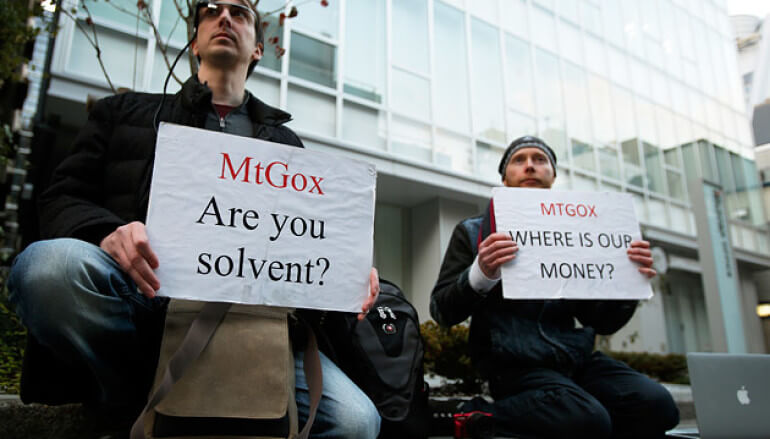
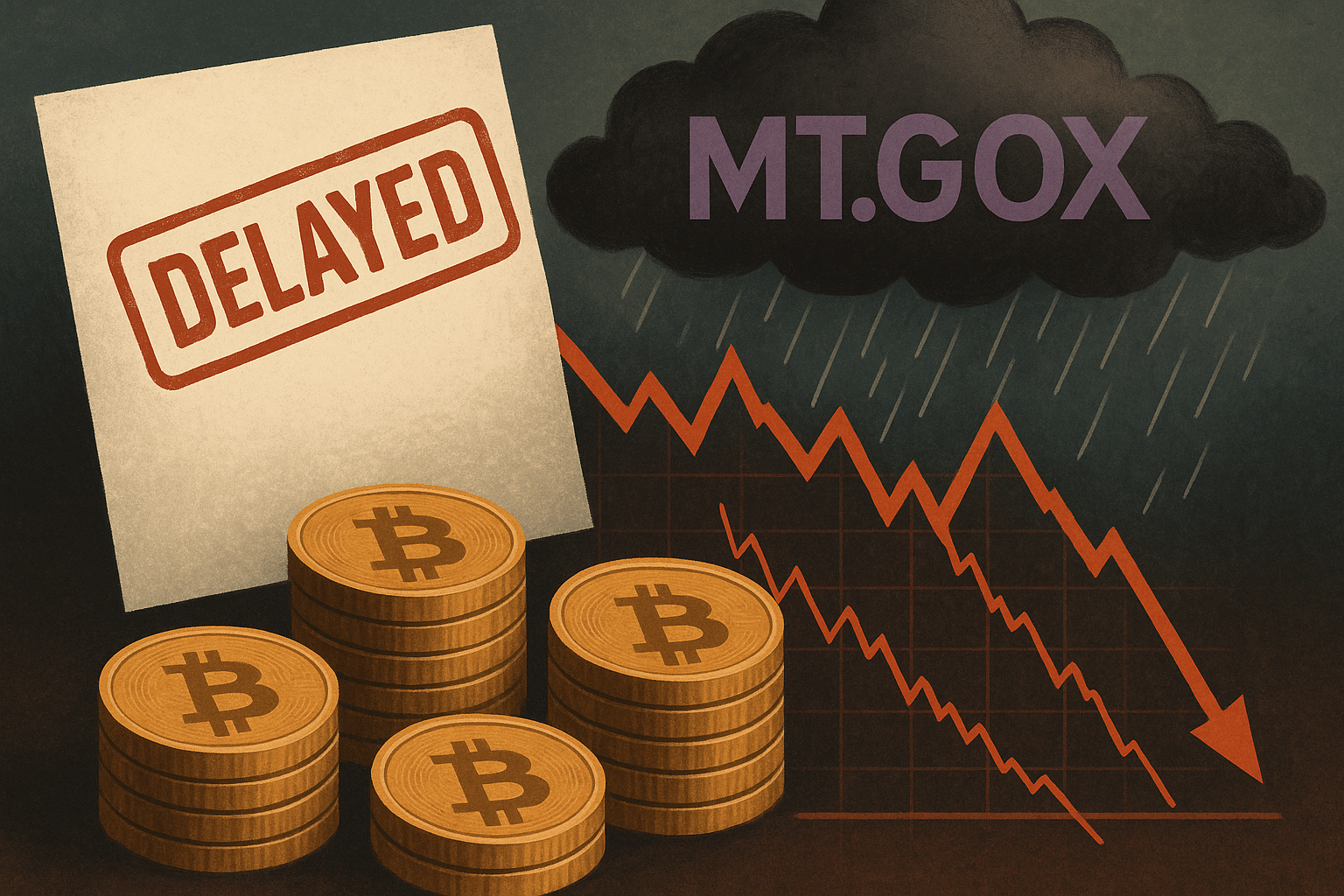
    Mt. Gox, once the world’s largest Bitcoin exchange, has delayed repayments to its creditors until October 2026 — extending a saga that began more than a decade ago.

    The announcement, made just days before its previous deadline of October 31, 2025, reflects ongoing administrative and technical challenges in finalising payments.

    While many creditors who submitted paperwork have received partial repayments, a significant number are still waiting for their funds.

    The Tokyo District Court approved the extension after the trustee cited the need for additional time to process remaining claims and complete settlements efficiently.

    Delayed Bitcoin repayments extended to 2026

    According to the latest notice, the Mt. Gox rehabilitation trustee confirmed that most base, early lump-sum, and intermediate repayments have been processed for creditors who completed the required steps.

    However, repayments for others remain pending.

    The trustee explained that it was “desirable to make the repayments to such rehabilitation creditors to the extent reasonably practicable,” leading the court to approve a new deadline of October 31, 2026.

    This marks another chapter in one of the cryptocurrency industry’s longest-running recovery efforts.

    Mt. Gox, which once handled over 70% of the world’s Bitcoin trading volume, collapsed in 2014 after a massive hack led to the loss of approximately 850,000 BTC.

    The company subsequently filed for bankruptcy in Japan.

    How the Mt. Gox collapse reshaped Bitcoin history

    When Mt. Gox failed, the exchange’s bankruptcy shook investor confidence in digital assets and exposed vulnerabilities in early crypto infrastructure.

    About 200,000 BTC were later recovered, but 650,000 BTC remain missing.

    The recovery process transitioned into a court-supervised civil rehabilitation in Japan, during which a trustee began redistributing recovered Bitcoin and Bitcoin Cash (BCH) in 2024.

    At the time of its collapse, Mt. Gox’s influence was unmatched.

    The incident not only caused a sharp decline in Bitcoin prices but also prompted tighter regulatory oversight in key markets.

    In the years since, it has become a landmark case in crypto regulation, bankruptcy law, and investor protection — shaping how global exchanges handle custody and insurance.

    Market impact and sell-off concerns

    With repayments scheduled to continue into 2026, traders and analysts have debated whether the eventual release of thousands of Bitcoin could trigger selling pressure.

    Historically, such fears have surfaced each time Mt. Gox announced repayment progress.

    However, recent on-chain data suggests that these effects may be limited.

    According to Arkham Intelligence, Mt. Gox currently holds 34,690 BTC worth nearly $4 billion, down from about 142,000 BTC in mid-2024 — a decline of more than 75%.

    Analysts tracking these wallets have noted that even large movements from the exchange have had only short-term effects on Bitcoin’s market price, indicating that most creditors are choosing to hold rather than sell immediately.

    What’s next for creditors and the crypto market

    The trustee’s revised timeline means that full repayments could now take another year, extending the wait for thousands of claimants worldwide.

    For many early Bitcoin investors, the repayments represent not only financial recovery but also closure on one of crypto’s most notorious events.

    Still, the Mt. Gox story continues to serve as a cautionary tale for digital asset investors.

    It underscores the importance of secure custody, transparent operations, and regulatory compliance — principles that have since become standard practice across global crypto exchanges.

    Source link

  • Tap Protocol delays TAP token distribution event

    Tap Protocol delays TAP token distribution event

    • Tap Protocol has delayed its TAP token launch date from October 21, 2024 to October 23, 2024.
    • TAP, with a total supply of 21 million, will go live on Bitcoin and Ethereum

    Tap Protocol, a decentralized finance platform on Bitcoin, has announced that its anticipated token distribution will now occur on October 23, 2024.

    The protocol has earlier announced the Token Generation Event (TGE) would be on Monday, October 21, 2024. However, it released an update early Monday noting that the TGE will now happen on Wednesday, October 23 at 12:00 UTC.

    Why the Tap Protocol TGE delay?

    According to the Bitcoin DeFi protocol, the postponement is meant to allow ecosystem partners such as bridges to be properly prepared for the potential surge in transactions.

    “Nobody likes delays, but unfortunately, we have to postpone our TGE to the 23rd of October at 12:00 UTC. While we understand the wait may be difficult, we want to ensure that our bridge and other products are in perfect condition to support the expected high volume of users,” Tap Protocol posted on X.

    TAP will be available on Bitcoin and Ethereum networks at launch, while the roadmap highlights token swap, marketplace and staking as key milestones.

    Notable about Tap Protocol is that the TAP token will have a fixed supply of 21 million tokens. The project uses the Ordinals system, with the aim being to advance the BTC ecosystem’s DeFi and dApps capabilities via various assets. It includes non-fungible tokens (NFTs).


    Source link

  • Mt. Gox delays repayment deadline, pushes it to October 2025

    Mt. Gox delays repayment deadline, pushes it to October 2025

    • The defunct exchange had an original repayment deadline of October 31, 2024
    • Mt. Gox said the delay was down to creditors not completing the repayment steps and issues arising from the repayment process
    • In 2024, Mt. Gox collapsed following a security breach, resulting in the loss of 850,000 Bitcoin

    Defunct crypto exchange Mt. Gox has pushed its repayment deadline to October 2025, adding another year from its original date.

    According to a statement from the exchange, it will now repay creditors on October 31, 2025.

    “As it is desirable to make the Repayments to such rehabilitation creditors to the extent reasonably practicable, the Rehabilitation Trustee, with the permission of the court, has changed the deadline for the Repayments from October 31, 2024 (Japan Standard Time) to October 31, 2025 (Japan Standard Time),” Mt. Gox said.

    This marks the second time the platform has moved its deadline. In a 2023 statement, the platform announced that it was moving its repayment deadline from October 31, 2023, to October 31, 2024.

    Launched in 2010, Mt. Gox was the biggest crypto exchange, handling around 70% of Bitcoin transactions, before a hack in 2014 caused its collapse. As a result of its security breach, the exchange lost around 850,000 Bitcoin.

    In July, it began repaying creditors around $9 billion in recovered assets; however, according to data from Arkham Intelligence, Mt. Gox still holds 44,905 Bitcoin worth around $2.8 billion.

    In the latest statement from the defunct exchange, the delay is down to two things: creditors haven’t completed the necessary steps for repayment and because of issues arising from the repayment process.

    Source link

  • SEC delays decision on 7RCC Spot Bitcoin and Carbon Credit Futures ETF

    SEC delays decision on 7RCC Spot Bitcoin and Carbon Credit Futures ETF

    SEC delays decision on 7RCC Spot Bitcoin and Carbon Credit Futures ETF
    • SEC postpones decision on 7RCC Spot Bitcoin and Carbon Credit Futures ETF to June 24, 2024.
    • The ETF plans to invest 80% in Bitcoin and 20% in Carbon Credit Futures-linked financial instruments.
    • Gemini has been named custodian for the ETF.

    The United States Securities and Exchange Commission (SEC) has announced a delay in its decision regarding the 7RCC Spot Bitcoin and Carbon Credit Futures ETF, a proposed exchange-traded fund focused on carbon credit futures contracts and Bitcoin (BTC).

    The delay was announced in a filing made on Thursday and it extends the timeline for the U.S. SEC to evaluate the proposed exchange-traded fund until June 24, 2024.

    During the extended timeline, the SEC aims to thoroughly review the proposal before making a final determination, citing the need for sufficient time to consider the potential impacts of the proposed rule change.

    The 7RCC Spot Bitcoin and Carbon Credit Futures ETF

    The 7RCC Spot Bitcoin and Carbon Credit Futures ETF plans to allocate 80% of its assets to Bitcoin and the remaining 20% to financial instruments linked to Carbon Credit Futures. This unique investment strategy aims to provide investors with a diversified portfolio that encompasses both digital assets and environmental sustainability.

    The ETF’s approach is aligned with the evolving landscape of finance, offering a single-trade solution for those seeking exposure to both innovative technologies and progressive environmental initiatives. Gemini, a leading crypto exchange, has been named as the custodian for the ETF, signalling a significant partnership in the burgeoning digital asset space.

    The postponement news reflects the ongoing scrutiny and evaluation by regulatory bodies like the SEC in navigating the intersection of traditional finance and emerging technologies.

    As the deadline approaches, stakeholders eagerly await the SEC’s decision, which will have implications for the future of investment opportunities in both the digital asset and environmental sectors.

    Source link

  • Kaspa price gives up gains as top exchange delays KAS listing

    Kaspa price gives up gains as top exchange delays KAS listing

    • Kaspa price rose to highs above $0.031 before giving up gains to sit around $0.030.
    • The upside momentum for the altcoin was derailed as major exchange Uphold announced it was delaying the listing of KAS.
    • Uphold says the delay is due to a technical issue that will soon be sorted out.

    Kaspa (KAS) was among the biggest gainers earlier today as cryptocurrencies looked to bounce following Bitcoin’s sharp decline overnight Wednesday.

    In the past 24 hours, as BTC looked to reclaim $29,000, the price of Kaspa rose more than 10% to break above $0.031. The upside saw KAS bulls begin to eye the token’s all-time high near $0.043 reached on 2 April 2023.

    That attempt to put bears in their place is on hold though as one of the major catalysts for the altcoin going up was the impending listing on a major US crypto exchange

    Uphold delays listing of Kaspa (KAS)

    On Thursday, Uphold, which was set to be the first centralised crypto exchange in the US to list KAS, announced it would be delaying the listing. The multi-asset digital asset platform said the “difficult decision” had been taken due to technical issues.

    But despite the delay, Dr. Martin Hiesboeck, the Head of Research at Uphold, has assured KAS holders that the issue was “minor” and will soon be solved. He tweeted:

    “As we’re expecting *high demand*, we’ve taken the difficult decision to delay this listing due to some technical issues – to ensure you get a smooth and fair trading experience and best execution. Won’t be long, it’s a minor thing we’ll sort out soon.”

    He offered to explain everything on the Twitter Space.

    After seeing a double digit uptick in price, with weekly gains rising to over 30%, Kaspa price is just in the green in the past day (at the time of writing) and about 28% higher over the week.

    Currently, KAS can be traded on multiple exchanges, including MEXC Global, Gate.io and BingX. The token’s recent momentum has come amid a flurry of listings, including on LBank and Bitget.


    Source link