Tag: Tokens

  • Prediction markets tokens rise as other tokens dip: Gnosis, Augur price outlook

    Prediction markets tokens rise as other tokens dip: Gnosis, Augur price outlook

    • Bitcoin has suffered its worst weekly percentage loss since the collapse of FTX.
    • Some of the factors behind the dip include reports of SpaceX selling its BTC holdings and the Chinese property giant Evergrande bankruptcy filing.
    • Top prediction markets tokens have maintained a bullish trend amid the crypto meltdown.

    In what has caught most crypto investors by surprise, the price of Bitcoin (BTC) has decreased by 11.2% to about US$26k. Last week has been the worst week for Bitcoin (BTC) since FTX’s demise in November 2022.

    The market crash has not only affected BTC, seeing that the rest of the asset class has not fared any better. Ethereum (ETH) fell by approximately 9.5% to $1.7K and Binance-coin (BNB) dropped by about 9.8% to $217, just to mention a few of the top cryptocurrencies by market capitalization.

    While most of the top cryptocurrencies experienced a price dip, popular prediction markets tokens like Gnosis (GNO), SX Network (SX), Kleros (PNK), and Augur (REP) registered significant gains. Chancer (CHANCER), a new prediction markets token is also gaining traction as its token presale continues to gain traction.

    What caused the crypto market to drop?

    The price decrease was caused by a number of causes. They included speculation that SpaceX wrote down the value of its Bitcoin assets, the collapse of the Chinese real estate firm Evergrande, and rising yields in the US.

    SpaceX Bitcoin holdings

    The Wall Street Journal published a report late last week stating that Elon Musk’s space exploration company SpaceX marked down the value of the Bitcoin it had on its books by US$373 million for the years 2022 and 2021. The report claims that the business also sold a portion of the BTC it had at one point over the previous two years. The WSJ has identified documents that it claims offer uncommon insights into the business’s finances.

    However, the WSJ’s assertions cannot be independently verified because SpaceX is a privately held corporation. Musk acknowledged that SpaceX did acquire Bitcoin during a panel appearance in 2021, but it is unclear how much or when the commodity was purchased.

    Evergrande bankruptcy 

    In a disclosure made over the weekend, the Chinese real estate tycoon Evergrande filed for bankruptcy protection in the United States. The corporation reportedly took action to secure its assets while still trying to control its creditors.

    Before proposing a comprehensive off-shore debt restructuring program in 2021, Evergrande experienced a public meltdown and went into default on its obligations. The business currently seems to be on life support.

    Investors are worried that China’s enormous real estate market may become contagious. Country Gardens and other significant developers are not paying their debts either, and the industry—which is thought to account for up to 30% of Chinese GDP—is in serious need of government assistance.

    US Treasury yields

    US Treasury yields are skyrocketing and pushing away investors from risky markets like the crypto market and toward saving. As the US Federal Reserve gradually increased rates throughout the previous year to reach a target rate of slightly over 5%, bond yields increased.

    As strong US economic data keeps coming out, yields have increased this week in anticipation that rate rises will continue. Since 2011, the 30-year US Treasury yield has never been higher. Treasury bonds give a high, secure yield, which is detracting from the value of other asset types like shares and cryptocurrencies.

    Gnosis and Augur price prediction

    Gnosis has risen by 0.2% while Augur has registered a 1% surge after a bear week. In the past seven days, Gnosis dropped by 8.8% while Augur fell by 11.7%.
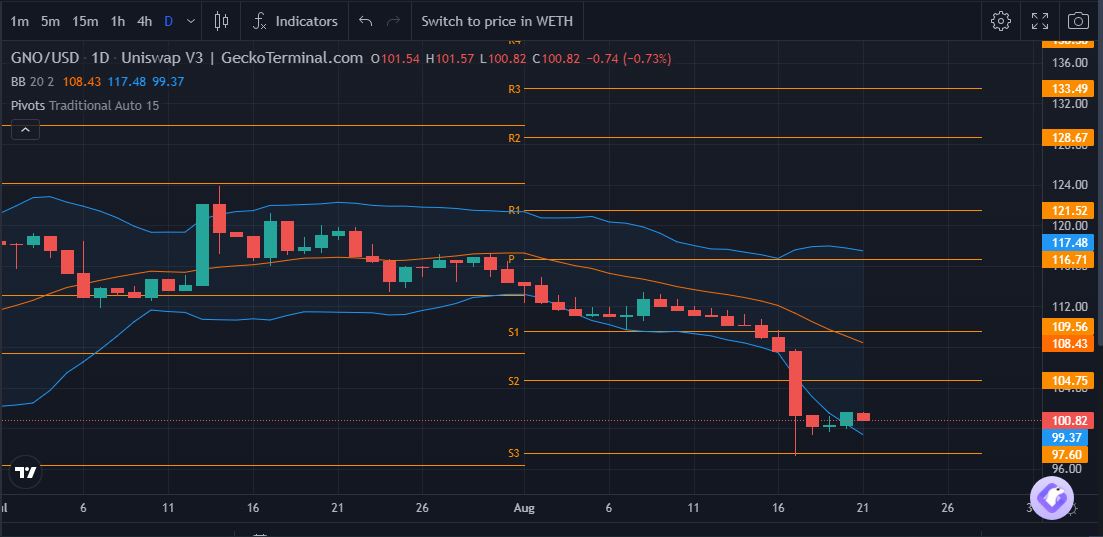
    Gnosis price daily chart


    Having bounced off the support at $97.60, the Gnosis (GNO) token is expected to test the resistance at $104.75. However, that depends on whether the current daily candlestick closes above the lower band line of the Bollinger Bands indicator.
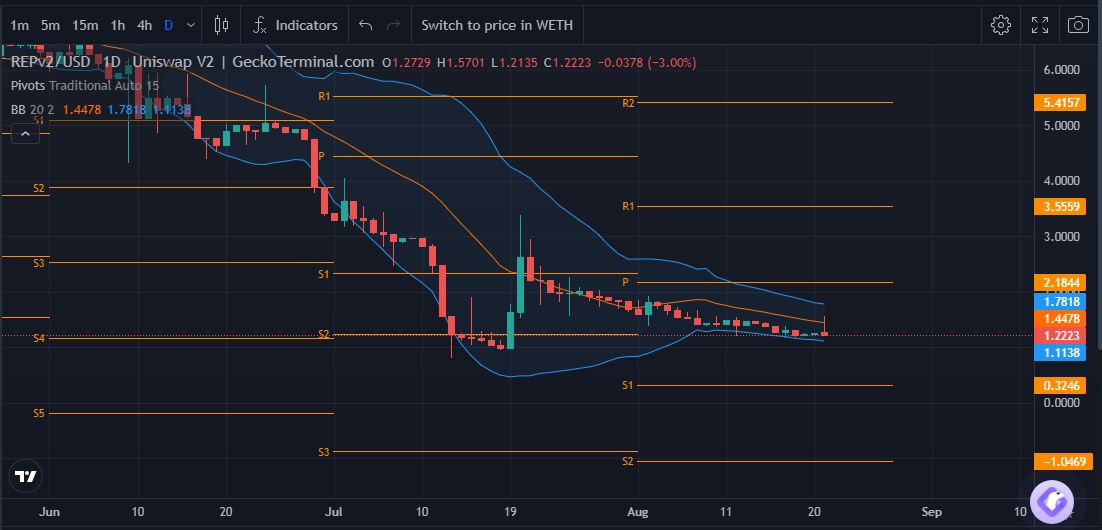
    Augur price daily chart


    Augur, on the other hand, seems to have slid into consolidation after erasing most of the gains it made between July 19 and July 20. All eyes are on the support at $0.3246 and the resistance at $2.1844. If the REP price jumps above the upper Bollinger Bands line, it could test the $2.1844 resistance level and if it drops below the lower Bollinger Bands line, it could drop to the support at $0.3246.

    The prediction markets tokens including Chancer, are expected to experience significant price gains as popular games including the English Premier League and the American MSL gather steam.
    Source link

  • Why are Bitcoin transaction fees rising, and what are BRC-20 tokens?

    Why are Bitcoin transaction fees rising, and what are BRC-20 tokens?

    Key Takeaways

    • BRC-20 tokens were launched on Bitcoin in March 2023
    • Transaction fees spiked to all-time highs in May 2023 as network activity spiked
    • Bringing memes and NFTs to Bitcoin has caused controversy
    • Some argue the rising fees are vital to the security of the network, while others scoff at the activity for getting away from Bitcoin’s “vision”

    We live in an inflationary world. Food prices, rent, energy – everything feels more expensive. That is not limited to the fiat world, however. Bitcoin users have noticed a hike in fees recently. So why is this happening, and what does it mean for Bitcoin? And what does this weird concept of NFTs on Bitcoin have to do with anything?

    Bitcoin fees rocket upwards in May

    Firstly, let us look at a chart presenting Bitcoin fees over the last three years to show the spike in fees. Clearly, the vertical jump in the first week of May is glaring. 

    While Bitcoin fees may rise in future regardless (and we will get to that in a moment), the outlier that is this wild spike in May 2023 is down to something I never thought I would say with regards to Bitcoin: memes.

    Specifically, the BRC-20 protocol, which is a token standard inspired by ERC-20 tokens on Ethereum. To explain this, we first need to look at Bitcoin Ordinals, because that is what has made this all possible. And yes, it is all on the Bitcoin blockchain. 

    What are Bitcoin Ordinals?

    Bitcoin was always viewed as the “pure” blockchain. There was no room for non-fungibility, meaning each Bitcoin is the same as another Bitcoin. No NFT nonsense here, thank you very much. 

    This changed in January 2023 when the Ordinal protocol was invented. In simple terms, the Ordinals protocol is a system for marking each satoshi, the smallest denomination of a Bitcoin (every Bitcoin is divided into 10 million satoshis). These marked satoshis can then be tracked and differentiated from other satoshis, meaning they are technically “non-fungible”. And so, against all odds, we (sort of) have Bitcoin NFTs. 

    The marks on satoshis have become known as “inscriptions”. These inscriptions were made possible by the Taproot upgrade to the Bitcoin network in November 2021. The protocol is known as Ordinals, named due to the fact the transfer scheme for satoshis relies on the order of transactions. 

    While this all sounds a little complex, in comparison to NFTs on other blockchains, it is very primitive and basic. There are no smart contracts here. Sidechains are not necessary. Everything is inscribed directly on the Bitcoin blockchain. 

    What are BRC-20 tokens?

    Two months after Ordinals arrived in the world, an experimental token standard, named BRC-20 in a nod to ERC-20 tokens on Ethereum, were launched in March 2023. This token standard creates fungible tokens within the Ordinal protocol. You may suspect where this is going. The ability to trade fungible tokens within this protocol of Bitcoin? Yes, memes. 

    In the below chart, I have presented the top 10 BRC-20 tokens by market cap. As one will be able to deduce pretty swiftly when looking at the names, a lot of these are memes. 

    (sidenote – eagle-eyed readers may also be able to deduce from the supply of some of these tokens that they are memes. Personally, I enjoy the nod to Satoshi Nakamoto with the 21 million supply of so many on the board). 

    What has all this got to do with fees?

    So, back to fees. The rise of Bitcoin Ordinals has thrown up an interesting dilemma. These inscribed satoshis are now competing for block space with conventional Bitcoin transactions. On the Bitcoin network, more activity leads to more fees, and this is why we have been seeing a spike in fees. As the BRC-20 tokens have taken off, we have seen Bitcoin’s network clog up and fees jump. 

    This has caused a debate. Some argue against these higher fees, lamenting the waste of time that NFTs and memes are, getting in the way of what Bitcoin is “meant” to be. On the other side, fees are vital for the security of the Bitcoin network. Additionally, once the final supply of 21 million Bitcoins is hit in 2140, miners will need to survive solely on fees. Indeed, as block rewards step down with each halving, mining fees become an ever larger portion of miners’ income, and hence these fees are a crucial incentive for miners and a driver of the hash power for Bitcoin. 

    Personally, my take on this is somewhat between the two extremes. I have every confidence that these memes and NFTs and whatever else trading on the Bitcoin network are inherently valueless. Then again, I don’t care much for NFTs in general. However, I don’t see the rising fees as an issue. 

    The key here is that the hash rate is still rising. This contrasts to April 2021, which was another time period when Bitcoin fees spiked violently, the average transaction on the network costing a staggering $70. This was due to a crash in the hash rate, which is very much a concern for Bitcoin’s security and stability as a network. 

    This is different. Rising fees due to increased activity is fine. That is true regardless of the transaction: regular, meme, NFT or other. It really doesn’t matter. Besides, the scalability issue with Bitcoin is well known, and fee spikes encourage people to look at solutions such as sidechains, like the popular Lightning network which bundles transactions together off-chain. But there are other Layer-2s besides Lightning, such as Liquid and Rootstock, to name a couple.

    The prediction that the Bitcoin blockchain will become a base settlement layer has been around for some time. The existence of what is likely a fad, i.e. these tokens and Ordinals, is relatively harmless and shouldn’t change much in the overall scheme of things. The fee and scalability issue will always be here, regardless of what is driving it. And this is exactly why we have the Lightning network, and why people are continuing to innovate to come up with Layer-2 or other solutions. 

    Source link

  • BRC-20 tokens have flaws and issues, Mintlayer CEO says

    BRC-20 tokens have flaws and issues, Mintlayer CEO says

    • Bitcoin BRC-20 tokens have skyrocketed over the past few days, with their combined market value rising to over $923 million as of 8 May, 2023.
    • Mintlayer CEO Enrico Rubboli has highlighted some of the flaws and issues plaguing the BRC-20 token standard.
    • Apart from not aligning with the “axioms of the core Bitcoin community,” flaws and issues mean users are likely to be rug pulled.

    Crypto news this week indeed has the skyrocketing transactions of BRC-20 tokens as one of the reasons the Bitcoin network experienced massive congestion amid rising fees. 

    As CoinJournal highlighted on Monday morning, the crypto market was down as Binance halted BTC withdrawals amid the network congestion. Some of the trending BRC-20 tokens include ordi, pepe, meme, piza and domo. 

    Enrico Rubboli, the CEO of Bitcoin sidechain Mintlayer, says that while BRC-20 tokens continue to create a frenzy, there are flaws and other issues that plague the tokens and offshoot decentralised applications that try to connect with smart contracts.

    What are BRC-20 tokens?

    BRC-20, or “Bitcoin Request for Comment,” is a token standard for Ordinals. The tokens allow for the issuance and transfer of fungible tokens on Bitcoin and hit the market soon after the mainnet launch of the Ordinals Protocol.

    With BRC-20 tokens, one can etch digital art references into small Bitcoin transactions. The tokens are a creation of a pseudonymous crypto developer known as Domo.

    According to market data for the token category, the combined value of all 11,705 BRC-20 tokens was $923 million as of Monday, 8 May 2023.

    BRC-20 tokens plagued by speed and transaction costs issues

    Among the insights Rubboli shared with CoinJournal on Monday is that while people pour BTC into minting BRC-20 tokens, there’s a need to realise that the technology behind these assets is “heavily flawed.” He also notes that BRC-20 tokens aren’t “in line with the axioms of the core Bitcoin community.”

    Rubboli said that some of the issues currently plaguing the tokens and offshoot dApps within the ecosystem include speed, transaction costs and security.

    On the issue of speed, he explains that transactions have to wait for Bitcoin block confirmation before settlement, which when combined with network congestion, has resulted in users waiting hours for transactions to clear.

    Mintlayer CEO says BRC-20 tokens are potential rug pulls

    According to Rubboli, the use of token bridges and wrapped BTC could expose users to exploits, with DeFi bridges seeing more than $1.4 billion lost to hackers that targeted crypto bridges in 2022. Rubboli believes the entire concept for BRC-20 was designed to confuse and mislead potential investors, with the creators leeching off the popular ERC-20 token standard.

    Saying this could be an opportunity for scams, he added:

    The entire ecosystem was set up to be confusing and misleading. BRC-20 was chosen not because it was the 20th proposed standard, but to leech off the popularity of Ethereum’s ERC-20 token. The developers of the standard and the tools are not affiliated with Bitcoin, they are anonymous, and their software has not been thoroughly tested in this application.”

    Besides, the hundreds of BRC-20 tokens might not just be totally worthless, but also minted specifically to rug pull later investors. BRC-20 token standard creator Domo has previously warned of the shortcomings of the software, including minting balances to intermediary wallets.

    Regulatory issues also arise, with the minting of BRC-20 tokens likely to lead to regulatory concerns around commingling of user-generated tokens with BTC.

    If users mint unregulated securities, it could expose the Bitcoin blockchain to further regulatory scrutiny, which in turn exposes every BRC-20 to regulation due to 1 bad actor. A layer 2 solution fixes this problem as tokens are not commingled with Bitcoin,” he opined.

    A layer 2 solution is a protocol that runs on top of a layer 1 blockchain, for instance Bitcoin or Ethereum. The key features that these protocols bring to the L1 include improved scalability and privacy among others. 

    In blockchain, common layer 2 solutions include state channels, sidechains, and zero knowledge roll-ups.


    Source link