In brief
- Adobe data shows AI-driven shopping traffic surging into the mainstream.
- AI-assisted shoppers now outperform traditional retail consumers.
- Report signals rapid shift toward agent-led commerce in U.S. retail.
The dead internet is more alive than ever.
A year ago, retailers were debating whether to block AI bots from crawling their websites. That calculation just got a lot harder. New data from Adobe Analytics shows AI-driven traffic to U.S. retail sites grew 393% in the first quarter of 2026 compared to the same period last year, and shoppers arriving from those sources are now spending more, staying longer, and buying at higher rates than everyone else.
Adobe reported that AI traffic from Q1 2026 grew 393% year over year, with March alone up 269% YoY. “This continues the momentum that was observed during the most recent holiday season (Nov. to Dec. 2025) where AI traffic was up 693% YoY,” the company wrote.
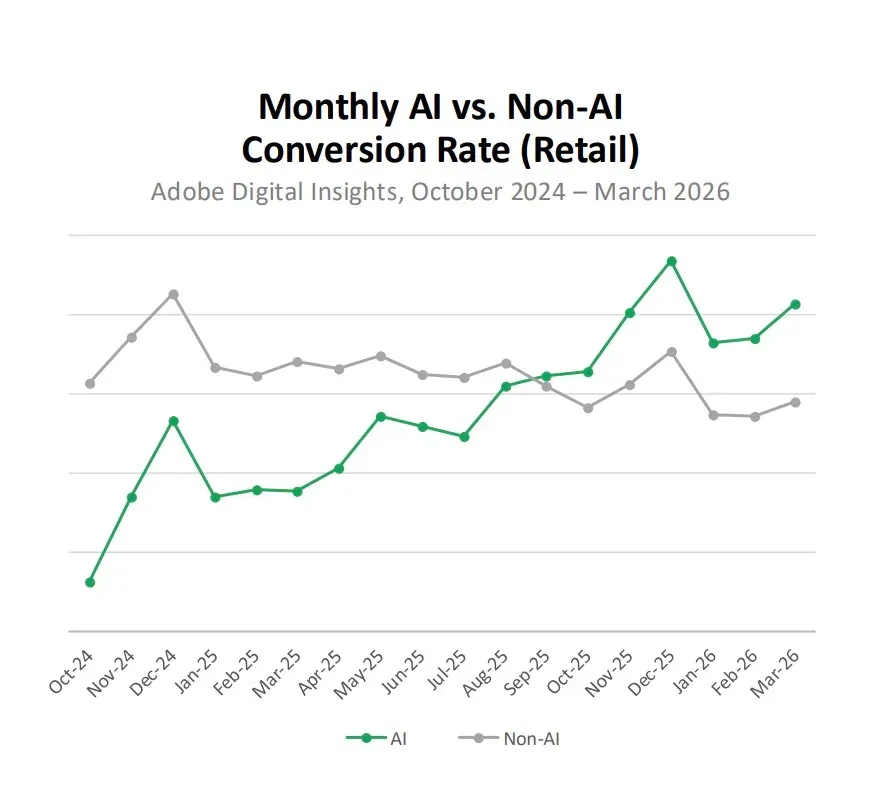
In March 2025, AI traffic converted 38% worse than standard non-AI sources like paid search and email.
This is the opposite of what is happening with the content creation industry. A new UNESCO report found that generative AI is on its way to cause revenue losses of 24% for music creators and 21% for audiovisual creators by 2028.
By March 2026, Adobe reports AI traffic was converting 42% better—a new record, according to the company, which tracks over one trillion visits to U.S. retail sites. Revenue per visit from AI referrals was 37% above non-AI traffic as of last month.
According to Adobe, just one year ago, regular human traffic was worth 128% more.
The engagement data also shows that once a shopper arrives at a retail site via an AI assistant, they spend 48% more time on the page, browse 13% more pages per visit, and show a 12% higher engagement rate than visitors from other channels. “AI is quickly becoming the primary interface between consumers and their favorite brands,” Vivek Pandya, director of Adobe Digital Insights, wrote in the report.
Adobe surveyed more than 5,000 U.S. consumers alongside its traffic data. Thirty-nine percent said they’ve used AI for online shopping, and 85% of that group said it improved their experience. Trust is also climbing: 66% of respondents said they believe AI tools provide accurate results—a figure that helps explain why conversion rates are surging instead of flattening.
AI is serious business
AI traffic is becoming a pretty big deal for service providers who are doing anything they can to control who provides the views and referrals in the ecommerce ecosystem.
Amazon and Perplexity had a spat in federal court over whether AI agents can make purchases on third-party platforms without the platform’s explicit consent. A San Francisco judge issued a preliminary injunction in March blocking Perplexity’s Comet browser from shopping on Amazon after the e-commerce giant argued the agent disguised automated sessions as human browser traffic. Perplexity called Amazon’s legal push “bullying,” arguing that agentic shopping would bring Amazon more transactions, not fewer.
OpenAI launched an “Instant Checkout” feature inside ChatGPT in September 2025. The same month Salesforce estimated that AI agents influenced more than 20% of all global online retail sales during the 2025 holiday season.
Now, with OpenClaw, AI agents can buy things more easily, be it via API connections, MCP servers, skills, integrations, or users activating browser control.
Adobe’s report also flags a structural problem that’s going to matter more as this traffic grows: a significant portion of U.S. retail websites aren’t fully readable by the models generating that traffic.
Homepages scored an average of 75% on Adobe’s AI Content Visibility Checker, meaning roughly a quarter of their content is invisible to LLMs. Individual product pages came in at 66%—a more critical gap, since that’s where purchase decisions happen. The best-performing retailers scored 82.5% on homepage visibility; the lowest-performing hit just 54.2%.
“Consumer adoption of these AI tools is not slowing down,” Adobe wrote, “and businesses need to ensure their digital front doors are optimized for AI to remain relevant in today’s environment.”
McKinsey projects that agentic commerce—AI systems that research, compare, and purchase autonomously—could drive $1 trillion in U.S. retail revenue by 2030, so it’s no wonder why AI companies want to be the ad companies of the agentic era.
Daily Debrief Newsletter
Start every day with the top news stories right now, plus original features, a podcast, videos and more.