European Central Bank (ECB) Executive Board member Isabel Schnabel said stablecoins could bring old financial-market vulnerabilities into tokenized finance, while strengthening the case for central banks to modernize public money through tools such as the digital euro and tokenized central bank settlement.
In a Monday speech at the 2026 Bank of Korea International Conference on Central Banks and the Future of Money in Seoul, Schnabel compared stablecoins with money market funds, arguing that both can offer useful financial innovation while also creating risks around bank disintermediation, runs, fire sales and monetary policy transmission.
Schnabel also warned that stablecoins could reinforce the US dollar’s global role as tokenized finance develops. “The growing use of stablecoins may further cement the international dominance of the U.S. dollar,” she said, adding that “virtually all stablecoins in circulation are denominated in dollars, with other currencies playing a negligible role.”
Schnabel said the Eurosystem’s response has two parts, including a retail digital euro and tokenized wholesale central bank money. In March, the ECB unveiled its Appia roadmap for Europe’s tokenized financial markets, with Pontes set to provide a distributed ledger technology settlement bridge to the Eurosystem’s TARGET services and scheduled to launch in the third quarter of 2026.
Schnabel argued that central banks should not resist innovation but must modernize public money, including through the digital euro and tokenized wholesale central bank settlement, to preserve financial stability and monetary control.
“Central banks cannot remain passive observers of these developments,” Schnabel said, adding that private forms of money, once widely adopted, can shape the financial system “in ways that can be difficult to reverse.” She said the proper response is not to resist innovation but to ensure it develops within a framework that preserves stability, monetary control and trust in the currency.
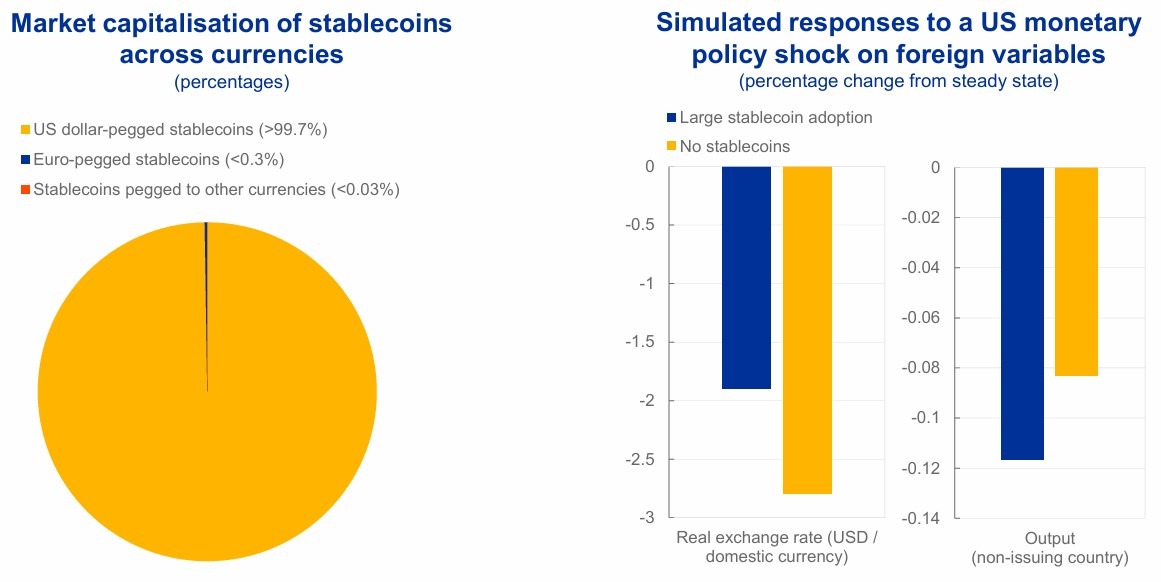
Stablecoins are overwhelmingly dollar-pegged, while broad adoption could amplify US policy spillovers abroad, ECB data shows. Source: European Central Bank
MiCA review sharpens stablecoin debate
The speech builds on ECB messaging that Europe should not answer dollar stablecoins simply by promoting euro-denominated stablecoins.
On May 8, ECB President Christine Lagarde said stablecoins are not Europe’s best route to strengthening the euro’s international role, arguing instead that Europe should build tokenized settlement infrastructure anchored by central bank money.
The debate unfolds as the European Commission reviews the European Union’s Markets in Crypto-Assets Regulation (MiCA), with a public consultation open until Aug. 31 examining whether the bloc’s crypto rules should be updated.
Related: MiCA has made euro stablecoins safe but weak, new report argues
Crypto exchange Coinbase has used the review to call for a more competitive EU crypto framework. In a Monday blog post, Katie Harries, Coinbase’s director and head of policy for Europe and the Americas, said MiCA should recalibrate stablecoin rules on reserves, rewards and multi-issuance, while clarifying how regulated crypto firms can provide access to decentralized finance and global liquidity.
Harries also argued that allowing more reserves in high-quality sovereign assets and permitting non-interest incentives, such as cashback and loyalty points, could help make euro stablecoins more competitive.
The ECB has taken a more cautious view. On May 23, the ECB warned EU finance ministers that loosening stablecoin rules could weaken bank lending and complicate monetary policy, even as policymakers debate whether Europe risks falling behind dollar-backed tokens.
Magazine: HYPE chases $100 target, ETH could dump below $1800: Market Moves