
-
How Bitcoin perps are entering regulated US markets
For years, Bitcoin perpetual futures have ranked among the most important products in crypto trading. They account for a large share of global crypto derivatives activity and are widely used by traders seeking leverage, hedging tools and short-term exposure to market moves.
Despite their popularity, perpetual futures have mostly operated outside regulated US markets. Most trading has taken place on offshore platforms. This left many American traders and institutions with limited choices: Avoid true perps, use offshore venues where permitted or turn to imperfect regulated alternatives.
That could now change.
In late May 2026, the US Commodity Futures Trading Commission (CFTC) approved KalshiEX to list the BTCPERP contract, a perpetual futures contract that references the spot price of Bitcoin. The decision marks an important step for crypto derivatives. It could also change how retail and institutional traders gain leveraged exposure to Bitcoin.
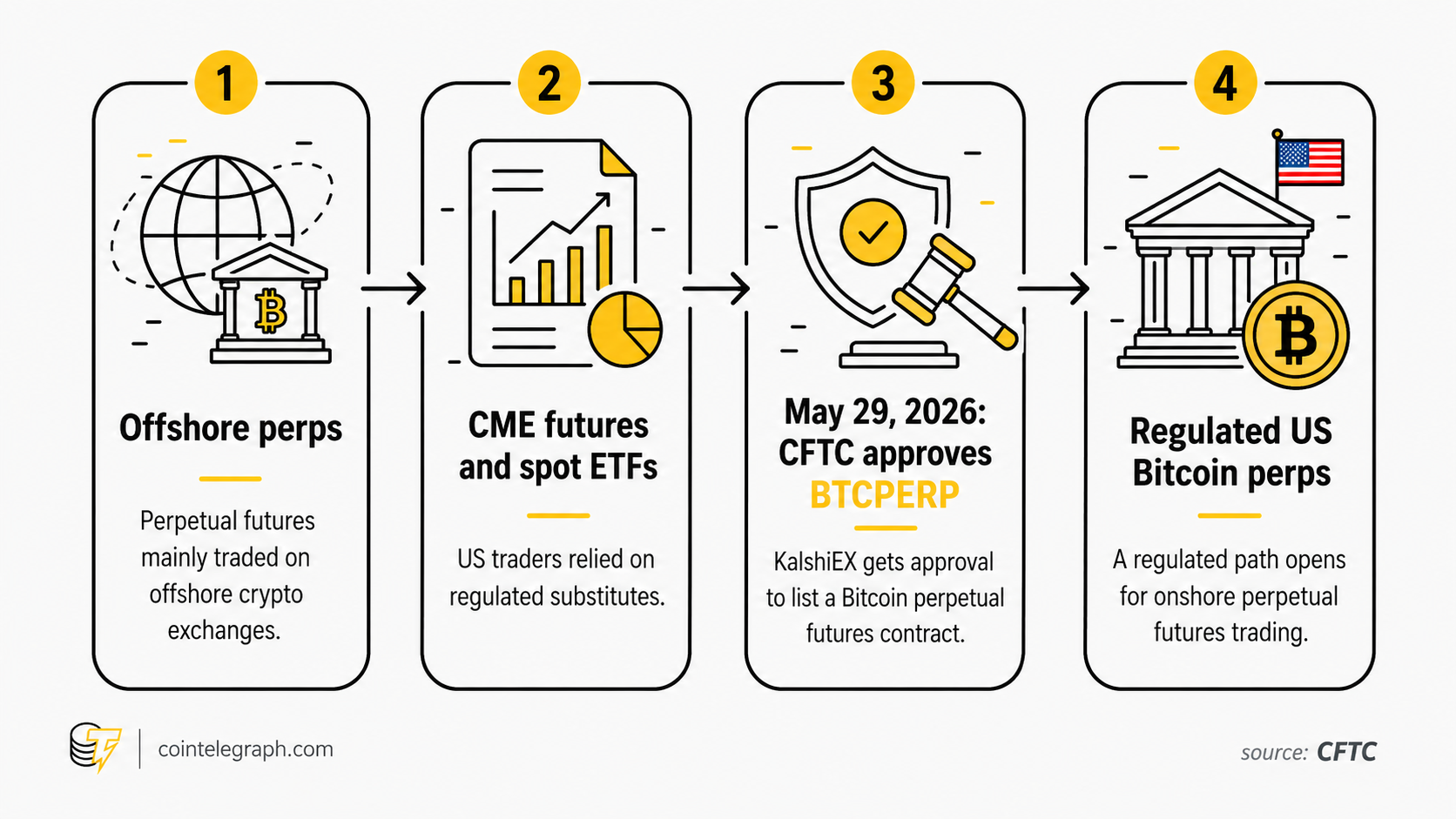
While the contract is important on its own, its larger meaning lies in the signal it sends: One of crypto’s most widely used financial tools is moving into regulated US financial markets.
-
What are Bitcoin perpetual futures?
A perpetual futures contract, often called a “perp,” is a type of derivative that lets traders take positions on Bitcoin’s price moves without holding the underlying asset.
Unlike traditional futures, perpetual futures have no set expiration date. Positions can stay open as long as traders maintain enough margin.
Standard futures contracts require traders to move into a new contract when the old one expires. Perpetual futures remove this step, making them more convenient and often more cost-effective for ongoing trading.
To keep perpetual contracts from moving too far away from Bitcoin’s spot price, platforms use a funding rate mechanism. Based on market conditions, traders in long or short positions make periodic payments to each other. This helps keep perp prices closer to the price of the underlying asset.
This simple design has helped perpetual futures become the preferred product for many crypto market participants.
-
How perpetual futures became crypto’s top trading product
Perpetual futures first became popular on offshore crypto exchanges. What started as a niche product grew into one of the most actively traded products in crypto.
The appeal is clear. These contracts provide leverage, letting traders manage larger positions with relatively modest capital. They allow traders to position for both rising and falling markets. They also avoid many of the practical challenges tied to traditional futures.
As the crypto sector grew, perpetuals became the go-to tool for speculators, hedge funds, market makers and arbitrage traders.
In many cases, perpetual futures trading volumes surpass spot market volumes for major cryptocurrencies. They also serve as a key venue for price discovery.
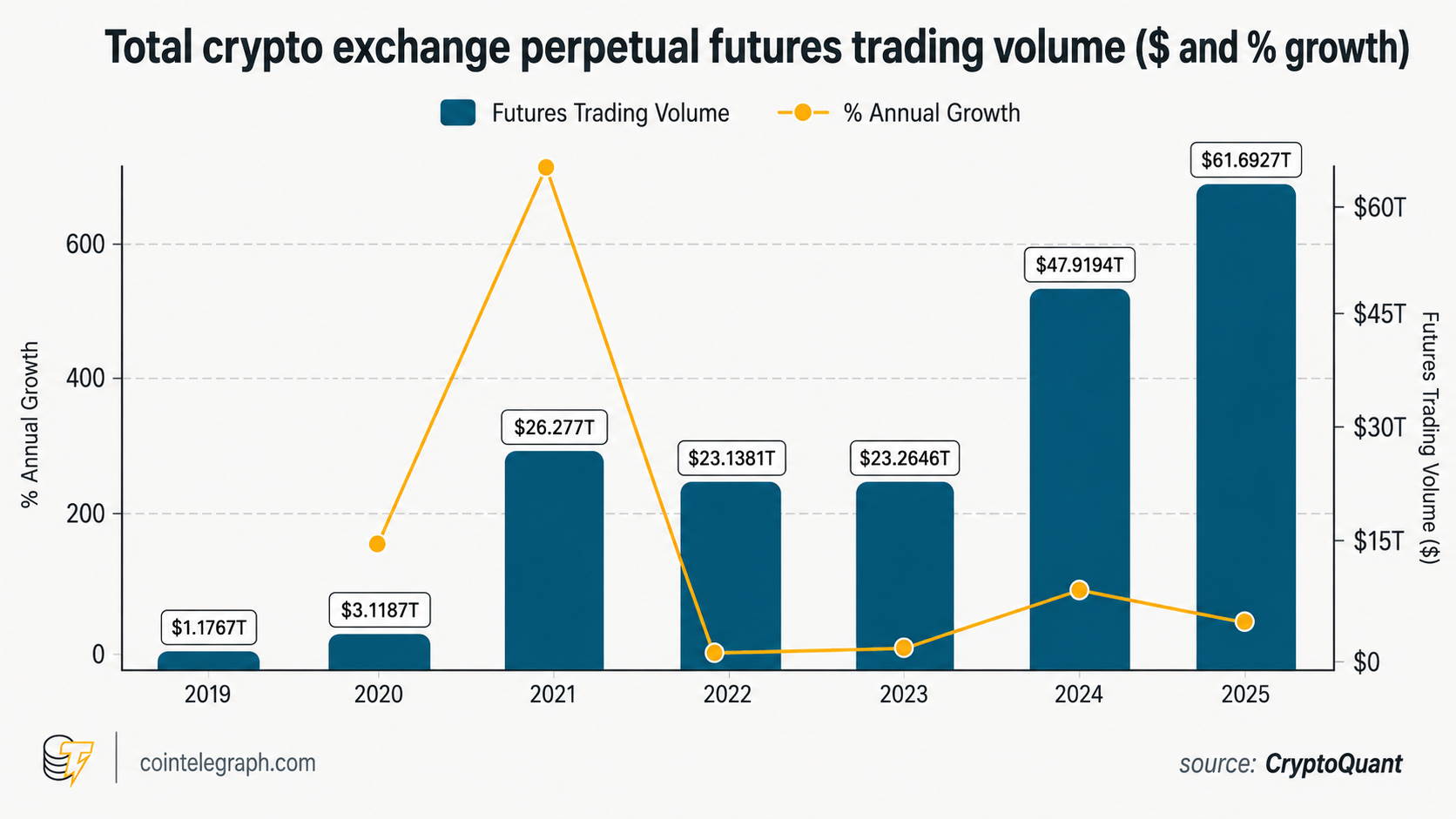
This growth has made perpetual futures one of the most important parts of crypto finance, even though their presence in regulated US markets has remained limited until recently.
Did you know? Unlike many financial products that began in traditional markets, perpetual futures first gained traction in crypto. The design solved a practical problem: Traders wanted futures-like exposure without constantly rolling contracts into new expiration dates.
-
Why the US stayed on the sidelines
For a long time, US regulators were cautious about crypto perpetual futures. That caution had a clear reason.
The hesitation was not about futures trading itself. Regulated futures markets have operated for many years. Instead, the concerns were tied to the features of several offshore crypto platforms.
Very high leverage, weak customer protections, limited transparency and risks of market manipulation made regulators reluctant to approve similar products in the US.
As a result, many US traders either used offshore platforms or relied on alternatives such as CME Bitcoin futures and, more recently, spot Bitcoin exchange traded funds (ETFs).
This created an unusual imbalance. One of crypto’s most popular products largely remained outside the reach of the world’s largest financial market. The recent approval of regulated Bitcoin perpetual futures may now help close that gap.
-
What exactly has the CFTC approved?
The CFTC recently approved KalshiEX’s Bitcoin perpetual futures contract, known as BTCPERP. The move gives the product a regulated path in the US.
Unlike many offshore alternatives, this contract operates under a US-regulated framework overseen by federal authorities.
The decision also gave the market more clarity on how perpetual futures can fit into existing futures rules. Rather than treating them as entirely new products, regulators found that they can work within current futures market rules if proper safeguards are in place.
The approval opens the door for regulated perpetual futures to trade alongside other established US derivatives products. This may be just as important as the contract approval itself.
Did you know? Many crypto enthusiasts assume Bitcoin’s spot market sets the price. In reality, large volumes of leveraged trading on futures and perpetual contracts often influence short-term price moves across the wider crypto market.
-
How regulated perpetuals differ from offshore versions
On the surface, regulated perpetual contracts and their offshore versions may look similar. Both offer leveraged exposure to Bitcoin without requiring traders to hold the actual asset.
But their market structures differ in important ways.
US-regulated products must follow strict compliance standards. Exchanges must use know-your-customer (KYC) and anti-money laundering (AML) checks. Trading is also monitored for signs of abuse, while risk management practices face regulatory review.
Margin rules are usually more conservative than those on offshore platforms.
Traders used to very high leverage may find regulated perpetuals more restrictive. Still, supporters argue that stronger protections can reduce systemic risks and improve market reliability.
Participants may accept lower leverage in exchange for better transparency and stronger regulatory oversight.
-
What regulated perpetuals mean for retail traders
For individual investors, regulated Bitcoin perpetuals could offer easier access to leveraged crypto trading within the traditional financial system.
In the past, traders seeking perpetual futures had few options beyond offshore platforms. This often meant dealing with unclear regulations and higher counterparty risks.
A regulated option may offer several advantages:
- Clearer market rules
- Stronger customer protections
- Official oversight of trading platforms
- Better safeguards for client assets
Still, retail traders should not confuse regulation with guaranteed safety.
Perpetual futures remain high-leverage products that can lead to large losses quickly. Even under regulation, weak risk controls can result in fast liquidations.
While market infrastructure may become safer, the risks of trading do not disappear.
Did you know? Perpetual futures have no expiry date, so exchanges use funding payments between traders. These payments help keep perpetual prices close to spot prices without direct intervention from the exchange.
-
Why institutions may gain the most
Although retail interest often gets more attention, institutions could benefit the most.
Hedge funds, asset managers and proprietary trading firms have been cautious about offshore perpetual futures because of compliance concerns. Even when the trading opportunities looked attractive, internal policies often limited their involvement.
A regulated US market changes that. Institutions could now access:
- Leveraged exposure to Bitcoin
- Advanced hedging tools
- Market-neutral strategies
- Arbitrage opportunities across spot, ETF and futures markets
The launch of regulated perpetuals may bring more institutional capital into crypto derivatives. That, in turn, could improve liquidity and make markets more efficient.
-
How ETFs and perpetual futures are becoming more connected
The approval of spot Bitcoin ETFs marked an important step in wider crypto adoption. Regulated perpetual futures could be the next step.
Spot ETFs offer simple exposure to Bitcoin price moves. Perpetual futures, on the other hand, offer leveraged access and more advanced risk management tools.
Together, these products help create a fuller market structure that looks more like those seen in traditional asset classes.
Institutional traders often use a mix of spot and derivatives products. With regulated perpetuals now available, new strategies linking ETFs, spot Bitcoin and futures contracts are likely to develop.
This could improve overall liquidity and strengthen the connection between traditional finance and digital assets.
-
Crypto exchanges face a new competitive test
The approval has also created a new competitive test for trading platforms. KalshiEX secured the first approval for a regulated Bitcoin perpetual contract, but it is unlikely to be the last.
Coinbase has shown strong interest in crypto derivatives. It has expanded its capabilities through acquisitions, including Deribit, and through regulatory efforts involving its CFTC-regulated futures commission merchant.
Other exchanges could seek similar approvals if the CFTC continues to review perpetual products under this framework.
Crypto derivatives can be commercially attractive because they generate large trading volumes and create new fee opportunities. This gives platforms strong reasons to compete for the market.
As a result, regulated perpetual futures could become a key area of competition among crypto exchanges.
-
Could regulated perpetuals weaken offshore exchanges?
A central question is whether regulated perpetuals will draw liquidity away from offshore venues. The answer is not simple.
The outcome will likely depend on several factors:
- Available leverage levels
- Trading costs
- Market depth
- Institutional involvement
- Regulatory predictability
Offshore platforms still have deep liquidity and loyal user bases. Many traders remain comfortable with their current setups.
Still, if US-regulated venues can offer competitive fees and enough liquidity, some trading activity may slowly move onshore. Any such shift would likely happen over years rather than months, though the trend could become more important over time.
-
The risks regulators still worry about
Even after the approval, regulators remain cautious about perpetual futures. Their main concern is leverage.
Leverage increases both profits and losses. During sharp market swings, heavily leveraged positions can trigger chains of liquidations that make price moves worse.
Crypto markets have seen such episodes across several market cycles. While regulated perpetuals may include stronger protections, they cannot remove the core risks of leveraged trading.
Participants need to understand that regulation mainly addresses market structure risks, not the risks of the investment itself.