
The crypto treasury model has largely lost its early advantage, with most digital asset treasury (DAT) companies no longer commanding the premiums that allowed them to raise capital and accumulate more crypto without diluting existing shareholders, according to a new report from DWF Ventures.
The report, published Thursday, found that only four of the 20 largest DATs by assets under management trade above an mNAV of 1, meaning their market value exceeds the value of their crypto holdings. They are Bit Digital, Strive, Hyperliquid Strategies and BitMine.
The widespread discounts suggest investors are no longer willing to pay the same premium for crypto exposure through publicly traded companies.
Since Michael Saylor’s Strategy pioneered the Bitcoin treasury model in 2020, most DAT stocks have underperformed simply holding the underlying crypto asset, according to DWF. Even among the DAT stocks that have outperformed, DWF found that the advantage over simply holding the cryptocurrency has generally been small.
The report comes as Sequans Communications, a French semiconductor company that launched a Bitcoin treasury strategy last year, disclosed that it sold its remaining 314 BTC, completing an exit it began by redeeming its convertible debt in May. Sequans now holds no cryptocurrency on its balance sheet.
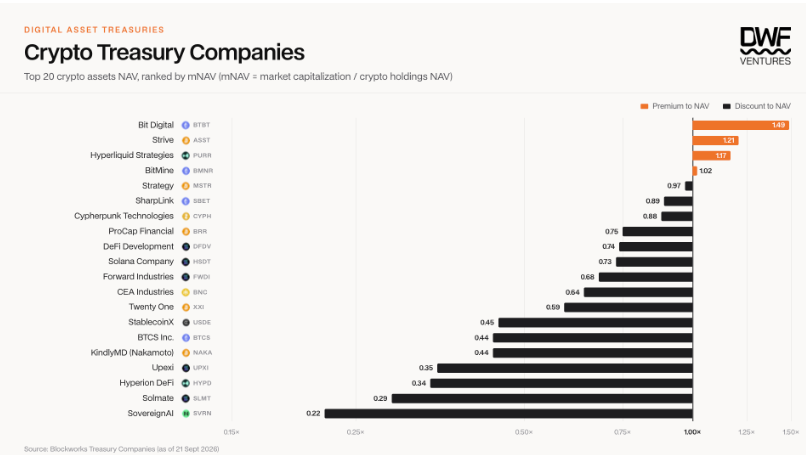
According to DWF, the premium investors paid for DAT stocks generally peaked when the strategy was new and attracting investor attention. Strategy, for example, saw its mNAV peak in late 2024 during Bitcoin’s rally, when demand for leveraged BTC exposure was strong.
Related: Strategy unveils $44.1B capital-raising capacity to buy more Bitcoin
DAT warnings predate the latest downturn
DWF isn’t the only firm to warn about falling mNAVs. Standard Chartered raised the issue in September 2025, when Bitcoin and the broader crypto market were booming, warning that an “mNAV collapse” could lead to widespread consolidation among digital asset treasury companies.
Galaxy Digital sounded a similar warning last year, arguing that the DAT model “critically depends on a persistent equity premium to NAV.”
That premium allows companies to issue shares and use the proceeds to buy more crypto without diluting existing shareholders’ holdings. If shares instead trade below NAV, raising equity to buy more crypto can become dilutive and undermine the strategy’s core financing mechanism.
“If the premium collapses, or worse, flips to a discount, the model begins to break,” Galaxy research analyst Will Owens wrote.
The model has proved harder to sustain this year, with Bitcoin falling from a record high of more than $126,000 last October to below $60,000 before recovering to around $86,000.
Magazine: Bitcoin treasury firms can outperform BTC… but is the risk worth taking?