Utexo is preparing to bring Tether’s dollar-backed stablecoin back to Bitcoin after a three-year hiatus.
The Dubai-based blockchain startup says it will achieve the integration through RGB, a protocol that keeps asset transaction data off-chain.
The public launch is scheduled for Nov. 28, with Lightning Network support planned for Q1 2027, promising private transfers and fast payments via Bitcoin’s payment network.
But with $300 billion of stablecoin supply already circulating on networks like Ethereum and Tron, why would users want to transact on a slower network that doesn’t offer smart contracts or DeFi? Can it compete with the stablecoin incumbents?
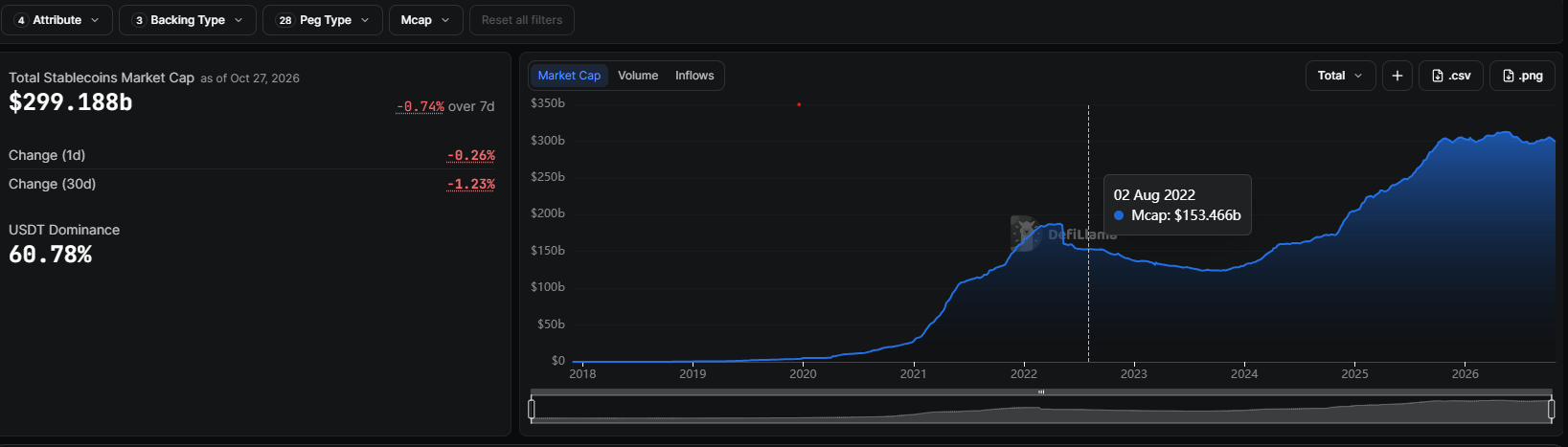
$300 billion of stablecoin supply. Source: DeFiLlama
Why bring USDT back to Bitcoin?
This isn’t the first time we’ve seen USDT on Bitcoin. It actually began life as a stablecoin on Bitcoin in 2014 through the Omni protocol, but Tether eventually halted issuance in August 2023, citing declining usage.
Tether then announced plans to launch USDT on RGB in August 2025. That didn’t happen, however, Tether subsequently led Utexo’s $7.5 million seed round in March, and the new firm will launch the Bitcoin version of the stablecoin using Tether’s USDT0 protocol.
But if usage of USDT on Bitcoin had declined to the point it was no longer viable the first time around, why would it be more popular now? What has changed since 2023?
Viktor Ihnatiuk, co-founder and chief executive of Utexo, tells Magazine the answer is two-fold: Speed and privacy. Using Bitcoin for the settlement layer, and RGB to keep transaction details off the public blockchain, makes private and fast transactions a reality.
“You can actually achieve any speed you want to achieve,” he says. “Bitcoin is the best blockchain. Lightning is the best technology to scale payments.”
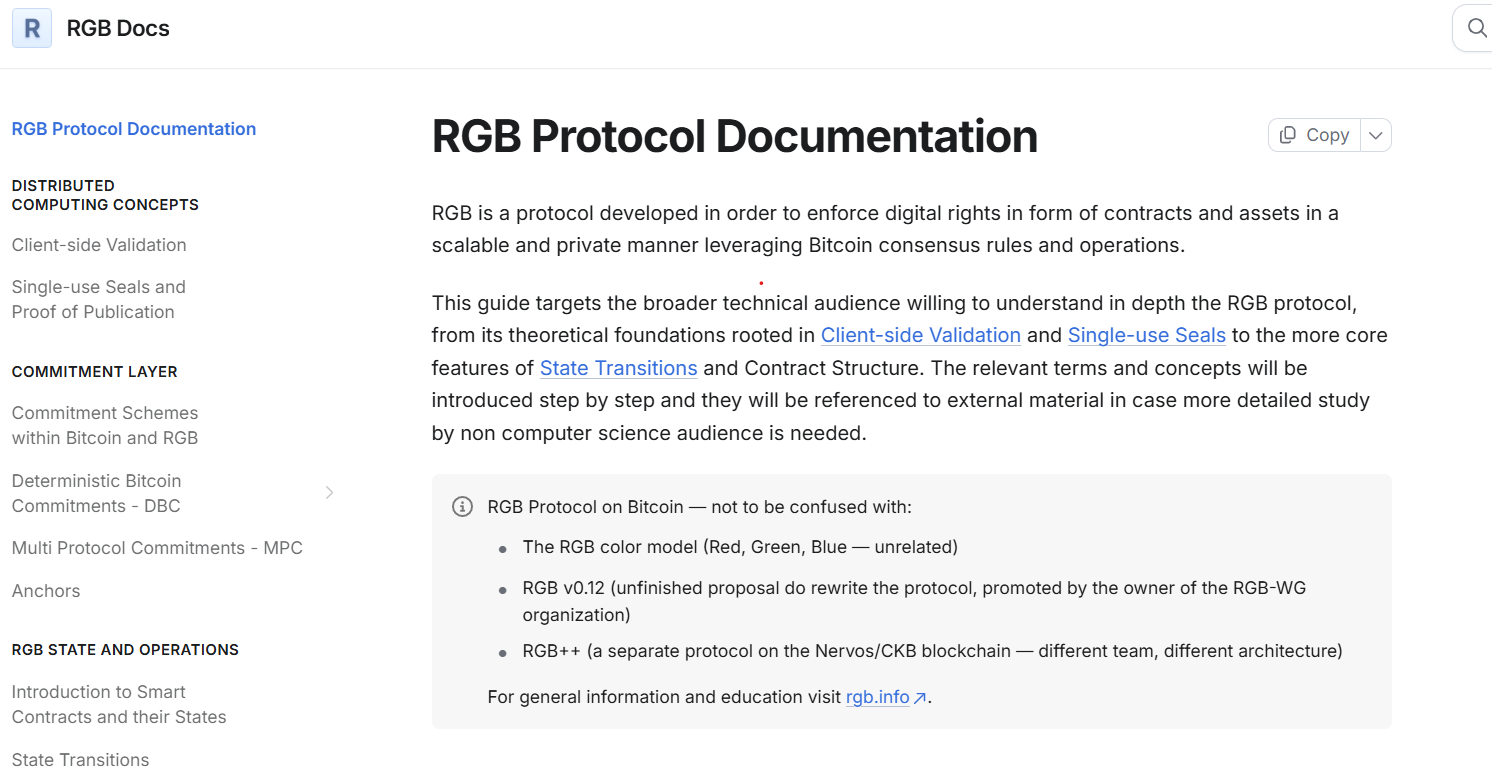
RGB Protocol Documentation. Source: RGB
Utexo grew out of an effort to bring dollar-denominated payments to Bitcoin, and Ihnatiuk says the idea took shape after a conversation with Tether at Bitcoin Prague in 2023.
The company also builds on RGB and Lightning infrastructure developed by ThunderStack, founded by fellow Utexo co-founder Renat Skitsan.
What is RGB, and how does it work?
RGB has been in development since 2016 and was designed to let users issue and transfer digital assets through contracts tied to Bitcoin, without recording every transaction detail on its public blockchain.
Rather than making Bitcoin behave like Ethereum, on RGB, the parties validate asset transactions themselves, while cryptographic commitments anchored to Bitcoin help secure the system. That means RGB is a Bitcoin-native protocol rather than a sidechain or rollup.
RGB also works with the Lightning Network, enabling USDT to move through its payment channels without each transfer requiring a base-layer transaction.
“Lightning allows you to do transactions with a dynamic of 100 milliseconds,” Ihnatiuk says. “It’s faster than Solana, it’s faster than Monad, it’s faster than Sui or Aptos. The limitation is only in the brain of people who don’t understand how to scale Bitcoin.”
Bitcoin’s transparency has hampered business adoption, as many firms like to keep their purchases and transaction counterparts confidential.
Ihnatiuk says that rather than compete with networks like Tron on retail transaction volume or Ethereum on decentralized finance, the company believes the combination of secure Bitcoin-based settlement and greater transaction confidentiality will be enough to persuade businesses to make the switch.
Utexo can also selectively disclose relevant transaction information for compliance purposes, Ihnatiuk says, and has procedures for responding to law enforcement requests.
Related: Is Bitcoin kidding itself about the Lightning Network?
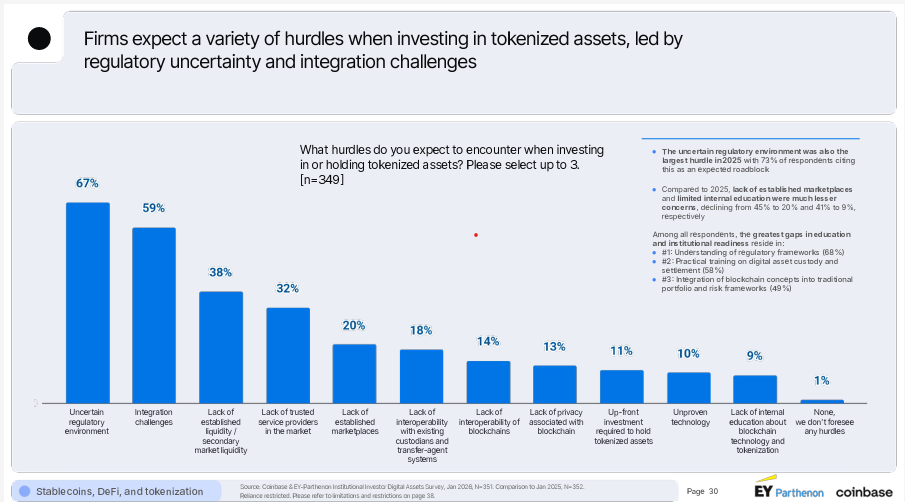
2026 institutional investor survey. Source: Coinbase and EY-Parthenon
Bridge over troubled waters
Utexo opened early access to its USDT Mint product on Oct. 22, allowing verified professional operators, like exchanges, wallets and market makers, to test minting, confidential transfers and redemption on Bitcoin’s Signet test network.
The sandbox gives operators time to test transaction flows and prepare integrations ahead of the public launch at the end of November, after which time Ihnatiuk predicts “everything will become so big.”
But getting existing USDT onto Bitcoin through Utexo Mint involves an additional step. The service locks USDT0 on Arbitrum before minting an equivalent amount of USDT on Bitcoin. Users can redeem their tokens by burning the RGB asset and triggering the release of the corresponding funds on the source network.
Related: Tether says it helped freeze $550M in Iran-linked USDT this year
That means Mint’s security also depends on the mechanisms connecting the networks, not on Bitcoin and RGB alone.
Users need to trust that the USDT0 locked on Arbitrum remains available and can be released when they redeem their Bitcoin-based USDT. Bridges have historically acted like honeypots to hackers, so this architecture introduces additional risk, even if the design attempts to mitigate them.
Utexo says Mint has been audited by Oxorio, although the full audit report is not publicly available.
What would success look like?
Utexo has named UniSat as a launch partner, with plans to support USDT transfers and swaps through its wallet, and Ihnatiuk says Utexo is working with 12 over-the-counter network partners and has another 40 in its pipeline.
Ihnatiuk sees opportunities in Bitcoin-native trading and lending, but he says Bitcoin won’t replicate Ethereum’s DeFi ecosystem; its strengths lie in payments and simpler financial arrangements like escrow-based exchanges.
“People who think that it’s possible to replicate Ethereum DeFi on Bitcoin make a huge mistake,” he says. “Bitcoin was never built for DeFi. Bitcoin was always built for payments.”
Another potential use case is helping keep miners on Bitcoin as they could swap BTC for USDT directly on Bitcoin rather than having to move funds to centralized exchanges. That would reduce their exposure to custodial risk and make it easier to automate hedging strategies. “So, for miners, it’s quite beneficial,” he says.
Ihnatiuk is setting an ambitious target for the first year.
“I would love to achieve our minimum milestone of $1 billion USDT on the Bitcoin network in the next 12 months,” he says. “My initial goal is $10 billion. My median goal is $5 billion.”
There is also a question about the benefits for Bitcoin itself. Ihnatiuk says greater USDT adoption will increase miner fee revenue.
“Once USDT comes back to Bitcoin,” he says, “you will get meaningful adoption; all the transactions will come to Bitcoin. So, yeah, miners will be able to make much more.”
So can Bitcoin compete with Ethereum, Tron and other networks as a new home for USDT? Possibly; it just needs to prove there’s a market this time around.
Related: ‘Bunker mode’ won’t protect your crypto, critics say