
Canada’s six largest banks are jointly exploring a system for tokenized Canadian dollar deposits that would allow digital representations of bank deposits to move between financial institutions.
The initiative involves Bank of Montreal, CIBC, National Bank of Canada, Royal Bank of Canada, Scotiabank and TD Bank Group, according to a joint announcement from the banks on Tuesday. The first phase will focus on moving tokenized deposits between Canadian financial institutions before potentially connecting with other digital asset systems.
The project comes less than two weeks after Canada’s banking regulator provided additional clarity on the legal permissibility of tokenized deposits for financial institutions.
On Sept. 10, the Office of the Superintendent of Financial Institutions (OSFI) said tokenized deposits are “not legally distinct from traditional deposits,” adding that the underlying technology of a financial product does not determine its legal nature.
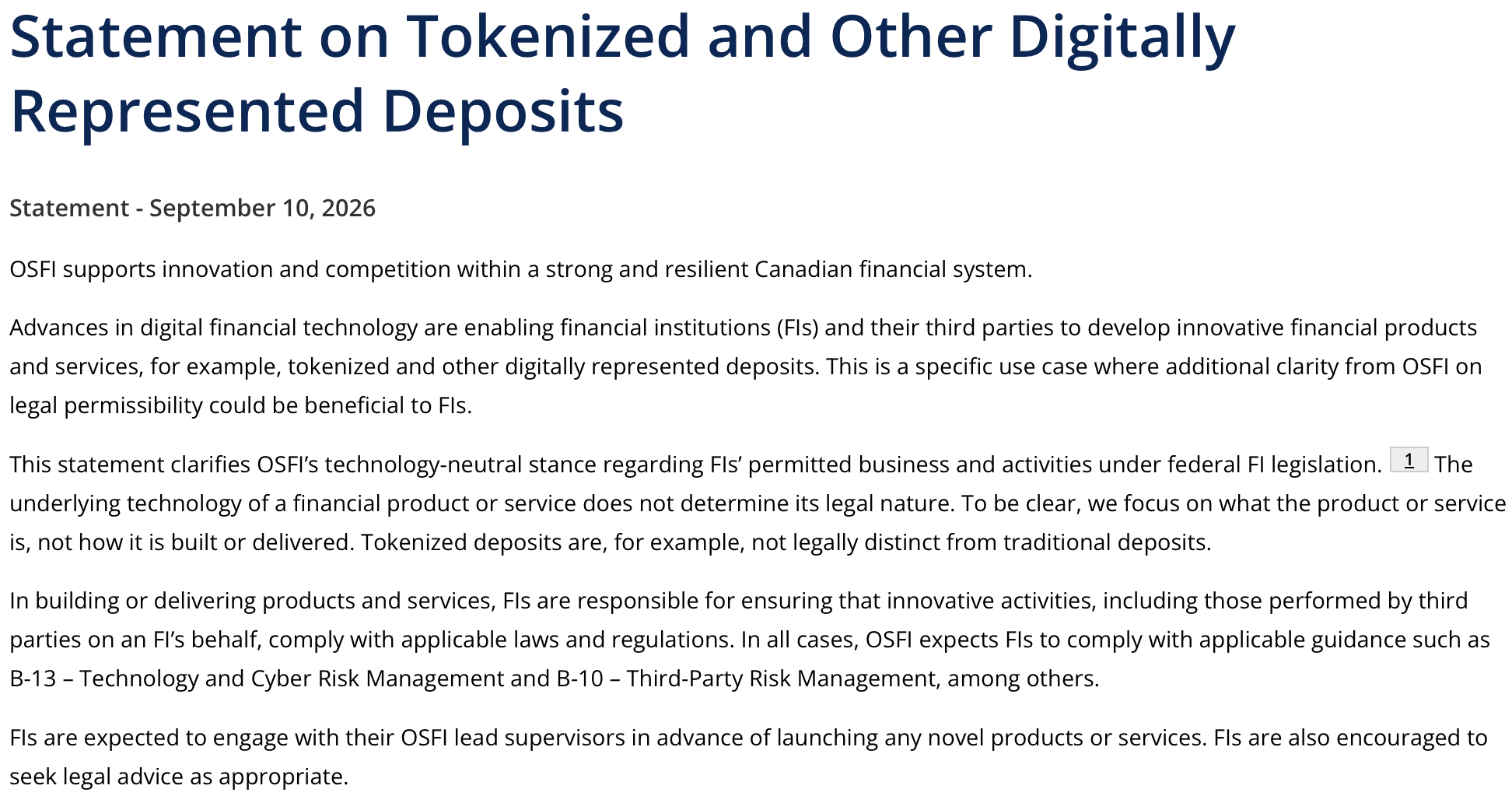
OSFI clarifies tokenized deposit rules. Source: Office of the Superintendent of Financial Institutions (OSFI)
Tokenized deposits represent money held at a regulated bank and remain a liability of that bank, unlike fiat-backed stablecoins, which are separate digital assets backed by reserves held by their issuer.
The banks said the system is intended to support faster and programmable payments, while longer-term plans include opening the initiative to other deposit-taking institutions. Cointelegraph contacted CIBC for additional details but did not receive an immediate response.
Related: Coinbase launches regulated crypto derivatives in Canada
Canada builds out stablecoin framework
The tokenized deposit initiative comes as Canada builds out a broader regulatory framework for digital money.
In March, Canada enacted its Stablecoin Act as part of Bill C-15, establishing a federal framework for fiat-backed stablecoins. Under the regime, non-financial institution issuers will be required to register with the Bank of Canada, maintain reserves of at least 1:1 in high-quality liquid assets and offer holders redemption at par. The framework is expected to take effect in 2027.
However, the framework only covers fiat-backed stablecoins issued by non-financial institutions. Banks and credit unions that are already subject to prudential regulation fall outside its scope. Issuers covered by the framework will also be prohibited from representing their stablecoins as deposits or as insured under a public deposit insurance system.
Magazine: Big Questions: Does Satoshi actually own 1.1 million Bitcoin?